Bappebti Crypto Oversight and Licensing: The Shift to OJK
 Oct, 29 2026
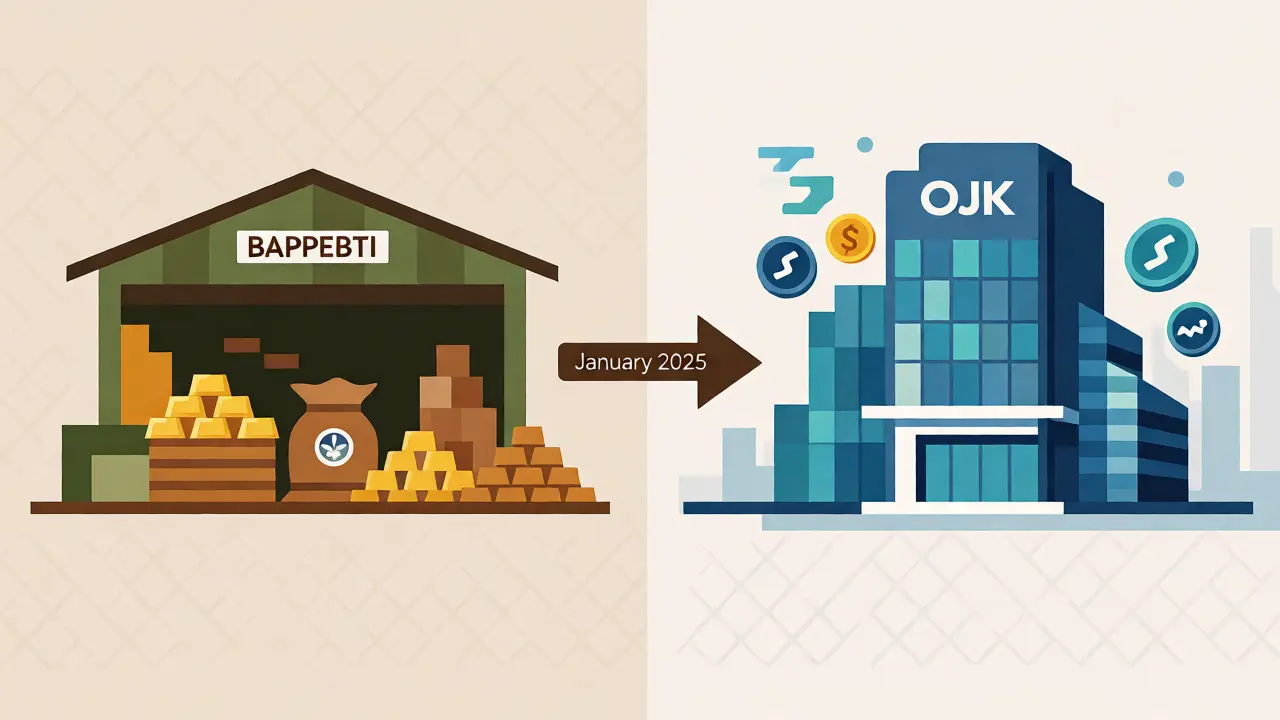
For years, if you wanted to trade Bitcoin in Jakarta, you had to answer to Bappebti. This agency, officially known as the Commodity Futures Trading Supervisory Body, treated your digital wallet like a warehouse for physical goods. You weren't holding a security or a currency; you were holding a commodity. But on January 10, 2025, that era ended. Regulatory authority over cryptocurrency in Indonesia shifted from Bappebti to the Financial Services Authority, or OJK. This wasn't just a paperwork shuffle. It was a fundamental reclassification of what crypto is in the eyes of the law, moving it from the realm of commodities to the world of financial services.
If you are an investor, a trader, or someone building a fintech product in Indonesia, this change matters. It changes who audits your exchange, how taxes might be viewed, and what licenses you need to operate. Let's break down exactly what happened, why it matters, and what you need to know about the new landscape.
The End of the Commodity Era
To understand where we are, you have to look at where we came from. Under Bappebti, cryptocurrencies were legally defined as commodities. Think of them alongside gold, coffee beans, or palm oil. The logic was simple: since crypto isn't issued by a central bank, it can't be money, so it must be a tradable good.
Bappebti operated under strict rules, specifically Regulation No. 8/2021 and later amendments like Regulation No. 13 of 2022. These rules dictated which coins could be traded. You couldn't just list any token you liked. As of mid-2023, only about 501 specific cryptocurrencies-including heavyweights like Bitcoin, Ethereum, and Solana-were approved for trading. If a new meme coin popped up, it had to wait its turn on the approval list.
This framework provided clarity but also rigidity. It protected consumers from outright scams by vetting assets, but it struggled to keep pace with the rapid innovation of DeFi (Decentralized Finance) and NFTs. The government realized that treating complex financial instruments like physical goods was becoming a bottleneck. That realization led to Law No. 4 of 2023, the Financial Sector Development and Strengthening Law (P2SK). This law laid the groundwork for handing crypto oversight over to the experts in finance: OJK.
The Big Handover: From Bappebti to OJK
The transition didn't happen overnight. It culminated on January 10, 2025, when officials from Bappebti, Bank Indonesia, and OJK signed the Minutes of Handover (BAST) in Jakarta. This date marks the official start of OJK’s jurisdiction.
Under the new regime, governed by OJK Regulation No. 27 of 2024, crypto assets are no longer "commodities." They are now classified as "digital financial assets". This semantic shift has huge practical implications. It means crypto exchanges, custodians, and traders are now regulated similarly to banks and stock brokers. They fall under the same umbrella of financial stability, consumer protection, and anti-money laundering standards that govern traditional finance.
Why does this matter? Because OJK has different tools than Bappebti. Bappebti focused on market fairness for physical goods. OJK focuses on systemic risk, capital adequacy, and investor suitability. For example, an exchange might now face stricter capital requirements to ensure they don't collapse during a market crash, protecting user funds more effectively than before.
| Feature | Old Framework (Bappebti) | New Framework (OJK) |
|---|---|---|
| Regulatory Body | Bappebti (Ministry of Trade) | OJK (Financial Services Authority) |
| Asset Classification | Commodity | Digital Financial Asset |
| Primary Focus | Physical market trading, asset listing | Financial stability, investor protection, systemic risk |
| Licensing Basis | Commodity Exchange License | Financial Service License |
| Key Regulation | Perba Bappebti No. 8/2021 & 13/2022 | POJK No. 27 of 2024 |
What Happens to Existing Licenses?
If you run a crypto business in Indonesia, you’re probably worried about your license. Do you have to start from scratch? The short answer is: mostly no. The transition was designed to prevent market disruption.
OJK Regulation 27/2024 includes provisions for continuity. Existing licenses, registrations, and approvals granted by Bappebti remain valid during a transition period. However, these aren't permanent grandfather clauses. Businesses must eventually align their operations with OJK’s stricter financial standards. This might involve submitting new compliance reports, adjusting internal controls, or meeting higher capital thresholds.
Think of it like changing insurance providers. Your coverage continues, but you need to update your policy details to match the new provider’s terms. For investors, this means your existing accounts on platforms like Indodax or Tokocrypto should continue working without interruption. But don’t be surprised if you see updates to Terms of Service or new KYC (Know Your Customer) prompts as exchanges tighten their compliance procedures.

The Role of Bank Indonesia
It’s important not to confuse OJK with Bank Indonesia (BI). While OJK took over crypto trading oversight, BI still holds significant power. BI regulates the payment system aspects of digital assets. So, if you use crypto to pay for goods via a stablecoin-backed payment rail, BI’s rules apply. If you buy Bitcoin on an exchange, OJK’s rules apply.
This dual-regulatory structure creates a comprehensive safety net. BI ensures the monetary infrastructure remains stable, while OJK ensures the financial markets involving crypto are fair and transparent. For most retail users, this distinction is subtle. But for businesses integrating crypto payments into e-commerce, navigating both BI and OJK requirements is essential.
Market Impact: Growth and Confidence
Did the regulatory uncertainty hurt the market? Actually, no. Indonesia’s crypto market exploded even as the regulatory winds changed. By the end of 2023, there were over 17 million crypto investors in the country. Transaction volumes hit IDR 300 trillion. By 2024, those numbers skyrocketed to over IDR 650 trillion.
This growth suggests that Indonesians are comfortable with crypto, regardless of who is regulating it. In fact, many industry analysts believe OJK’s involvement will boost institutional confidence. Global banks and investment firms often hesitate to enter markets where crypto is seen as a "wild west" commodity sector. By bringing crypto under the financial services umbrella, Indonesia signals that it is ready for serious institutional adoption.
Moreover, OJK’s expertise allows for better handling of emerging technologies. DeFi protocols, NFT marketplaces, and tokenized real-world assets fit much more naturally under a financial regulator’s purview than a commodity one. We can expect clearer guidelines for these sectors in the coming years, reducing the gray areas that previously kept some innovators on the sidelines.

Challenges and Pitfalls
It’s not all smooth sailing. Moving from a commodity mindset to a financial services mindset requires a cultural shift within the regulatory bodies themselves. Bappebti staff specialized in physical goods inspection; OJK staff specialize in banking audits. Ensuring a seamless transfer of knowledge is critical.
There is also the risk of over-regulation. Financial regulations are notoriously heavy. If OJK imposes banking-level compliance costs on small crypto startups, it could stifle innovation. The key will be finding a balance between rigorous oversight and enabling growth. The concept of Digital Financial Innovation (DFI) frameworks suggests OJK intends to create sandboxes for testing new products, which is a positive sign.
Another pitfall for users is assuming that "regulated" means "risk-free." Crypto remains volatile. OJK protects you from fraud and mismanagement, not from the price of Bitcoin dropping 20% in a week. Always read the fine print regarding custody solutions and withdrawal limits, as these may change under the new compliance standards.
Looking Ahead: What’s Next for Indonesian Crypto?
With the handover complete, attention now turns to implementation. Expect to see OJK issuing detailed technical guidelines throughout 2026. These will cover topics like:
- Custody Standards: How exchanges must store private keys and client assets.
- Marketing Rules: Restrictions on how crypto products can be advertised to retail investors.
- Taxation Clarity: Potential alignment of crypto tax treatment with other financial instruments.
- DeFi Regulations: How decentralized platforms interact with centralized gateways.
For international players looking to enter Indonesia, the message is clear: come prepared for financial-grade compliance. The days of operating on the fringes of the commodity market are over. Indonesia is positioning itself as a mature, regulated hub for digital assets in Southeast Asia.
Is Bappebti still involved in crypto regulation?
No, Bappebti’s direct oversight of cryptocurrency trading ended on January 10, 2025. Regulatory authority has fully transferred to the Financial Services Authority (OJK). Bappebti continues to regulate other commodity futures and derivatives, but crypto is now considered a digital financial asset under OJK’s jurisdiction.
Do I need a new account if my exchange switched from Bappebti to OJK oversight?
Generally, no. Existing accounts remain active. However, you may need to accept updated Terms of Service or provide additional identity verification documents to comply with OJK’s stricter Know Your Customer (KYC) and Anti-Money Laundering (AML) standards. Check your exchange’s announcements for specific actions required.
Are all cryptocurrencies legal to trade in Indonesia?
Not necessarily. While OJK oversees the market, there is still a whitelist of approved digital assets. Previously, Bappebti maintained a list of around 500+ approved coins. OJK is expected to refine this process, potentially making it easier to add new assets while maintaining quality control. Always verify if a specific token is listed on a licensed Indonesian exchange.
How does this affect crypto taxes in Indonesia?
The classification change from commodity to financial asset may influence tax reporting structures. Currently, crypto transactions are subject to income tax and VAT-like levies. OJK’s oversight doesn't directly set tax rates (that’s the Ministry of Finance), but it may lead to clearer reporting mechanisms and standardized data sharing between exchanges and tax authorities.
Can I still use crypto for payments in Indonesia?
Using crypto directly as a medium of exchange for everyday purchases is still restricted because Bank Indonesia maintains that Rupiah is the sole legal tender. However, you can use crypto-based payment solutions (like stablecoins converted to Rupiah at point-of-sale) that comply with BI’s payment system regulations. OJK regulates the asset side; BI regulates the payment flow.