Best MultiSig Wallet Platforms and Solutions for Secure Crypto Storage
 Jun, 2 2025
MultiSig Transaction Cost Calculator
Calculate Your Transaction Costs
Estimate how much more you'll pay for multi-signature transactions compared to single-key wallets.
Results will appear here after calculation
Imagine losing access to your crypto because one password got hacked, one device died, or someone you trusted turned out to be untrustworthy. That’s the reality with single-key wallets. But there’s a better way - MultiSig wallets - and they’re not just for tech experts anymore. If you’re holding serious amounts of cryptocurrency, especially for business, family, or institutional use, a multisig setup isn’t optional. It’s essential.
What Is a MultiSig Wallet and Why Does It Matter?
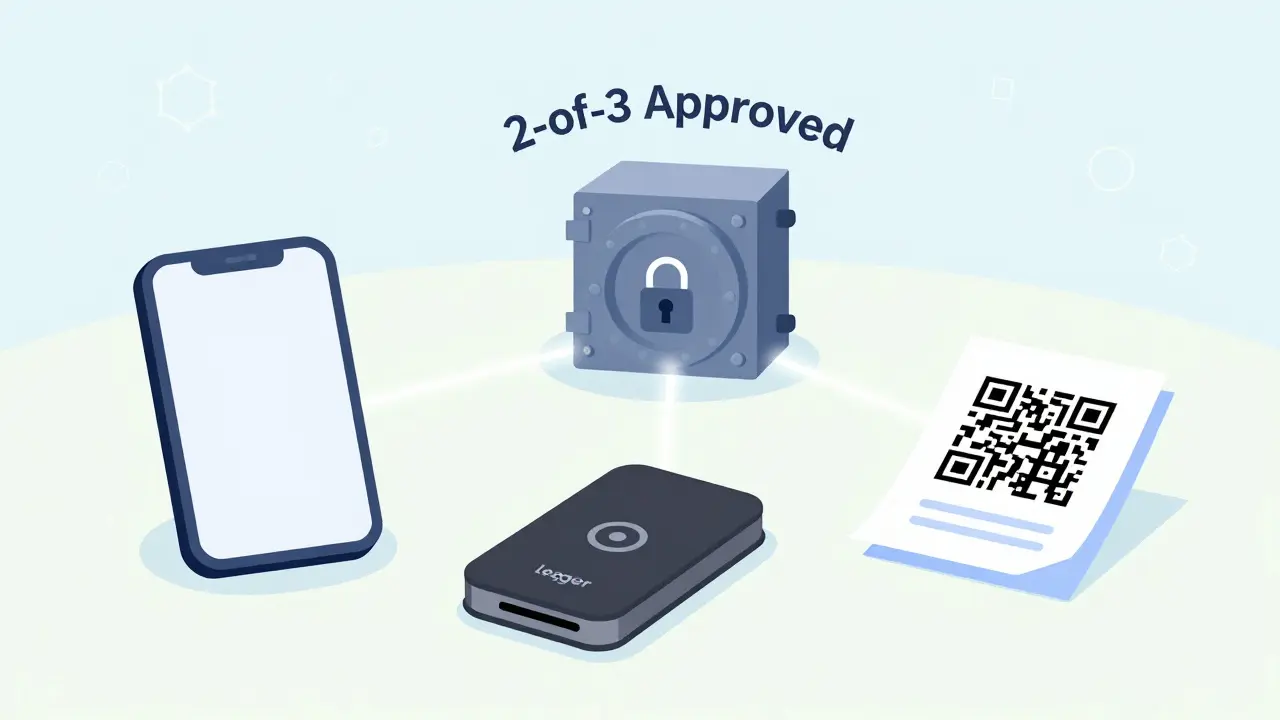
A MultiSig (multi-signature) wallet requires more than one private key to approve a transaction. Think of it like a bank account that needs two out of three authorized people to sign off before money moves. In crypto terms, that means instead of one person holding the only key to your funds, you spread control across multiple devices, people, or hardware wallets. The most common setups are 2-of-3 or 3-of-5. In a 2-of-3 system, you have three keys - maybe one on your phone, one on a hardware wallet like Ledger, and one stored offline. To send crypto, you need any two of those three to sign. Lose one key? No problem. One device gets hacked? Still safe. A single point of failure? Gone. This isn’t just theory. Over $100 billion in crypto assets are managed through multisig wallets today. Institutions like Coinbase, BitGo, and even Vitalik Buterin use them. The reason? They make theft, insider fraud, and accidental loss dramatically harder.How MultiSig Wallets Work - Step by Step
Setting up a multisig wallet isn’t plug-and-play, but it’s simpler than you think. Here’s how it actually works:- You choose the number of keys needed - usually 2-of-3 or 3-of-5.
- You generate each private key on a separate device or location - never on the same phone or computer.
- You store each key securely: one on a hardware wallet, one in a fireproof safe, one with a trusted family member.
- When you want to send crypto, you start the transaction on one device.
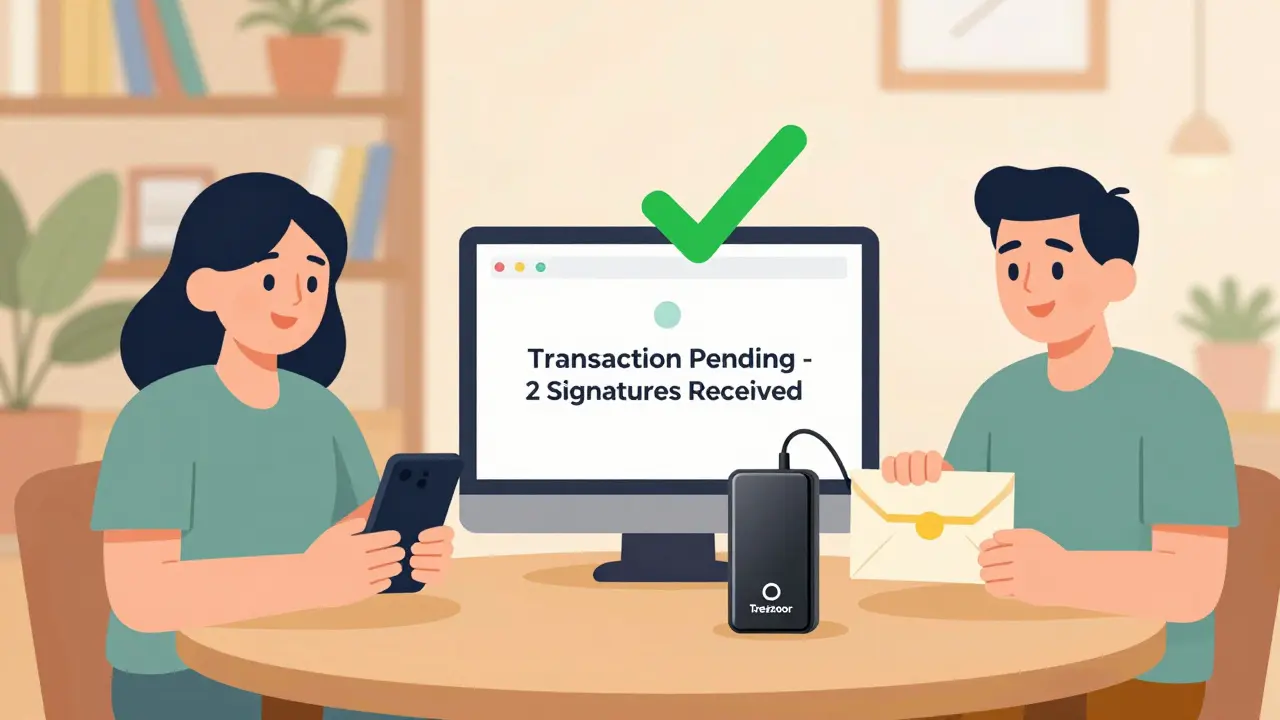
- The system waits for the other required signers to approve - via app, hardware device, or QR code scan.
- Once enough signatures are collected, the transaction broadcasts to the blockchain.
Top MultiSig Wallet Platforms Compared
Not all multisig wallets are built the same. Some focus on Bitcoin, others on Ethereum. Some are self-custodial. Others offer recovery tools. Here are the leading platforms as of 2025:| Platform | Supported Chains | Setup Type | Hardware Wallet Support | Key Recovery | Best For |
|---|---|---|---|---|---|
| Safe Wallet (Gnosis Safe) | Ethereum, Polygon, Arbitrum, and 50+ EVM chains | Smart contract-based (2-of-3 default) | Yes - Ledger, Trezor, MetaMask | Yes - funds accessible via Etherscan even if front-end fails | Institutions, DAOs, DeFi teams |
| Blue Wallet Vault | Bitcoin only | 2-of-3 or 3-of-5 | Yes - Ledger, Trezor | Yes - seed phrase backup required for each key | Bitcoin holders, families, small businesses |
| Electrum | Bitcoin only | 2-of-3, 3-of-5 | Yes - via hardware wallet integration | Manual - requires all seed phrases | Advanced Bitcoin users, privacy-focused |
| Coinbase Vault | Bitcoin, Ethereum, Litecoin | 2-of-3 with time delays | No - custodial keys managed by Coinbase | Yes - but relies on Coinbase’s infrastructure | Beginners wanting institutional-grade security without setup |
| BitGo | Bitcoin, Ethereum, and 20+ others | Custom 2-of-3, 3-of-5, or 4-of-7 | Yes - enterprise-grade hardware integration | Yes - multi-layered recovery with legal and technical safeguards | Crypto funds, hedge funds, exchanges |
Safe Wallet dominates Ethereum ecosystems because it’s open-source, audited, and lets you access funds even if the website crashes. Blue Wallet is the go-to for Bitcoin users who want enterprise security without enterprise complexity. Coinbase Vault is the easiest for newcomers - but you’re trusting Coinbase with key management, so it’s not fully self-custodial.
When to Use MultiSig - And When Not To
Not every crypto user needs a multisig wallet. Here’s the rule of thumb:- Use multisig if: You hold over $10,000 in crypto, manage funds for a team or business, or want to protect assets for heirs or partners.
- Stick with single-key if: You’re trading small amounts daily, using exchanges regularly, or just starting out and want simplicity.
Security Risks and How to Avoid Them
Multisig isn’t magic. Poor setup can be just as dangerous as a single-key wallet. One big mistake? Storing all your keys in the same place. If you keep your phone, hardware wallet, and paper backup in your home office - and someone breaks in - you’re back to square one. Another? Using unverified software. Always use wallets with public, audited code. Safe Wallet’s contract has been reviewed by multiple security firms. Electrum is open-source and has been around since 2011. Avoid obscure apps with no transparency. Also, don’t forget about time-locked transactions. Some platforms let you add delays - like a 48-hour cooldown before funds can be moved. That gives you time to cancel a suspicious transaction. And never forget: multisig doesn’t protect you from social engineering. If someone tricks your co-signer into approving a transaction, the wallet will let it go. That’s why trust matters as much as technology.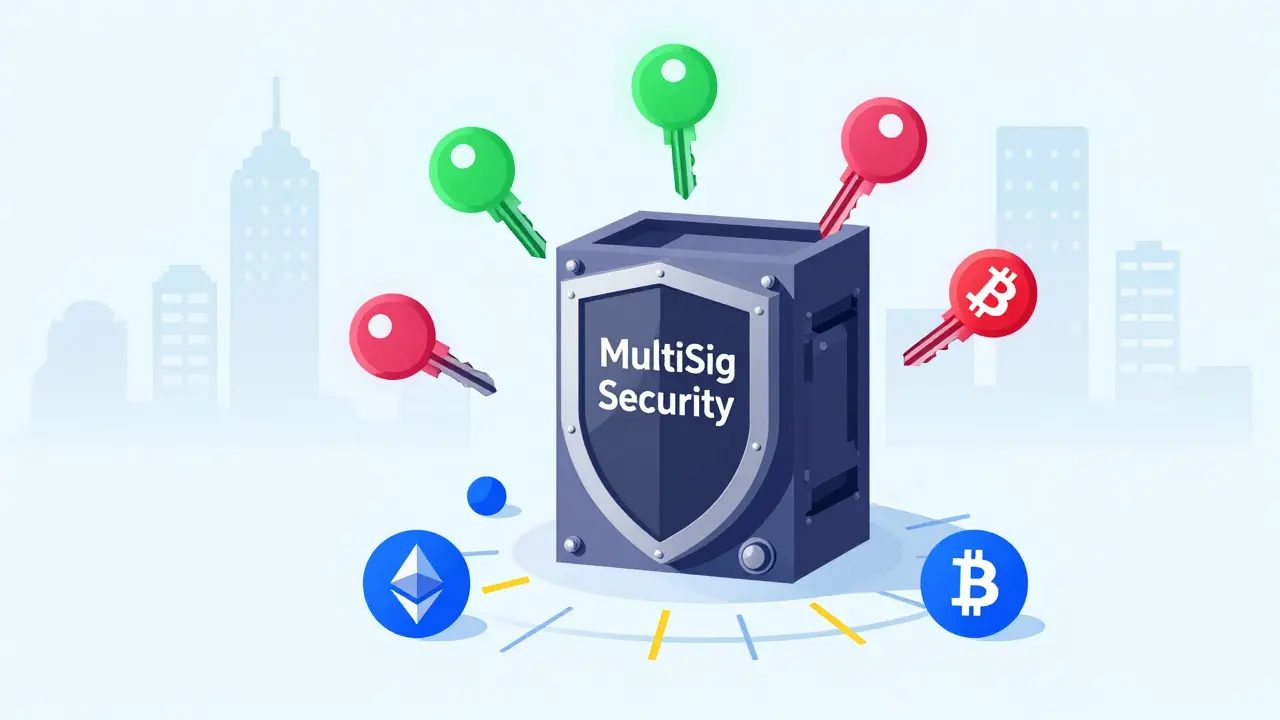
Future of MultiSig: What’s Coming Next
The next wave of multisig wallets is smarter, not just safer. New platforms are adding:- Time-locked withdrawals using Bitcoin’s CLTV (CheckLockTimeVerify) to prevent rushed or malicious transfers.
- Biometric authentication - fingerprint or face ID as one of the required signatures.
- Smart contract automation - like paying out dividends to token holders automatically when a multisig approves a transaction.
- Cross-chain compatibility - managing Bitcoin, Ethereum, and Solana assets from one interface.
Getting Started With MultiSig - A Practical Guide
Ready to set up your own? Here’s how to do it right:- Decide your threshold: 2-of-3 is the sweet spot for most people.
- Choose your platform: Safe Wallet for Ethereum, Blue Wallet for Bitcoin.
- Get three separate devices: one smartphone, one hardware wallet (Ledger or Trezor), one offline paper backup.
- Generate each key on a different device - never copy-paste keys between devices.
- Store each key in a different location: home, safe deposit box, trusted friend’s house.
- Test the process: send a small amount of crypto and make sure all signers can approve.
- Write down recovery steps - who does what if someone disappears or loses their key?
Final Thought: Security Isn’t a Feature - It’s the Foundation
Crypto isn’t just about returns. It’s about ownership. And ownership means control - not just over your keys, but over how they’re used. Single-key wallets are like leaving your house key under the mat. Multisig is like having a security system with multiple locks, motion sensors, and backup codes. It’s not perfect. But it’s the best we’ve got. If you’re holding crypto long-term - especially for family, business, or legacy - multisig isn’t an upgrade. It’s the baseline. Start simple. Start with 2-of-3. Protect what matters.Are MultiSig wallets safer than single-key wallets?
Yes, significantly. Single-key wallets rely on one point of failure - if that key is lost, stolen, or compromised, your funds are gone. MultiSig wallets require multiple signatures to move funds, so even if one key is compromised, attackers can’t access your assets without the others. This reduces theft risk by over 90% in real-world cases.
Can I use a MultiSig wallet for Bitcoin and Ethereum together?
Most wallets are chain-specific. Blue Wallet and Electrum are Bitcoin-only. Safe Wallet works on Ethereum and EVM-compatible chains like Polygon. There are no mainstream wallets yet that manage both Bitcoin and Ethereum multisig in one interface. You’ll need separate setups unless you use a custodial service like BitGo, which supports multiple chains under one dashboard.
What happens if one of my co-signers disappears or loses their key?
It depends on your setup. In a 2-of-3 wallet, you only need two keys to move funds. So if one person loses their key, you can still access your crypto with the other two. But if you’re using a 3-of-5 setup and three keys are lost, you’re locked out. Always plan for recovery - document where each key is stored and who has access.
Do MultiSig wallets cost more to use?
Yes. Each signature adds data to the transaction, increasing the size and therefore the gas or mining fee. A 2-of-3 transaction on Ethereum can cost 2-3x more than a single-key transfer. On Bitcoin, fees are higher too, but less volatile. This is the trade-off for security - you pay more in fees to avoid losing everything.
Is Safe Wallet really safe if the website goes down?
Yes. Safe Wallet runs on a smart contract on the Ethereum blockchain. Even if the Safe Wallet website shuts down, you can still interact with your wallet using Etherscan or any other Ethereum block explorer. Your funds are never tied to the platform - only to your private keys and the immutable contract code.
Can I change who my co-signers are later?
It depends on the wallet. Safe Wallet allows you to update signers after setup - you just need enough current signers to approve the change. Blue Wallet doesn’t let you swap signers once the wallet is created. Always check if your chosen platform allows signer updates before committing.
Are MultiSig wallets compatible with hardware wallets?
Yes - and you should use them. Ledger and Trezor are fully supported by Safe Wallet, Blue Wallet, and BitGo. Using a hardware wallet as one of your signers adds a layer of offline security, making it nearly impossible for remote hackers to steal your keys.
Should I use MultiSig for my personal crypto or just for business?
Use it for both. If you’re holding more than $5,000 in crypto long-term, multisig is worth the setup. Families use it to pass crypto to heirs. Investors use it to protect against personal emergencies. Even solo users benefit from splitting keys between phone, hardware, and paper. It’s not just for companies - it’s for anyone who values control.
Philip Mirchin
December 5, 2025 AT 23:46Also, test transfers are non-negotiable. Sent 0.001 ETH first. Watched all three signers approve. Felt like a NASA launch.
Maggie Harrison
December 6, 2025 AT 05:34Lawal Ayomide
December 6, 2025 AT 10:17Darlene Johnson
December 6, 2025 AT 19:02Ivanna Faith
December 7, 2025 AT 04:08alex bolduin
December 7, 2025 AT 16:32Althea Gwen
December 8, 2025 AT 09:41Durgesh Mehta
December 10, 2025 AT 08:27Sarah Roberge
December 10, 2025 AT 13:57Steve Savage
December 11, 2025 AT 23:24Also, test it. Don't just set it up and forget it. I sent 0.0001 ETH to myself from my own wallet. Watched all three approvals happen. Felt like a wizard.