Bitcoin and Ethereum ETF Approvals in the US: Timeline, Fees & In-Kind Changes
 Aug, 21 2026
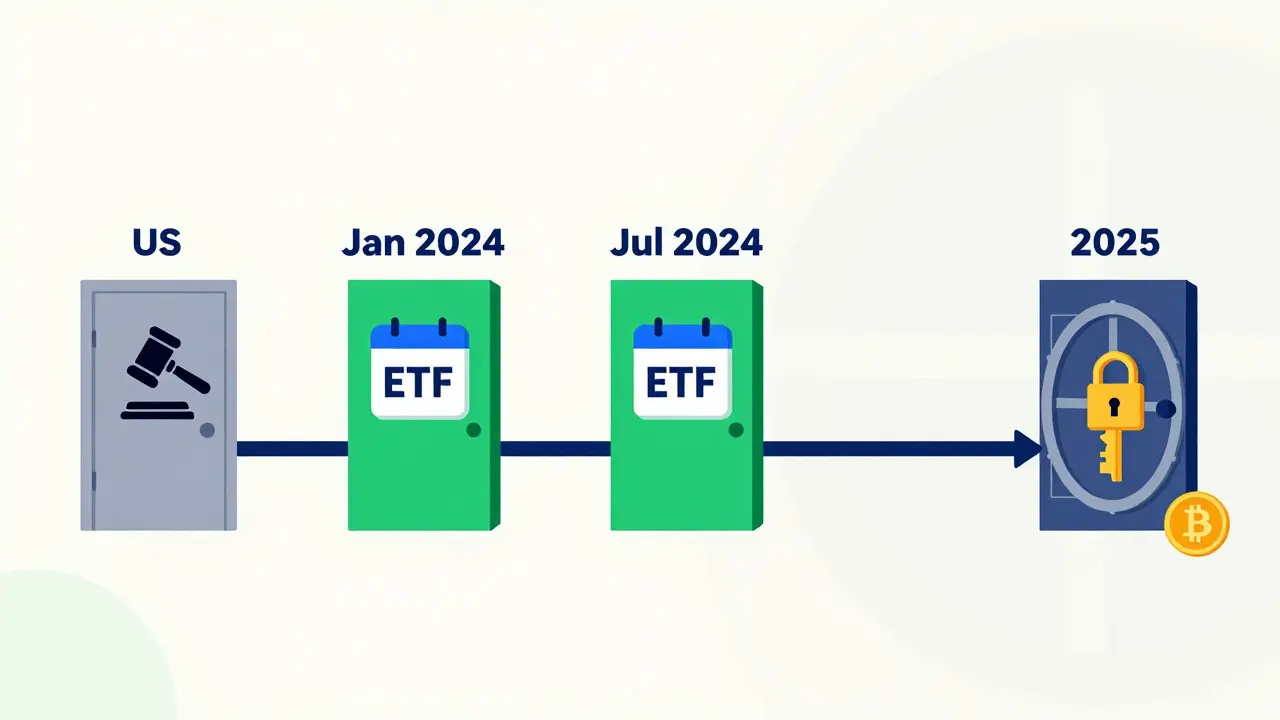
For over a decade, investors waited for the U.S. Securities and Exchange Commission (SEC) to give the green light to spot Bitcoin exchange-traded funds (ETFs). That wait ended on January 10, 2024, when the SEC approved the first batch of these products. Just six months later, on July 23, 2024, the door opened for Ethereum is a decentralized platform that enables smart contracts and staking rewards, leading to the approval of the first spot Ethereum ETFs. These two milestones marked a fundamental shift in how traditional finance views digital assets. But the story didn't stop at initial approval. The regulatory landscape has continued to evolve, particularly with the introduction of in-kind creation mechanisms in 2025, which changed how these funds operate under the hood.
If you are looking to invest through an ETF or just want to understand why the market reacted so strongly to these approvals, you need to look beyond the headlines. This guide breaks down the timeline, the technical differences between Bitcoin and Ethereum ETFs, the fee structures, and the recent operational changes that affect your costs and tax implications.
The Regulatory Timeline: From Rejection to Approval
The path to approval was long and winding. Between 2013 and 2023, the SEC rejected 13 applications for spot Bitcoin ETFs. The turning point came not from the SEC itself, but from the courts. In August 2023, the U.S. Court of Appeals for the D.C. Circuit ruled in Grayscale Investments LLC v. SEC that the commission had applied inconsistent standards when rejecting these funds. This legal pressure forced the SEC to reconsider its stance.
Once the dust settled, the approvals happened quickly:
- January 10, 2024: First spot Bitcoin ETFs approved.
- July 23, 2024: First spot Ethereum ETFs approved.
- July 29, 2025: SEC approves in-kind creation and redemption for crypto ETPs.
- October 2025: Expanded framework for in-kind processing across multiple crypto assets.
This progression shows a clear pattern: the SEC moved from skepticism to structured acceptance, prioritizing a "fit-for-purpose" regulatory framework as stated by Chairman Paul S. Atkins in late 2025.
Bitcoin vs. Ethereum ETFs: Key Differences
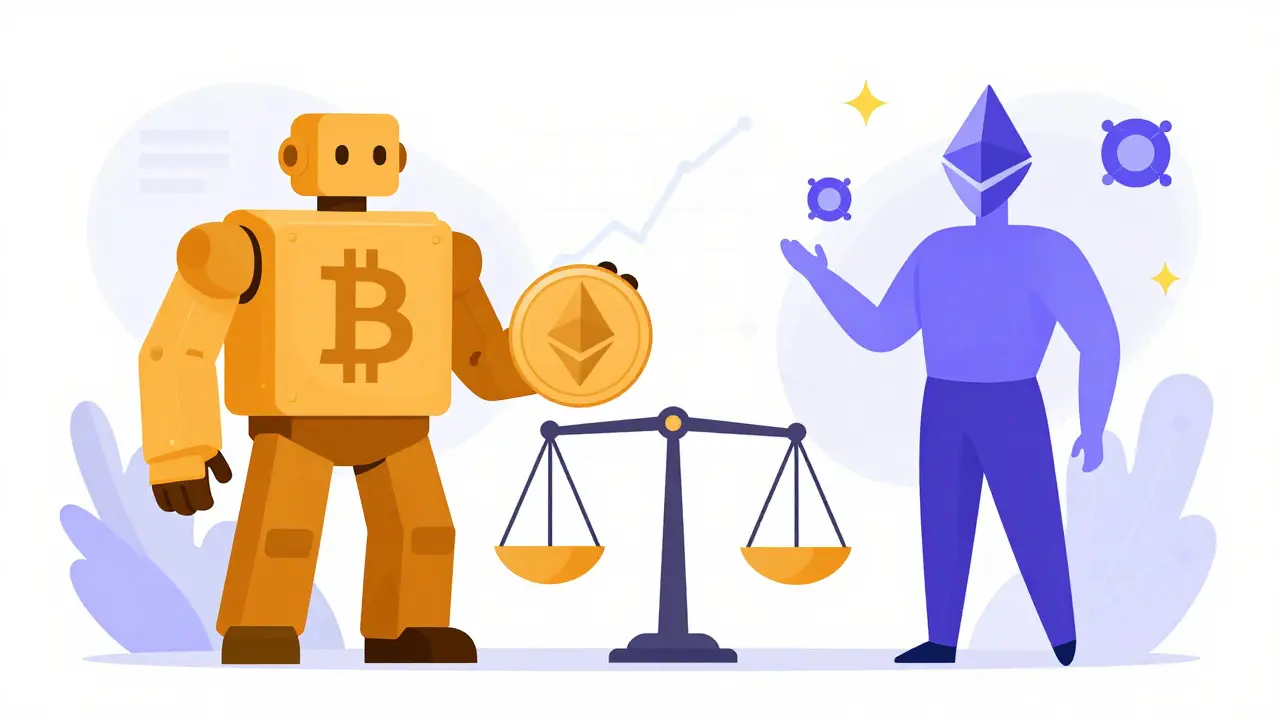
While both are spot crypto ETFs, they are not identical products. The core difference lies in the underlying asset's technology. Bitcoin uses proof-of-work consensus, meaning it doesn't generate yield. Ethereum uses proof-of-stake, which allows validators to earn staking rewards. This distinction directly impacts how the ETFs are managed and what returns investors might see.
| Feature | Spot Bitcoin ETFs | Spot Ethereum ETFs |
|---|---|---|
| Consensus Mechanism | Proof-of-Work | Proof-of-Stake |
| Staking Rewards | No | Yes (for some providers) |
| Average Management Fee | 0.25% | 0.35% |
| Lowest Fee Example | Fidelity FBTC (0.00%) | VanEck EETH (0.15%) |
| Highest Fee Example | Grayscale GBTC (0.90%) | Grayscale ETHE (1.50%) |
| Total AUM (Sept 2025) | $54.3 billion | $18.7 billion |
Note that not all Ethereum ETFs stake their holdings. As of September 2025, only five of the eleven approved Ethereum ETFs elected to participate in staking. Grayscale’s ETHE, for instance, allocated about 4.2% of its ETH holdings to staking, generating quarterly rewards distributed to shareholders. If you choose a non-staking Ethereum ETF, you will only capture price appreciation, similar to Bitcoin.
The Game Changer: In-Kind Creation and Redemption
When these ETFs first launched, they operated on a "cash-only" model. This meant that when large institutional investors (authorized participants) wanted to create new shares, they had to pay cash to the fund, which then bought the crypto. When redeeming, the fund sold the crypto and paid cash back. This process often triggered taxable events and added friction.
In July 2025, the SEC approved In-Kind Creation is a mechanism allowing authorized participants to exchange physical crypto assets for ETF shares without selling. This aligns crypto ETFs with traditional commodity ETFs like gold. Now, investors can deliver actual Bitcoin or Ether to the fund to receive shares, or redeem shares for the underlying crypto. This change eliminated unnecessary sales, reducing tax liabilities and operational costs by an estimated 0.15% to 0.25% annually.
The impact has been immediate. By October 2025, BlackRock processed over $3 billion in in-kind conversions. For large holders, this offers a way to hold crypto within a regulated structure while maintaining control over their specific coins, useful for estate planning or collateralization in prime brokerage arrangements.
Market Performance and Institutional Adoption
The adoption numbers speak to the scale of this shift. By the end of September 2025, the spot Bitcoin ETF market reached $54.3 billion in assets under management (AUM), with BlackRock’s iShares Bitcoin Trust (IBIT) holding a 31.2% market share. Ethereum ETFs collectively held $18.7 billion, led by Grayscale’s ETHE with a 27.3% share.
However, market dynamics have diverged recently. While Bitcoin ETFs experienced net outflows of $1.2 billion in Q3 2025 due to rising interest rates, Ethereum ETFs saw net inflows of $478 million. This suggests that investors may be rotating toward Ethereum’s utility features, such as staking yields, during periods of macroeconomic uncertainty.
Institutional sentiment remains largely positive. A survey of 142 institutional investors found that 78% prefer holding Bitcoin through ETFs for easier collateralization. Retail sentiment is also strong, with 63% of comments on major crypto forums expressing positive views on Ethereum ETFs, though complaints about high fees from legacy providers like Grayscale remain common.

What This Means for Your Investment Strategy
The approval of these ETFs has lowered the barrier to entry for traditional investors who want exposure to crypto without managing private keys. However, it’s not a one-size-fits-all solution. Here is how to approach it:
- Check the Staking Policy: If you buy an Ethereum ETF, verify if it stakes. If you want yield, look for providers like Grayscale or Fidelity that distribute staking rewards. If you don’t care about yield, a lower-fee non-staking option might be better.
- Mind the Fees: Fees vary significantly. Fidelity’s FBTC charges 0%, while Grayscale’s GBTC charges 0.9%. Over time, this difference compounds. Compare the expense ratios carefully before choosing.
- Consider Tax Implications: With in-kind creation now available, large holders can avoid capital gains taxes when moving assets into ETFs. For retail investors, buying and selling ETF shares still triggers standard capital gains rules based on your cost basis.
- Monitor Premiums: Bitcoin ETFs currently trade at a 0.08% premium to Net Asset Value (NAV), while Ethereum ETFs trade at 0.23%. Trading at a significant premium means you’re paying more than the underlying asset is worth. Keep an eye on these spreads.
Looking ahead, analysts project the combined market for Bitcoin and Ethereum ETFs could reach $150 billion by December 2026. The SEC’s open stance on other cryptocurrencies suggests that Solana, XRP, or other assets could follow, but for now, Bitcoin and Ethereum remain the blue chips of the crypto ETF world.
Frequently Asked Questions
Do I need a crypto wallet to buy a Bitcoin or Ethereum ETF?
No. You can buy these ETFs through any standard brokerage account that supports ETF trading, such as Fidelity, Schwab, or Robinhood. You do not need to manage private keys or interact directly with the blockchain.
Which Ethereum ETF pays staking rewards?
As of late 2025, several Ethereum ETFs offer staking rewards, including Grayscale’s ETHE and Fidelity’s FETH. However, not all do. Check the specific fund’s prospectus to confirm if it allocates assets to staking and how rewards are distributed (usually quarterly).
What is the main advantage of in-kind creation for investors?
In-kind creation allows large holders to convert their existing crypto holdings into ETF shares without selling the asset. This avoids triggering capital gains taxes and reduces transaction costs, making it more efficient for institutional investors and high-net-worth individuals.
Are Bitcoin and Ethereum ETFs safe from hacking?
The risk profile is different from self-custody. The ETF providers use professional custodians like Coinbase Custody or BitGo to store the assets. While no system is 100% hack-proof, the institutional-grade security measures are generally considered more robust than individual wallet management. However, you are exposed to counterparty risk with the fund provider and custodian.
Will there be ETFs for other cryptocurrencies like Solana or XRP?
It is likely. The SEC’s recent framework allows for case-by-case evaluation of other assets. Hong Kong has already approved a Solana ETF, and global trends suggest the U.S. may follow suit. However, Chairman Paul Atkins has noted that not all crypto assets will qualify immediately, so expect a slower rollout for altcoins compared to Bitcoin and Ethereum.
Evelyn Kula
August 22, 2026 AT 02:36Finally, the sheep have a pen to be herded into. It is quite amusing how the 'free market' only works when the state decides to stamp its approval on it. I suppose we should all be grateful that our benevolent regulators decided to let us buy digital IOUs without needing a PhD in cryptography.
Marco Maldonado
August 23, 2026 AT 19:07YEAH! America wins again. The SEC was just scared of losing to China or some random island nation. Now that we control the flow, the dollar stays king. Stop whining about fees and start buying American ETFs. That's what patriots do. 🇺🇸
OLIVER CHRISTIAN
August 25, 2026 AT 09:40Great breakdown of the timeline. One thing worth noting for those new to this: the shift to in-kind creation is massive for tax efficiency. Before July 2025, if an AP wanted to redeem shares, the fund had to sell BTC/ETH, triggering capital gains events that were distributed to shareholders. Now, they can just hand over the coins. It aligns these products much more closely with traditional commodity ETFs like gold. If you are holding long-term, this reduces the 'hidden' tax drag significantly.
Susan Kiley
August 26, 2026 AT 00:13Omg, did anyone else notice the fee difference?! 😱 Fidelity charging 0% is basically a gift from the gods of finance, right? Meanwhile, Grayscale is still charging 0.9%?? That is literally robbery! Why are people even sticking with GBTC? It’s like paying extra to sit in the back row of the movie theater. Move your money, people! 💸✨
Daniel Brown
August 26, 2026 AT 17:39The distinction between staking and non-staking Ethereum ETFs is often overlooked by casual investors. For instance, if you purchase ETHE, you are exposed to the operational risks associated with validator node management, albeit mitigated by professional custodians. Conversely, a non-staking ETH ETF offers pure price exposure but forfeits the approximately 3-4% annual yield inherent to proof-of-stake consensus. This bifurcation creates two distinct risk-return profiles within the same asset class.
Sonia Gomez Gomez
August 28, 2026 AT 12:53You guys really need to stop ignoring the moral hazard here. :P These funds are basically letting rich guys park their dirty money in a regulated box so they don't have to deal with the 'chaos' of the blockchain. It’s all about control. Who thinks the SEC will actually protect the little guy from another rug pull? Just saying. 🤔
Tasha Davis
August 29, 2026 AT 17:15I am so excited about this! 🎉 It makes it so much easier for normal people to get in. No more worrying about losing your password or getting hacked. Just buy it like a stock. My neighbor bought some last week and he says it feels safe now. Let's gooo! 🔥
manish jha
August 31, 2026 AT 12:59In India, we waited years for similar clarity. The US moving first sets a precedent, but don't mistake this for global acceptance. Regulations here are different. Still, the institutional adoption numbers are undeniable. 54 billion dollars is not small change. The narrative has shifted from 'speculative bubble' to 'asset class'. Embrace the change or be left behind.
Calliope Clio
September 2, 2026 AT 06:40Meh. Another way for Wall Street to skim off the top. 🙄 The article mentions $150B projected by 2026, which sounds impressive until you realize most of that is just existing holders swapping wallets for brokerage accounts. The 'innovation' is mostly administrative. But sure, enjoy your 0.25% fee for doing nothing. #BoringFinance
Dianne Ritter
September 4, 2026 AT 00:18I think it's a positive step for mainstream adoption. It lowers the barrier to entry significantly. Whether one likes crypto or not, having a regulated product available in standard brokerage accounts legitimizes the space for many conservative investors who were previously hesitant. It bridges the gap between DeFi and TradFi nicely.