Blockchain IP Marketplaces: How Decentralized Tech Transforms Intellectual Property
 Sep, 25 2026
Imagine you just invented a new type of battery or composed a track that’s going viral. You want to license it, sell the rights, or prove you created it first. In the traditional world, this means hiring lawyers, filing paperwork with government agencies, waiting months for approval, and hoping no one steals your work while you wait. It’s slow, expensive, and often opaque.
Blockchain IP marketplaces are digital platforms that use distributed ledger technology to register, trade, and manage intellectual property assets without needing central intermediaries like patent offices or record labels. They turn intellectual property into something you can verify instantly, trade globally, and automate through code. If you’re a creator, inventor, or business owner dealing with patents, trademarks, or copyrights, understanding these platforms isn’t just trendy-it’s becoming essential for protecting your assets in a digital-first economy.
Why Traditional IP Management Fails Creators
Let’s be honest: the current system for managing intellectual property is broken. If you’re an independent artist trying to protect a song, or a startup holding a crucial patent, you face three major hurdles: verification delays, high transaction costs, and rampant infringement.
Traditional registration processes are fragmented. You might file a patent in the US, but proving ownership in Europe requires separate filings. This fragmentation creates gaps where infringers slip through. Worse, when disputes arise, resolving them takes years. Legal fees pile up while your product sits on the shelf because you can’t prove who owns the rights quickly enough.
Then there’s the money problem. Intermediaries-agents, brokers, collecting societies-take significant cuts. For small creators, these fees can eat up most of their earnings. And if you’re outside major hubs like New York or London, accessing international buyers is nearly impossible without expensive representation.
| Feature | Traditional IP System | Blockchain IP Marketplace |
|---|---|---|
| Verification Time | Months to Years | Minutes (Timestamped) |
| Intermediaries | High (Lawyers, Agents, Offices) | Low (Smart Contracts) |
| Transparency | Opaque, Siloed Databases | Public, Immutable Ledger |
| Cross-Border Trade | Complex, Costly | Seamless, Global |
| Royalty Payments | Manual, Delayed | Automated, Instant |
How Blockchain Solves the Ownership Problem
The core value proposition of blockchain technology in this context is its ability to create an immutable, time-stamped record of creation. When you upload your design, patent claim, or music file to a blockchain marketplace, the system generates a unique digital fingerprint (hash) and locks it into a block.
This isn’t just a database entry; it’s cryptographic proof. Because the ledger is distributed across thousands of computers (nodes), no single entity can alter the history. If someone tries to claim they created your work earlier, you can point to the timestamp on the chain. This provides definitive evidence of priority, which is often the hardest part of IP litigation to prove.
Moreover, transparency builds trust. Potential buyers don’t need to take your word for it-they can verify the entire history of ownership transfers directly on the public ledger. This reduces the risk of fraud and simplifies due diligence for investors looking to buy IP portfolios.
Smart Contracts: The Engine of Automation
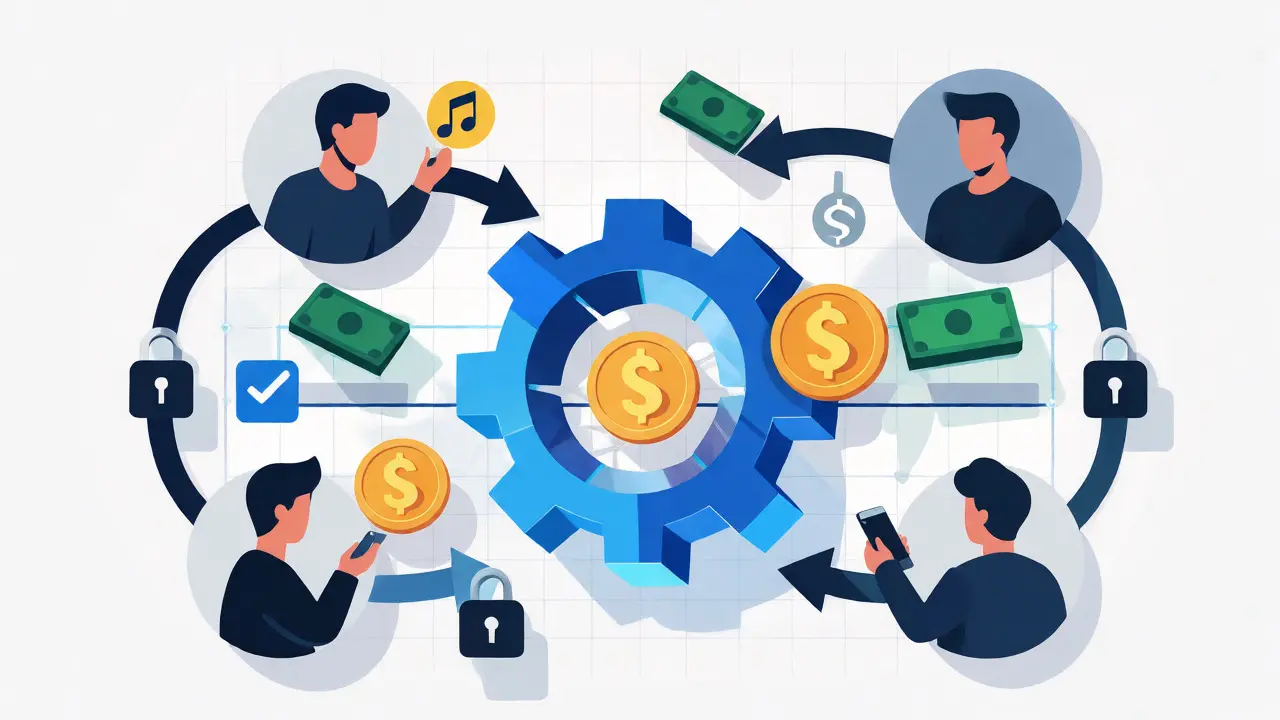
If immutability is the foundation, smart contracts are the automation layer that makes trading viable at scale. These are self-executing contracts with the terms of the agreement directly written into code.
Consider a licensing deal. Traditionally, you negotiate terms, sign papers, invoice the licensee, wait for payment, and then manually update records. With smart contracts, you encode the rules: "If User A pays X amount, grant access to File Y for Z days." The contract executes automatically. Royalties? They split instantly between the original creator and any subsequent resellers according to pre-set percentages.
This eliminates the "black box" of royalty distribution. Artists have long complained about not knowing how much streaming services owe them. On a blockchain platform, every stream or usage triggers a micro-payment that lands in your wallet within seconds. No quarterly statements, no accounting discrepancies.
Types of IP Marketplaces and Use Cases
Not all blockchain IP platforms do the same thing. Understanding the landscape helps you choose the right tool for your needs.
- Open Marketplaces: Platforms like IPwe or DEIP Ledger allow broad trading of various IP types. They focus on liquidity and connecting global buyers with sellers.
- Niche/Specialized Platforms: Some focus exclusively on specific industries. For example, platforms dedicated to pharmaceutical patents or fashion designs offer tailored compliance features relevant to those sectors.
- NFT-Based Marketplaces: While often associated with art, Non-Fungible Tokens (NFTs) represent a form of digital IP certificate used for music, video, and collectibles. These are less about legal patent registration and more about provenance and community engagement for creative works.
- Secondary Markets: Just like stocks, IP can be traded after the initial sale. Secondary markets allow investors to buy fractional shares of a patent portfolio, democratizing access to high-value IP assets.
A practical example: A small software company develops a unique algorithm. Instead of selling the whole patent outright, they list it on a blockchain marketplace. They retain 70% ownership but sell 30% as tokens to early backers. Every time a third party licenses the algorithm, the smart contract automatically distributes royalties to both the company and the token holders. This creates a liquid asset out of what was previously an illiquid intangible.

Getting Started: What You Need to Know
If you’re ready to try this, don’t expect it to be as simple as posting on Instagram. There’s a learning curve.
First, you need a digital wallet capable of interacting with blockchain networks and holding cryptocurrencies. Most platforms require transactions in crypto, though some are integrating fiat on-ramps. You’ll also need to understand basic concepts like gas fees (transaction costs) and private keys (your password to the wallet).
Second, metadata matters. When you register IP, you aren’t just uploading a file; you’re attaching data. Who is the author? What are the license terms? Which jurisdictions apply? Garbage in, garbage out. Ensure your documentation is accurate before minting your asset on-chain.
Finally, check the platform’s legal framework. Does the blockchain record replace official government registration, or does it supplement it? Currently, most jurisdictions still require formal government filing for full legal protection. Think of blockchain as a powerful evidentiary tool and efficiency mechanism, not yet a complete replacement for statutory law in every country.
Challenges and Future Outlook
It’s not all smooth sailing. Regulatory uncertainty remains the biggest hurdle. Governments are still figuring out how to classify IP tokens. Are they securities? Commodities? Digital goods? Until frameworks stabilize, large institutional players may hesitate to enter fully.
Interoperability is another issue. If your patent is registered on Ethereum but a buyer uses Polygon, can they easily transfer rights? Cross-chain compatibility is improving but isn’t seamless yet.
However, the trajectory is clear. As digitalization increases, so does the volume of IP creation. We are generating more content, code, and inventions than ever before. Centralized systems cannot keep up. Decentralized, automated, and transparent solutions will likely become the standard for managing the next generation of intellectual assets.
Does registering IP on a blockchain replace government patents?
Not entirely, not yet. In most countries, blockchain registration serves as strong proof of creation date and ownership history, which is valuable in court. However, you usually still need to file with national patent or trademark offices (like the USPTO or EUIPO) to secure exclusive legal rights enforceable by law. Blockchain complements rather than replaces these statutory registrations.
Can anyone steal my IP once it's on the blockchain?
No. Putting an asset on the blockchain doesn't make it public domain. It creates a verifiable record of who owns it. Others can see the transaction history, but they cannot alter the ownership record or copy the underlying asset's legal status without permission. Smart contracts can further restrict access or usage rights based on coded rules.
What are the main costs involved in using a blockchain IP marketplace?
Costs typically include network transaction fees (gas fees), platform listing fees, and potentially smart contract deployment costs. These vary significantly depending on the blockchain network used (e.g., Ethereum can be expensive during congestion, while newer chains like Solana or Polygon are cheaper). Always check the current fee structure of the specific marketplace before listing.
Are blockchain IP marketplaces suitable for small inventors?
Yes, arguably even more so than for large corporations. Small inventors often lack the budget for international legal teams. Blockchain platforms lower barriers to entry by reducing intermediary costs and providing global visibility. Automated royalty splits ensure small creators get paid fairly without needing complex accounting setups.
How do NFTs relate to intellectual property rights?
Buying an NFT generally grants you ownership of the token itself, not necessarily the copyright to the underlying artwork or media. Unless explicitly stated in the smart contract metadata, the creator retains reproduction and distribution rights. Always read the license terms attached to the NFT to understand exactly what IP rights are transferred.