Calculating Liquidation Price: A Trader's Guide to Crypto Futures
 Oct, 13 2026
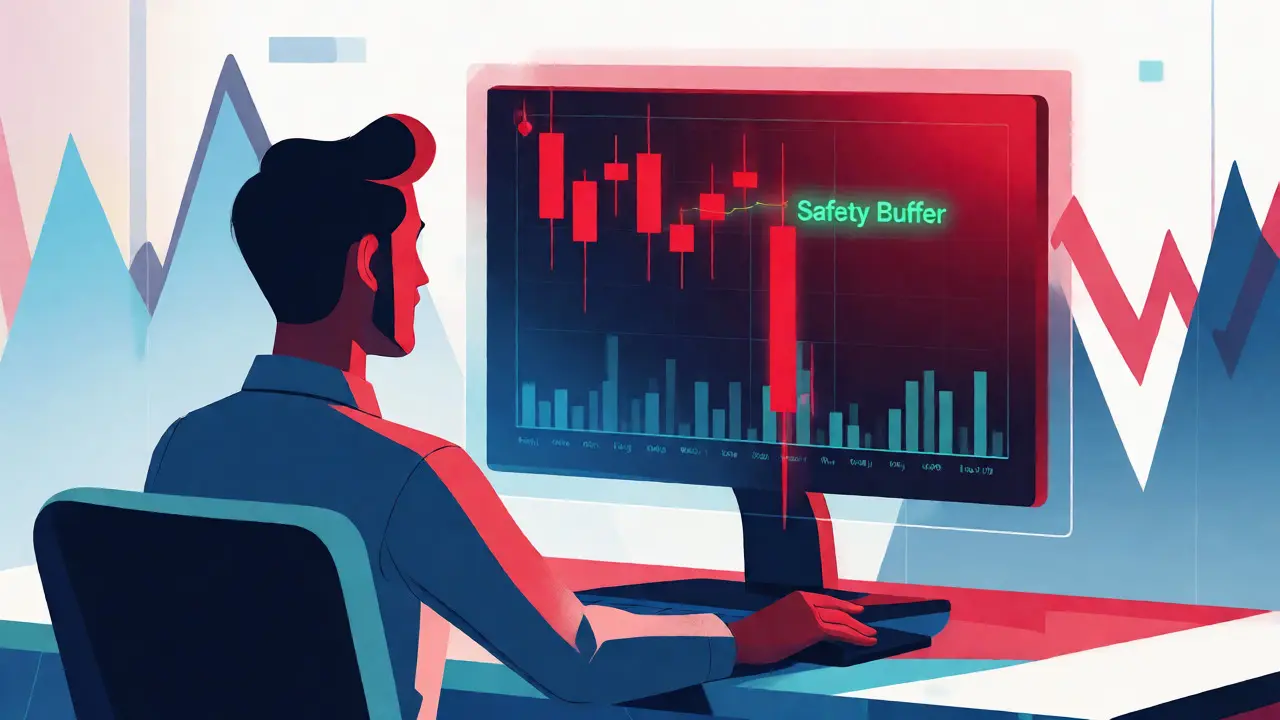
You think you're safe because the chart hasn't hit your number yet. Then a sudden wick drops Bitcoin by 2% in seconds, and your position vanishes. You check your account, confused. Why did you get liquidated before the price actually reached your displayed liquidation price? This isn't a glitch; it's how leverage works. Understanding exactly how this number is calculated-and where it fails-is the difference between surviving a market crash and getting wiped out.
The Core Concept: What Actually Triggers Liquidation?
Liquidation happens when your margin balance falls below the maintenance margin requirement. Think of it as the exchange saying, "You've lost enough money that we can no longer guarantee you'll cover the rest if the price moves against us." The system forcibly closes your position to prevent further losses. It’s not optional, and there’s no negotiating with the engine once the trigger hits.
Most major exchanges like Binance, Bybit, and BitMEX use Mark Price instead of the last traded price to calculate this threshold. Why? Because Mark Price is an index value derived from multiple spot exchanges, making it harder for whales to manipulate a single low-volume trade into triggering mass liquidations. If they used the last traded price, a single large sell order on a thin order book could wipe out thousands of long positions instantly.
The Math Behind the Magic Number
Don't let the formulas scare you off. They are just ways to figure out how much cushion you have left. For a long position, the basic estimation looks like this:
- Long Position: Entry Price × (1 - Initial Margin Rate + Maintenance Margin Rate)
- Short Position: Entry Price × (1 + Initial Margin Rate - Maintenance Margin Rate)
Let's break down those variables. Your Initial Margin Rate is determined by your leverage. If you use 10x leverage, your initial margin rate is 10%. The Maintenance Margin Rate is set by the exchange and varies by asset. For major coins like BTC or ETH, it might be 0.5% to 1%. For volatile altcoins, it can jump to 2% or even 5%. Higher maintenance margins mean tighter safety nets and higher liquidation prices for longs.
| Leverage | Initial Margin Rate | Maintenance Margin Rate (BTC) | Approx. Drop % to Liquidation |
|---|---|---|---|
| 2x | 50% | 0.5% | ~49.5% |
| 5x | 20% | 0.5% | ~19.5% |
| 10x | 10% | 0.5% | ~9.5% |
| 20x | 5% | 0.5% | ~4.5% |
| 50x | 2% | 0.5% | ~1.5% |
Notice how tight the window gets at 50x leverage? A mere 1.5% drop wipes you out. That’s why high-leverage trading is often called gambling with extra steps.
Cross Margin vs. Isolated Margin: Changing the Equation
Your choice of margin mode fundamentally changes how the liquidation price is calculated and what’s at risk.
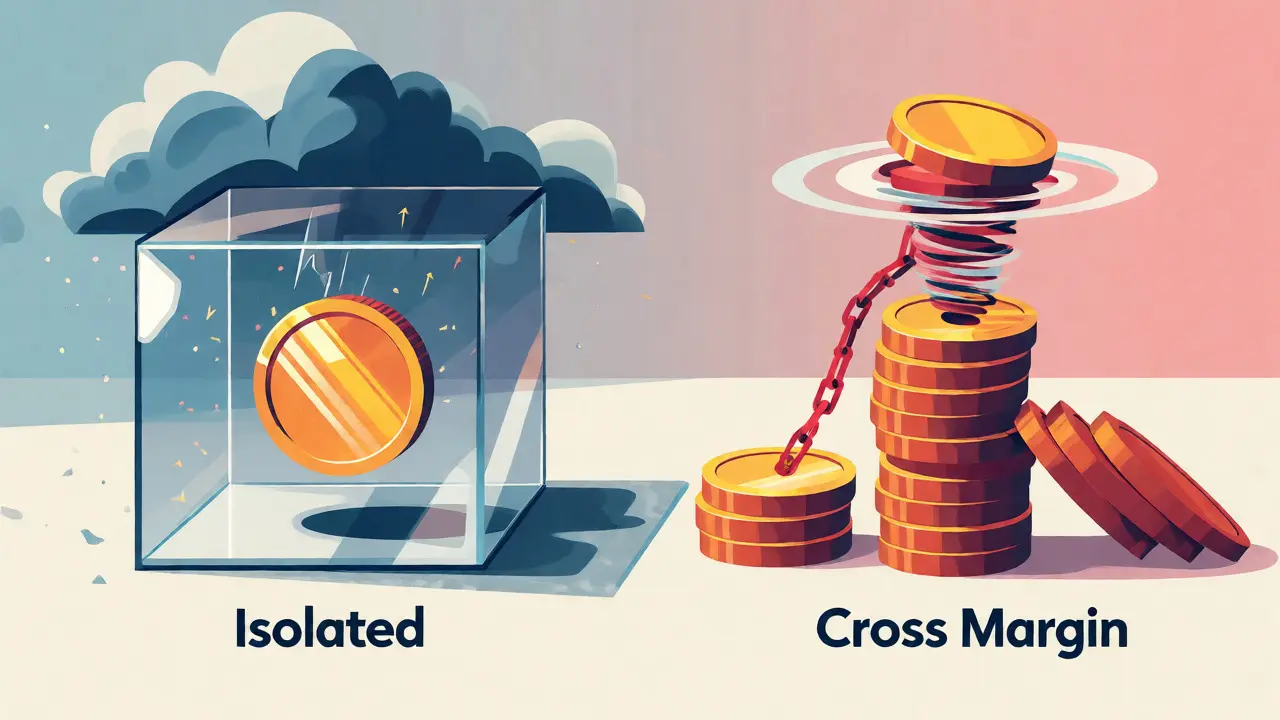
Isolated Margin keeps each position separate. The liquidation price depends only on the funds allocated to that specific trade. If you open a $1,000 long position with $100 of collateral, only that $100 is at risk. If it gets liquidated, the rest of your wallet remains untouched. This is ideal for testing risky strategies without blowing up your entire account.
Cross Margin shares all available funds across every open position. Here, the liquidation price is lower (for longs) because your entire account balance acts as collateral. This allows for larger positions with less upfront capital but creates a dangerous domino effect. If one bad trade drains your margin, it can pull other profitable positions into liquidation territory. During the March 2020 "Black Thursday" crash, many traders using cross margin saw their entire portfolios vanish because a few losing positions consumed all the shared liquidity.
Liquidation Price vs. Bankruptcy Price: The Hidden Gap
Traders often confuse these two terms, but the difference saves-or costs-money.
The Liquidation Price is the point where the exchange starts closing your position to protect itself. At this stage, you still have some equity left. The Bankruptcy Price is where your equity hits zero. In a perfect world, liquidation would happen exactly at bankruptcy. In reality, markets move fast.
If the market gaps down past your liquidation price, you might be closed out at a worse price than expected. This creates a deficit. To cover this, exchanges use an Insurance Fund. If you’re liquidated above the bankruptcy price, the leftover cash goes into the Insurance Fund. If you’re liquidated below it (meaning you owe more than you had), the Insurance Fund pays the difference. If the fund runs dry during extreme volatility, socialized loss mechanisms kick in, taking a small cut from all profitable traders to cover the shortfall.

Why Your Displayed Price Might Be Wrong
Here is the uncomfortable truth: the liquidation price shown on your dashboard is a theoretical estimate. It assumes smooth market conditions. It does not account for slippage, funding rates accumulating against you, or sudden liquidity droughts.
During high-volatility events, actual liquidations can occur 2-3% away from the displayed price. This is known as "early liquidation." For example, if your display says you’ll be liquidated at $26,500, a flash crash might force-close you at $26,850 because there were no buyers at the exact liquidation level. Always assume your real safety buffer is smaller than the screen suggests.
Practical Strategies to Stay Alive
Knowing the math is good; managing the risk is better. Here is how professionals handle liquidation calculations:
- Maintain a Buffer: Never aim to ride right up to the liquidation line. Keep at least a 20-30% distance between your entry price and your liquidation price. If the indicator shows you can survive a 10% drop, treat a 7% drop as your danger zone.
- Monitor Funding Rates: On perpetual futures, you pay or receive funding every 8 hours. If you’re paying funding fees consistently, your effective margin decreases over time, nudging your liquidation price closer to the current market price. Recalculate your liquidation price daily if holding leveraged positions for weeks.
- Use Stop-Losses Wisely: Don’t rely solely on liquidation as your stop-loss. Set manual stops well above your liquidation price. Liquidation is a penalty box; a stop-loss is a tactical retreat.
- Watch Altcoin Margins: Remember that maintenance margins for altcoins are significantly higher than for BTC or ETH. A 10x leverage on a small-cap coin behaves very differently than 10x on Bitcoin due to wider spreads and higher required collateral.
Does adding more margin change my liquidation price?
Yes. Adding additional margin to an existing position lowers the liquidation price for long positions (and raises it for shorts). This increases your safety buffer. However, remember that in Cross Margin mode, this added margin affects all your open positions, potentially lowering the liquidation thresholds for others too.
What happens if I am liquidated at a price better than my bankruptcy price?
If the market moves quickly and your position is closed at a price that leaves some equity remaining (above the bankruptcy price), that leftover amount is transferred to the exchange's Insurance Fund. You lose your initial margin, but you don't incur a debt beyond what you deposited.
Why did I get liquidated before hitting the displayed price?
This usually happens due to slippage or insufficient liquidity. The displayed price is a theoretical calculation based on Mark Price. In fast-moving markets, the actual execution price may differ. Additionally, if funding fees have been draining your margin since you opened the trade, your real-time liquidation price may have shifted closer to the current price than the static display indicated.
Is isolated margin safer than cross margin?
It depends on your strategy. Isolated margin caps your maximum loss to the amount allocated to that specific position, protecting the rest of your account. Cross margin allows for greater capital efficiency and easier management of multiple positions but risks a cascade failure where one bad trade impacts all others. For beginners, isolated margin is generally safer.
Do exchanges charge fees upon liquidation?
Typically, you do not pay a standard trading fee upon liquidation, but you lose your remaining margin. Some exchanges may apply a liquidation penalty or spread cost depending on the severity of the market movement and the size of the position relative to the order book depth.