Cambodia Banking Restrictions on Crypto: What You Need to Know
 Oct, 10 2026
Imagine trying to buy a coffee in Phnom Penh with Bitcoin. In most of the world, that’s a quirky but possible transaction. In Cambodia, it’s practically impossible if you’re using a local bank account. The country has drawn a hard line in the sand regarding digital assets, creating one of the strictest regulatory environments in Southeast Asia. If you are a trader, an expat, or a business owner operating here, understanding these rules isn't just about compliance-it's about keeping your money accessible.
The core issue is simple: Cambodian banks are largely prohibited from handling unbacked cryptocurrencies like Bitcoin and Ethereum. This isn't a new rumor; it’s codified law. As of early 2025, the National Bank of Cambodia (NBC) enforces a framework that separates "approved" digital tokens from the wild west of crypto speculation. For anyone hoping to cash out their gains or move funds through traditional channels, the friction is real. But why such strictness? And more importantly, how do you navigate this landscape without getting your accounts frozen?
The Two-Tier Classification System
To understand the restrictions, you first need to grasp how Cambodia categorizes digital assets. The NBC doesn't view all crypto as equal. They split the market into two distinct groups, and this distinction dictates everything from banking access to legal status.
Group 1 includes tokenized securities and approved stablecoins fully backed by traditional assets like the US dollar or gold. Think of these as digital representations of things we already trust. Banks can hold these, provided they stay within specific exposure limits-capped at 15% of their Tier 1 capital. This allows for some innovation, particularly in remittances and institutional settlement.
Group 2 covers everything else: Bitcoin, Ethereum, Solana, and other unbacked cryptocurrencies. Here, the door slams shut. Commercial banks under NBC supervision are expressly forbidden from holding Group 2 assets on their balance sheets. While they can offer services like custody or exchange conversions for clients, they cannot treat Bitcoin as a standard asset class. This creates a bottleneck. If you try to wire large amounts of Bitcoin-related value through a major bank like ANZ Royal or Acleda, expect scrutiny, delays, or outright rejection unless you have prior approval.
| Feature | Group 1 (Tokenized/Stable) | Group 2 (Unbacked/Crypto) |
|---|---|---|
| Examples | USDT (approved), Tokenized Bonds | Bitcoin, Ethereum, Altcoins |
| Bank Holdings | Allowed (up to 15% capital) | Prohibited on balance sheet |
| Client Services | Full integration likely | Limited to custody/exchange only |
| Risk Profile | Low (Asset-backed) | High (Volatility-driven) |
The Rise of Bakong and the Ban on Offshore Exchanges
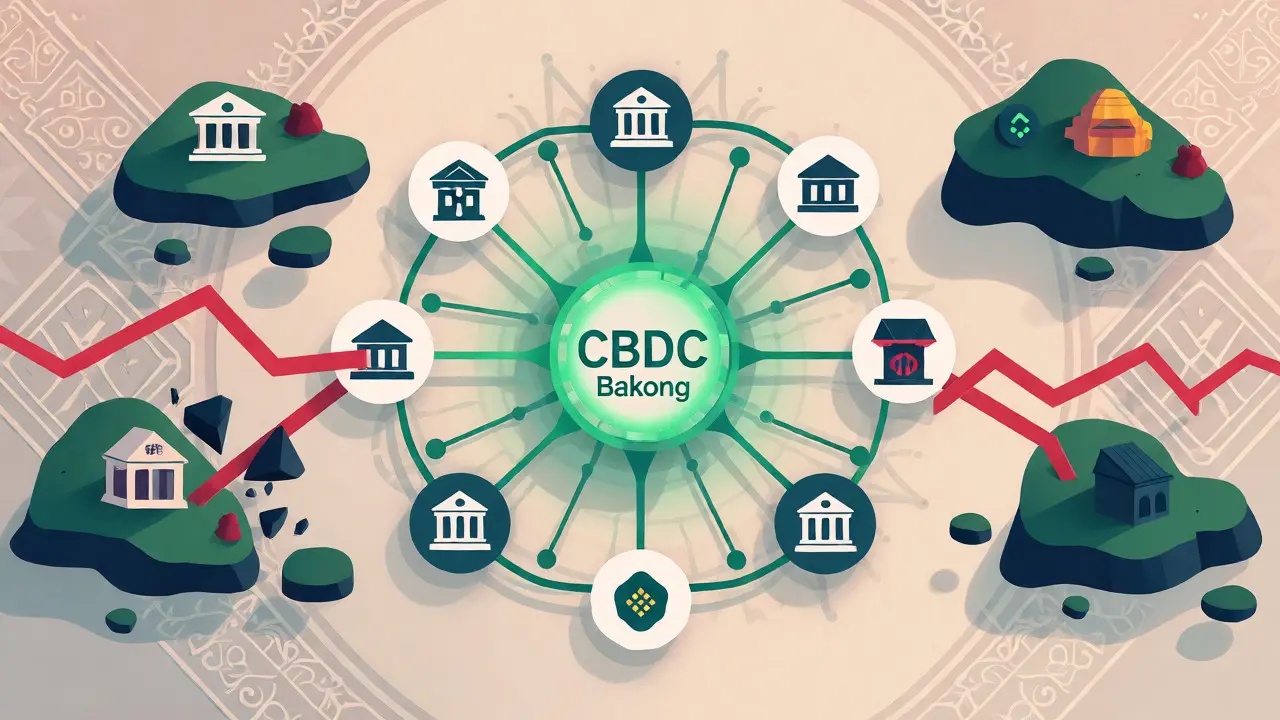
Cambodia didn’t just ban crypto; it replaced it with its own solution. Project Bakong is the country’s blockchain-based payment system, launched in 2020 with support from Japan. It’s not a cryptocurrency in the speculative sense; it’s a Central Bank Digital Currency (CBDC) infrastructure that allows instant transfers between banks and merchants. With over 65% population penetration and millions of daily transactions, Bakong works.
But here’s the catch: Bakong operates on a permissioned ledger. It doesn’t talk freely to public blockchains like Ethereum or Binance Smart Chain. To protect this ecosystem, the Telecommunication Regulator of Cambodia (TRC) took aggressive action in late 2024. They blocked access to 16 major offshore exchanges, including giants like Binance, Coinbase, and OKX. These platforms were flagged for operating without proper licensing from the Securities and Exchange Regulator of Cambodia (SERC).
This means you can’t simply log into Binance from a Cambodian IP address and trade freely anymore. Many users report connection issues or forced verification hurdles. The goal is clear: force liquidity back into licensed, local entities. Currently, only a handful of platforms, such as Royal Group Exchange, have received authorization. If you’re trading, you’re likely confined to these sandboxed environments or peer-to-peer networks that operate in a gray area.
Real-World Impact on Traders and Businesses
So, what does this mean for your wallet? Let’s look at the practical reality. If you’re a retail trader trying to convert Riel to USDT via P2P, you might face unexpected account freezes. There are documented cases where small, legitimate P2P transactions triggered automatic flags in banking systems, leading to weeks-long investigations. The banks’ anti-money laundering (AML) algorithms often struggle to distinguish between a hobbyist trader and illicit flows, especially given Cambodia’s history with online scam centers linked to crypto.
For businesses, the impact is twofold. First, cross-border payments remain expensive and slow compared to neighbors. While Vietnam leverages blockchain rails for 24-hour settlements, Cambodia’s restrictive stance keeps processing times at 3-5 days. Second, accessing global capital markets is harder. Startups looking for venture capital often find that international investors hesitate to route funds through Cambodian banks due to compliance risks. However, there is a silver lining: regulatory certainty. Companies that navigate the Crypto Asset Service Provider (CASP) licensing process gain a moat against competitors who rely on shaky offshore loopholes.
Consider the case of RiceX, an AgriTech startup. They secured $2 million in stablecoin funding through NBC-approved channels. Yes, the approval process took ten days longer than they hoped, but once cleared, the funds moved smoothly. This contrasts sharply with the chaos seen in jurisdictions where sudden bans wipe out liquidity overnight.
Why So Strict? The Anti-Money Laundering Angle
You might wonder why Cambodia takes such a hardline approach when neighbors like Thailand and Singapore embrace crypto. The answer lies in reputation and risk management. Cambodia has faced intense international scrutiny over its role in transnational crime, particularly concerning human trafficking and online scam operations funded by cryptocurrency.
In September 2024, the U.S. Treasury sanctioned several high-profile Cambodian entities for links to forced labor in scam centers. This wasn't just a PR hit; it was a wake-up call. The NBC realized that unchecked crypto flows could destabilize the financial sector and attract further sanctions. By tightening the screws, Cambodia improved its AML rating from "partially compliant" to "largely compliant" in recent assessments. The government argues that protecting the integrity of the Riel and preventing another massive exchange collapse outweighs the short-term benefits of open crypto trading.
It’s a defensive strategy. The banking sector is relatively young and fragile compared to regional powerhouses. A crash in Bitcoin prices or a failure of a major unlicensed exchange could trigger panic withdrawals. By keeping Bitcoin off bank balance sheets, the NBC insulates depositors from direct exposure to crypto volatility.

Navigating the Restrictions: Practical Tips
If you live or work in Cambodia, don’t let the restrictions paralyze you. Adaptation is key. Here is how to handle crypto transactions without triggering alarms:
- Use Licensed Local Platforms: Stick to SERC-authorized entities like Royal Group Exchange for fiat-crypto conversions. Avoid using personal bank accounts for frequent, high-volume P2P trades.
- Leverage Bakong for Fiat Transfers: Use Bakong for moving money between banks. It’s fast, cheap, and fully recognized. Convert to/from crypto only at the endpoints.
- Maintain Clean Records: Keep detailed logs of every transaction. If your bank asks questions, be ready to show source-of-funds documentation immediately.
- Watch the Thresholds: Be aware of reporting requirements. Transactions exceeding $3,000 may trigger enhanced due diligence under FATF Travel Rule guidelines adopted by Cambodian banks.
Avoid mixing business and personal crypto activities in the same bank account. If you run a business accepting crypto, consider opening a separate corporate account dedicated to those flows. This separation helps prevent your personal salary deposits from being entangled in complex compliance reviews.
The Future Outlook
Is this the end state for Cambodia? Probably not. The regulatory framework is still maturing. The NBC has signaled that future updates may expand the definition of Group 1 assets, potentially allowing more types of tokenized instruments. However, a full embrace of Bitcoin as legal tender remains unlikely in the near term. Governor Chea Chanto has stated clearly that private cryptocurrencies won’t challenge the Riel until Bakong achieves full stability and dominance.
For now, Cambodia represents a unique experiment: a nation attempting to harness blockchain technology for efficiency while rejecting the speculative excesses of decentralized finance. It’s a cautious path, slower than its neighbors, but arguably safer for the average citizen. If you’re patient and compliant, the system works. If you’re looking for quick, anonymous flips, you might find yourself fighting the current.
Can I use Bitcoin to pay for goods in Cambodia?
Technically, yes, because it is not illegal for individuals to hold or trade crypto. However, it is not legal tender. Most merchants will not accept it directly. You would need to convert it to Riel or USD via a licensed exchange or P2P platform before spending it. Additionally, banks may scrutinize accounts showing frequent crypto-to-fiat conversions.
Are Binance and Coinbase blocked in Cambodia?
Yes, the Telecommunication Regulator of Cambodia blocked access to 16 major offshore exchanges, including Binance, Coinbase, and OKX, in December 2024. Users often experience connectivity issues or are required to use VPNs, though doing so may violate terms of service or local regulations depending on interpretation. Licensed local alternatives are recommended.
What is Project Bakong?
Project Bakong is Cambodia’s blockchain-based payment system launched by the National Bank of Cambodia. It functions as a Central Bank Digital Currency (CBDC) infrastructure, enabling instant, low-cost transfers between banks and merchants. Unlike Bitcoin, it is centralized and backed by the Riel and USD reserves, making it fully integrated into the formal banking sector.
Why did Cambodia ban crypto banking services?
The primary reasons are financial stability and anti-money laundering (AML). Unregulated crypto flows were linked to illicit activities, including online scams and human trafficking. By restricting bank involvement with volatile assets like Bitcoin, the NBC aims to protect the banking sector from contagion risk and improve Cambodia’s international compliance ratings.
Can I receive crypto payments as a freelancer in Cambodia?
You can receive them, but converting them to Riel through a bank can be difficult. Many freelancers use licensed local exchanges or P2P methods to off-ramp. Be prepared for potential bank inquiries regarding the source of funds. Keeping clear records of invoices and exchange receipts is crucial to avoid account freezes.