CDONK X CoinMarketCap Airdrop: Is It Real or a Scam? (Club Donkey Analysis)
 May, 26 2026
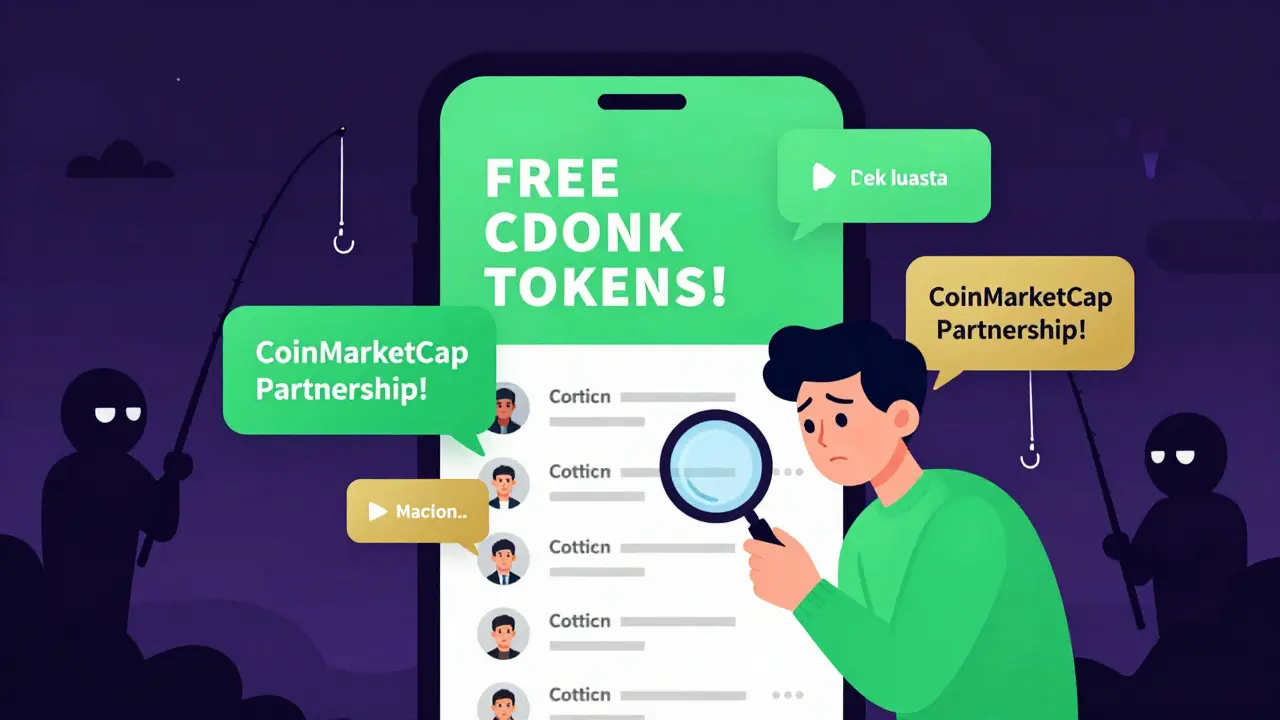
You’ve likely seen the flashy posts on social media claiming that Club Donkey is hosting a massive airdrop in partnership with CoinMarketCap. The promise is tempting: free tokens for simple tasks. But here is the hard truth you need to hear right now. There is no official CDONK X CoinMarketCap airdrop. In fact, searching for this specific event puts your wallet at immediate risk.
As of late 2025 and into 2026, CoinMarketCap has explicitly warned users about these false claims. This article breaks down exactly why this "partnership" doesn't exist, how scammers are using the Club Donkey name to steal funds, and what you should do if you've already interacted with one of these fake sites.
The Truth About the CDONK X CoinMarketCap Claim
Let’s look at the facts directly from the source. CoinMarketCap is the world's leading cryptocurrency price tracking platform. They have a dedicated section for airdrops. If you check their official page, you will see "Current airdrops (0)" and "Upcoming airdrops (0)". There is no listing for CDONK. There is no announcement. There is no partnership.
Club Donkey, often referred to by its ticker CDONK, is a decentralized meme token built on the Binance Smart Chain (BSC). According to its own listing, it positions itself as a "100% community-driven experiment." However, being listed on CoinMarketCap does not mean CoinMarketCap endorses the project, let alone hosts an airdrop for it. Listing status is simply data aggregation; it is not a seal of approval for marketing campaigns.
Scammers exploit this confusion. They know people trust the CoinMarketCap brand. So they create fake websites that look almost identical to the real thing, adding "CDONK Airdrop" to the URL or header. When you visit these sites, they aren’t giving you tokens. They are trying to take yours.
How the Club Donkey Phishing Scam Works
You might be wondering, "If I don't give them money, how can they hurt me?" That’s the trick. These scams usually don't ask for upfront payments. Instead, they use psychological tricks and technical exploits to drain your wallet. Here is the typical flow of a CDONK phishing attack:
- The Hook: You see a tweet or Telegram message saying "Claim your free CDONK via CoinMarketCap!" It often features a screenshot of a fake dashboard showing huge rewards.
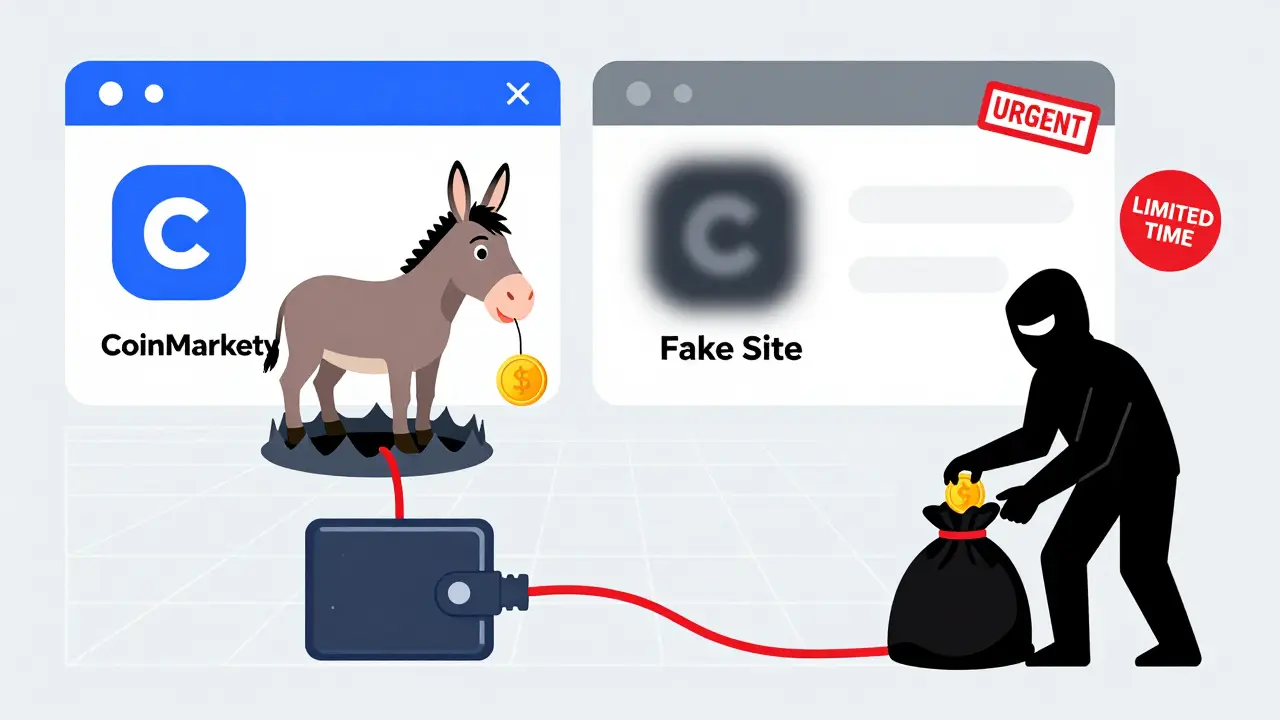
- The Fake Site: You click a link that leads to a domain like coinmarketcap-cdonk-airdrop.com or similar variations. The design mimics the real CoinMarketCap site perfectly.
- The Connection: The site asks you to connect your wallet (like MetaMask or Trust Wallet) to "verify eligibility." Connecting a wallet is normal for legitimate dApps, so you lower your guard.
- The Trap: Once connected, the site triggers a transaction. It might ask you to "approve" a token transfer or sign a message. This signature gives the scammer permission to move assets from your wallet.
- The Drain: Within seconds, the scammer executes a command to pull all supported tokens-USDT, BNB, ETH, or other valuable assets-from your wallet. By the time you realize what happened, the funds are gone.
Blockchain security experts like ZachXBT have analyzed thousands of these incidents. In Q3 2025 alone, forensic data showed that over 98% of notifications claiming to be "CoinMarketCap airdrops" were phishing attempts. The numbers are staggering because the method is so effective against casual users.
Red Flags: How to Spot a Fake Airdrop Instantly
You don't need to be a blockchain expert to spot these scams. Legitimate projects follow strict protocols. If you see any of the following signs, close the tab immediately:
- CoinMarketCap Never Hosts Direct Airdrops: CoinMarketCap is an information provider, not an exchange or a distribution platform. They do not hold tokens to give away. Any site claiming CMC is distributing tokens is lying.
- Requests for Private Keys or Seed Phrases: No legitimate service will ever ask for your 12-24 word seed phrase or private key. If a site pops up a text box asking for this, it is 100% a scam.
- Urgency and Exclusivity: Scammers use phrases like "Last chance," "Limited supply," or "Only for early adopters." Real airdrops from major platforms have clear, public terms and long claim windows.
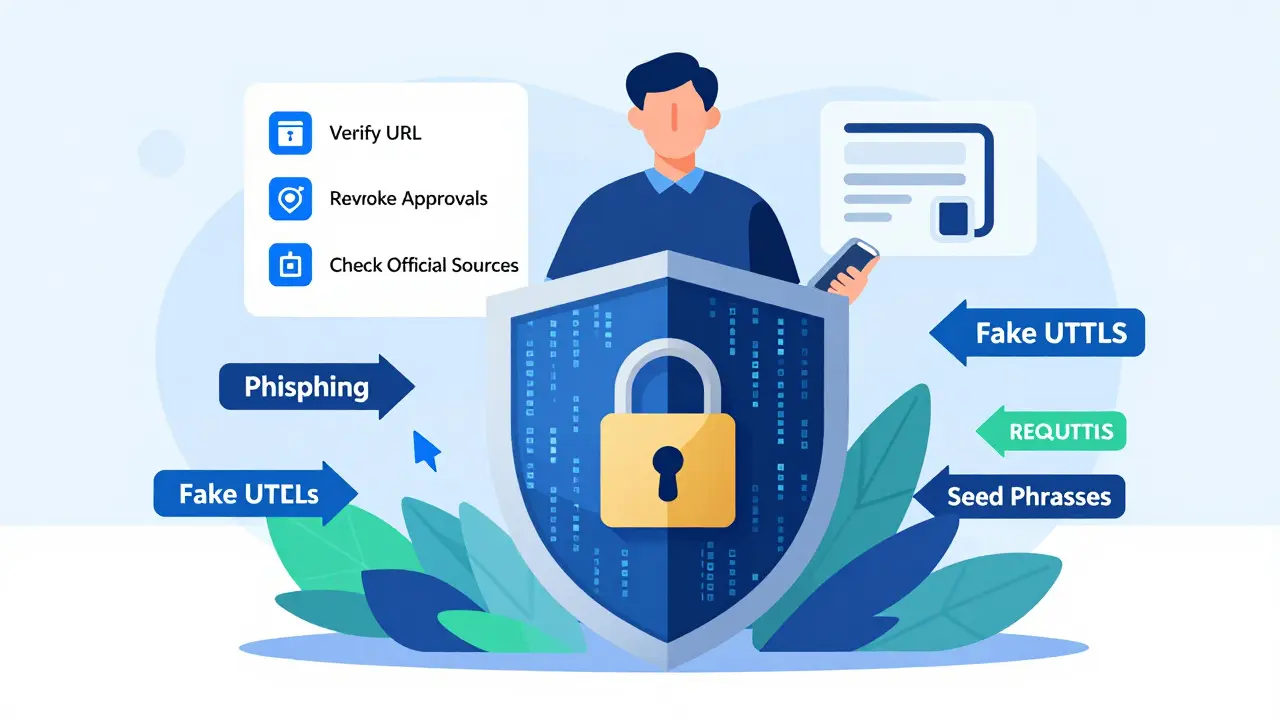
- Suspicious URLs: Check the web address carefully. The only official CoinMarketCap domain is coinmarketcap.com. Anything else, including subdomains that look slightly off, is dangerous.
- Zero Trading Volume: Look at the token's actual stats. CDONK had zero circulating supply and zero trading volume reported on CoinMarketCap during the height of these rumors. A token with no market activity cannot sustain a massive giveaway.
Why CDONK and Similar Meme Tokens Are Targets
Why do scammers choose tokens like Club Donkey? It comes down to volatility and attention. Meme coins rely heavily on social hype. Projects like SHIBA INU or AKITA INU gained fame through viral moments. Newer tokens try to replicate this by manufacturing hype.
CDONK is linked to the broader "Donkey" ecosystem, which includes the DONK token. While these projects may have genuine communities, their low liquidity and speculative nature make them perfect bait. Scammers know that people interested in meme coins are often looking for high-risk, high-reward opportunities. They prey on that greed.
Furthermore, many of these tokens lack robust security audits. A report from CertiK in October 2025 identified dozens of active phishing domains impersonating "CoinMarketCap CDONK Airdrop" portals. These domains were traced to a single Ethereum address associated with over $287,000 in stolen assets. The attackers didn't care about the token's value; they cared about the USDT or BNB sitting in the victims' wallets.
What To Do If You Already Connected Your Wallet
If you clicked a link and connected your wallet to a suspicious CDONK airdrop site, act fast. Time is critical. Follow these steps immediately:
- Disconnect the Wallet: Go to your wallet extension (MetaMask, Trust Wallet, etc.) and disconnect the site. This stops future interactions but does not reverse past damage.
- Revoke Approvals: Use a tool like Revoke.cash or Etherscan's Token Approval feature. Check for any approvals granted to unknown contracts. Revoke them immediately. This prevents the scammer from draining remaining funds.
- Move Funds to a New Wallet: If you suspect your private keys or seed phrase were compromised, assume your current wallet is unsafe. Create a brand new wallet with a new seed phrase. Move any remaining assets to this new wallet.
- Check Transaction History: Look at your blockchain explorer history (e.g., BscScan for Binance Smart Chain). If you see outgoing transactions to unknown addresses, those funds are likely lost. Unfortunately, blockchain transactions are irreversible.
- Report the Incident: Report the phishing site to CoinMarketCap support and relevant cybersecurity bodies. This helps protect others.
Legitimate Airdrops vs. Scams: A Comparison
| Feature | Legitimate Airdrop (e.g., Arbitrum, dYdX) | Fake CDONK X CMC Claim |
|---|---|---|
| Official Announcement | Posted on official blog, Twitter, and Discord by verified accounts. | No official announcement from CoinMarketCap or Club Donkey. |
| Platform Hosting | Hosted on the project's own website or a verified partner like CoinGecko. | Claims to be hosted on CoinMarketCap (which denies this). |
| Requirements | On-chain activity (swaps, staking) over months/years. | Simple tasks like "connect wallet" or "follow on X" for instant reward. |
| Security | Never asks for private keys or seed phrases. | May prompt for signatures that grant unlimited spending access. |
| Token Status | Established projects with liquidity and trading history. | Often involves tokens with zero volume or unverified contracts. |
Protecting Yourself in the Future
The crypto space moves fast, and scammers adapt quickly. To stay safe, build good habits. First, never trust links from DMs or unsolicited tweets. Always navigate to a project's website by typing the URL manually or using a bookmarked link. Second, use a hardware wallet for significant holdings. Even if your computer is compromised, a hardware wallet requires physical confirmation for transactions, adding a crucial layer of security.
Third, verify everything. If you hear about an airdrop, check the official CoinMarketCap airdrop page. Check the project's verified Twitter account. If the information isn't there, it doesn't exist. Finally, educate yourself on smart contract risks. Understanding what "approving" a token actually means can save you from losing life savings.
Remember, if an offer sounds too good to be true, it almost certainly is. Free money doesn't drop from the sky, especially not from a data aggregator like CoinMarketCap. Stay skeptical, stay secure, and keep your keys private.
Is there an official CDONK airdrop on CoinMarketCap?
No. CoinMarketCap has confirmed there are no current or upcoming airdrops for CDONK or any other token on their platform. Any claims otherwise are scams.
What is Club Donkey (CDONK)?
Club Donkey is a meme token on the Binance Smart Chain (BSC). It is part of the "Donkey" ecosystem, related to the DONK token. It is marketed as a community-driven experiment but has faced scrutiny due to phishing scams impersonating it.
How do I know if an airdrop site is fake?
Check the URL carefully. Official CoinMarketCap domains end in coinmarketcap.com. Also, CoinMarketCap does not host direct token distributions. If a site asks for your private key or seed phrase, it is a scam.
Can I recover funds stolen by a CDONK phishing scam?
Generally, no. Blockchain transactions are irreversible. Once funds are sent to a scammer's wallet, they cannot be retrieved. Prevention and quick revocation of approvals are the only defenses.
Does CoinMarketCap endorse CDONK?
Listing a token on CoinMarketCap does not constitute endorsement. It simply means the token meets basic data criteria for inclusion. CoinMarketCap has explicitly warned against scams using the CDONK name.
Christina Pearce
May 28, 2026 AT 06:03I really appreciate this breakdown because it saves people so much unnecessary stress. It is honestly terrifying how easy it is to get tricked when you just want to participate in the crypto space safely. I always double check links now after seeing friends lose money on similar scams. The part about CoinMarketCap not hosting direct airdrops is such a crucial detail that many overlook. Thank you for keeping the community informed and safe.
Barclay Chantel
May 29, 2026 AT 14:07It is truly pathetic that people still fall for these obvious traps in 2026. One would think basic digital literacy would have evolved by now but clearly the masses are too greedy to think critically. These scammers prey on the intellectually lazy who cannot distinguish between a data aggregator and a distribution platform. If you need free tokens handed to you, you deserve to lose what little you have. The sheer ignorance displayed by those clicking random links is embarrassing for the entire demographic.
Miss Masquer
May 30, 2026 AT 15:40I have been following the developments in the decentralized finance sector for quite some time now and it is fascinating to observe how these predatory tactics evolve alongside the technology itself. What strikes me most profoundly is the psychological manipulation involved in these schemes, where urgency and exclusivity are weaponized against individuals who are simply seeking financial empowerment through emerging markets. It is imperative that we continue to educate ourselves and our communities about the importance of verifying sources and understanding the fundamental mechanics of blockchain transactions before engaging with any platform that promises substantial returns for minimal effort. The distinction between legitimate projects and fraudulent operations often lies in the transparency of their communication channels and the verifiability of their smart contract audits, which are details that casual participants frequently neglect at their own peril.
Joshua Alcover
May 31, 2026 AT 00:01The epistemological framework underlying these deceptive practices reveals a profound deficiency in the collective cognitive resilience of the populace regarding cryptographic asset management protocols. When one examines the ontological status of the purported partnership, it becomes evident that the semantic void between the actual function of CoinMarketCap as an informational repository and the imagined utility of a distribution mechanism is exploited by malicious actors leveraging social engineering paradigms. This phenomenon necessitates a rigorous deconstruction of the trust metrics employed by users, suggesting that reliance on superficial brand recognition constitutes a critical vulnerability in the security architecture of individual wallet interactions. Furthermore, the systemic failure to recognize the syntactic irregularities in phishing URLs indicates a broader cultural malaise wherein heuristic shortcuts replace analytical scrutiny, thereby facilitating the exfiltration of assets through unauthorized transaction signatures.
Diana Morris
May 31, 2026 AT 22:51stop falling for it guys its so obvious just use your brain and check the url before you click anything i am so tired of seeing people complain about losing money when they could have prevented it if they were just more careful and paid attention to the details
Dianne Wright
June 1, 2026 AT 21:34i feel so drained reading all these comments because everyone acts like they know everything but then they go and connect their wallets to sketchy sites anyway it is exhausting trying to explain the same things over and over again and nobody listens until they lose their savings then suddenly they want advice but by then it is too late and i just want to be left alone from the constant negativity surrounding this topic
trisya hazriyana
June 2, 2026 AT 18:13the irony is palpable here because while we discuss the technical intricacies of smart contract approvals and private key security the average user is still operating on pure instinct and greed which makes them perfect targets for these sophisticated phishing campaigns so let us embrace the chaos and realize that no amount of education will stop someone from wanting free money instantly