CMP Airdrop Details: How Caduceus Metaverse Protocol Distributed Tokens in Past Events
 Feb, 21 2026
Back in 2022, the Caduceus project ran several airdrop campaigns to distribute its CMP (Caduceus Metaverse Protocol) tokens. These weren’t just random giveaways-they were strategic moves to build a community around a new kind of metaverse platform. If you’re wondering whether you missed out or just want to understand how these airdrops worked, here’s the full breakdown with real numbers, rules, and outcomes.
What Was the CMP Airdrop?
CMP stands for Caduceus Metaverse Protocol. It’s the token behind a blockchain-based metaverse project focused on decentralized edge rendering. That’s a fancy way of saying they wanted to make virtual worlds run faster and smoother by using distributed computing instead of relying on centralized servers. The project launched its Token Generation Event (TGE) on July 26, 2022, and soon after, they started giving away CMP tokens to early supporters.These airdrops weren’t meant to pump the price. They were meant to get people using the platform, testing it, and building things on it. The total supply of CMP was capped at 90 million tokens. By the time the TGE happened, 82.27 million had already been unlocked-meaning over 91% of the total supply was already in circulation.
How the Airdrops Actually Worked
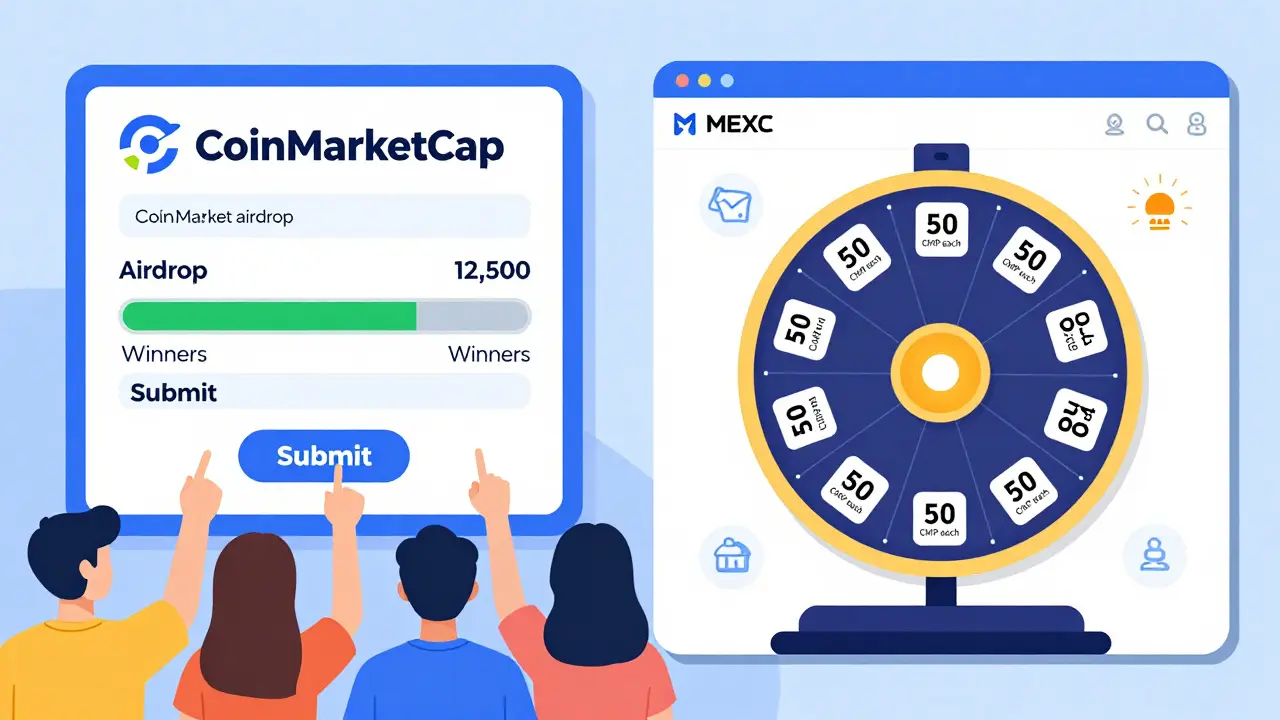
There were three major airdrop campaigns, each with different rules and rewards. None of them required you to buy anything. All you needed was to be active on the right platforms.1. MEXC Exchange - 62,000 CMP Lottery
One of the biggest CMP airdrops happened on MEXC, a global crypto exchange. This wasn’t a simple claim-it-and-forget-it deal. It was a lottery system.- **Total reward pool**: 62,000 CMP tokens
- **Number of winners**: 950
- **Reward per winner**: 50 CMP tokens each
- **How to enter**: You had to hold at least 10 MX tokens (MEXC’s native token) and complete a simple registration form on their website
- **Distribution method**: Random draw-no weighting based on how many MX you held
That’s 47,500 CMP tokens total distributed (950 x 50). The remaining 14,500 CMP tokens were kept for future use, but no public details were ever given about what happened to them.
2. CoinMarketCap - 62,500 CMP Giveaway
This was the largest airdrop in terms of participants. CoinMarketCap, one of the most popular crypto data sites, ran a campaign targeting its user base.- **Total reward pool**: 62,500 CMP tokens
- **Number of winners**: 12,500
- **Reward per winner**: 5 CMP tokens each
- **How to enter**: You had to have a CoinMarketCap account and complete a short form-no token holdings required
- **Distribution method**: First come, first served until the pool ran out
That’s 62,500 tokens handed out to 12,500 people. Each person got 5 tokens, which at the time was worth less than $1. But the goal wasn’t to make people rich-it was to get them to sign up, learn about Caduceus, and maybe try out the metaverse app later.
A YouTube tutorial from July 2022 still exists showing exactly how to enter this airdrop. It had over 20,000 views, proving people were actively trying to get involved.
3. MEXC Kickstarter - 50,000 USDT for CAD Tokens
This one was for CAD (Caduceus Protocol), not CMP. But since both tokens were part of the same ecosystem, it’s worth mentioning.- **Total reward pool**: 50,000 USDT
- **How to enter**: Hold between 1,000 and 500,000 MX tokens
- **Action required**: Vote on whether MEXC should list CAD
- **Reward**: Winners received USDT, not tokens
This wasn’t a token airdrop-it was a listing vote. If enough people voted yes, MEXC would list CAD. The campaign raised over $1 million in voting commitments. The listing went through, and CAD was added to MEXC shortly after.
Why Did Caduceus Run So Many Airdrops?
The total value of these airdrops adds up to over 174,500 CMP tokens plus 50,000 USDT. That’s a lot of tokens for a project with an $86,000 market cap at the time. Why spend so much?Simple: they needed users. Most metaverse projects fail because no one shows up. Caduceus knew that. They didn’t just want investors-they wanted players, builders, testers. By handing out tokens for free, they created a network of people who had skin in the game.
Compare that to other blockchain games that just airdropped to wallets with no real engagement. Caduceus tied each airdrop to a specific action: voting, signing up, holding a token. That built real community momentum.
Did Anyone Profit From These Airdrops?
At the time of distribution, CMP was trading around $0.006. So 50 CMP tokens were worth about $0.30. Not life-changing money. But here’s the catch: the project didn’t stop after the airdrops.After the TGE, the price of CMP hovered around $0.005 for months. Then, in late 2023, it briefly spiked to $0.012 due to renewed interest in metaverse projects. Someone who got 50 CMP in the MEXC airdrop could have doubled their money if they held.
But most people didn’t hold. They cashed out immediately. That’s the problem with small airdrops-people treat them like free snacks, not long-term assets.
What Happened to the Project After the Airdrops?
Caduceus didn’t disappear. They kept developing. Their decentralized edge rendering tech was tested in beta with three blockchain games. One of them, called Neon Realm, used their rendering engine to cut latency by 60% compared to traditional cloud servers.But adoption was slow. The metaverse space got crowded. Competitors like The Sandbox and Decentraland had bigger budgets and more brand recognition. Caduceus never raised another major funding round after 2022. Their market cap stayed under $100,000.
Their website is still live. Their GitHub still has commits. But there’s no major update since early 2024. The airdrops worked-they built a community. But they didn’t build a movement.

Could You Still Get CMP Tokens Today?
No. All public airdrop campaigns ended in 2022. There are no active ones as of 2026. If you see anyone claiming to run a “new Caduceus airdrop,” it’s a scam.The only way to get CMP now is to buy it on exchanges like MEXC, Gate.io, or Bitrue. But be warned: the 24-hour trading volume is around $72,000. That’s low. Liquidity is thin. You could easily get stuck if you try to sell a large amount.
Lessons From the CMP Airdrops
- Airdrops work best when tied to action-not just wallet addresses. Caduceus got real users by requiring voting, signing up, or holding a token.
- Small rewards build communities-not fortunes. 5 tokens might seem pointless, but 12,500 people now knew about the project.
- Marketing spend matters-spending $174,500 in tokens on a project with an $86,000 market cap was risky. It showed confidence, but also desperation.
- Don’t chase airdrops for profit-unless you’re in it for the long haul, you’ll lose money.
The CMP airdrops were a textbook case of how to use token distribution to build awareness-not wealth. They didn’t make anyone rich. But they did give real people a chance to be part of something new.
Did the Caduceus airdrop require KYC?
No, none of the public Caduceus airdrops required KYC. You only needed a crypto wallet or an account on MEXC or CoinMarketCap. No personal documents, ID, or verification steps were ever asked for.
Can I still claim old CMP airdrop tokens?
No. All airdrop campaigns ended in 2022. The claim windows closed permanently. If a website or social media post says you can still claim tokens, it’s a phishing scam. Always double-check official Caduceus channels-though they’ve been inactive since 2024.
What’s the difference between CAD and CMP tokens?
CAD (Caduceus Protocol) was the original token used for governance and protocol fees. CMP (Caduceus Metaverse Protocol) was the token for in-metaverse activities like buying land, skins, and accessing games. They were separate but linked-both part of the same ecosystem.
Why did the price of CMP stay so low after the airdrops?
The project never gained major adoption. While the tech was solid, there was no big marketing push, no celebrity partnerships, and no major game studios integrated. Without users actually playing on the platform, the token had no utility beyond speculation. Low demand = low price.
Are there any active Caduceus projects today?
As of early 2026, there are no active public projects or updates from the Caduceus team. Their website remains online but hasn’t been updated since late 2023. The core team appears inactive. The project is considered dormant, though the codebase is still publicly available on GitHub.
What Should You Do Now?
If you’re interested in similar projects, look at newer metaverse protocols like Render Network, Akash Network, or Hivemind. They’re using similar decentralized rendering tech-but they’re actively building, not just airdropping.The CMP airdrop is over. But the idea behind it-giving users real control over virtual worlds-is still alive. Just don’t wait for another free token. Build something instead.
Ryan Burk
February 22, 2026 AT 00:07Amanda Markwick
February 23, 2026 AT 12:50Sriharsha Majety
February 25, 2026 AT 10:58Tabitha Davis
February 27, 2026 AT 10:27Vishakha Singh
February 27, 2026 AT 19:35Don B.
February 28, 2026 AT 12:35Andrew Hadder
March 1, 2026 AT 05:42Neeti Sharma
March 1, 2026 AT 18:56