Cross-border crypto services in EU under MiCA: What you need to know in 2026
 Jan, 7 2026
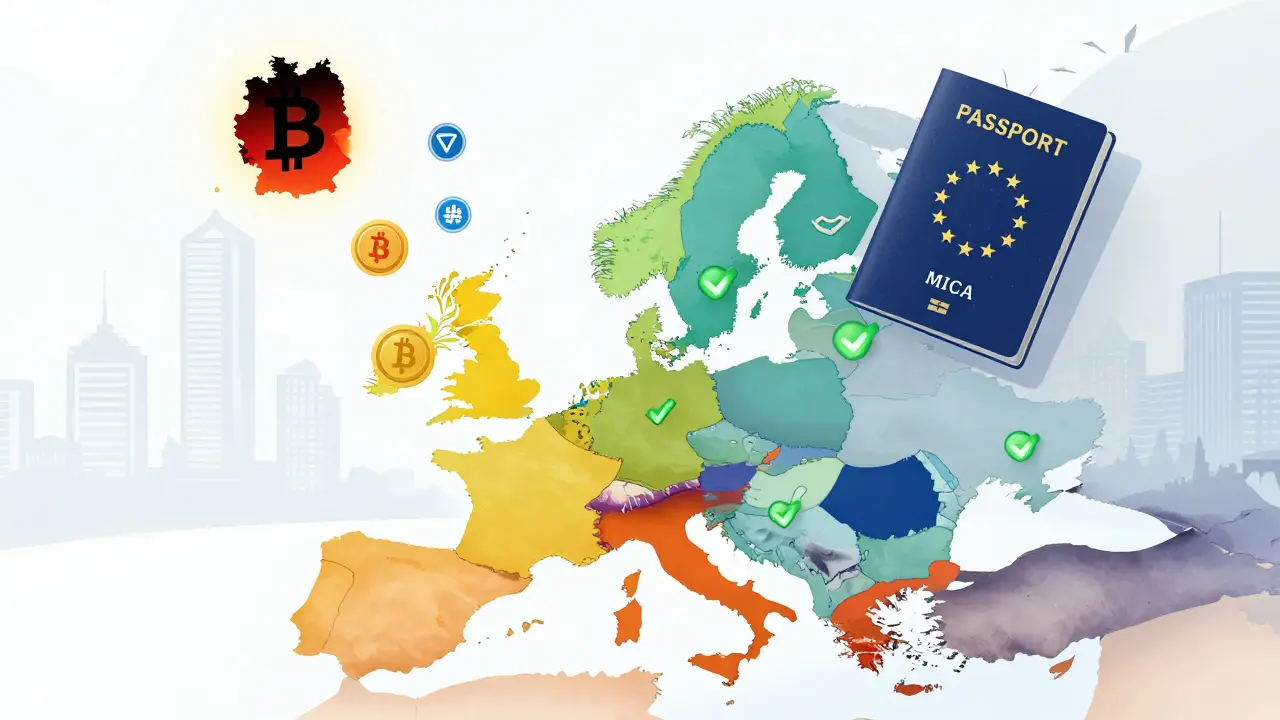
Before MiCA, if you ran a crypto exchange in Germany and wanted to serve customers in Spain, you had to apply for a separate license in Spain. Same for France. Same for Italy. It was slow, expensive, and messy. That changed on December 30, 2024, when the second phase of the Markets in Crypto-Assets (MiCA) regulation fully kicked in. Now, a single authorization from one EU country lets you offer crypto services across all 27 member states. It’s called the EU passport-and it’s rewriting the rules for how crypto businesses operate across borders.
How the EU crypto passport works
The passport isn’t a physical document. It’s a legal right. Once a crypto service provider (called a CASP-Crypto-Asset Service Provider) gets approved by its home country’s regulator-say, Germany’s BaFin-it can start offering services in any other EU country without reapplying. All it needs to do is notify its home regulator and the target country’s authority. That’s it. No extra fees. No extra paperwork. No waiting six months for approval in each new market. This isn’t just convenient. It’s transformative. Before MiCA, startups had to choose: focus on one country and grow slowly, or try to juggle 27 different rulebooks. Now, a small team in Estonia can serve clients in Portugal, Poland, and Romania under one license. That’s the power of harmonization. But here’s the catch: you can’t just apply anywhere. The passport only works if you’re based in an EU member state. And you can’t skip the rules. Every CASP must meet strict requirements: keep client funds safe, disclose all risks clearly, prevent market manipulation, and maintain enough capital to cover losses. If you’re serving more than 15 million active users in the EU, you’re labeled a “significant” CASP-and you answer directly to ESMA, the European Securities and Markets Authority.What services need a license?
MiCA doesn’t just cover big exchanges like Binance or Coinbase. It applies to anyone offering crypto-related services to EU users-even if it’s not their main business. That means:- Crypto exchanges (buying, selling, trading)
- Custodial wallet providers (holding your private keys)
- Token issuers (launching new coins or tokens)
- Stablecoin operators (like USDT or EURC)
- Platforms that let you earn interest on crypto
- Even fintech apps that embed crypto trading into their service
What about non-EU companies?
This is where things get tough. If you’re based outside the EU-say, in the U.S., Singapore, or Dubai-you can’t just offer services to EU customers anymore. MiCA says: if you want to actively market or solicit EU clients, you must set up a legal entity inside the EU and get a full CASP license. There’s one narrow exception: reverse solicitation. That means an EU customer finds you on their own-no ads, no emails, no website targeting EU users-and reaches out to you. Even then, ESMA’s guidelines make this nearly impossible to rely on. Most regulators treat it as a loophole, not a strategy. Major international exchanges like Kraken and Bybit have already opened EU subsidiaries. Coinbase set up its EU headquarters in Ireland. Even smaller firms are opening offices in Malta, Lithuania, or Spain just to get the passport. If you’re not in the EU legally, you’re not in the EU market.
Stablecoins face extra scrutiny
Not all crypto-assets are treated the same. Stablecoins-tokens pegged to euros, dollars, or other assets-are under the microscope. MiCA requires them to:- Hold reserves in liquid, low-risk assets
- Allow users to redeem their tokens for the underlying asset at any time
- Prove their reserves are fully backed, with regular audits
- Have contingency plans if the peg breaks
Anti-money laundering rules are tighter
MiCA doesn’t replace the EU’s Anti-Money Laundering Directive (AMLD)-it layers on top of it. That means CASPs must:- Verify the identity of every customer (KYC)
- Monitor transactions for suspicious patterns
- Report anything unusual to national financial intelligence units
- Keep records for at least five years
What’s changed since December 2024?
The full rollout of MiCA’s second phase on December 30, 2024, marked the end of the transition period. As of January 2026:- 15 EU countries have already closed their transitional periods ahead of schedule
- ESMA has issued detailed rules on capital requirements, stress testing, and executive pay for token issuers
- National regulators are setting up joint oversight teams for cross-border CASPs
- Over 80 firms have received full CASP authorization across the EU
Who wins? Who loses?
Big firms with deep pockets win. They can afford the legal teams, compliance software, and EU offices. They get the passport and scale fast. Startups lose-if they don’t plan ahead. The cost of a CASP license can run into hundreds of thousands of euros. The paperwork is complex. The deadlines are strict. Many small players are stuck. Some are pivoting to non-EU markets. Others are partnering with licensed providers to use their passport as a backdoor. The EU didn’t design MiCA to help startups. It was built to protect consumers, prevent financial crime, and bring crypto into the same regulatory box as banks. Whether that’s good or bad depends on your perspective. But one thing’s clear: if you’re doing crypto business in Europe, you’re now playing by EU rules.What’s next?
MiCA isn’t the end. It’s the beginning. ESMA is already working on rules for decentralized finance (DeFi), non-fungible tokens (NFTs), and algorithmic stablecoins. The EU is watching how other regions-like the U.S., UK, or Japan-handle crypto. If those places move toward similar rules, MiCA could become the global standard. For now, if you’re offering crypto services to EU customers, there’s only one path: get licensed. No shortcuts. No workarounds. No hoping the rules will change. The EU has spoken. And it’s not backing down.Do I need a license if I only serve EU customers from outside the EU?
Yes, if you actively market or solicit EU customers. MiCA requires non-EU firms to establish a legal entity inside the EU and obtain a CASP license. The only exception is reverse solicitation-when an EU user contacts you without any prior promotion. But ESMA’s guidelines make this nearly impossible to use legally for business growth. Most regulators treat it as a compliance risk, not a loophole.
What happens if I don’t get a MiCA license?
You risk being blocked by EU regulators. Payment processors may cut you off. Banks may refuse to work with you. EU customers won’t be able to use your service legally. National authorities can issue fines, freeze assets, or even pursue criminal charges for operating without authorization. The EU has already shut down unlicensed platforms-your business won’t survive long without compliance.
Are all crypto wallets covered by MiCA?
Only custodial wallets. If you hold the private keys for your users, you’re a CASP and need a license. Non-custodial wallets-where users control their own keys-are not regulated under MiCA. That’s why apps like MetaMask aren’t affected. But if you offer a wallet that stores keys for users, even as a side feature, you’re in scope.
Can I use a MiCA license from one country to operate in another?
Yes. That’s the whole point of the EU passport. Once you’re authorized in your home country (like Germany or Estonia), you can offer services across all 27 EU member states. You just need to notify the regulator in each target country. No extra licenses, no extra fees. But you still must follow all MiCA rules everywhere you operate.
How much does a MiCA license cost?
There’s no fixed fee, but costs vary widely. Application fees range from €5,000 to €50,000 depending on the country. Legal and compliance setup can cost €100,000-€500,000. You’ll also need to hold capital reserves-typically €125,000 minimum, plus more if you’re handling large volumes. For significant CASPs (over 15M users), costs jump even higher. Many startups spend over €1 million total to get compliant.
Is MiCA good for innovation in crypto?
It’s mixed. On one hand, clear rules reduce uncertainty and attract institutional investors. On the other, high compliance costs favor big players and make it harder for startups to compete. Some argue MiCA stifles innovation by forcing DeFi and new token models into old banking-style boxes. Others say it’s the only way crypto can go mainstream safely. The EU chose stability over speed-and time will tell if that’s the right trade-off.
Surendra Chopde
January 8, 2026 AT 16:20So now every tiny crypto app in Estonia has to hire a legal team just to serve a Polish user? This isn't regulation-it’s a tax on innovation disguised as consumer protection.
Allen Dometita
January 9, 2026 AT 08:58Bro, if you're not licensed and you're serving EU customers, you're playing with fire. I saw a guy get his bank account frozen last month just because his wallet app had EU traffic. No warnings. No grace period. Just gone. Don't be that guy.
Tre Smith
January 11, 2026 AT 08:49Let’s be clear: MiCA isn’t about protecting consumers-it’s about protecting legacy financial institutions from disruption. The capital requirements, the KYC overload, the reserve rules-all designed to make it impossible for agile startups to compete. The EU didn’t regulate crypto. They buried it under paperwork. And now they’re calling it ‘market stability.’
Meanwhile, non-EU platforms are quietly migrating to Asia and LATAM, where regulations are actually sane. This isn’t leadership. It’s isolationism with a compliance checklist.
And don’t get me started on the ‘reverse solicitation’ loophole. It’s a joke. Regulators know full well that if your website loads in the EU, you’re targeting them. They just don’t want to admit it.
sathish kumar
January 11, 2026 AT 13:19The implementation of the Markets in Crypto-Assets Regulation constitutes a monumental advancement in the harmonization of financial services across the European Union. The establishment of a unified authorization framework eliminates the previous fragmentation, thereby enhancing operational efficiency and regulatory certainty for Crypto-Asset Service Providers. It is imperative that all entities engaged in crypto-related activities adhere strictly to the prescribed capital adequacy, custody, and transparency standards. Non-compliance not only exposes firms to severe financial penalties but also undermines the integrity of the broader financial ecosystem. The European Union has demonstrated commendable foresight in establishing a robust, scalable, and consumer-centric regulatory architecture.
Jordan Leon
January 13, 2026 AT 03:42It’s funny how we call this ‘freedom’-one license, 27 countries. But the cost of entry is so high that only corporations can play. What happened to the idea that crypto was supposed to be decentralized? Now you need a lawyer, a bank account, and a balance sheet just to offer a wallet. We traded chaos for bureaucracy. And I’m not sure which one is worse.
Maybe the real innovation isn’t in the tech anymore. Maybe it’s in figuring out how to survive the system that was supposed to kill it.