Crypto Tax Enforcement and Penalties in India: What You Need to Know in 2025
 May, 23 2025
Crypto Tax Calculator for India
Calculate Your Tax Liability
Based on India's current crypto tax laws (30% tax on gains, 1% TDS, 18% GST)
Estimated Tax Breakdown
Penalty Alert
India’s crypto tax system isn’t just strict-it’s one of the harshest in the world. If you’re trading, staking, or even just holding Bitcoin or Ethereum in India, you’re under the microscope. And unlike most countries, there’s no room for loss offsets, no deductions, and no leniency. The government isn’t trying to encourage crypto-it’s trying to contain it. But here’s the real question: what happens if you don’t pay?
How Crypto Taxes Work in India (2025)
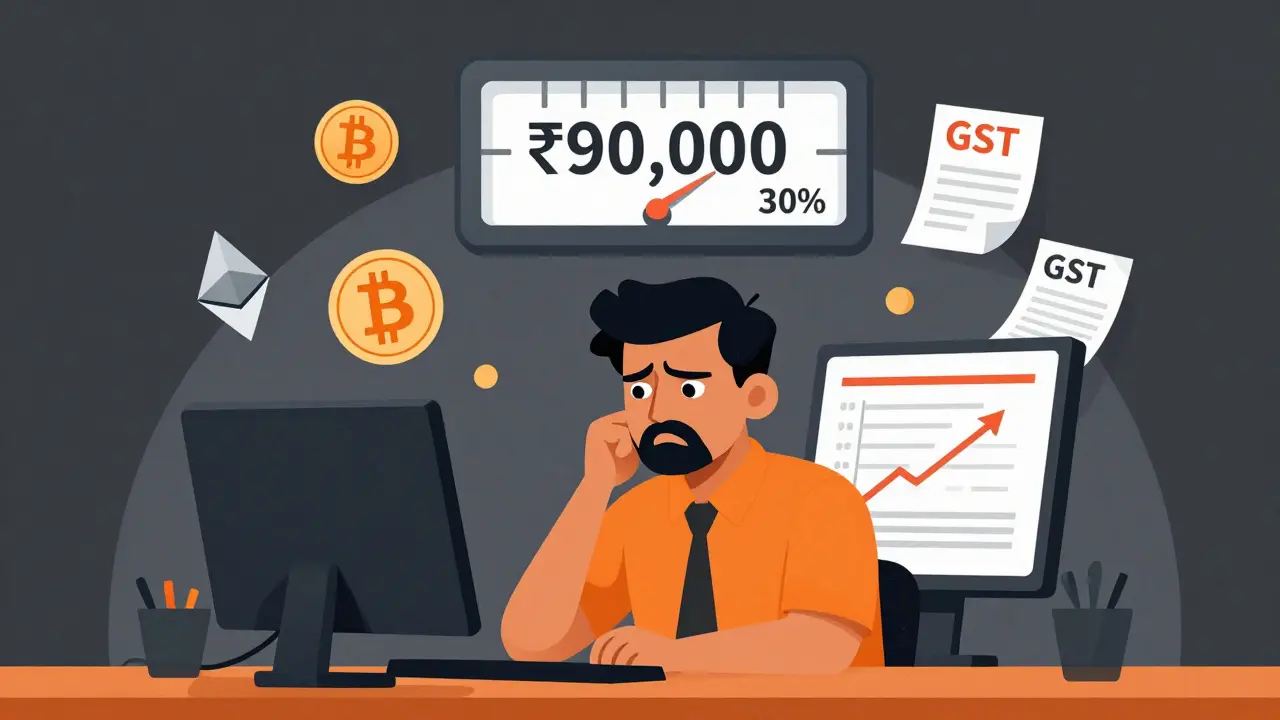
Since April 2022, every profit from cryptocurrency in India is taxed at a flat 30%. That’s it. No deductions. No carrying forward losses. Not even a basic exemption. If you bought Bitcoin for ₹5 lakh and sold it for ₹8 lakh, you owe ₹90,000 in taxes-no matter if you lost money on Ethereum the same year. This rule, under Section 115BBH of the Income Tax Act, treats crypto gains like lottery winnings. No logic, no fairness, just a hard number.
Then there’s the 1% TDS. Every time you sell crypto-whether on WazirX, CoinSwitch, or a peer-to-peer app-the buyer must deduct 1% of the transaction value and pay it to the government. That applies even if you’re selling to a friend. If you trade ₹10 lakh worth of Solana, ₹10,000 gets withheld automatically. This isn’t optional. Exchanges are legally required to do it. And if they don’t, they face penalties.
Starting July 7, 2025, a new layer kicked in: 18% GST on platform services. This isn’t on the crypto itself-it’s on the fees. Trading fees, withdrawal charges, staking rewards, wallet management, even KYC verification. If you’re using an Indian exchange, you’re paying GST on top of everything else. Platforms like CoinDCX and ZebPay now have to register for GST regardless of their turnover. That’s unusual. Most businesses only register if they hit ₹20 lakh in sales. Crypto platforms? They’re forced in, no exceptions.
How the Government Tracks You
India’s tax department doesn’t need to guess what you’re doing. They’re getting data straight from the exchanges. Every trade, every deposit, every withdrawal-exchanges report it to the Income Tax Department. The system is automated. If you bought ETH on CoinSwitch in January and sold it in March, the government already has the timestamp, amount, and price. You can’t hide it.
And now, with GST invoicing required for every service, there’s a second paper trail. Every time you pay a fee to a crypto platform, they issue a GST invoice. That invoice is linked to your PAN and your KYC details. Cross-reference that with your bank statements, and the government can map your entire crypto activity-even if you use multiple wallets.
For individuals, reporting crypto income is mandatory. You file either ITR-2 (for capital gains) or ITR-3 (if you’re running a crypto business). Both forms now include a dedicated section called ‘Schedule VDA’-Virtual Digital Assets. You must list every transaction: buy date, sell date, cost, sale price, profit. No shortcuts. No estimates. If you skip this, you’re not just being careless-you’re breaking the law.

What Are the Penalties?
Here’s the scary part: the government hasn’t published a clear list of crypto-specific penalties. That doesn’t mean there aren’t any. Instead, they’re using existing income tax rules to punish non-compliance.
If you don’t file your ITR and have crypto gains, you could face:
- Interest at 1% per month on unpaid tax (Section 234A)
- Penalty up to 50% of the tax evaded (Section 270A)
- Penalty up to ₹10 lakh for failure to maintain records (Section 271A)
- Prosecution for tax evasion if the amount exceeds ₹10 lakh (Section 276C)
There’s no first-time warning. No gentle reminder. The moment the tax department matches your unreported crypto profit with exchange data, the clock starts ticking. Interest accumulates. Penalties pile up. And if you’re caught deliberately hiding income, you could be looking at criminal charges.
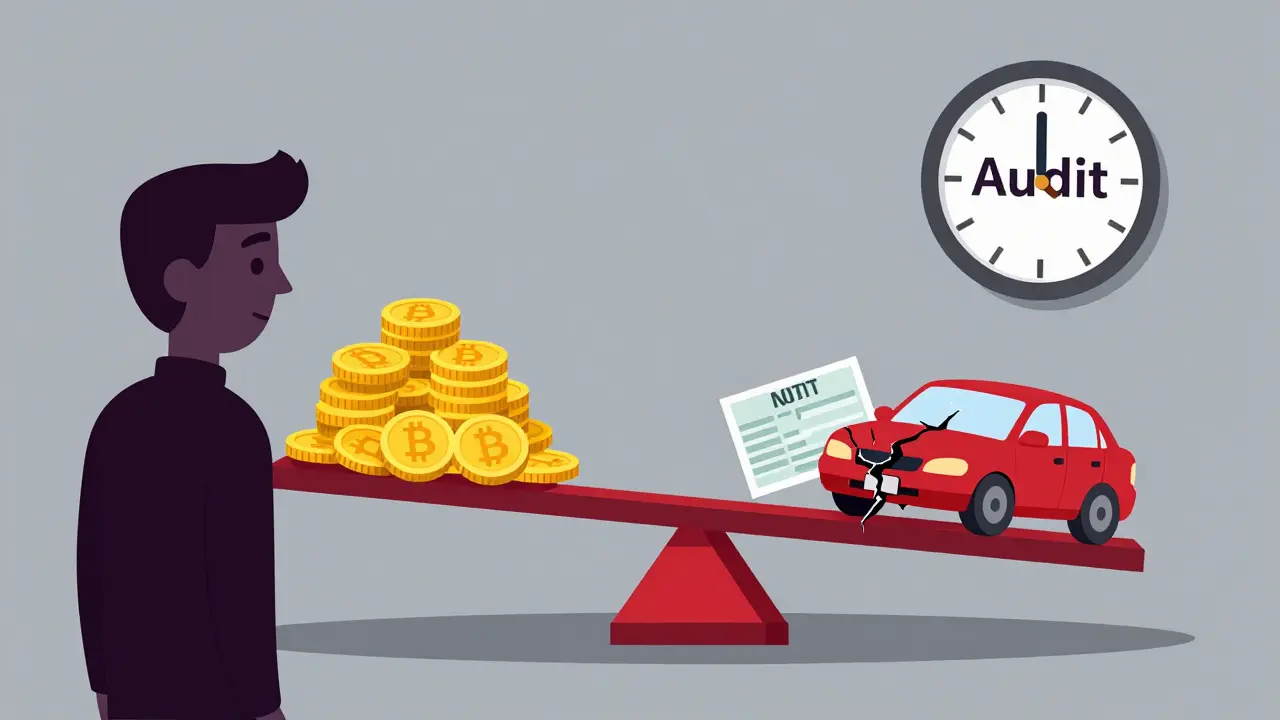
One real case from 2024 involved a trader in Pune who made ₹22 lakh in crypto profits over two years and didn’t report it. The IT department matched his bank deposits with exchange data. He got hit with ₹6.8 lakh in tax, ₹3.4 lakh in interest, and ₹11 lakh in penalties-more than double what he originally earned. He didn’t go to jail, but he lost his car, his savings, and his credit score.
Why the System Is Broken
India’s crypto tax policy sounds tough on paper. In practice, it’s failing. The 30% tax rate is so high that traders are fleeing. According to industry estimates, over 60% of Indian crypto trading volume has moved offshore to platforms like Binance, Kraken, and Bybit. Why? Because those exchanges don’t deduct TDS. They don’t report to Indian authorities. And they don’t charge GST.
That creates a massive loophole. If you’re using a foreign exchange, you’re not just avoiding TDS-you’re avoiding the entire enforcement system. The government knows this. That’s why, in August 2025, the Central Board of Direct Taxes (CBDT) sent detailed questionnaires to Indian exchanges asking:
- Is the 1% TDS too high?
- Is the 30% tax killing market liquidity?
- Do offshore exchanges have an unfair advantage?
That’s not a routine review. That’s a crisis call. The policy is backfiring. It’s driving activity underground and into unregulated spaces-exactly what the government claims it wants to stop.
And then there’s the loss problem. If you lose ₹5 lakh on crypto this year, you can’t use it to reduce your tax on a ₹3 lakh profit from another coin. You pay tax on the ₹3 lakh. Then you’re left with a ₹5 lakh loss that disappears-no carryforward, no deduction. That’s not tax policy. That’s punishment.
What You Should Do Now
If you’re trading crypto in India, here’s your action plan:
- Track every transaction. Use a tool like Koinly or CoinTracker. Manually logging buys and sells is too risky.
- File ITR-2 or ITR-3. Don’t wait. Use Schedule VDA. Report every profit-even small ones.
- Keep records for 6 years. The tax department can audit you anytime within that window.
- Don’t use offshore exchanges to evade TDS. If you’re an Indian resident, your global income is taxable. The government is already working with foreign regulators to get data.
- Don’t assume you’re safe because you didn’t get a notice. Audits are happening. The first wave targeted traders with over ₹5 lakh in gains. The next wave will be broader.
If you’ve already made profits and didn’t report them, don’t panic. You can still file a revised return. You’ll pay interest and a penalty-but it’s better than waiting for a notice. The tax department has a voluntary disclosure scheme. It’s not publicized, but it exists.
The Future of Crypto Tax in India
Change is coming. The CBDT review isn’t just a formality. It’s a sign the government knows the current system is unsustainable. They’re likely considering:
- Lowering the tax rate to 20-25%
- Allowing loss offsets
- Removing or reducing the 1% TDS
- Creating a legal framework for crypto exchanges
But until then, the rules are clear: pay up or face consequences. The government isn’t trying to ban crypto. It’s trying to control it. And control means taxes, tracking, and penalties.
Don’t think this is just about money. It’s about trust. If you’re not reporting, you’re betting that the government won’t find you. But they already have the data. You’re just delaying the moment they come knocking.
Is crypto legal in India?
Yes, crypto is legal to hold and trade in India, but it’s not legal tender. The Supreme Court lifted the banking ban in 2020, but the government has never given it official status. You can buy and sell, but you’re subject to strict tax rules and reporting requirements.
Do I have to pay tax on crypto losses?
No, you don’t pay tax on losses-but you also can’t use them to reduce your tax bill. Crypto losses can’t be offset against gains from other coins or against income from salary or business. They simply disappear for tax purposes.
What happens if I don’t report crypto income?
You risk interest (1% per month), penalties up to 50% of the unpaid tax, and possible prosecution if the amount exceeds ₹10 lakh. The tax department matches exchange data with your bank statements, so hiding income is extremely risky.
Is the 1% TDS on every crypto trade mandatory?
Yes. If you’re selling crypto on an Indian exchange or through a peer-to-peer transaction where the buyer is an Indian resident, 1% must be deducted and deposited with the government. The buyer (or exchange) is legally responsible for this deduction.
Do I need to pay GST on crypto transactions?
You don’t pay GST on buying or selling crypto. But if you pay fees to a crypto platform-like trading fees, withdrawal charges, or staking service fees-you’re paying 18% GST on those services. The platform collects it and remits it to the government.
Can I avoid crypto taxes by using foreign exchanges?
No. As an Indian resident, your global income is taxable in India. Even if you trade on Binance or Kraken, you must report all profits. The government is working with foreign tax authorities to get data. Avoiding Indian exchanges doesn’t mean avoiding tax.
Are airdrops and staking rewards taxable?
Yes. Both are treated as income at their fair market value on the day you receive them. For example, if you get 0.5 ETH as a staking reward when ETH is worth ₹2.5 lakh, you owe 30% tax on ₹2.5 lakh. You’ll need to track the price at the exact time of receipt.
How long should I keep crypto transaction records?
Keep records for at least six years from the end of the financial year in which the income was earned. The tax department can reopen your case for up to six years if they suspect underreporting.
Vincent Cameron
December 6, 2025 AT 07:13India’s crypto tax regime feels like they’re taxing the air you breathe. 30% flat? No loss offsets? It’s not taxation-it’s extortion disguised as policy. If you make money on crypto, you’re a criminal. If you lose, you’re just a sucker who didn’t pay enough. The government wants control, not revenue. They’re not trying to regulate-they’re trying to scare people away. And guess what? It’s working. But not how they planned. People aren’t complying. They’re just going offshore and laughing all the way to their untracked wallets.
Meanwhile, the 1% TDS is a joke. It’s not preventing tax evasion-it’s just making trading so frictionless that no one wants to use Indian exchanges anymore. And now GST on trading fees? That’s like taxing the ink on the receipt. This isn’t policy. It’s performance art for bureaucrats who think complexity equals authority.
And yet… here’s the real tragedy. The people who actually care about compliance-the ones tracking every satoshi-are the ones getting punished. The real tax evaders? They’re not even on the radar. They’re using Phantom wallets and Telegram bots. The system isn’t broken because it’s too strict. It’s broken because it’s completely misaligned with reality.
What’s next? A tax on blockchain nodes? A levy on mining rigs? At this point, I wouldn’t be surprised if they started taxing the electricity used to power your router when you check your portfolio.
They say they want to ‘contain’ crypto. But containment doesn’t mean crushing it. It means channeling it. This isn’t containment. It’s a bonfire with a ‘No Trespassing’ sign.
Krista Hewes
December 6, 2025 AT 21:36i just read this and my head hurt. like… why is it so hard to just let people trade? i lost like 70% of my crypto last year and still got taxed on the 30% i made before that. it’s not fair. and now i’m scared to even look at my wallet. what if they come for me? i didn’t even know about the gst on fees until now. 😣
Noriko Robinson
December 8, 2025 AT 03:14It’s wild how the government is treating crypto like a dangerous drug instead of an asset class. You’re penalizing innovation because you don’t understand it. The 30% tax is so high that even legitimate traders are fleeing. The 1% TDS is a blunt instrument-it hits everyone, even people doing small, occasional trades. And GST on fees? That’s like charging sales tax on the paper your receipt is printed on.
But here’s the thing: the real winners aren’t the ones paying taxes. They’re the offshore platforms. India’s policy is creating a black market for crypto, not eliminating it. And guess who gets hurt? Regular people trying to do the right thing. The government isn’t protecting consumers. They’re punishing them.
Meanwhile, the world is moving on. The EU has clear rules. Singapore has a sandbox. Even the US has tax guidance that makes sense. India? We’re stuck in a loop of fear, confusion, and overreach. This isn’t control. It’s chaos dressed up as law.
And the worst part? The people who could fix this-the policymakers-are too scared to admit they got it wrong. So now we’re all just waiting for the next crackdown, hoping we don’t get caught in the net.
Mairead Stiùbhart
December 9, 2025 AT 20:12Oh wow, so the Indian government is now the world’s most enthusiastic crypto tax collector? Congratulations. You’ve managed to turn a financial innovation into a bureaucratic nightmare. 30% tax? No loss offsets? GST on trading fees? That’s not taxation-that’s a performance of incompetence.
Let me get this straight: you want people to report their crypto gains, but you make it so punishing that the only rational move is to go offshore? Brilliant. Now you’ve created a parallel economy where no one pays taxes, and you’re still stuck with the paperwork.
And the 1% TDS? That’s not enforcement. That’s a tax on trust. Every time someone sells crypto, they’re being treated like a criminal. No wonder people are using Telegram groups and peer-to-peer apps. At least there, you don’t have to pay the state for the privilege of owning digital money.
Meanwhile, the tax department is probably sitting in a room full of spreadsheets, wondering why their revenue projections are falling. The answer? You scared off the people who would’ve paid. Well done. You win. Everyone’s broke and angry. And the government? Still collecting nothing.
ronald dayrit
December 10, 2025 AT 02:53Let’s take a step back from the numbers and the penalties and the TDS and the GST and the Schedule VDA and ask ourselves: what are we really doing here? Are we building a tax system, or are we constructing a surveillance apparatus under the guise of fiscal policy? The 30% rate isn’t about revenue-it’s about deterrence. The government doesn’t want you to profit from crypto. It wants you to stop thinking about it. It wants you to forget that money can exist outside the state’s control.
And yet, here’s the irony: by making crypto so unattractive to trade domestically, they’ve forced the entire ecosystem underground. The very thing they fear-unregulated, untraceable, decentralized finance-is now thriving precisely because of their overreach. The 1% TDS? It’s not stopping evasion. It’s just making it more expensive to be honest. The GST on fees? It’s not generating revenue-it’s alienating users. The audits? They’re not catching tax evaders. They’re catching the last honest people who still believe in compliance.
And the loss offset? That’s not a loophole. That’s a moral failure. If you lose money on one asset, you’re punished. If you win on another, you’re taxed as if the loss never happened. This isn’t economics. This is punishment theology. It assumes that suffering is a virtue. That if you lose, you deserve to pay. That if you win, you owe the state more than your profit. That’s not capitalism. That’s feudalism with a blockchain interface.
The government claims it’s trying to ‘control’ crypto. But control isn’t about regulation. It’s about balance. It’s about understanding that innovation can’t be legislated into submission. You can’t tax away decentralization. You can’t audit away trustless systems. You can’t punish away a global movement. All you can do is push it further from your reach-and that’s exactly what’s happening.
And the people who are still filing ITR-2? They’re not just taxpayers. They’re martyrs. They’re the ones holding the line for a system that doesn’t care about them. And when the policy finally changes-because it will, eventually-they’ll be the ones who got crushed by it. And no one will thank them.
So what’s the future? A lower rate? Loss offsets? Maybe. But by then, the damage will be done. The trust will be gone. The ecosystem will have moved on. And India? It’ll be the country that taxed its way out of the future.