dApp Security Considerations: A Complete Guide to Protecting Smart Contracts and Users
 Jun, 28 2026
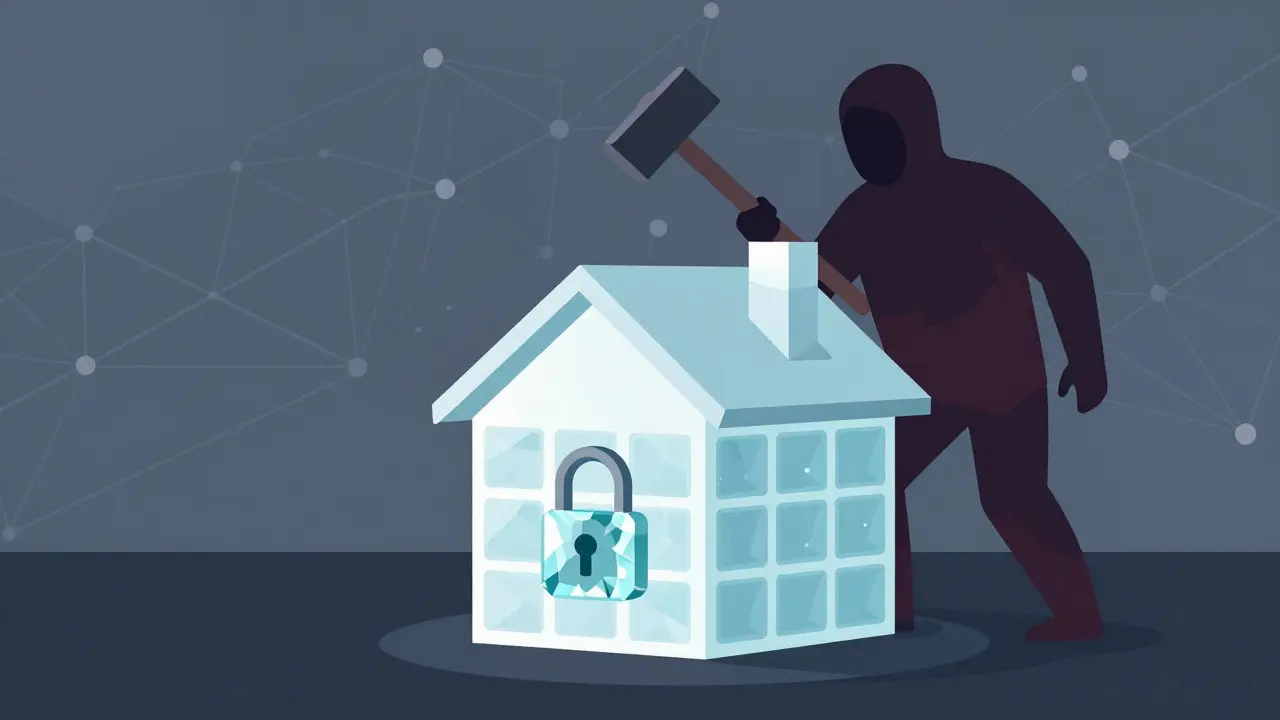
Imagine building a house where the locks are made of glass. That’s what deploying a decentralized application (dApp) without proper security looks like. In the world of blockchain, code is law, but bad code is still just bad-and it costs millions. From rug pulls to reentrancy attacks, the stakes in Web3 are higher than in traditional web development because there is no "undo" button once a transaction hits the chain.
If you are a developer, investor, or power user, understanding dApp security considerations isn't optional anymore. It’s the difference between your project thriving and getting drained in seconds. This guide breaks down exactly how to secure your smart contracts, protect frontend interactions, and manage access controls so you can build with confidence.
The Core Pillars of dApp Security Architecture
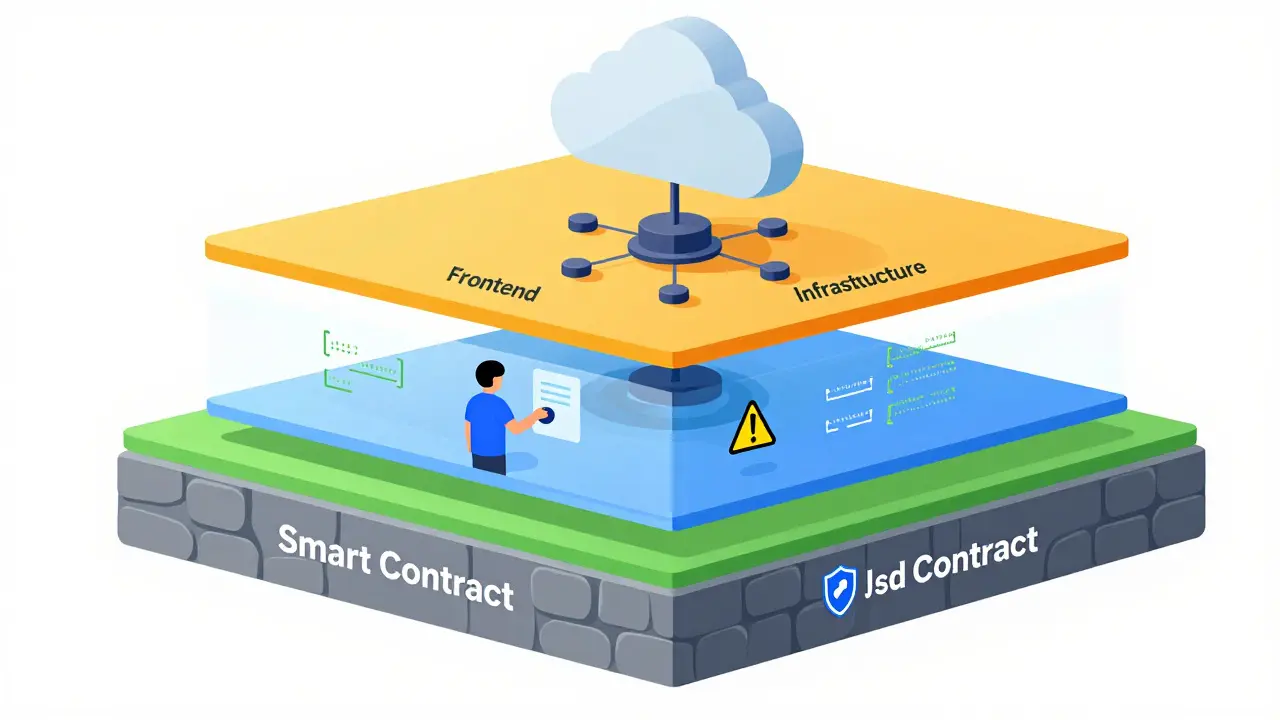
Security in a decentralized environment isn’t a single feature; it’s a layered defense system. You have to think about three distinct layers: the smart contract itself, the frontend interface that users interact with, and the underlying infrastructure that supports the app. If any one of these fails, the whole system is compromised.
Then there is the Frontend Security. Even if your backend code is flawless, a malicious JavaScript library or a phishing link can drain a user’s wallet before they even sign a transaction. Frontend security involves validating all inputs, ensuring HTTPS connections, and verifying that the contract addresses displayed to users match the verified ones on block explorers like Etherscan. If a user sees a token swap on a fake Uniswap clone, no amount of smart contract security will save their funds.
Finally, consider the Infrastructure Layer. Many dApps rely on centralized components like cloud servers for indexing data or storing images. If your AWS bucket goes down or gets hacked, your dApp breaks. True decentralization requires moving these dependencies off-chain or using decentralized storage solutions like IPFS or Arweave, which reduces single points of failure.
Critical Vulnerabilities Every Developer Must Avoid
You don’t need to be a hacker to know what breaks most often. Historical data from major exploits shows that a small set of vulnerabilities causes the majority of losses. Knowing these patterns allows you to write defensive code from day one.
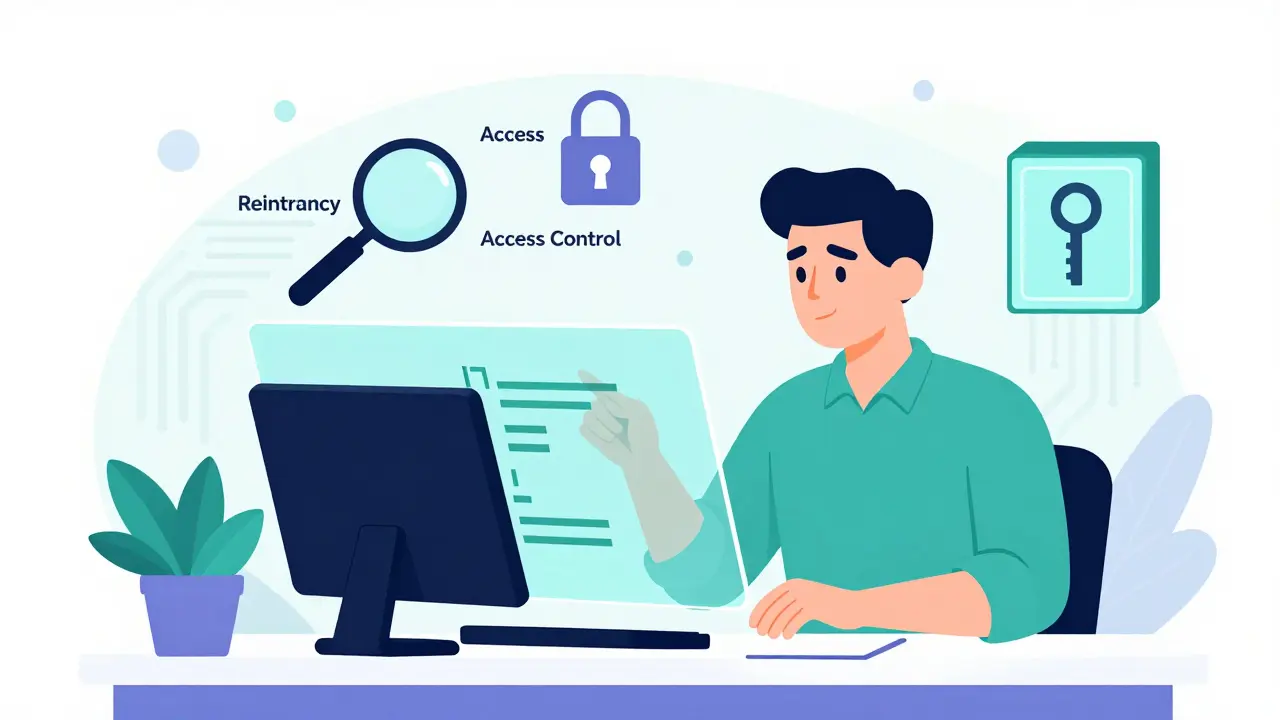
- Reentrancy Attacks: This happens when a contract sends ether to an untrusted address, which then calls back into the original contract before the first transaction completes. The classic DAO hack exploited this. Always update internal state variables (like user balances) before making external calls.
- Integer Overflows and Underflows: While newer versions of Solidity handle this automatically, older codebases or custom math libraries can still suffer. An underflow might turn a balance of 0 into the maximum possible number, allowing a user to mint infinite tokens.
- Insecure Oracle Data: Most DeFi apps rely on price feeds from Chainlink or other oracles. If an oracle is manipulated-say, by trading a large volume on a shallow liquidity pool-the price feed skews, and arbitrage bots drain the protocol. Always use time-weighted average prices (TWAP) rather than spot prices for critical calculations.
- Access Control Failures: Leaving admin functions unprotected means anyone can pause withdrawals or change fee structures. Use role-based access control (RBAC) and require multi-signature approvals for any administrative action.
These aren’t theoretical risks. They are the reason why audits are non-negotiable. However, an audit is not a silver bullet. It’s a snapshot in time. New vulnerabilities emerge constantly, and new code paths are added after the audit. Continuous monitoring and bug bounties are essential complements to a one-time audit.
Frontend Safety: Protecting the User Experience
The frontend is where trust is built and broken. Users are often confused by complex permission requests. A secure dApp guides them safely through these interactions.
First, implement strict Wallet Integration Security. Never hardcode private keys. Use reputable libraries like ethers.js or web3.js, and keep them updated. More importantly, validate the origin of every request. If a user connects MetaMask, ensure the domain matches your verified site. Phishing sites mimic legitimate dApps perfectly, tricking users into signing malicious transactions that approve unlimited token spending.
Second, prioritize Transaction Transparency. Before asking a user to sign, show them exactly what will happen. Display the exact token amounts, gas fees, and slippage tolerance. Provide a direct link to the contract verification page on the block explorer. If a user is swapping tokens on a DEX, they should see the router address and verify it matches the official documentation. Multi-step confirmation dialogs reduce accidental clicks. For high-value actions, like NFT transfers or governance votes, add a delay or a secondary confirmation step.
Third, enforce Role-Based Access Control (RBAC) on the frontend too. If your dApp has a dashboard for admins, moderators, and regular users, ensure the frontend only renders buttons and forms relevant to that role. While backend checks are ultimate authority, hiding unauthorized options prevents confusion and potential social engineering attempts.
Data Privacy and Identity Management
Blockchain is transparent by design, which is great for accountability but terrible for privacy. Your transaction history, token holdings, and interaction patterns are public forever. For enterprise dApps or sensitive consumer applications, this is a dealbreaker. You need mechanisms to shield user data while maintaining verifiability.
Zero-Knowledge Proofs (ZKPs) are the gold standard here. ZKPs allow a user to prove they meet certain criteria-like being over 18 or having sufficient funds-without revealing their actual age or balance. Protocols like zkSync and StarkNet are building entire ecosystems around this technology. By integrating ZKP circuits, you enable private transactions and confidential computing within your dApp.
Another approach is Decentralized Identity (DID). Instead of tying a user’s activity directly to their wallet address, use DID systems like Ceramic or ENS. These allow users to create pseudonymous profiles that they control. The Gateway Protocol is an emerging tool in this space, acting as a permission layer. It lets users selectively share data with dApp providers. For instance, a lending platform might need to know your credit score but not your entire transaction history. With DID and selective disclosure, you grant minimal necessary access, reducing the blast radius if the dApp is compromised.
Additionally, consider Homomorphic Encryption. This advanced technique allows computations to be performed on encrypted data without decrypting it first. While computationally expensive today, it’s becoming viable for specific use cases like private voting or confidential auctions, ensuring that even the node operators cannot see the raw data being processed.
Governance and Decentralization Levels
How decentralized is your dApp? This question determines your security posture. A dApp controlled by a single developer’s private key is essentially a centralized app with extra steps. True decentralization distributes control among multiple parties, reducing the risk of insider threats or single-point failures.
The Internet Computer protocol categorizes dApp control levels, offering clear guidance. At the lowest level, central off-chain components give full control to cloud service owners. As you move up, developer teams retain control but should implement multi-sig requirements for critical operations. At the highest level, fully decentralized autonomous organizations (DAOs) govern the protocol via token voting.
To achieve this, use tools like Hardware Security Modules (HSMs). Devices like YubiHSM provide physical protection for key material. They support threshold signature schemes, meaning multiple devices must cooperate to sign a transaction. No single person can steal the keys. Combine this with decentralized governance systems like SNS (Service Nervous System) or Snapshot, where proposals are voted on-chain or off-chain, and executed only after community consensus.
Transparency is key. Use platforms like LaunchTrail to log all changes made to the dApp’s codebase and configuration. This creates an immutable record of who changed what and when, enhancing accountability. If a vulnerability is found, auditors can trace it back to the specific commit and decision-maker.
| Security Measure | Primary Benefit | Implementation Complexity | Best For |
|---|---|---|---|
| Smart Contract Audits | Identifies logical flaws and known vulnerabilities | Medium (requires budget/time) | All production dApps |
| Zero-Knowledge Proofs | Enables privacy-preserving verification | High (complex cryptography) | Identity, Voting, Private Finance |
| Multi-Sig Wallets | Prevents single-key compromise | Low (easy to set up) | Treasury management, Admin functions |
| Frontend Input Validation | Blocks phishing and malformed requests | Low (standard practice) | User-facing interfaces |
| Bug Bounties | Continuous crowd-sourced testing | Medium (requires coordination) | High-value protocols |
Practical Checklist for Secure Deployment
Before you push your dApp to mainnet, run through this checklist. Skipping any step increases your risk exponentially.
- Code Review: Have at least two senior developers review every line of code. Look for edge cases, especially in math operations and external calls.
- Automated Testing: Write unit tests for every function. Aim for 100% branch coverage. Use fuzzing tools like Echidna or Foundry to test random inputs and find unexpected behaviors.
- Third-Party Audit: Hire a reputable firm like OpenZeppelin, Trail of Bits, or CertiK. Don’t just get the report; fix every finding, even low-severity ones.
- Dependency Check: Ensure all libraries (OpenZeppelin, Chainlink) are pinned to specific, audited versions. Avoid using master branches.
- Access Control Setup: Configure multi-sig wallets for admin roles. Remove unnecessary privileges from deployer accounts.
- Frontend Verification: Verify that contract addresses in your UI match the deployed bytecode on the block explorer. Enable HTTPS and CSP headers.
- Incident Response Plan: Define what happens if a bug is found. Do you have a pause function? Who holds the keys? Communicate this clearly to users.
Security is not a destination; it’s a continuous process. As the ecosystem evolves, so do the attacks. Stay informed, follow standards like OWASP SCSVS, and always prioritize user safety over speed to market.
What is the most common vulnerability in dApps?
Reentrancy attacks and access control failures are historically the most common and damaging. Reentrancy occurs when a contract calls an external address that calls back into the original contract before the first execution finishes, allowing attackers to drain funds. Access control failures leave admin functions open to anyone, enabling malicious actors to pause withdrawals or alter critical parameters.
How do I protect user privacy on a public blockchain?
Use Zero-Knowledge Proofs (ZKPs) to allow users to prove attributes without revealing underlying data. Implement Decentralized Identity (DID) solutions to let users control their digital personas and selectively share information. Additionally, consider homomorphic encryption for processing encrypted data without decryption, though this is more complex to implement.
Is a smart contract audit enough to ensure security?
No. An audit is a point-in-time assessment. It does not guarantee future security, especially if new code is added later. You should combine audits with continuous monitoring, bug bounty programs, and rigorous automated testing. Also, remember that frontend vulnerabilities and oracle manipulation are often outside the scope of standard smart contract audits.
What is the role of the OWASP SCSVS in dApp security?
The OWASP Smart Contract Security Verification Standard (SCSVS) provides a structured framework for designing, building, and testing secure smart contracts. It consolidates best practices into actionable guidelines, addressing specific risks like reentrancy, overflow, and access control. Released in draft form in 2024, it helps developers and auditors maintain consistent security standards across the industry.
How can I prevent phishing attacks on my dApp users?
Educate users to verify URLs and contract addresses. On the technical side, implement strict frontend validation, display clear transaction details before signing, and use multi-step confirmations for high-risk actions. Encourage users to use hardware wallets and never share their seed phrases. Providing direct links to verified block explorer pages helps users double-check contract authenticity.
Why is decentralization important for dApp security?
Centralized components create single points of failure. If a cloud server or a single admin key is compromised, the entire dApp can be taken down or drained. Decentralization distributes control among multiple nodes and participants, making it much harder for attackers to disrupt the system. Using multi-sig wallets, DAO governance, and decentralized storage enhances resilience against both external attacks and insider threats.