DEX Security: Risks and Protections for Safe Trading
 Jul, 5 2026
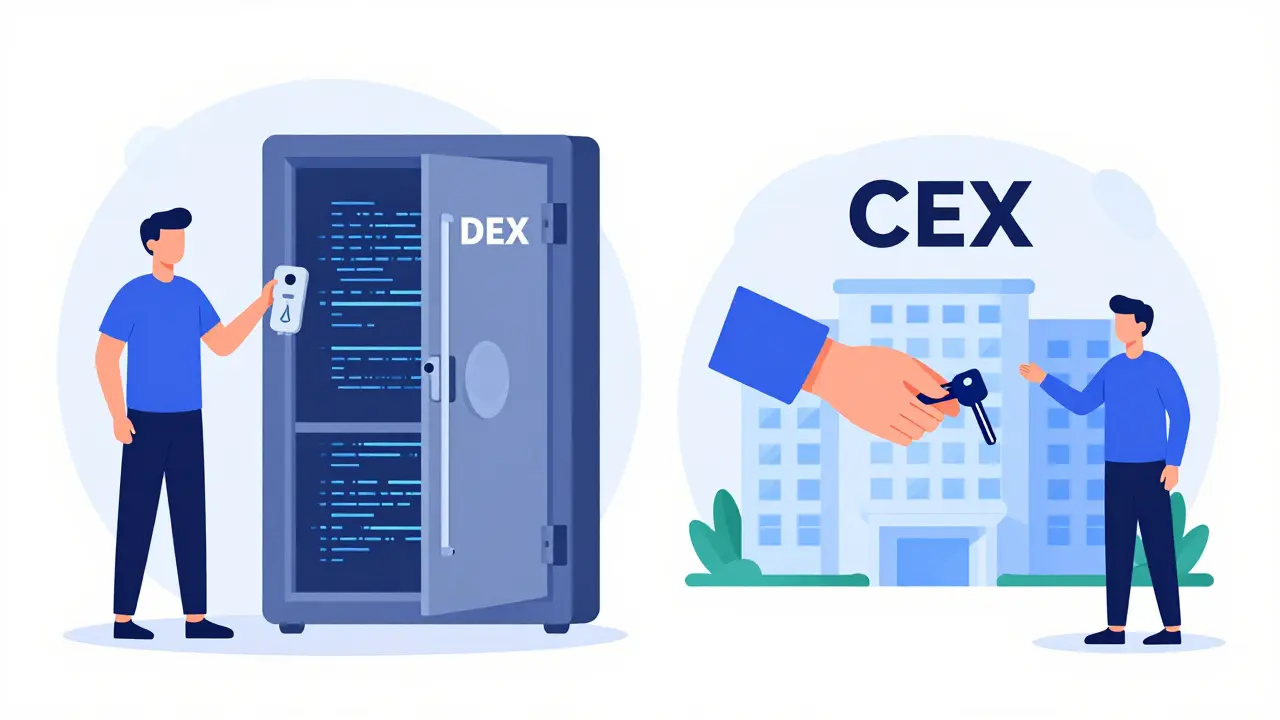
You hand over your private keys to a centralized exchange, you trust them with your money. But on a Decentralized Exchange (DEX), you keep the keys. You also keep the risk. In Q1 2025, DEXs processed $1.37 trillion in volume. That’s huge growth. It’s also a massive target. In 2024 alone, hackers stole $1.48 billion from DeFi protocols. If you are trading on Uniswap, PancakeSwap, or Curve, you need to know exactly where the holes are in the floor.
This isn’t about fear-mongering. It’s about survival. The architecture of DEXs means there is no customer support to call when you make a mistake. There is no 'undo' button. This guide breaks down the real threats facing your funds right now and gives you concrete steps to lock them down.
The Core Threat: Smart Contract Vulnerabilities
When you trade on a DEX, you aren’t talking to a human trader. You are interacting with code. Specifically, Smart Contracts written primarily in Solidity. These contracts hold the liquidity pools. If the code has a bug, the pool can be drained.
In 2024, 63.2% of user losses on DEXs came from smart contract vulnerabilities. Compare that to 28.7% for centralized exchanges. Why? Because once a contract is deployed on Ethereum or BNB Chain, it is immutable. You cannot patch a hole after a hacker finds it.
Consider the Velocore exploit in June 2024. Hackers exploited a flaw in the protocol’s logic, stealing $6.8 million. Or look at the Jupiter Aggregator exploit on Solana in February 2025, which cost users $7.3 million. These weren’t random acts of violence; they were mathematical inevitabilities based on poor code design.
How to protect yourself:
- Stick to Blue-Chip Protocols: Use platforms like Uniswap v3, PancakeSwap v3, or Curve Finance. These have undergone multiple audits and have large bug bounty programs totaling millions of dollars.
- Check Audit Status: Before using a new DEX, check if their smart contracts have been audited by reputable firms like OpenZeppelin or Trail of Bits. If you can’t find an audit report, assume it’s unsafe.
- Understand Re-entrancy Attacks: While you don’t write the code, knowing that re-entrancy is a common flaw helps you understand why older, unaudited forks of popular DEXs are dangerous.
User Error: The Silent Killer
Hackers get headlines. User error gets wallets. According to Cyvers’ 2025 security survey, 19.3% of users accidentally grant excessive token permissions. This is often called 'infinite approval.'
Here is how it happens: You want to swap 10 USDC for ETH. You click 'Approve.' Many interfaces default to approving the *entire* balance of that token type forever. If the DEX interface is later compromised, or if you connect to a malicious site, the attacker can drain every single USDC in your wallet because you already gave them permission.
A May 2025 Trustpilot review documented a user losing $8,450 this exact way. They didn’t get hacked via a complex exploit. They just clicked 'approve' without reading the fine print.
Immediate Fixes:
- Use Revoke.cash: Connect your wallet to Revoke.cash. This tool shows you all the tokens you’ve approved for spending. Revoke permissions for any token you aren’t actively trading.
- Set Slippage Tolerance: Misconfigured slippage settings caused 43.2% of reported incidents in Reddit’s 'DEX Horror Stories' thread. If slippage is too high, MEV bots will front-run your trade. If it’s too low, your transaction fails, and you pay gas fees for nothing. Stick to 0.5% - 1% for stable pairs.
- Verify URLs: Phishing through fake DEX interfaces accounts for 18.3% of security incidents. Bookmark the official DEX URL. Never click links from Discord, Telegram, or Twitter DMs.
Oracle Manipulation and Price Feeds
DEXs need to know the price of assets. They don’t use stock market data directly. They use Oracles, specifically services like Chainlink or Pyth.
Here is the catch: CoinDesk’s January 2025 investigation found that 68% of DEXs claiming 'full decentralization' rely on centralized oracle providers. Chainlink and Pyth control 73.2% of price feeds. If an oracle is manipulated-say, by pumping the price of a low-cap token in a liquidity pool-the DEX might lend out more collateral than it should, leading to insolvency.
This creates a single point of failure. The Financial Stability Board identified this as a 'systemic risk vector' in November 2024. A single large withdrawal could trigger cascading liquidations worth billions.
Mitigation Strategy:
- Avoid Low-Liquidity Pools: Oracle manipulation works best on tokens with thin liquidity. Stick to major pairs like ETH/USDC or BTC/ETH where the price is hard to move.
- Monitor TVL Changes: Sudden drops in Total Value Locked (TVL) can signal an oracle attack or a rug pull. Use tools like DefiLlama to track these metrics.
Gas Fees and Network Congestion
Security isn’t just about hackers. It’s about economics. On Ethereum mainnet, gas fees averaged $1.85 per transaction in mid-2025, down from $4.22 in late 2024 thanks to EIP-4844. However, during network congestion, fees can spike unpredictably.
High gas fees lead to failed transactions. Georgia Tech’s usability study showed 32.7% of new users fail their first trades due to insufficient gas. Worse, some scams involve sending you a 'free NFT' or token that drains your gas balance when you try to send it away.
Pro Tip:
Use Layer 2 solutions like Arbitrum or Optimism. They offer settlement finality within seconds and drastically lower fees. If you must use Ethereum mainnet, always add a 10-20% buffer to your estimated gas limit to ensure the transaction goes through, but never approve unknown contracts.
Comparison: DEX vs. CEX Security Profiles
| Feature | DEX (e.g., Uniswap) | CEX (e.g., Coinbase) |
|---|---|---|
| Custody Model | Non-custodial (You hold keys) | Custodial (Exchange holds keys) |
| Hack Risk Source | Smart Contract Bugs / User Error | Exchange Database Breaches |
| Recovery Option | None (Irreversible) | Customer Support / Insurance |
| KYC Requirement | Usually None (Pseudonymous) | Mandatory (Identity Verified) |
| 2024 Losses | $1.48 Billion (DeFi Exploits) | $427 Million (CEX Breaches) |
Regulatory Shifts in 2025 and Beyond
The wild west days are ending. The EU’s MiCA framework, effective June 30, 2025, requires DEXs to implement optional KYC for EU users. In the US, the SEC’s April 2025 'DEX Framework' guidance demands that platforms with centralized governance register as exchanges.
This affects security. On one hand, regulated entities may have better compliance and insurance. On the other, it reduces privacy. Currently, 89.7% of DEXs lack mandatory KYC. As regulations tighten, expect a split between fully anonymous DEXs (higher risk, harder to use) and compliant hybrid models.
Vitalik Buterin noted a 90% reduction in exploit losses since 2020 due to formal verification and bug bounties. The industry is maturing. Cybersecurity insurance adoption grew from 12.3% to 48.7% of major DEXs in 2025. Look for DEXs that offer insurance coverage for your deposits.
Your Daily Security Checklist
Don’t let complexity paralyze you. Follow this routine before every trade:
- Check the URL: Is it the official domain? Check against a trusted list like DefiLlama.
- Review Permissions: Have you revoked old approvals? Use Revoke.cash weekly.
- Verify the Contract Address: When adding a custom token, copy the address from a verified source like Etherscan, not from a social media post.
- Start Small: If trying a new DEX, test with a small amount ($10-$50) before moving significant capital.
- Keep Software Updated: Ensure your MetaMask, Phantom, or Coinbase Wallet is on the latest version to patch known vulnerabilities.
DEXs offer freedom, but freedom requires responsibility. By understanding the technical realities of smart contracts and oracles, and by rigorously managing your own permissions, you can participate in DeFi without becoming a statistic.
What is the biggest risk when using a DEX?
The biggest risk is usually user error, specifically granting infinite token approvals to malicious contracts or connecting your wallet to phishing sites. While smart contract hacks are severe, individual users lose more money annually to scams and misconfigurations than to protocol exploits.
Can I recover funds if my DEX trade fails?
No. Blockchain transactions are irreversible. If you send tokens to the wrong address or approve a malicious contract, there is no customer support to reverse the action. Always double-check addresses and use tools like Revoke.cash to manage permissions.
Are Layer 2 DEXs safer than Ethereum Mainnet DEXs?
Layer 2s like Arbitrum and Optimism are generally safer for daily use due to lower gas fees, which reduce the incentive for certain types of bot attacks. However, they introduce bridge risks. Funds must move between layers, and bridges have historically been targets for hackers. Stick to established L2s with robust security audits.
What does 'infinite approval' mean?
Infinite approval means you give a smart contract permission to spend an unlimited amount of a specific token from your wallet. If that contract is later compromised, attackers can drain your entire balance of that token instantly. Always revoke unused approvals regularly.
Is Uniswap safe to use in 2026?
Uniswap is one of the safest DEXs available, having undergone extensive audits and featuring a large bug bounty program. However, 'safe' is relative. You must still verify the URL, manage your slippage settings, and avoid clicking suspicious links. The platform itself is secure, but user behavior remains the primary vulnerability.
Jackie D
July 5, 2026 AT 16:22honestly this post is a lifesaver for people like me who just want to swap tokens without losing their shirt. i always thought infinite approval was fine until i read about that $8k loss. scary stuff.
i started using revoke.cash last week and wow, i had approvals open for three dead meme coins from 2023. why did i leave those open? no idea. but thanks for the tip on checking urls too. bookmarking official sites is such a basic step yet everyone forgets it when theyre rushing.
also the bit about oracle manipulation blew my mind. i never realized how much we rely on centralized feeds even in 'decentralized' systems. it feels like a contradiction but makes sense when you think about it. gonna stick to eth/usdc pairs for now until i get more comfortable with all this.
Ruth Williams
July 6, 2026 AT 17:05The average retail participant clearly lacks the intellectual discipline required to navigate these sophisticated financial instruments safely. It is not surprising that user error accounts for such a significant portion of losses when one considers the sheer negligence displayed by the majority of traders.
While the author suggests 'sticking to blue-chip protocols,' this advice is almost patronizingly simplistic. True security requires an understanding of Solidity code structure and the ability to audit transactions manually before execution. Relying on tools like Revoke.cash is merely a crutch for those unwilling to engage with the underlying technology at a fundamental level.
Furthermore, the reliance on Layer 2 solutions introduces bridge risks that most users are woefully unprepared to assess. The notion that Arbitrum or Optimism are 'safer' is a dangerous misconception propagated by venture capitalists seeking liquidity. One must remain skeptical of any system that promises ease of use over absolute control.
Sophie Nakasako
July 6, 2026 AT 21:22I love how this breaks down the technical jargon into something we can actually use! It’s so empowering to know that we have control, even if it means doing a little extra homework.
The part about slippage tolerance really clicked for me. I’ve had so many failed trades where I paid gas fees for nothing, and I never connected the dots to my settings. Setting it to 0.5% sounds like a game changer.
Also, the comparison table between DEX and CEX is super helpful. I’ve been hesitant to move away from Coinbase because of the support aspect, but reading about the $1.48 billion in DeFi losses makes me realize that maybe taking responsibility is worth the risk. Has anyone else made the switch recently? I’d love to hear your experiences with Uniswap v3 specifically.
Kristy Morrow
July 7, 2026 AT 07:46you think audits matter? please. auditors miss things constantly. the whole premise of trustless systems is undermined by the fact that we still need third parties to tell us if code is safe. its ironic really.
and don't get me started on the regulatory shifts mentioned. miCA and sec frameworks are just attempts to sanitize the wild west into a boring corporate playground. the moment kyc becomes mandatory for dexs the privacy aspect dies and then what do you have left? just another bank with worse ui.
people worry about smart contract bugs but ignore the bigger picture of centralization creeping back in through oracles and governance tokens. true decentralization is dead long live decentralization.
John Harman
July 7, 2026 AT 14:05Look, I've been trading since 2017 and let me tell you, most of this panic is overblown. Yes, hacks happen, but if you aren't clicking links from discord bots or connecting your wallet to random airdrop sites, you're probably fine.
The biggest issue isn't the code, it's the users. People approve infinite amounts because they're lazy. They don't check contracts because they're impatient. If you treat your private key like a nuclear launch code, you won't lose money. Simple as that.
Also, stop complaining about gas fees. If you can't afford $2 in gas, you shouldn't be trading crypto. Use L2s if you're broke, but don't whine about the mainnet economics. Ethereum is expensive because it's secure. That's the trade-off.
Antony Lopez
July 9, 2026 AT 05:26This article ignores the reality of foreign interference in our digital markets. While US regulations like the SEC framework are trying to protect American investors, we see overseas exchanges operating with zero oversight.
The mention of Chainlink controlling 73% of price feeds is concerning from a national security standpoint. We cannot allow foreign entities to manipulate the pricing mechanisms of American assets. The MiCA framework in Europe is a step in the right direction, but the US needs to lead, not follow.
We need stricter KYC requirements on all DEXs accessible to US citizens. Privacy should not be a shield for illicit activities. If you want anonymity, go offshore. But if you're trading here, you play by our rules. This isn't just about security; it's about sovereignty.
Kat Barr
July 9, 2026 AT 17:31Oh my gosh!! This is SO helpful!! 😍 I was literally just reading about someone getting hacked yesterday and I was terrified!! 😱 Thank you for explaining the 'infinite approval' thing in simple terms!! 🙏
I’m definitely going to check my permissions on Revoke.cash tonight!! 👀 It’s crazy how easy it is to mess up, right?? 😅 But hey, we’re all learning together!! 💪 Keep spreading the knowledge!! 🌟✨
Logan Edmison
July 11, 2026 AT 11:00thats cool n all but honestly im just gonna keep my shit on binance till they hack it. seems easier than dealing with all this tech nonsense.
plus why would i bother revoking approvals if im only swapping once a month? seems like a lot of work for small gains. maybe ill look into that layer 2 stuff later though. arbitrum sounds fancy.
Michelle Walker
July 11, 2026 AT 14:56Your analysis is superficial. You fail to address the systemic fragility of cross-chain bridges which represent the single largest attack vector in DeFi history.
Layer 2 solutions are not 'safer'; they are complex abstractions that introduce additional failure points. The assumption that lower gas fees equate to higher security is logically flawed.
Stop relying on bug bounties. They are reactive measures for proactive negligence. The industry is built on sand. Wake up.