EasiCoin Crypto Exchange Review: Red Flags, Risks, and Why to Avoid It
 Dec, 25 2025
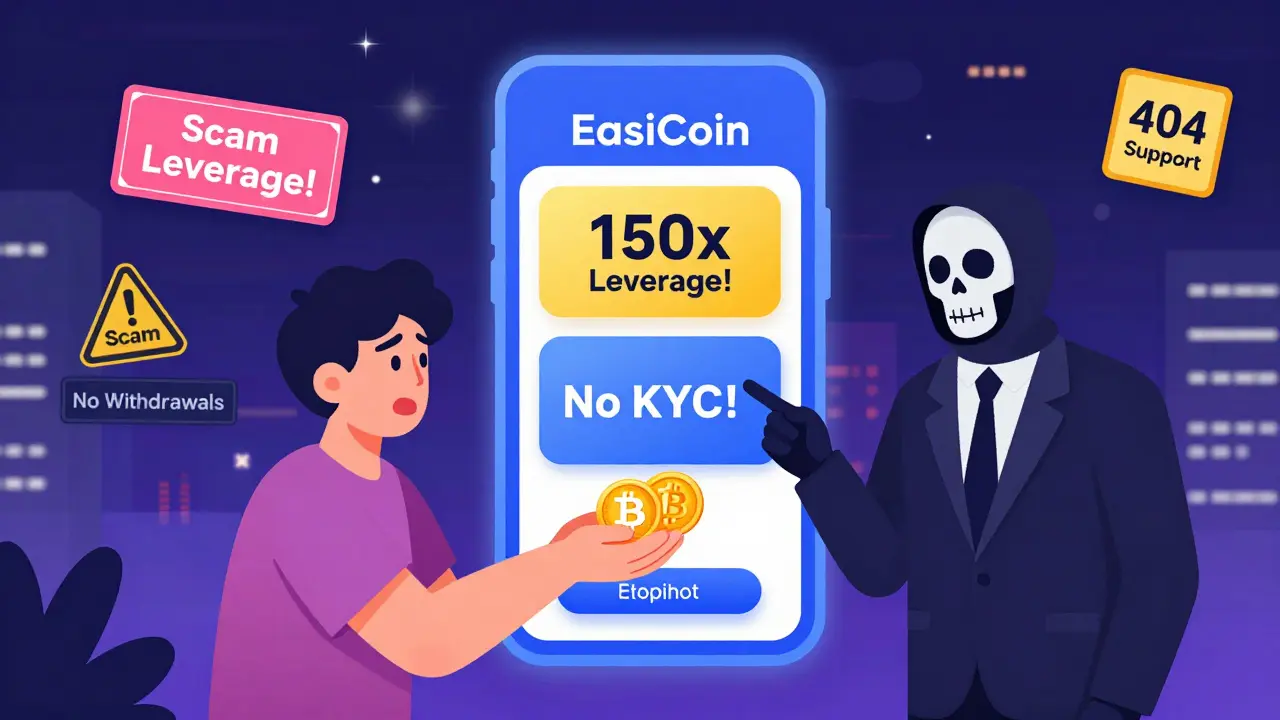
There are thousands of crypto exchanges out there. Most are messy, complicated, or slow. But EasiCoin doesn’t just fall into that crowd-it’s a warning sign wrapped in flashy marketing. If you’ve seen ads promising "150x leverage," "no KYC," and "instant withdrawals," you might be tempted. Don’t. EasiCoin isn’t a legitimate exchange. It’s a high-risk platform with clear signs of a scam operation.
What EasiCoin Claims to Be
EasiCoin’s website says it’s a "next-generation crypto exchange" built for beginners. It promises easy trading, copy trading, and deep liquidity for Bitcoin, Ethereum, Solana, and meme coins like PEPE and NOT. The app, available on Google Play, claims to be "non-custodial," meaning you control your own keys. It also says it doesn’t require KYC-no ID, no documents, no questions asked. Sounds great, right? Especially if you hate paperwork. But here’s the problem: none of it checks out.The Red Flags Are Everywhere
Start with the basics. The domain easicoin.io was registered in March 2023. That’s less than two years ago. Legitimate exchanges like Binance, Coinbase, or Kraken have been around for over a decade. They have offices, legal teams, and public leadership. EasiCoin has nothing. No team page. No company registration details. No address. No phone number. Just a website with generic buzzwords. Then there’s the app. On Google Play, it has just over 100 downloads. Compare that to Crypto.com (10 million+) or even newer platforms like Bybit (500K+). If this were a real exchange with deep liquidity and smart tools, it would be growing fast. Instead, it’s barely visible."Non-Custodial" Is a Lie
EasiCoin says it’s non-custodial. That means your private keys stay with you. No one else holds them. That’s how Uniswap, Phantom, or MetaMask work. But EasiCoin doesn’t publish a single smart contract address. No audit reports. No blockchain verification. You can’t check if your funds are really yours. Real non-custodial platforms make their code public. EasiCoin hides it. That’s not security-it’s deception. If you can’t verify where your money is, you don’t own it. You’re trusting a black box.
150x Leverage? That’s Not a Feature-It’s a Trap
The platform advertises up to 150x leverage on Bitcoin and Ethereum. That’s insane. Even the most aggressive exchanges like Bybit or OKX cap leverage at 125x-and they’re regulated in places like the UAE. 150x means you can lose your entire deposit in seconds if the market moves just 0.67% against you. This isn’t for experienced traders. It’s for people who don’t understand risk. And EasiCoin knows it. High leverage + no KYC = perfect setup for a pump-and-dump or exit scam. The platform doesn’t need to make money from trading fees. It just needs you to deposit, get hooked on the hype, and then vanish with your cash.Withdrawals Don’t Work
This is the most damning part. Users are reporting the same thing over and over: they deposit, the app shows a balance, then they try to withdraw-and nothing happens. On Google Play, one user wrote: "Deposited $200. Withdrawal never processed. App says "pending" for 14 days. No reply from support." Another said: "App disappeared after I tried to verify my account." That’s not a bug. That’s a shutdown. Reddit threads from r/Scams and r/CryptoCurrency list at least a dozen verified cases of people losing money. No one gets a response. No one gets their funds back. The support form on the website? It returns a 404 error. The company isn’t trying to help. It’s trying to disappear.No Security, No Reputation, No Trust
Legitimate exchanges publish security reports. They get audited. They show proof of reserves. Kraken, Coinbase, and Bitstamp all do this every quarter. EasiCoin? Nothing. Zero transparency. ScamAdviser gives easicoin.io a score of 12 out of 100. Trustpilot has no listing. The Crypto Regulatory Alliance added EasiCoin to its "Emerging Risk Watchlist" in September 2023. Cybersecurity experts call it a "classic scam profile"-exactly like Thodex, which vanished with $2 billion in 2021. And here’s the kicker: there are no positive reviews from credible sources. CoinDesk, CoinTelegraph, The Block-none have covered EasiCoin. Not one expert says it’s safe. Not one analyst recommends it. That’s not an oversight. That’s a verdict.
Why People Fall for It
It’s not hard to see why. The ads are slick. The promises are simple: "Trade crypto without ID. Earn fast. No hassle." For someone new to crypto, that sounds like magic. But real crypto trading isn’t about shortcuts. It’s about control, transparency, and security. EasiCoin preys on the same fears and hopes that scams always use: fear of bureaucracy, hope for quick gains, and ignorance of how real exchanges work. It’s designed to look like the real thing-until it’s too late.What You Should Do Instead
If you want to trade crypto safely, use platforms with real history and public records:- Coinbase: Regulated in the U.S., transparent fees, insured custodial wallets.
- Binance: Highest volume globally, advanced tools, educational resources.
- Kraken: Strong security, public audits, supports fiat deposits.
- Bybit: Good for derivatives, clear leverage limits (max 125x), active community.
Final Warning
EasiCoin isn’t a crypto exchange you can trust. It’s not even a risky one-it’s a dangerous one. The lack of transparency, the fake non-custodial claims, the impossible leverage, the vanished withdrawals, and the complete absence of any credible reputation all point to one thing: this platform is designed to take your money and disappear. If you’ve already deposited funds, you’re likely out of luck. But if you haven’t-don’t start. Walk away. There are hundreds of legitimate exchanges. You don’t need to gamble on a ghost.Is EasiCoin a scam?
Yes, based on overwhelming evidence. EasiCoin shows all the classic signs of a scam: no verifiable company details, no security audits, no withdrawal history, user reports of lost funds, and a website with minimal content. It’s listed on multiple scam watchlists and has no positive coverage from reputable crypto sources.
Can I withdraw money from EasiCoin?
Multiple users report that withdrawals fail or never process. The support system doesn’t respond, and the contact form on the website returns a 404 error. There are no verified cases of successful withdrawals. If you’ve deposited, assume your funds are gone.
Is EasiCoin really non-KYC?
EasiCoin claims to be non-KYC, but this is misleading. Even if you don’t submit ID, the platform lacks any technical proof of non-custodial operations-no smart contracts, no wallet addresses, no audits. Real non-KYC platforms like Uniswap are open-source and transparent. EasiCoin is not. The "non-KYC" label is used to attract users who want to avoid oversight, but it’s a cover for fraud.
Why does EasiCoin offer 150x leverage?
150x leverage is extremely dangerous and only offered by unregulated platforms targeting inexperienced traders. It allows tiny price movements to wipe out your entire balance. Legitimate exchanges cap leverage at 100x-125x. EasiCoin uses this to encourage risky behavior, increasing the chance users will lose everything quickly-making it easier for the platform to disappear with their funds.
Is EasiCoin available on iOS?
There is no official iOS app. The website and Google Play listing suggest mobile access, but no Apple App Store listing exists. If you find an iOS version, it’s likely a fake app designed to steal your credentials or install malware.
What should I do if I already used EasiCoin?
If you deposited funds and can’t withdraw, your chances of recovery are extremely low. Report the incident to your local financial crime unit and file a complaint with the FTC (in the U.S.) or equivalent authority. Do not send more money. Do not respond to any "recovery service" that contacts you-those are secondary scams. Your best move is to cut losses and avoid similar platforms in the future.
Megan O'Brien
December 26, 2025 AT 12:57EasiCoin is just another DeFi graveyard bait. Non-custodial? Lol. No smart contract audit, no GitHub repo, no team. Just a landing page with 150x leverage and a 404 support link. Classic exit scam architecture. If your exchange doesn’t publish its code, it’s not tech-it’s theater.
And don’t get me started on the ‘no KYC’ marketing. That’s not freedom, that’s regulatory arbitrage for criminals. Real DeFi is transparent. This is opaque by design.
Google Play has 100 downloads? Bro, even a niche altcoin wallet has 50K. This isn’t a startup-it’s a ghost town with a domain name.
I’ve seen this script before. Thodex, FTX Lite, BitConnect 2.0. Same playbook. Flashy UI. Fake testimonials. Withdrawal delays that turn into silence. Then poof-domain expires, Discord dies, Telegram vanishes.
People think they’re being smart avoiding KYC. Nah. They’re just handing their funds to a bot with a crypto logo.
Bottom line: if you can’t verify the team, the code, or the reserves, you’re not investing. You’re gambling with a loaded dice.
And yes, 150x leverage on BTC? That’s not trading. That’s Russian roulette with your life savings.
Just walk away. There are 100 legit exchanges that don’t need to lie to attract users.
Earlene Dollie
December 27, 2025 AT 23:17They made it look so pretty I almost cried 😭
Like someone took a Canva template and called it a crypto empire
150x leverage? That’s not innovation that’s a suicide pact
I felt so seen until I realized they were selling me a coffin with a Bitcoin sticker on it
My heart still hurts
Why do they always make the lie look like love?
Melissa Black
December 28, 2025 AT 02:18Let’s deconstruct the psychological architecture here. EasiCoin doesn’t sell crypto-it sells escapism. The promise of no KYC isn’t about privacy-it’s about avoiding accountability. The 150x leverage isn’t a feature-it’s a behavioral trap designed to trigger dopamine spikes in inexperienced traders.
Real financial systems are built on transparency because trust is the only asset that can’t be forged. EasiCoin’s entire model is predicated on the erosion of that trust.
The absence of public audits, team profiles, or regulatory alignment isn’t negligence-it’s a calculated risk assessment. They’re not building a platform. They’re building a time bomb with a mobile app interface.
And the fact that users report withdrawal failures but no one gets a response? That’s not poor customer service. That’s the business model.
This is a textbook case of predatory financial engineering. It exploits cognitive biases: the allure of simplicity, the myth of speed, the illusion of control.
Legit exchanges like Kraken or Coinbase don’t need to lie because their value is in institutional credibility. EasiCoin’s value is in its ability to vanish before the IRS notices.
Don’t confuse anonymity with autonomy. You don’t own your assets if you can’t verify their location on-chain.
And if you’re still tempted? Ask yourself: if this were a bank, would you deposit your life savings into a branch with no sign, no employees, and no windows?
The answer is obvious. So why are you still reading this?
chris yusunas
December 28, 2025 AT 18:51Man I saw this EasiCoin thing on Instagram and thought hey maybe this is the one
But then I checked the domain age and laughed so hard my dog looked at me weird
Like bro you registered this in 2023 and already claiming 150x leverage?
Even my uncle in Lagos with his phone and a SIM card knows that’s fishy
Real crypto don’t need flashy ads
Real crypto got code on GitHub and people who show their faces
Stay away fam. There’s plenty of real shit out here
And if you lost money? You ain’t dumb-you just got hustled by a pretty UI
That’s not your fault. That’s their game.
Naman Modi
December 30, 2025 AT 05:22Wait so you're saying KYC is good? 😂
What about privacy? What about freedom?
150x leverage is just math bro
And who says no audits = scam?
Maybe they're just ahead of the curve 😏
Also I made 500% on a rug pull last month
So your ‘red flags’ are just FUD
And why do you hate innovation so much?
😭
Mmathapelo Ndlovu
December 30, 2025 AT 17:08My heart goes out to everyone who lost money on this 😔
It’s so sad when people just want to believe in something beautiful
And it gets twisted into something that hurts
I hope whoever made this app feels the weight of it one day
Not because they got caught
But because they knew
And still chose to take the money
Sending love to anyone reading this
You’re not alone
And you’re not stupid
It was designed to fool us all 💛
Tyler Porter
January 1, 2026 AT 01:21Okay. STOP. RIGHT NOW. If you're even THINKING about putting money into EasiCoin-DON'T. I mean it. I'm not joking. I'm not being dramatic. This is a straight-up scam. No KYC? That's not a feature-that's a red flag that's flashing like a police siren. 150x leverage? That's not trading-that's playing Russian roulette with your rent money. Withdrawals don't work? That's not a glitch-that's the whole point. You're not getting your money back. Ever. I've seen this movie before. The ending is always the same: you lose everything, you cry, and then you blame yourself. Don't. Just don't. Use Coinbase. Use Kraken. Use Binance. They're boring. They're safe. And they won't steal your life savings. Please. Just. Walk. Away.
Rishav Ranjan
January 1, 2026 AT 23:27Scam.
Done.