EU Crypto Travel Rule: Zero Threshold Compliance Guide
 Oct, 31 2026
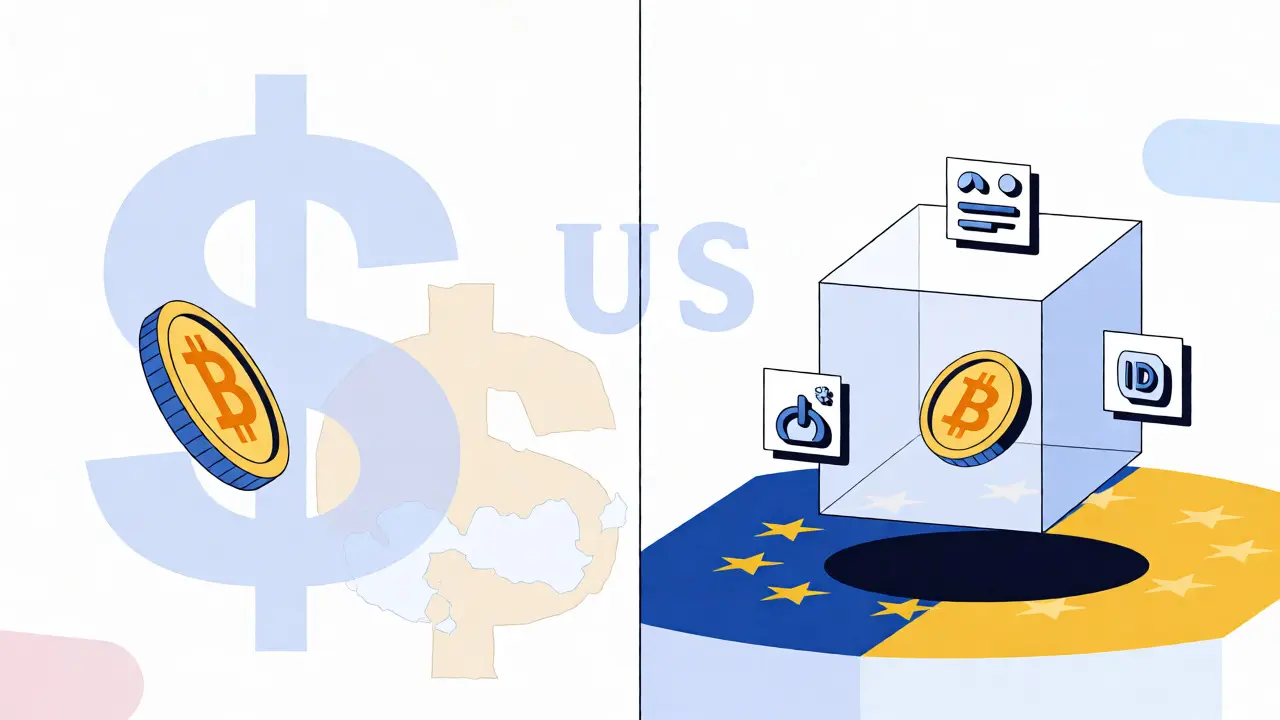
You send $50 in Bitcoin to a friend. In the US, that transaction likely flies under the radar of strict reporting rules because it’s below the $3,000 threshold. But if you’re in Europe and sending that same $50 to another regulated exchange, every single detail about who sent it and who received it gets logged, verified, and stored. This isn’t a hypothetical scenario for 2027-it’s the reality right now.
The European Union has implemented the world’s strictest interpretation of the Travel Rule, applying a zero-euro threshold to all cryptocurrency transfers between regulated entities. Gone are the days when small transactions could slip through the cracks. Since December 30, 2024, any crypto transfer between two Crypto-Asset Service Providers (CASPs) in the EU must carry full sender and receiver data, regardless of value. If you run a business or just move assets across borders, understanding this shift is no longer optional; it’s essential for keeping your money moving.
What Is the EU Travel Rule?
At its core, the Travel Rule requires financial institutions to pass along specific information about the originator and beneficiary of a fund transfer. Originally designed for traditional banking wire transfers, regulators extended this concept to digital assets to combat money laundering and terrorist financing. The logic is simple: if cash needs a paper trail, so does code.
In the EU, this mandate is codified under Regulation (EU) 2023/1113, often referred to as the Transfer of Funds Regulation (TFR). It works alongside Regulation (EU) 2023/1114, known as MiCA (Markets in Crypto-Assets). While MiCA handles licensing and consumer protection, TFR handles the data attached to your transactions. The key difference here is the scope. Unlike other jurisdictions that set minimum amounts (like the US’s $3,000 limit), the EU decided that even a €1 transfer warrants scrutiny.
This zero-threshold approach means there is no "de minimis" exemption. Every transaction, from buying a coffee with stablecoins to moving millions in Ethereum, triggers the same compliance checks. For users, this might feel like friction. For regulators, it closes the loop on anonymity.
Why the Zero Threshold Matters
You might wonder why the EU chose such a stringent path. The Financial Action Task Force (FATF), the global watchdog for anti-money laundering standards, initially recommended a threshold of €1,000 for virtual asset service providers. Most countries followed suit. The EU went further.
By removing the threshold entirely, Brussels aims to prevent "smurfing," where large illicit sums are broken down into tiny, unreported transactions. It also aligns crypto more closely with traditional finance, where bank wires of any size generally require identification. Critics argue this creates unnecessary burden for legitimate users making small purchases. Proponents counter that consistency is the only way to ensure security. Regardless of your stance, the rule is live, and it affects how exchanges operate daily.
Who Needs to Comply?
The regulation targets CASPs-exchanges, custodians, and brokers registered within the EU. If you use a platform like Coinbase, Kraken, or Bitpanda, they are responsible for collecting and transmitting your data. You don’t need to file paperwork yourself, but you do need to provide accurate identity information during onboarding.
The obligation falls on both the originating CASP (the one sending the funds) and the beneficiary CASP (the one receiving them). Both parties must verify that the required data accompanies the transaction. If the data is missing or mismatched, the receiving exchange has the authority to reject, return, or suspend the transfer until the issue is resolved. This puts the onus on platforms to maintain robust communication channels with each other.

Data Requirements: What Gets Shared?
When you initiate a transfer, your exchange doesn’t just send coins; it sends a packet of metadata. This includes:
- Originator Details: Your name, address, date and place of birth, and account number or unique identifier.
- Beneficiary Details: The recipient’s name, address, date and place of birth, and account number or unique identifier.
- Transaction Data: Amount, currency, date, and time of the transfer.
For transfers involving self-hosted wallets (where you control the keys), the rules are slightly different but still strict. Exchanges may require additional verification to prove you own the wallet before allowing withdrawals, especially for larger amounts or frequent activity. The goal is to link the blockchain address back to a real-world identity.
Handling Non-Compliant Transactions
Not every jurisdiction follows the EU’s lead. Countries like Japan or Singapore have their own versions of the Travel Rule, while others lag behind. This creates what experts call the "Sunrise Issue." When an EU exchange sends funds to a provider in a country without strict Travel Rule enforcement, the receiving end might not accept the data package properly.
The European Banking Authority (EBA) guidelines classify these cross-border transfers as higher risk. If a beneficiary CASP cannot provide the necessary counterparty data, the EU-based exchange must assess the risk. They might decide to block the withdrawal, request extra documentation, or flag the transaction for enhanced due diligence. Repeated failures by a partner institution can lead to severed business relationships. Essentially, if your favorite offshore exchange ignores these rules, your EU-based exchange might stop supporting deposits to or from it.
Technical Challenges and Solutions
Implementing this at scale is a technical nightmare. Blockchain networks weren’t built to carry personal identification numbers. To solve this, the industry relies on off-chain messaging protocols. Standards like IVMS101 help structure the data so machines can read it. Companies like KYC-AID, Notabene, and Chainalysis provide middleware that translates blockchain transactions into compliant data packets.
These systems must be fast. Users expect instant settlements, but compliance adds latency. Exchanges invest heavily in APIs that connect directly to counterparties’ systems, ensuring data validation happens in seconds, not hours. Security is paramount too; sharing personal data increases the attack surface, requiring encryption and strict access controls.
| Jurisdiction | Threshold | Status | Key Impact |
|---|---|---|---|
| European Union | €0 (Zero) | Active since Dec 2024 | All transfers require full data exchange. |
| United States | $3,000 | Active | Smaller transfers exempt from strict data sharing. |
| United Kingdom | £1,000 | Active | Similar to FATF baseline recommendations. |
| Japan | ¥100,000 (~$650) | Active | Moderate threshold, focused on high-value flows. |
Practical Implications for Users
So, what does this mean for you? First, expect delays. Transfers between non-EU exchanges might take longer as compliance teams manually review edge cases. Second, keep your profile updated. If your address changes, update it on your exchange immediately. Mismatched data causes rejections. Third, understand that privacy is reduced. The era of pseudonymous ease-of-use for small transactions in Europe is over.
If you’re trading frequently, choose exchanges with strong compliance infrastructure. Platforms that integrate well with major payment rails will offer smoother experiences. Avoid obscure platforms that lack clear Travel Rule policies, as they may become blacklisted by larger partners.
Future Outlook
The EU’s zero-threshold experiment will likely influence global standards. If it proves effective without stifling innovation, other regions may tighten their thresholds. Conversely, if compliance costs drive businesses out of the EU, we might see a regulatory arbitrage effect. For now, the focus remains on harmonization. Regulators want seamless cross-border data exchange, pushing for universal adoption of standards like IVMS101.
Expect more automation. As AI tools improve, manual reviews will decrease. Smart contracts might eventually embed compliance checks directly into token transfers, though that’s years away. Until then, human oversight and robust software remain the backbone of EU crypto compliance.
Does the Travel Rule apply to peer-to-peer transfers?
Generally, no. The Travel Rule applies to transfers between two regulated entities (CASPs). Direct peer-to-peer transfers using self-custody wallets typically fall outside this specific regulatory requirement, although exchanges may impose their own internal checks when you withdraw to a self-custody wallet.
Can I refuse to share my data?
You can, but the consequence is usually that your transaction will be rejected or suspended. Regulated exchanges are legally obligated to collect this data. If you don’t provide it, they cannot process the transfer in compliance with EU law.
What happens if the receiving exchange doesn't comply?
The sending exchange may block the transfer. Under EU guidelines, transfers to non-compliant jurisdictions are considered high-risk. The sending CASP must perform enhanced due diligence and may decide to reject the transaction to avoid regulatory penalties.
Is there a minimum amount for Travel Rule compliance in the EU?
No. The EU has implemented a zero-threshold policy. All transfers between CASPs, regardless of value-even those worth less than one euro-must include the required originator and beneficiary information.
How does this affect privacy?
It significantly reduces privacy for on-chain transactions involving regulated entities. Your name, address, and other identifiers are shared with the counterparty exchange. However, this data is not broadcast publicly on the blockchain; it is transmitted securely between the financial institutions.
Cameron Scott
October 31, 2026 AT 23:22oh my god this is actually insane i just tried to send like ten euros to a mate on kraken and it took literally twenty minutes because they had to verify the other side of the transaction. i was standing there refreshing the page thinking am i going crazy or is the system broken? apparently not, apparently every single cent has to be logged now which feels so dystopian but also makes sense in a weird way? i mean we do it for bank transfers right? but doing it for crypto felt different before. now it feels like the government is watching your wallet directly. does anyone else feel like their privacy is completely gone when using these exchanges? i hate it but i guess it stops the bad guys? or maybe it just annoys normal people like me who just want to buy coffee with bitcoin without filling out a form.
Carolyn Newham
November 2, 2026 AT 10:40The implementation of Regulation (EU) 2023/1113 represents a significant paradigm shift in how digital assets are treated within the European Union. By eliminating the de minimis threshold, regulators have effectively aligned cryptocurrency transactions with traditional wire transfers, ensuring that no amount is too small to warrant scrutiny.
This zero-threshold approach serves two primary purposes: first, it prevents 'smurfing,' where illicit actors break down large sums into smaller, unreported transactions; second, it establishes a consistent compliance framework that applies uniformly across all member states. For users, this means that the pseudonymous nature of blockchain technology is increasingly constrained by Know Your Customer (KYC) requirements at both ends of the transaction.
It is crucial to understand that while the data is shared between Crypto-Asset Service Providers (CASPs), it is not broadcast publicly on the blockchain itself. The metadata travels through secure off-chain channels, such as those provided by protocols like IVMS101. This distinction is vital for preserving user privacy while maintaining regulatory oversight. Furthermore, the burden of compliance falls primarily on the exchanges rather than the individual user, although users must ensure their profile information remains accurate to avoid rejected transfers.
As we move forward, the interoperability between EU-regulated entities and non-EU jurisdictions will remain a challenge. The 'Sunrise Issue' mentioned in the post highlights the friction that occurs when compliant systems interact with less regulated ones. Ultimately, this regulation aims to integrate crypto into the mainstream financial system, reducing its reputation as a haven for anonymity and increasing its legitimacy as a standard asset class.
ari yanto
November 3, 2026 AT 17:04i honestly think everyone is overreacting a bit here because if you look at the actual mechanics of how these things work most of the heavy lifting is done by the exchanges themselves and not the end user
the point about delays is valid though because i have noticed that withdrawals to smaller altcoin exchanges sometimes get stuck in a pending state for hours while the compliance bots talk to each other which is annoying but not the end of the world
what really bugs me is the lack of clear communication from some of these platforms about why a transaction failed instead of just saying error code 404 they should tell you hey your address is missing a city field or something simple like that
but yeah the zero threshold thing is definitely stricter than the us which is funny because usually europe is seen as more relaxed about tech stuff but here they went full lockdown mode on even tiny amounts
anyway i guess if you are trading big money you dont care about five cents worth of btc moving around but for microtransactions this might kill the utility of crypto as actual currency for buying small items
Sean Roberts
November 5, 2026 AT 02:11yeah its kinda wild how fast this changed everything for eu folks i remember when you could just send a few bucks back and forth without thinking twice now its all about matching names and addresses perfectly or the tx gets bounced back which is super frustrating when ur trying to pay someone quickly
Keegan Hagger
November 6, 2026 AT 21:52You're missing the forest for the trees if you think this is just about annoyance. This is the death of crypto's original promise. We didn't build this technology to become another layer of bureaucracy on top of SWIFT codes. By enforcing a zero-euro threshold, the EU has essentially admitted that they cannot compete with traditional finance on efficiency, so they decided to match it on surveillance.
Let's be real: the technical challenges mentioned aren't 'nightmares' for competent engineers; they are basic API integrations that have existed for years. The industry uses them as an excuse to slow down adoption and justify high fees. When you force every €1 transfer to carry a passport copy, you destroy the velocity of money. You turn a peer-to-peer network into a centralized clearinghouse with extra steps.
Furthermore, the claim that this reduces privacy significantly is an understatement. It eliminates privacy entirely for any interaction with a regulated entity. You are handing over your name, address, date of birth, and account ID to a third party every time you move value. If that third party gets hacked-and they will-your entire financial history is exposed.
The 'Sunrise Issue' isn't a bug; it's a feature of global fragmentation. The EU is trying to create a walled garden where only compliant players can enter. This drives innovation offshore to places like Dubai or Singapore, leaving Europe with a stagnant market dominated by legacy banks playing catch-up.
Don't let the 'anti-money laundering' narrative fool you. Most illicit flows use mixers, tumblers, or self-custody wallets that bypass CASPs entirely. This rule mostly burdens the honest retail investor who wants to buy a sandwich with Bitcoin. It creates friction that discourages usage, leading to lower liquidity and higher spreads, which ultimately hurts the consumer.
If the EU wanted to foster innovation, they would have set a reasonable threshold, say €1,000, and focused enforcement on high-value anomalies. Instead, they chose the path of maximum resistance. This will likely result in capital flight and a loss of competitive edge for European fintechs. We are witnessing the bureaucratization of decentralization, and it tastes bitter.