Fraxswap v2 (Avalanche) Crypto Exchange Review: Is It Worth Using in 2026?
 Feb, 23 2026
Fraxswap v2 on Avalanche isn't another copy of Uniswap. It tries to solve a real problem most decentralized exchanges ignore: how to trade large amounts of crypto without crashing the price. If you've ever tried swapping 100,000 FRAX or 500 AVAX and watched your order get eaten by slippage, you know this isn't theoretical. Fraxswap v2’s answer is something called TWAMM - Time-Weighted Average Market Maker. It’s not marketing fluff. It’s a technical upgrade that breaks big trades into tiny, invisible pieces spread over minutes or hours. But here’s the catch: it only works if people actually use it. And right now, barely anyone does.
How Fraxswap v2 Actually Works
At its core, Fraxswap v2 still uses the old xy=k formula you’ve seen on Uniswap. That means the price changes based on how much you buy or sell. But instead of executing your whole order at once, TWAMM splits it into hundreds of tiny virtual trades. Imagine you want to swap 10,000 USDT for AVAX. On a normal DEX, you’d trigger a single trade that might move the price by 5%. On Fraxswap v2, your order gets broken into 200 smaller trades, each happening every 30 seconds. The market barely notices. Slippage drops from 5% to under 0.5%.
This isn’t just theory. CoinMarketCap’s February 2026 report confirmed it’s the first AMM to implement this on-chain without relying on off-chain order books. That matters because it means no middlemen, no trust issues, and full transparency. Every step of the split order is recorded on Avalanche’s blockchain. You can verify it yourself.
The system only works if you’re trading large amounts - think over $10,000. For small swaps under $1,000, it’s slower and more expensive than just using Trader Joe. But for institutional traders, hedge funds, or even serious DeFi whales, this is a game-changer. No more front-running. No more price manipulation. Just clean, slow, stealthy execution.
Why Avalanche? Speed and Cost Matter
Fraxswap v2 doesn’t run on Ethereum. It runs on Avalanche’s C-Chain. Why? Because Ethereum fees during peak times hit $15-$20 in early 2026. On Avalanche, a typical trade costs between $0.01 and $0.05. That’s not a difference - it’s a revolution. Transaction finality? Under two seconds. That’s faster than most credit card processors.
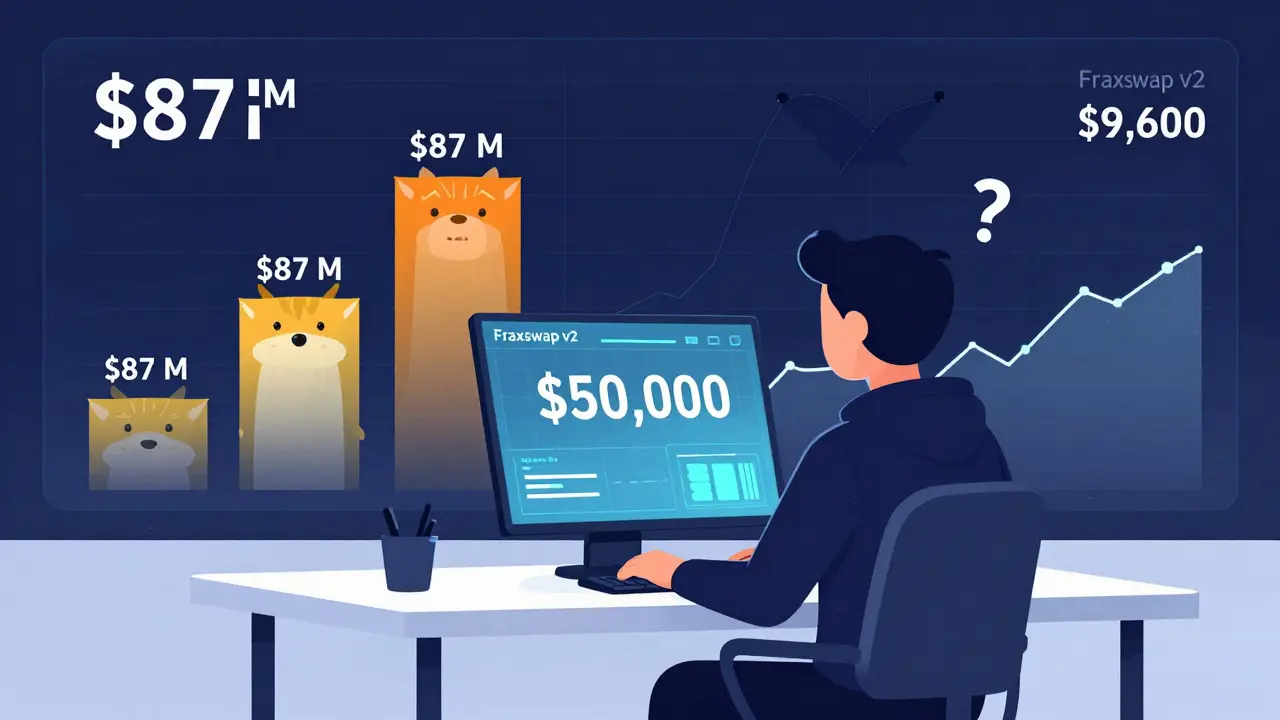
And Avalanche isn’t some niche chain. In December 2025, it processed over 1.2 billion transactions. That’s real activity. But here’s the irony: almost all of it flows through Trader Joe and Pangolin. Fraxswap v2 gets a tiny sliver. Its 24-hour trading volume? Around $9,600 according to CoinMarketCap. That’s less than 0.01% of Trader Joe’s volume. For comparison, a single large institutional trade on another platform can move more than Fraxswap v2 moves in a full day.
What You Can Trade
Technically, Fraxswap v2 supports any token pair on Avalanche. But in practice, liquidity is razor-thin. The main pools are FRAX/AVAX, FRAX/USDT, and a few others tied to the Frax Finance ecosystem. You won’t find obscure memecoins. You won’t find new tokens. You won’t find deep markets. If you’re looking to trade something outside of FRAX, AVAX, or major stablecoins, you’re out of luck. The platform doesn’t have the liquidity to support it.
Compare that to Trader Joe, which has over 300 token pairs with deep liquidity. Or Pangolin, which has 200+ and better UI. Fraxswap v2 doesn’t compete on variety. It competes on one thing: how you execute large orders.
Who Is This For? (And Who Should Stay Away)
Fraxswap v2 isn’t for beginners. It’s not for casual traders. It’s not for people who just want to swap ETH for DAI and call it a day.
This is for:
- Whales moving large FRAX or AVAX positions
- Institutional traders who need minimal slippage
- DeFi protocols that need to rebalance large reserves
- Anyone who’s been burned by slippage on other DEXs
It’s NOT for:
- New users who don’t understand wallets or gas fees
- People looking for high-volume trading pairs
- Those who want fast swaps under $500
- Anyone expecting customer support or easy help
The interface looks like Uniswap. That’s intentional. If you’ve used a DEX before, you’ll feel right at home. Connect your wallet (MetaMask, Trust Wallet, Core Wallet - all work), switch to Avalanche network, and you’re in. No KYC. No sign-up. Just direct on-chain trading.
The Big Problem: Almost No One Uses It
Here’s the uncomfortable truth: Fraxswap v2 (Avalanche) is a brilliant idea stuck in a quiet corner of the crypto world. It has innovation. It has technical superiority. But it lacks one thing: users.
CoinCodex ranks it #265 among all crypto exchanges. That’s not just low - it’s irrelevant. Trader Joe, the dominant DEX on Avalanche, handles over $87 million in volume daily. Fraxswap v2 handles less than $10,000. That’s a 1,000x difference. Even if you’re the best engineer in the world, if no one uses your product, it doesn’t matter.
There are no Reddit threads. No Trustpilot reviews. No YouTube tutorials. No success stories. Only scattered mentions in Avalanche Discord channels, usually along the lines of: “Cool tech, but where’s the liquidity?”
Even Frax Finance itself seems to focus more on its Ethereum-based products. No major roadmap updates for the Avalanche version were announced in early 2026. That’s a red flag. If the team behind it isn’t pushing it, why should you?
Is It Safe?
Yes, technically. It’s fully decentralized. No central server. No company can shut it down. All code is open-source on GitHub. The smart contracts have been audited by reputable firms. But safety isn’t just about code. It’s about liquidity.
If you’re swapping $50,000 worth of AVAX, and the pool only has $20,000 in it? You’ll get a terrible price. Or worse - your transaction might fail. That’s not a bug. That’s how AMMs work. And with such shallow pools, the risk is real.
Also, Avalanche is full of scam tokens. If you’re not careful, you might approve a token that drains your wallet. Always double-check contract addresses. Never click random links. Use only verified pools listed on Frax Finance’s official site.
What’s Next?
The future of Fraxswap v2 depends on one thing: institutional adoption of Avalanche. If big players start using AVAX for staking, lending, or treasury management - and they need to move large amounts without slippage - then Fraxswap v2 could explode. VanEck’s recent ETF filing mentioning AVAX staking rewards is a signal. Bitwise’s request to list an AVAX ETF is another.
But right now? It’s a prototype. A proof-of-concept. A technical marvel with no users. Unless Fraxswap v2 hits at least $1 million in daily volume (a 100x increase), it won’t survive. And there’s no sign that’s coming soon.
Final Verdict
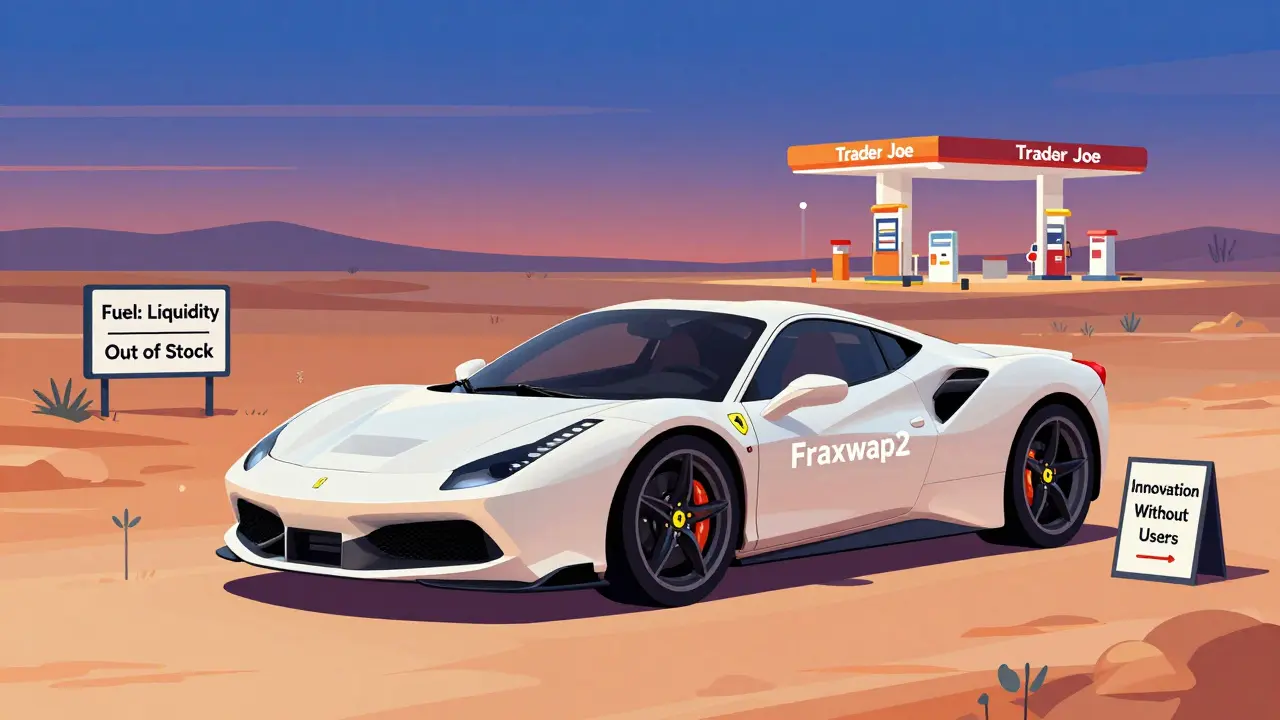
Fraxswap v2 on Avalanche is like having a Ferrari with no gas station nearby. The engine is incredible. The design is flawless. But if you can’t find fuel, it’s just a pretty car.
If you’re a large trader who needs to move crypto without moving the market - and you’re already deep in the Avalanche ecosystem - then Fraxswap v2 is worth testing. Use small amounts first. See how the TWAMM execution feels. Check the slippage. Compare it to other options.
If you’re anyone else - retail trader, beginner, casual user - skip it. Use Trader Joe. Use Pangolin. They have liquidity, community, and support. Fraxswap v2 has a brilliant idea and zero traction. Innovation without adoption is just noise.
The real question isn’t whether Fraxswap v2 works. It’s whether anyone will ever need it enough to make it matter.
Richard Cooper
February 24, 2026 AT 00:34Shannon Holliday
February 25, 2026 AT 05:58Jeremy buttoncollector
February 26, 2026 AT 16:50Michelle Xu
February 27, 2026 AT 14:52Ryan Burk
February 27, 2026 AT 15:59Amanda Markwick
February 28, 2026 AT 07:56Sriharsha Majety
March 2, 2026 AT 03:10Tabitha Davis
March 3, 2026 AT 14:00