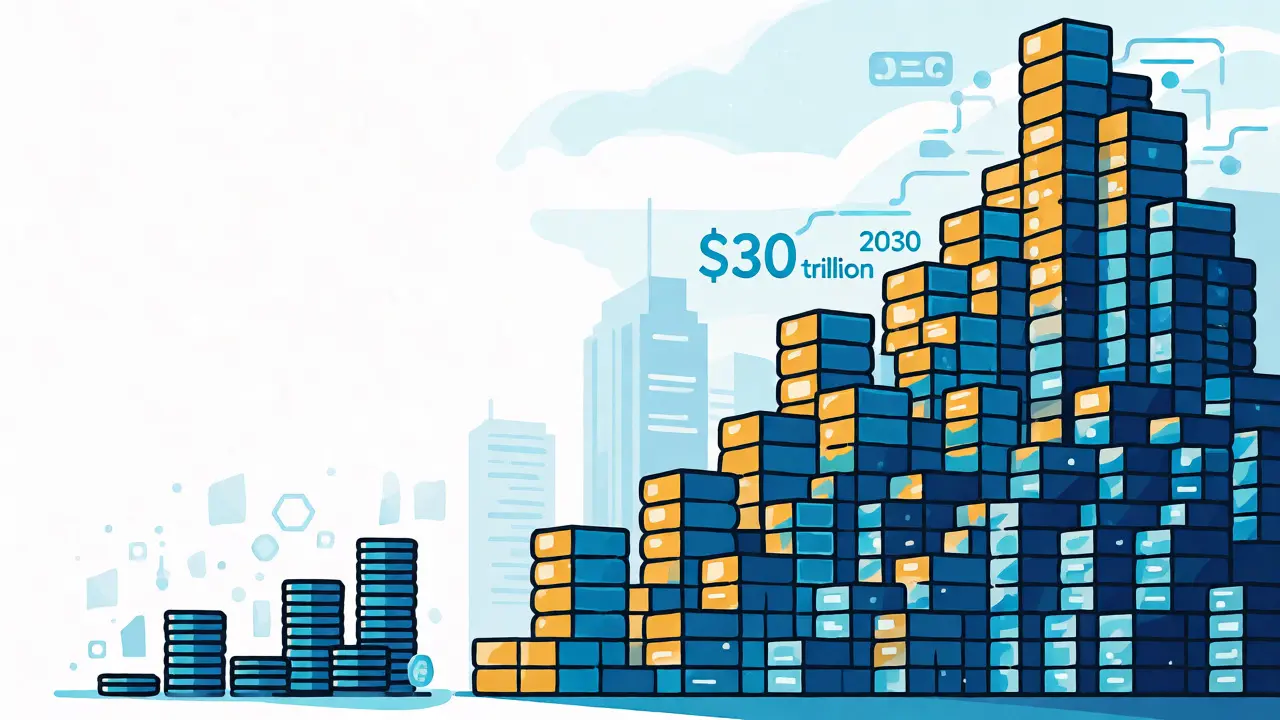
Future of Security Token Markets: From $250B to $30T by 2030
 Oct, 27 2026
You might have heard the hype about tokenization before. Maybe you rolled your eyes at the buzzwords or dismissed it as another crypto fad that didn't stick. But here is a number that should make you pause: analysts now project the security token market could hit $30 trillion by 2030. That is not a typo. We are talking about moving from a niche experiment worth roughly $250 billion in 2024 to a force that rivals traditional global equity markets. This isn't just about digital coins anymore; it is about putting real-world assets-stocks, bonds, real estate-on the blockchain.
If you are wondering why this shift matters to you, whether you are an investor, a business owner, or just someone watching the financial news, the answer lies in efficiency and access. Traditional finance is slow, expensive, and often locked behind high barriers to entry. Security tokens promise to fix that. But how do we get from today's fragmented landscape to that massive future? Let's break down what is actually happening, who is driving it, and where the risks lie.
The Real Numbers Behind the Hype
Let's cut through the noise with some hard data. The term "security token" refers to a digital representation of ownership in a real-world asset. Unlike utility tokens, which give you access to a service, security tokens represent legal rights to dividends, interest, or capital gains. They are securities, plain and simple, but they live on a blockchain.
The forecasts vary wildly, which tells you this sector is still young and volatile. McKinsey, a conservative giant in consulting, pegged the potential value at around $2 trillion. BCG (Boston Consulting Group) sees it closer to $16 trillion. Then there is the aggressive projection from Security Token Market, suggesting a leap to $30 trillion. Why such a huge spread? Because traditional models struggle to predict the speed of technological adoption. If regulatory clarity hits faster than expected, the lower estimates look outdated almost immediately.
| Source/Model | 2024 Value (Est.) | 2030 Projection | CAGR |
|---|---|---|---|
| Security Token Market | $250 Billion | $30 Trillion | N/A (Aggressive) |
| Mordor Intelligence | $2.08 Trillion* | $13.55 Trillion | 45.46% |
| Grand View Research | $2.03 Billion** | $13.53 Billion | 24.09% |
Notice the difference between "asset tokenization" and the broader "tokenization market." Asset tokenization-putting actual financial instruments on-chain-is growing much faster, with a compound annual growth rate (CAGR) over 45%. This suggests that while general digital transformation is steady, the specific use case of trading securities on blockchain is accelerating rapidly.
Who Is Actually Buying In?
You might think this is all retail traders chasing the next big thing. Wrong. Institutional investors held nearly 70% of deployed capital in security token markets as of 2024. This is a professional game now. Big names like BlackRock and Franklin Templeton aren't just dipping their toes in; they are building infrastructure. BlackRock launched on-chain liquidity funds, signaling that the biggest asset manager in the world sees value in blockchain rails for traditional products.
Why would these giants care? It comes down to settlement times and costs. In traditional finance, buying a stock can take days to fully settle. With smart contracts, settlement can happen in minutes or even seconds. For institutions moving billions, saving three days on settlement frees up massive amounts of capital. Plus, fractional ownership allows them to buy slices of commercial real estate or private equity deals that were previously too large or illiquid to touch.
What Assets Are Getting Tokenized?
Not all assets are created equal when it comes to tokenization. Currently, real estate dominates the space, holding about 30.5% of the market share in 2024. It makes sense: property is illiquid, expensive to manage, and hard to divide. Tokenizing a building lets you sell shares to hundreds of investors globally, lowering the barrier to entry from $100,000 to maybe $100.
However, commodities are growing the fastest, with a projected CAGR of 50.1%. Think gold, oil, or agricultural products. These are already standardized and liquid, making them easier to wrap into tokens. Meanwhile, stablecoins-which are essentially tokenized dollars-already account for over $200 billion in circulation. When you add tokenized stocks and bonds to that mix, you are looking at a quarter-trillion-dollar ecosystem right now.
- Real Estate: The current leader due to high fragmentation needs.
- Commodities: Fastest growing segment due to standardization.
- Bonds & Stocks: High volume potential as regulations mature.
- Private Equity: Unlocking trillions in illiquid venture capital stakes.

Regulation: The Make-or-Break Factor
This is the elephant in the room. Without clear rules, institutions won't commit fully. In the US, the Securities and Exchange Commission (SEC) has clarified that many tokens qualify as securities. This means they must follow registration requirements, similar to traditional IPOs. This creates a higher barrier to entry compared to the wild west of Initial Coin Offerings (ICOs), but it also offers investor protection.
Regions are moving at different speeds. North America currently leads with a 36.45% market share, driven by robust legal frameworks and early adopters. However, Asia Pacific is expected to grow the fastest in terms of revenue CAGR. Countries like India are implementing tokenization mechanisms for payment cards, showing that governments are comfortable using this tech for everyday finance. The Middle East and Africa are also seeing rapid growth, projected at a 27.52% CAGR, as they leapfrog legacy banking systems.
For investors, this geographic divergence means opportunity and risk. A token issued in Singapore might have different compliance burdens than one in New York. Interoperability protocols are trying to bridge these gaps, allowing a token to move seamlessly across jurisdictions, but we aren't there yet.
Technology: Permissionless vs. Permissioned
There is a technical debate shaping the future of these markets: should blockchains be open (permissionless) or closed (permissioned)? Early enterprise solutions favored permissioned networks like Hyperledger, where only approved parties could validate transactions. But the trend is shifting toward permissionless networks like Ethereum or Solana.
Why? Liquidity. A permissionless network has millions of users and thousands of applications interacting with it. A permissioned network is a walled garden. Data shows that solution components on permissionless networks are growing at a 53.20% CAGR, outpacing restricted environments. Investors want to trade their tokens easily without asking for permission from a central authority. Smart contracts enable this programmable money, automating things like dividend payments or voting rights directly on the chain.

Challenges You Can't Ignore
It’s not all smooth sailing. The path to $30 trillion is paved with hurdles. First, implementation complexity varies wildly. Setting up a compliant STO (Security Token Offering) requires legal expertise, technical development, and marketing. Many small issuers fail because they underestimate the cost of compliance.
Second, liquidity remains a concern. While the technology enables 24/7 trading, secondary markets for security tokens are still thin compared to the NYSE. If you buy a tokenized apartment building, you might not find a buyer instantly. Market makers are stepping in to provide depth, but it takes time to build trust and volume.
Finally, user experience is clunky. Managing private keys, understanding gas fees, and navigating decentralized exchanges can be intimidating for average investors. Until wallets and platforms become as easy to use as Venmo or Robinhood, mass adoption will remain limited to tech-savvy users and professionals.
What Should You Do Next?
If you are an investor, keep an eye on regulatory announcements from major hubs like the US, EU, and Singapore. Clarity drives capital. Look for projects backed by established financial institutions rather than pure-play crypto startups. Diversification is key; don't put all your eggs in one tokenized asset class.
For businesses, consider if your assets can benefit from fractionalization. Can you raise capital more efficiently by selling tokens instead of taking on debt? The tools are becoming more accessible, but you need a solid legal strategy first.
The future of security token markets isn't about replacing banks overnight. It's about upgrading the plumbing of finance. The transition from experimental trials in 2017 to mainstream deployment by 2030 is underway. Whether the final number is $2 trillion or $30 trillion, the direction is clear: assets are going digital, and they are coming to a blockchain near you.
What is the main difference between a security token and a cryptocurrency?
A cryptocurrency like Bitcoin is primarily a medium of exchange or store of value, often with no underlying physical asset. A security token represents ownership in a real-world asset, such as equity in a company, debt in a bond, or title to real estate. Security tokens are subject to securities laws and offer legal rights like dividends or voting power.
Why are institutional investors interested in tokenization?
Institutions seek efficiency, transparency, and new revenue streams. Tokenization reduces settlement times from days to minutes, lowers transaction costs by removing intermediaries, and provides fractional ownership capabilities that unlock liquidity in traditionally illiquid assets like private equity and real estate.
Is the $30 trillion forecast realistic?
Forecasts vary significantly, ranging from $2 trillion to $30 trillion by 2030. The higher end assumes rapid regulatory clarity and widespread institutional adoption. The lower end reflects slower integration and persistent technical or legal hurdles. Most experts agree on strong growth, but the exact magnitude depends on how quickly traditional finance adapts to blockchain infrastructure.
Which regions are leading the security token market?
North America currently holds the largest market share, estimated at over 36%, driven by clear regulatory frameworks and early institutional adoption. However, the Asia-Pacific region is projected to have the highest growth rate due to increasing adoption in banking, financial services, and insurance sectors.
What are the risks of investing in security tokens?
Key risks include regulatory changes, lack of liquidity in secondary markets, technical vulnerabilities in smart contracts, and custody issues related to managing private keys. Additionally, the value of the underlying asset still dictates the token's price, so traditional investment risks apply.
Hailey Phillips
October 27, 2026 AT 15:06It is truly inspiring to see how far we have come, isn't it? The shift from niche experiments to institutional adoption is a testament to human ingenuity and our collective desire for efficiency. I believe that if we continue to prioritize inclusivity in these new financial frameworks, we can unlock opportunities for everyone, not just the elite few. It’s wonderful to see major players like BlackRock stepping up; their involvement validates the entire ecosystem for smaller investors who might otherwise feel intimidated by the technology. We must remember that every step forward, no matter how small, contributes to this massive transformation. Let us remain optimistic about the potential for fractional ownership to democratize wealth building. This journey is just beginning, and there is so much more to discover together. I am genuinely excited to watch how regulations evolve to protect users while fostering innovation. The future looks bright if we keep our hearts open to change and our minds focused on solutions. Thank you for sharing such a comprehensive overview of this pivotal moment in finance history.
Johnny Garza
October 28, 2026 AT 13:57Man listen up cause im tired of seeing these $30 trillion headlines thrown around like confetti at a parade nobody wants to attend. You think big banks gonna let some code run the show without taking their cut first nah they gonna squeeze every last penny outta this before the little guy even gets a seat at the table. Its all smoke and mirrors designed to distract us from the fact that regular folks still cant afford rent let alone buy tokenized real estate shares. They talk about efficiency but its really about control and speed of capital flow for the rich while we get stuck with the volatility and the tech headaches. Dont fall for the hype train my friend its gonna derail faster than you can say smart contract.
jackie hernandez
October 29, 2026 AT 04:05OMG YES FINALLY SOMEONE GETS IT!!! 🇺🇸 America is leading this charge and honestly thank GOD because if anyone else tried to regulate this mess we’d be stuck in bureaucratic hell forever!! 😤🔥 It’s about time we showed the world how it’s done with clear rules and actual market power. I’m so proud of our institutions stepping up instead of just sitting around doing nothing like some other countries. Go USA go!!! 🙌💪
dajuan garcia
October 30, 2026 AT 03:16Love the energy here! Really digging the breakdown of where the assets are actually going. Real estate being the leader makes total sense because that liquidity crunch has been killing property owners for years. If we can actually get settlement times down to minutes that changes everything for cash flow management. Gotta stay positive though cause the regulatory stuff is tricky but once it clicks the growth curve is gonna look insane. Keep pushing!
Sean J Fortune
October 31, 2026 AT 08:45While one appreciates the enthusiasm displayed by the previous commentators, it is rather amusing to witness such naive optimism regarding what is essentially a repackaged version of existing financial instruments dressed up in blockchain terminology. One must consider that the 'efficiency' touted here is merely the elimination of intermediaries who historically provided necessary friction and oversight, thereby introducing systemic risks that the current generation of digital natives is woefully ill-equipped to comprehend. Furthermore, the assertion that North America leads due to 'robust legal frameworks' ignores the historical precedent of American regulatory overreach stifling innovation, a point which any student of economic history would readily acknowledge. The projection of $30 trillion assumes a level of global interoperability that does not currently exist and may never exist given the entrenched nationalistic tendencies of sovereign regulators. It is quite frankly intellectually lazy to assume that technological capability equates to immediate or even eventual widespread adoption when cultural and legal inertia remains the dominant force in global finance. One suspects that the true beneficiaries will not be the retail investor seeking access, but rather the institutional giants who will use these rails to further consolidate their already overwhelming market dominance. Thus, while the numbers may look impressive on paper, the practical reality is likely to be a fragmented landscape of walled gardens rather than the unified global market promised by the evangelists. We should approach these forecasts with a healthy dose of skepticism rather than the blind faith exhibited by those who fail to read beyond the press releases.
Tony Byrne
November 1, 2026 AT 02:34I... I just want to say, thank you, for this post. It means so much to me.
The idea that we can all share in ownership, that barriers can fall... it gives me hope. Hope for a fairer system.
Please, don't lose sight of the people behind the tokens.
We are all in this together, aren't we?
Let's support each other through the changes.
It's scary, yes, but also beautiful.
Keep going.
You're doing great work.
Really, truly great work.
Lucy Florence
November 2, 2026 AT 19:14But do we really understand the nature of value itself? If the asset is tokenized, does the essence of the ownership change, or is it merely a shadow cast by the original form? We speak of efficiency, yet we ignore the philosophical disconnection between the holder and the held. Is a digital representation of a house truly a home, or is it just data floating in the ether? The fragmentation of identity in these markets mirrors the fragmentation of the self in modern society. We seek security in tokens, but security is an illusion born of fear. Perhaps the true risk is not regulatory, but existential: losing touch with the tangible reality of what we own. We build these systems to escape uncertainty, yet we create new forms of chaos in the process. It is a paradox that defines our age. We must ask ourselves what we are truly buying when we buy a token. Is it the asset, or the promise of the asset? The distinction matters more than the price tag. In the end, we are all just trading ghosts for gold.
Sarah Khan
November 3, 2026 AT 15:03I appreciate the diverse perspectives shared here. It seems important to acknowledge that while the potential is significant, the pace of adoption may vary greatly depending on individual circumstances and regional regulations. Patience might be a virtue in navigating this transition.
Andrew Ellison
November 4, 2026 AT 23:54From a cross-cultural perspective, the divergence in regulatory approaches mentioned in the article highlights a key challenge. What works in the US may not translate directly to APAC or EMEA markets. Investors need to be mindful of jurisdictional nuances rather than assuming a one-size-fits-all solution. Local compliance expertise will likely become as valuable as technical knowledge in this space.