Hong Kong Virtual Assets Framework 2025: A Guide to the New Rules
 Apr, 15 2026
If you're operating a crypto business or investing from Hong Kong, the landscape just shifted. While people often search for a single "Virtual Assets Ordinance 2025," the reality is that Hong Kong has launched a coordinated web of laws and licensing regimes to turn the city into a global digital asset hub. It's not just one law, but a strategic push known as the LEAP vision-focusing on legal streamlining, expanding tokenized products, advancing use cases, and building partnerships.
The biggest immediate change is the Stablecoins Ordinance is a legislative measure that took effect on August 1, 2025, creating a mandatory licensing regime for any entity issuing fiat-referenced stablecoins (FRS) . If you're issuing a coin pegged to a currency like the USD or HKD, you can't just launch and hope for the best anymore; you need a license. This move separates "stablecoins" from other digital tokens, like security tokens or banking deposits, to avoid the kind of regulatory mess we've seen in other regions.
What exactly counts as a stablecoin now?
The law doesn't leave much to guesswork. To be classified as a stablecoin under the new rules, a digital asset must meet five specific criteria: it has to be a cryptographically secured representation of value, act as a unit of account, be accepted by the public as a medium of exchange, operate on a distributed ledger, and explicitly claim to maintain a stable value relative to other assets.
This is a critical distinction because not everything "stable" is covered. The ordinance specifically ignores central bank digital currencies (CBDCs) and limited-purpose tokens. This means if you're dealing with a government-backed digital dollar, you're looking at a different set of rules entirely.
The New Licensing Maze: SFC vs. HKMA
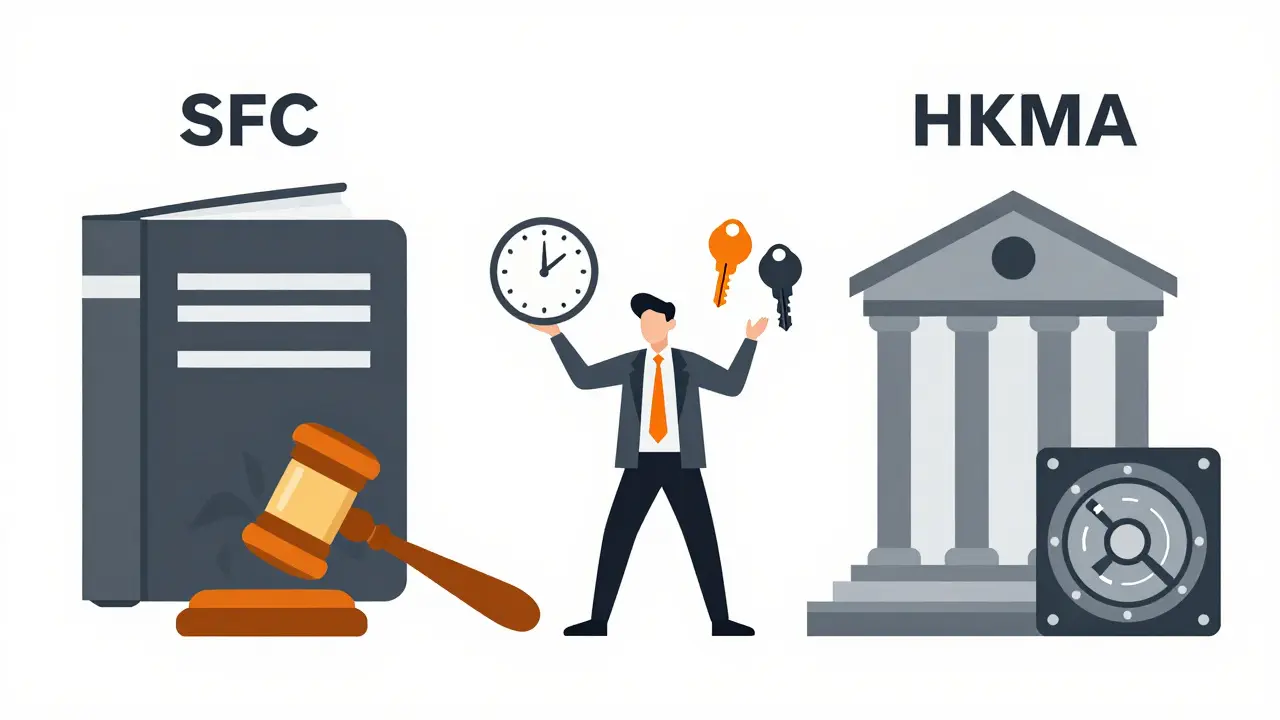
Hong Kong has adopted a dual-regulator model that might feel a bit like having two bosses. On one side, the Securities and Futures Commission (SFC) acts as the standard-setter. They write the rulebook for virtual asset (VA) dealing and custody. On the other side, the Hong Kong Monetary Authority (HKMA) is the frontline regulator for banks and stored value facility (SVF) licensees who provide these services.
If you're a VA dealer-meaning you're making agreements or inducing others to enter agreements regarding virtual assets-you're moving into a highly supervised environment. The requirements aren't light. For instance, you'll need a minimum capital of HK$129,730. While that sounds manageable for a big firm, small startups have already flagged this as a hurdle.
| Feature | Hong Kong (2025/26) | Singapore (PSA) | European Union (MiCA) |
|---|---|---|---|
| Regulatory Approach | Phased / Specialized | Broad Payments Framework | Risk-Based / Comprehensive |
| Extraterritoriality | High (Targets HK investors) | Lower (Local incorporation focus) | High (EU-wide) |
| Implementation | Milestone-based | Abrupt/Broad | Simultaneous |
| Key Constraint | Dual-approval systems | General payment limits | Strict reporting |
The Operational Headache: What Firms are Facing
Compliance isn't just about filling out a form; it's changing how you work every day. One of the most debated rules is the 24-hour active supervision requirement for portfolios. Imagine trying to manage a global fund where you need a human eye on the assets every single second of the day-it's a logistical nightmare for firms operating across different time zones.
Then there's the "dual approval" system for wallet whitelisting. To prevent fraud and theft, the SFC requires two different people (or systems) to sign off before a wallet can be whitelisted. While this is great for security, it's a killer for speed. About 43% of firms have reported that this slows down their transaction processing time by 30% to 40%.
To keep up, most compliant firms have turned to Chainalysis is a blockchain analysis tool used by approximately 68% of compliant firms in Hong Kong to track transactions and ensure AML compliance and multi-signature wallet systems. If you're trying to get licensed, you'll also need a Responsible Officer who has at least three years of actual experience in virtual asset portfolio management. You can't just hire a traditional finance guy and hope for the best.
Restrictions on Trading and Custody
One of the toughest pills for institutional investors to swallow is the restriction on where they can trade. The SFC requires that funds must only trade through and with regulated exchanges. This doesn't just mean Hong Kong exchanges; it includes those in the US, UK, Dubai, and Japan. If an exchange isn't on the approved list, your fund can't touch it.
This is a double-edged sword. It protects investors from the kind of collapses we've seen with unregulated platforms, but it limits market efficiency. It also means your due diligence workload triples because you have to vet the regulatory status of every counterparty in multiple different countries.

The Road Ahead: Tokenization and NFTs
Hong Kong isn't stopping at stablecoins. The government is moving toward Tokenized Real-World Assets (RWA) which are financial instruments or physical assets, like bonds or real estate, represented as digital tokens on a blockchain . In Q1 2026, we're expecting a legal review focusing on tokenized bonds to make it easier for institutions to move traditional assets onto the chain.
What about NFTs? For now, they're in a grey area. The government plans to review how to regulate NFTs by 2027, once the current framework for stablecoins and VA dealing has had time to breathe. For now, the focus remains heavily on the institutional side-about 83% of the activity in the city is institutional, leaving retail investors with a much tighter, more restricted experience.
How to Get Compliant: A Checklist
If you're a firm looking to enter the market, don't expect a quick process. Early adopters say it takes 3 to 6 months just to get your house in order. Here is what you need to tackle:
- Capital Check: Ensure you have at least HK$129,730 in liquid capital.
- Personnel: Hire or designate a Responsible Officer with 3+ years of VA experience.
- Tech Stack: Implement multi-sig wallets and a blockchain analytics tool for AML.
- Process: Set up a dual-approval workflow for all wallet whitelisting actions.
- Legal Review: Check if your tokens fall under the "excluded" list to see if the Stablecoins Ordinance even applies to you.
When did the Stablecoins Ordinance actually start?
The Stablecoins Ordinance officially took effect on August 1, 2025. Any issuer of fiat-referenced stablecoins operating in Hong Kong must have their license sorted by the end of 2025.
Who regulates crypto in Hong Kong?
It's a dual system. The Securities and Futures Commission (SFC) sets the standards and regulates VA trading platforms and asset managers, while the Hong Kong Monetary Authority (HKMA) regulates banks and stored value facility (SVF) licensees.
What happens if I operate from outside Hong Kong but target HK investors?
You're still on the hook. The regulations have extraterritorial application. If your services target Hong Kong residents, you must comply with the licensing regimes or face severe penalties, including fines up to HK$5 million and up to 7 years in prison.
Does the 2025 framework cover NFTs?
Not yet. The government has indicated that a review of the regulatory approach for Non-Fungible Tokens (NFTs) will happen around 2027, after the initial VA and stablecoin regimes are fully implemented.
What is the 'dual approval' requirement?
It's a security mandate from the SFC requiring that any action to whitelist a new wallet must be approved by two separate authorized parties. This is intended to prevent single-point-of-failure thefts but often slows down operational speed.
Prachi Bhadarge
April 17, 2026 AT 06:15Oh great, another "strategic push" that basically means more paperwork for everyone while the big banks just glide right through. Classic.
Joshua Salwen
April 18, 2026 AT 22:53LITERALLY WHO THOUGHT 24 HOUR SUPERVISSION WAS A GOOD IDEA??? its actually INSANE!! like do these people even sleep or are they just sadists trying to kill every startup in HK!! absolute madness omg 😱
Trudy Morse
April 19, 2026 AT 19:19Regulation is just the shadow of trust. They're trying to codify trust because they can't actually build it into the protocol.
Mark Pfeifer
April 20, 2026 AT 13:59The dual-approval system for whitelisting is a reasonable trade-off for security. Speed is a luxury when you're dealing with millions in assets that can disappear in one click.
Sandeep Bhoir
April 21, 2026 AT 08:06Sure, because nothing says "innovation" like having two different government agencies sign off on a single wallet address. I'm sure the efficiency will be breathtaking.
Yuhan Mo
April 23, 2026 AT 02:24The integration of Chainalysis for AML compliance is a standard industry move. Maintaining a high-fidelity audit trail is paramount for institutional-grade liquidity provision in this regulatory climate.
Keri Pommerenk
April 23, 2026 AT 18:10it really helps to have a checklist like this for the teams starting out and the RO requirement makes a lot of sense for stability
Sean Mitchell
April 24, 2026 AT 19:15This entire framework is an absolute catastrophe of bureaucratic overreach! The sheer audacity of demanding a human eye on a portfolio every single second is a theatrical display of incompetence that would make a Kafka novel look like a children's book! It is a tragedy of the highest order that we allow such inefficiency to stifle the very essence of digital finance!
Thomas Jewett
April 26, 2026 AT 18:36Why are we even talking about Hong Kong when the US should be the only place leadin the charge in crypto anyway because we got the real money and the real power and these other countries are just copyin our homework while tryin to pretend they are more "sophisicated" with their little dual-regulator systems which are honestly just a way to hide the fact that they dont know how to handle the tech properly and probably just want to tax everything into oblivion like they always do in those places lol
Kevin Lư
April 26, 2026 AT 20:19Honestly guys we should just be glad they are trying to stop the scams. If you can't handle a few forms to keep people from getting robbed then maybe you shouldn't be in finance lol. Just do the right thing and get licensed it's not that hard if you actually care about people.