How Mining Difficulty Affects Cryptocurrency Miners' Profits and Survival
 Dec, 16 2025
When you hear someone say "Bitcoin mining is getting harder," they’re not talking about the tech being confusing. They’re talking about something far more real: mining difficulty. It’s the invisible force that decides whether your mining rig turns a profit or becomes an expensive space heater.
What Mining Difficulty Actually Is
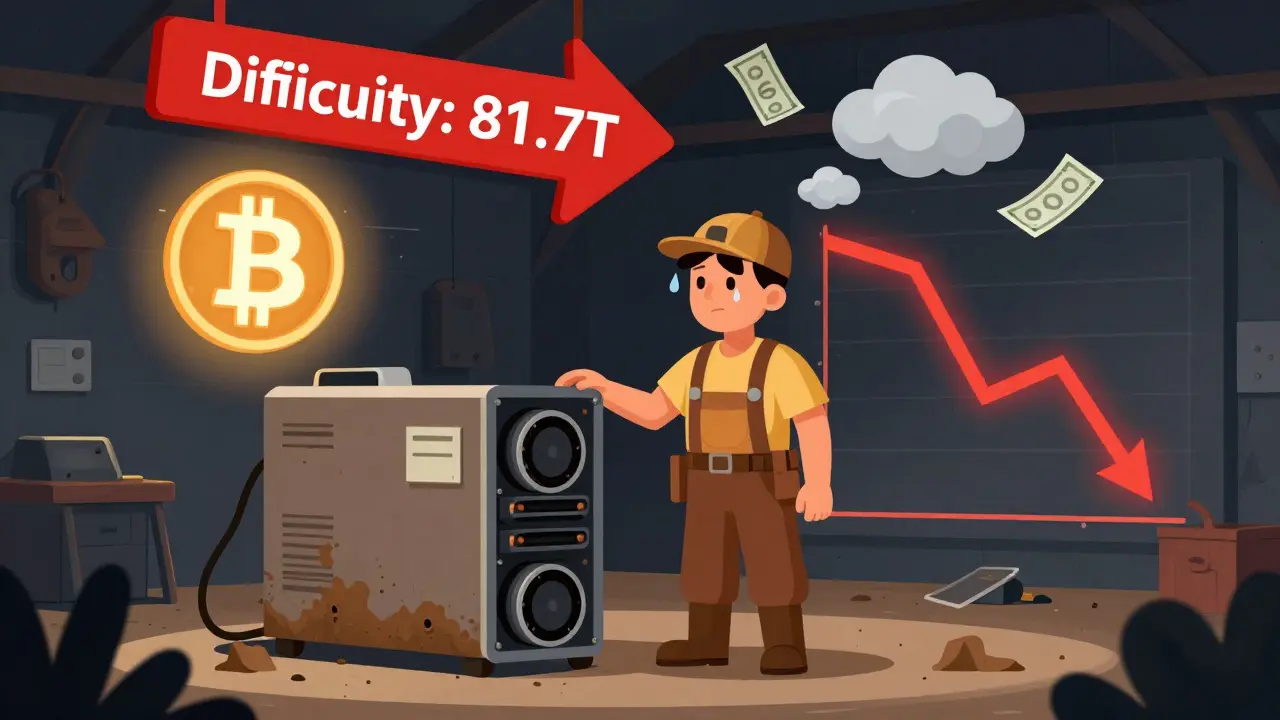
Mining difficulty isn’t a setting you can tweak. It’s an automatic, self-adjusting system built into Bitcoin and other proof-of-work blockchains. Its only job? Keep the block time at around 10 minutes - no matter how many miners jump in or quit. Think of it like a race where the finish line keeps moving. Every 2,016 blocks - roughly every two weeks - the network checks how long it took to mine those blocks. If they came in faster than 20,160 minutes (10 minutes per block), the difficulty goes up. If it took longer, it goes down. Simple. Brutal. Effective. By February 2024, Bitcoin’s mining difficulty hit 81.7 trillion. That means, on average, miners had to generate 81.7 trillion guesses (hashes) before one of them found the right answer. In 2012, that number was just 1.873 trillion. Over 11 years, it jumped over 4,200%. That’s not progress. That’s a war zone.Why Difficulty Kills Profitability
Your profit as a miner isn’t just about how much Bitcoin you mine. It’s about how much it costs you to mine it. Bitcoin’s block reward is fixed. Right now, it’s 6.25 BTC per block. That won’t change until the next halving. But your costs? They’re always there - electricity, hardware wear, cooling, rent for your warehouse, internet bills. And mining difficulty eats into your reward every time it rises. Here’s the math: If you’re running a 100 TH/s miner and the difficulty doubles, your chance of finding the next block drops by half. You’re still using the same amount of electricity. You’re still paying the same bills. But now you’re earning half as much. That’s not a slowdown. That’s a financial cliff. Many solo miners don’t realize this until their electricity bill arrives and their wallet stays empty. A miner with a 2020-era ASIC might have made $15 a day in 2021. By 2024, with difficulty up and electricity prices unchanged, that same machine made $2 - or lost money after cooling and maintenance.The Hardware Arms Race
You can’t win this game with last year’s gear. The mining world runs on ASICs - chips built for one thing: solving Bitcoin’s hash puzzles as fast and cheaply as possible. When Antminer S19 Pro came out in 2021, it was the king. By 2024, it was already outdated. Newer models like the Antminer S21 and MicroBT WhatsMiner M56S++ deliver 20-30% more hash power per watt. But here’s the twist: when enough miners upgrade, the network difficulty rises to match. That new efficiency? It gets canceled out. This creates a brutal cycle: buy new hardware → increase network hash rate → difficulty rises → your new rig barely breaks even → you need to upgrade again. The only winners? The companies selling the machines. The losers? Everyone else trying to keep up on a budget.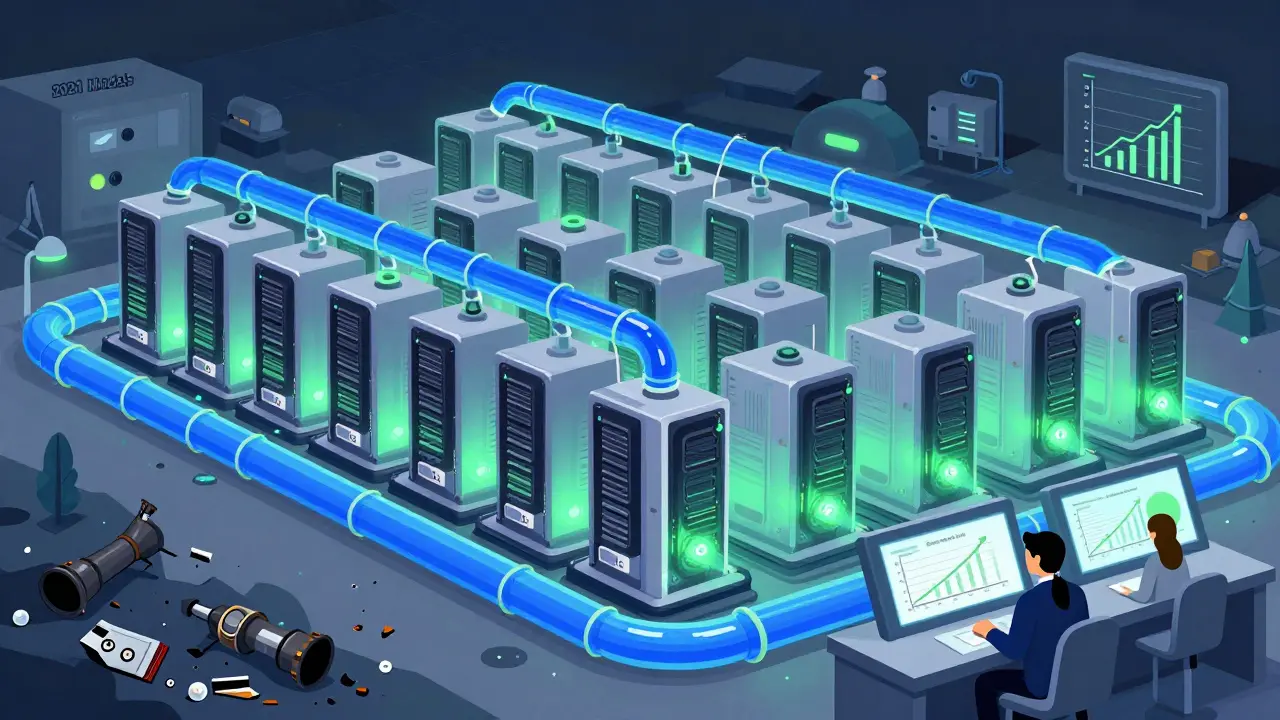
Big Miners vs. Small Miners
Mining difficulty doesn’t hit everyone the same. Large mining farms in Texas, Kazakhstan, or Georgia have advantages you can’t match. They buy electricity in bulk at $0.03/kWh. They use liquid cooling systems that cut energy waste. They replace hardware in waves, not one rig at a time. They have engineers on staff to predict difficulty spikes weeks in advance. Small miners? They’re stuck with $0.12/kWh power bills, air-cooled rigs in garages, and no forecasting tools. When difficulty jumps, they’re the first to shut down. In 2022, after Bitcoin’s price crash and a sharp difficulty hike, over 30% of small-scale miners in North America stopped operating. They didn’t quit because they lost interest. They quit because their machines were literally costing them money every hour. This isn’t just unfair - it’s structural. Difficulty is designed to be neutral. But in practice, it favors scale. The result? More than 70% of Bitcoin’s hash rate now comes from just 10 mining pools. That’s centralization. And it’s a direct side effect of rising difficulty.How Price and Difficulty Feed Each Other
Bitcoin’s price and mining difficulty are locked in a dance. When Bitcoin hits $70,000, new miners flood in. They buy rigs, plug them in, and hope to cash in. More miners = more hash power = faster block times. The network responds by raising difficulty. Within weeks, the extra miners are barely breaking even. Then the price drops. Suddenly, miners with high costs can’t cover their bills. They unplug. Hash rate falls. Blocks take longer than 10 minutes to find. After two weeks, difficulty drops. Now, the miners who stayed in - the efficient ones - see their profits rise again. It’s a boom-bust cycle built into the protocol. And it’s why mining isn’t a steady job. It’s a rollercoaster. You don’t just need a good rig. You need nerves of steel and a financial buffer.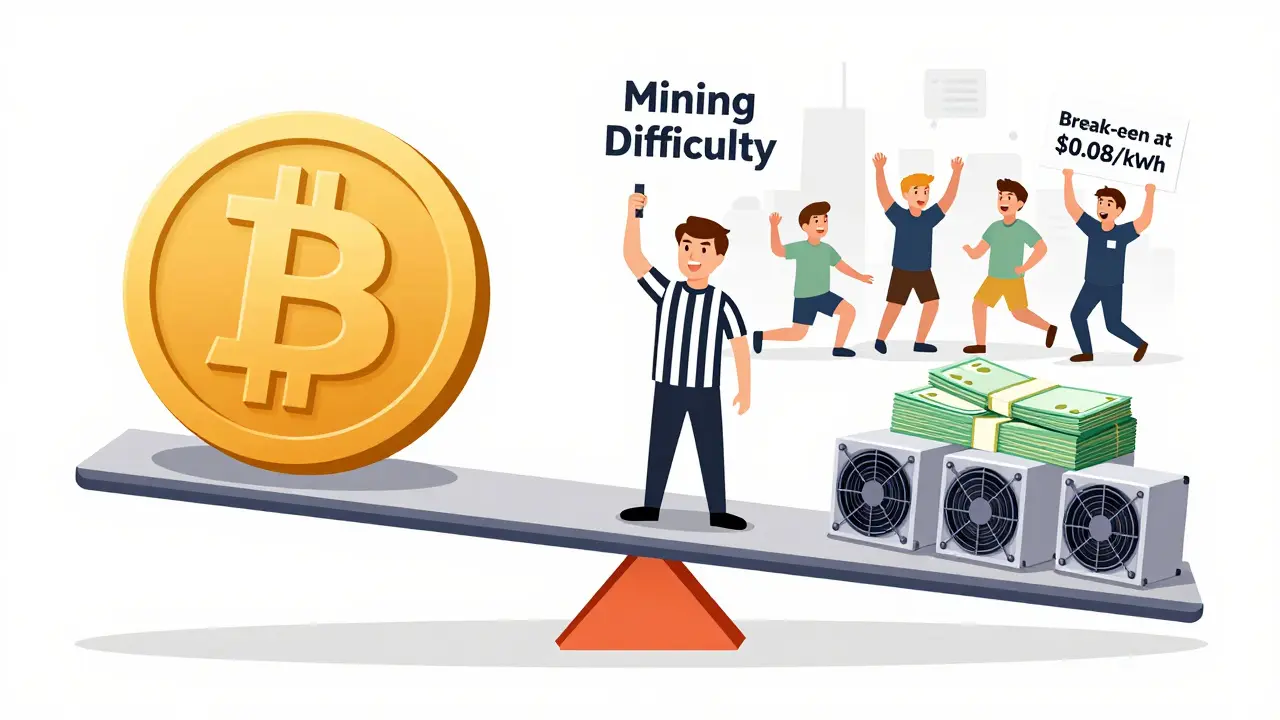
What Miners Can Do About It
If you’re still mining, here’s what actually works:- Use a mining profitability calculator like Minerstat or WhatToMine. Plug in your exact hardware, electricity cost, and current difficulty. Don’t guess.
- Track difficulty trends. If it’s been rising 5%+ per adjustment for three cycles, it’s a red flag. Your gear might be on borrowed time.
- Don’t buy new hardware unless your current one is already unprofitable. The next model might be obsolete in 6 months.
- Join a mining pool. Solo mining is a lottery. Pools give you steady, small payouts - which is better than $0.
- Know your break-even point. If your electricity costs more than $0.08/kWh and you’re using a 2021-era ASIC, you’re already in the red.
George Cheetham
December 16, 2025 AT 09:56It’s wild how difficulty just silently erodes your margins like a tide you didn’t notice rising. I used to think mining was about tech - turns out it’s about economics, endurance, and knowing when to walk away. The real question isn’t ‘can I mine?’ but ‘can I survive the next cycle?’
Most people treat this like a side hustle. It’s not. It’s a full-time financial gamble with hardware as your only currency.
I’ve seen guys burn through $20k on S19s only to watch their ROI vanish in 90 days. The network doesn’t care if you’re trying to pay rent. It just adjusts.
There’s a quiet dignity in quitting before you’re broke. That’s not failure. That’s wisdom.
And yeah - the centralization sucks. But let’s be real: decentralization was always a myth once the hash rate got this high. The dream was never meant to be scalable. It was meant to be sacred.
Maybe we’re not supposed to all be miners. Maybe we’re just supposed to believe in the ledger.
Either way, I’m not buying another ASIC until the next halving. And even then… I’m watching first.
Emma Sherwood
December 16, 2025 AT 11:53Y’all act like mining difficulty is some new problem. Nah. This is just capitalism with a blockchain sticker on it.
Remember when everyone was selling GPUs for crypto? Same script. Same players. Same losers.
Big miners don’t care about you. They’re not your friends. They’re not even your competition - they’re the system you’re trying to break into.
And yet, we keep coming back. Why? Because we still believe the myth that this is a level playing field.
It’s not. But hey - at least the math is transparent. Unlike your broker’s fees or your landlord’s ‘maintenance surcharge.’
So yeah. Quit if you’re bleeding. But don’t hate the game. Hate the fact that we let it become a casino where only the house has the cards.
And if you’re still mining? Send me your electricity bill. I’ll tell you if you’re delusional or just brave.
Donna Goines
December 17, 2025 AT 10:54Did you know the difficulty algorithm is actually controlled by a secret group inside the Fed? They use it to manipulate Bitcoin’s price so they can buy up the cheap rigs after the small miners get wiped out.
They’ve been doing it since 2013. The 2021 surge? That was a coordinated dump. The 2024 halving? A distraction. They want you to think it’s about energy costs - but it’s about control.
They even planted those ‘profitability calculators’ to make you think you’re making smart choices. But they’re all rigged to show you a positive ROI when you’re actually in the red.
And don’t get me started on mining pools - they’re all owned by the same five hedge funds that also run the exchanges. It’s all one big Ponzi with ASICs.
I’ve got a friend who works at Bitmain. He says the S21s are intentionally underclocked to force upgrades. That’s why your new rig ‘breaks even’ - it’s designed to fail.
They’re not trying to secure Bitcoin. They’re trying to own it. And the difficulty? That’s the leash.
Next time you see a miner talking about ‘efficiency’ - ask them who owns their power contract. I bet it’s BlackRock.
Wake up.
They’re coming for your wallet next.
Greg Knapp
December 18, 2025 AT 17:32Shruti Sinha
December 19, 2025 AT 22:10The structural inequality in mining is undeniable, but it’s also predictable. Proof-of-work was never designed to be egalitarian - it was designed to be secure. The trade-off was always going to be centralization.
What’s interesting is how little public discourse exists around this. Everyone talks about price, none about access.
It’s not just about electricity cost - it’s about capital access, technical literacy, and geographic privilege.
Small miners in India or Nigeria don’t even have the option to compete. They’re locked out before they start.
And yet, we still romanticize the ‘individual miner.’ That’s nostalgia, not strategy.
The real innovation won’t be in ASICs. It’ll be in how we redefine participation - maybe through decentralized cloud mining, or community-owned rigs, or energy cooperatives.
Until then, mining is just a metaphor for late-stage capitalism with more fans.
Cheyenne Cotter
December 20, 2025 AT 07:55Okay so I’ve been thinking about this for like 3 months now and I’ve read every whitepaper and watched every YouTube video and even joined 4 Discord servers and here’s what I’ve realized - mining difficulty isn’t the problem, it’s the symptom.
The real issue is that Bitcoin’s protocol is fundamentally anti-user. It doesn’t care about your electricity bill, your rent, your kid’s tuition, or your mental health. It just runs. Like a godless machine.
And the worst part? The people who designed it didn’t even think this far ahead. They thought miners would be hobbyists with home rigs. They didn’t foresee that corporations would turn it into a utility with 100-megawatt data centers.
And now we’re stuck. Because if you change the difficulty algorithm, you break the chain. If you change the block reward, you break trust. If you change the halving schedule, you break the narrative.
So we’re trapped in a feedback loop where the only way to win is to be the biggest, richest, most efficient player - and even then, you’re just delaying the inevitable.
And don’t even get me started on how the whole thing is powered by coal in Kazakhstan and hydro in China and natural gas in Texas - so the ‘green’ crypto movement is just a marketing lie.
It’s like trying to build a democracy on top of a dictatorship. The foundation is broken.
And yet… I still hold BTC. Because I believe in the idea. Not the reality.
Maybe that’s the tragedy.
Sean Kerr
December 21, 2025 AT 04:21bro i just saw a guy on youtube mine with a toaster and he made 0.0003 btc a day 😭
but my s19 j pro is running at 95% and i’m still in the green 💪🔥
just make sure your power is under 0.06 and you’ll be fine 😎
also join a pool like f2pool or antpool - solo is for chumps 🤡
and if you’re reading this and still using a 2021 rig… bro… just sell it for scrap and get a job at starbucks 😅
mining ain’t a hobby anymore… it’s a job with 24/7 stress and a 10k electricity bill 😭