How Mining Pools Share Rewards: A Guide to PPS, PPLNS, and PROP
 Jul, 13 2026
You spin up your rig, join a pool, and watch the hashes fly. But when does the money actually hit your wallet? It’s not magic, and it’s certainly not instant for everyone. Understanding how mining pools share rewards is the difference between steady income and frustrating volatility. If you’ve ever wondered why your neighbor gets paid daily while you wait weeks, or why some pools charge higher fees than others, the answer lies in the payout scheme.
Mining pools exist because solo mining Bitcoin today is like buying a single lottery ticket hoping to win the jackpot against millions of other buyers. The odds are astronomically low. By joining forces, miners combine their hash power to find blocks more consistently. But once that block reward-currently 3.125 BTCthe current block subsidy following the April 2024 halving plus transaction fees-is secured, the pool has to decide who gets what. That decision defines your earnings.
The Currency of Contribution: What Is a Share?
Before diving into payment methods, you need to understand the unit of measurement: the Sharea valid proof-of-work result that meets the pool's difficulty but not necessarily the network's. Think of a share as a "near miss." The blockchain network sets an incredibly high bar (difficulty) for finding a valid block. The pool sets a much lower bar. Every time your miner finds a solution that clears the pool’s lower bar, it submits a share.
This share proves you’re doing work. It doesn’t mean you found the block, but it confirms your hardware is running correctly and contributing to the pool’s collective effort. Your payout is almost always calculated based on how many shares you submitted compared to everyone else in the pool during a specific timeframe. Without shares, there is no record of contribution, and therefore, no reward.
Pay-Per-Share (PPS): Stability at a Premium
If you prefer predictable income over potential windfalls, Pay-Per-Share (PPS)a payout method where miners receive a fixed rate for every valid share submitted is likely your go-to. Under PPS, the pool pays you a flat fee for every share you submit. You get paid instantly, regardless of whether the pool actually finds a block.
Here’s the catch: the pool takes on all the risk. If the pool goes three days without finding a block, they still have to pay you for your shares. To cover this financial exposure, PPS pools charge higher fees-often around 1% to 2% more than other methods. Additionally, you typically don’t receive any transaction fees from the blocks mined; you only get your agreed-upon share rate. This model is excellent for miners who need consistent cash flow to cover electricity bills, but it caps your upside during lucky streaks.
Pay-Per-Last-N-Shares (PPLNS): Loyalty Pays Off
Pay-Per-Last-N-Shares (PPLNS)a payout system that calculates rewards based on shares submitted over a rolling window of recent blocks works differently. Instead of paying per share immediately, PPLNS looks back at a sliding window of shares submitted before and after a block is found. When a block is finally mined, the reward is distributed among all miners who contributed shares within that window.
This method penalizes "pool hopping"-the practice of jumping between pools to chase better luck. If you leave a PPLNS pool right before it mines a block, you lose the value of your recent shares. Conversely, if you stay loyal through dry spells, you benefit when the pool eventually strikes gold. PPLNS pools often charge lower fees because the miner shares the variance risk. However, your income will fluctuate wildly day-to-day. In the short term, it feels random. Over months or years, it averages out to be roughly equivalent to PPS, assuming average luck.
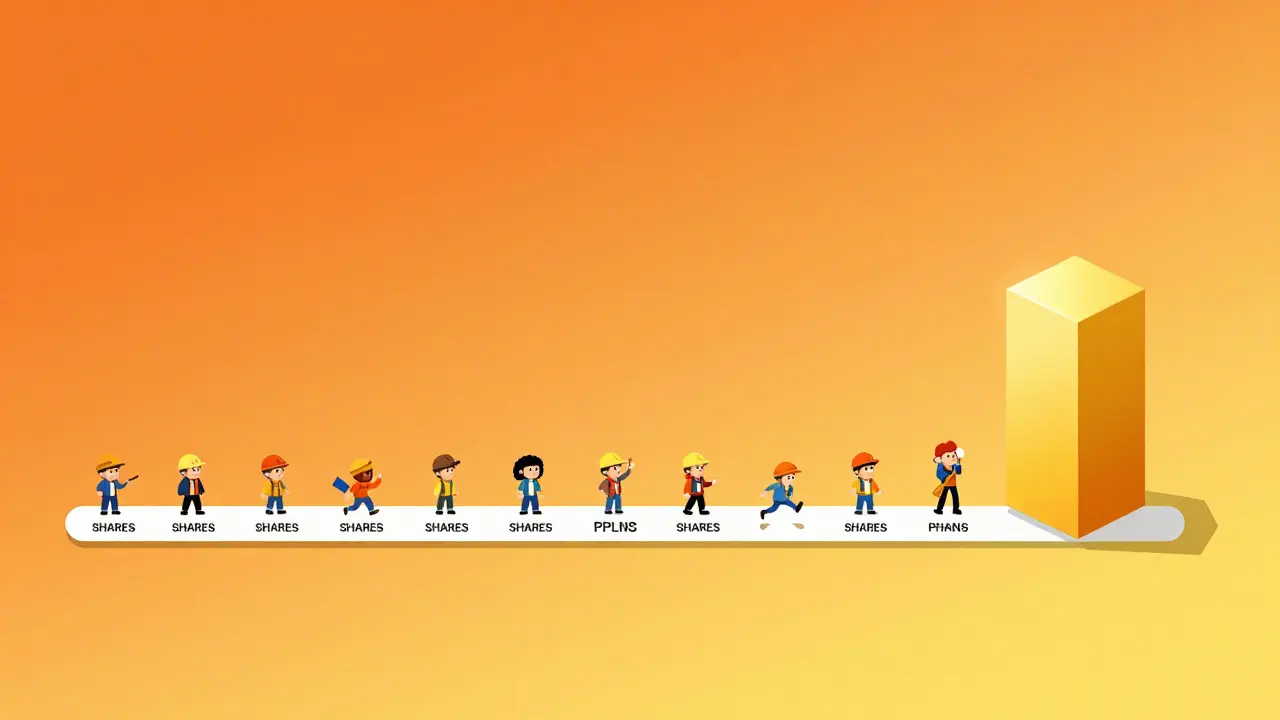
Proportional (PROP): Paying Only on Success
Proportional (PROP)a payout method where rewards are distributed based on the percentage of shares submitted during a specific block round is the most straightforward but also the most volatile for new users. With PROP, you only get paid when a block is found. Your payout depends entirely on your percentage of the total shares submitted *during that specific block attempt*.
If you contribute 10% of the shares needed to find a block, you get 10% of the reward. Simple, right? The problem arises if you join a pool just as it’s about to mine a block. You might submit zero shares during that round, yet still expect a payout because you were connected. In PROP, you get nothing. This makes PROP risky for small miners or those who frequently disconnect. It favors large, stable operations that maintain constant uptime.
Solo Mining: High Risk, High Reward
Some platforms offer a "Solo" mode within their pool interface. Here, you aren’t really in a pool with others; you’re using their infrastructure to mine alone. If you find a block, you keep the entire 3.125 BTC plus all transaction fees. No one else gets a dime.
However, the probability of an individual miner finding a Bitcoin block today is near zero unless you operate a massive industrial farm. Most solo miners will run their hardware for years without seeing a single satoshi in return. It’s essentially a lottery ticket with very poor odds, reserved for those with immense hash power or infinite patience.
| Method | Predictability | Risk Bearer | Fees | Best For |
|---|---|---|---|---|
| PPS | High | Pool Operator | Higher | Cash flow stability |
| PPLNS | Low (Short-term) | Shared | Lower | Long-term loyal miners |
| PROP | Medium | Miner | Variable | Stable, large operations |
| Solo | None | Miner | Low/None | Industrial-scale farms |

Why Fees and Transaction Fees Matter
In 2026, with the block subsidy halved again in anticipation of future reductions, transaction fees play a larger role in total profitability. Some payout methods include these fees in the split, while others exclude them. PPS usually excludes transaction fees, meaning you miss out on network congestion bonuses. PPLNS and PROP often include them, allowing you to capture extra value during busy network periods. Always check the fine print: a pool advertising "low fees" might be excluding transaction fees from your payout, effectively raising your cost.
Avoiding Common Pitfalls
New miners often make the mistake of chasing "lucky" pools. They see a pool mined a block yesterday and switch immediately. This is pool hopping, and it’s detrimental under PPLNS systems. Since PPLNS rewards recent history, switching pools resets your contribution window, leaving you with empty hands. Stick to one method and one reputable pool for at least a few months to smooth out the variance.
Also, consider your hardware efficiency. Whether you use ASICsApplication-Specific Integrated Circuits designed solely for mining or GPUsGraphics Processing Units used for versatile computing and mining, your profit is determined by energy efficiency, not just raw speed. A powerful miner that draws excessive power can lose money even with the best payout scheme. Calculate your break-even point based on your local electricity rates before choosing a pool.
What is the best payout method for beginners?
For most beginners, PPS (Pay-Per-Share) is the best choice. It offers predictable, daily payouts which helps with budgeting and covering electricity costs. While the fees are slightly higher, the lack of variance reduces stress and confusion for those new to mining economics.
Does PPLNS really punish pool hoppers?
Yes. PPLNS calculates rewards based on a rolling window of shares. If you leave a pool and return later, your previous shares drop out of the window. If a block is found shortly after you leave, you get nothing. Staying loyal ensures your shares remain in the calculation window, maximizing your long-term returns.
Why do PPS pools charge higher fees?
PPS pools assume all the financial risk. They must pay miners for every share submitted, even if the pool fails to find a block for days. The higher fee acts as an insurance premium for the pool operator, ensuring they can sustain operations during unlucky streaks.
Can I earn transaction fees with PPS?
Typically, no. Standard PPS models pay a fixed rate for shares and exclude transaction fees from the miner's payout. These fees are retained by the pool operator to help offset their risk. If you want to capture transaction fees, look for PPLNS or PROP pools that explicitly state they include them.
Is Solo mining worth it for a home user?
Almost never. Unless you control a significant percentage of the network's total hash rate, the odds of finding a block solo are negligible. Home users should stick to pools to ensure regular, albeit smaller, payouts rather than gambling on rare, massive wins.
Tuan Nguyen
July 13, 2026 AT 13:14The fundamental misunderstanding exhibited by the majority of this community regarding mining economics is frankly depressing. You are not 'investing'; you are renting computational capacity to a centralized entity that holds all the leverage. The PPS model is essentially a subscription service for delusion, where the operator insures their own incompetence against your hash rate. It is a parasitic relationship disguised as cooperation.
Josephine Finlayson
July 14, 2026 AT 13:31I think it is really important to consider how these different methods affect our mental well-being, don't you agree?; I find that sticking with one pool helps me feel more grounded and less anxious about the daily fluctuations in earnings.; It is wonderful to see such a detailed breakdown of the technical aspects, which allows us to make more informed decisions without feeling overwhelmed by the complexity of the blockchain network.; Perhaps we should all take a moment to appreciate the stability that loyalty brings to our mining operations, rather than chasing the elusive high of a lucky block.; Thank you for sharing this perspective, as it encourages a more thoughtful approach to our participation in the digital economy.
Deep Rahman
July 16, 2026 AT 08:14When we look at the nature of work itself, whether it is physical labor or digital hashing, we must ask ourselves what value truly means in a decentralized system, because if the reward is delayed, does the effort lose its intrinsic worth, or does it gain a deeper meaning through patience and endurance, which are virtues that modern society often forgets to cultivate, leading us to seek instant gratification instead of long-term fulfillment, which is a philosophical dilemma that applies not just to mining but to all aspects of human endeavor where time and trust are the primary currencies exchanged between participants in a shared economic ecosystem.
Melissa Beckwith
July 16, 2026 AT 09:32Actually, the explanation of PPLNS here is slightly misleading regarding the mathematical expectation over infinite time horizons, because while it averages out, the variance penalty is non-linear and disproportionately affects smaller miners who cannot absorb the cash flow gaps, which is a critical distinction that most casual readers overlook due to their lack of statistical literacy, and furthermore, the claim that PROP favors large operations ignores the fact that large operations often use hybrid models to mitigate risk, so the binary classification presented in the article is an oversimplification that fails to capture the nuanced reality of industrial-scale mining strategies.
Hazel Fruitman
July 18, 2026 AT 03:21its honestly kinda messed up how pools charge us for the privilage of trying to make money when the whole point was supposed to be decentralization and freedom from banks and big corps controlling everything, i mean like yeah they do work but come on, its just greedy behavior wrapped up in tech jargon to make it sound legit, people need to wake up and realize they are being played by the same old power structures just with new shiny tools.
Brad Semp
July 18, 2026 AT 22:59It is imperative to note that the grammatical precision of one's understanding of these protocols correlates directly with one's profitability, as ambiguity in payout terms leads to financial loss, and thus, only those who meticulously read the fine print and possess the intellectual fortitude to comprehend the stochastic nature of block discovery should attempt to engage in this sophisticated arena, leaving the rest to wander in ignorance.
Kim Kay
July 20, 2026 AT 21:45i totally get why ppl switch pools but like u said it resets ur window so maybe just stick with one for a bit?; also ty for explaining the shares part cause that was confusing me before i started mining last month and now i finally feel like i know whats going on with my rig
Hamza k
July 22, 2026 AT 17:05Oh boy, talk about a rollercoaster of emotions! One minute you're feeling like a king with a PPS payout hitting your wallet, and the next you're staring at a dry spell in PPLNS wondering if the universe hates you. It’s a wild ride, folks, but hey, that’s the crypto life for you-pure adrenaline mixed with spreadsheet anxiety!
Autumn Story
July 24, 2026 AT 16:52I hope everyone finds the method that works best for them!!!; It can be so stressful to worry about electricity bills, so if PPS gives you peace of mind, then go for it!!; Just remember to be kind to yourself during the dry spells, because every miner goes through them, and it doesn't mean you are doing anything wrong!!!; We are all in this together, learning and growing as we navigate this complex world of digital currency mining!!!
Mark Tuason
July 25, 2026 AT 15:59It is quite evident that the choice of payout scheme depends largely on individual risk tolerance and operational scale. For those seeking predictable income streams to cover fixed costs such as electricity, PPS remains the most logical choice despite the higher fees. Conversely, larger operations with sufficient capital reserves may benefit from the lower fee structures associated with PPLNS, provided they can withstand the inherent volatility. It is advisable to calculate break-even points carefully before committing to any specific pool strategy.