How to Calculate Staking Rewards and APY: A Complete Guide
 Jul, 8 2026
You put your coins into a staking pool, see a shiny "5% APY" on the screen, and assume you’ll get exactly that amount at year-end. But when you check your balance, the number is different. Maybe it’s higher because of compounding. Maybe it’s lower because the rate dropped or your coin’s price crashed. Understanding staking rewards calculation isn’t just about math; it’s about managing expectations in a volatile market.
In this guide, we break down how Annual Percentage Yield (APY) actually works, why it differs from the simpler Annual Percentage Rate (APR), and how to calculate your true potential earnings. We will look at real numbers, not just theory, so you can decide if a specific staking offer is worth your time and capital.
The Core Difference: APY vs. APR
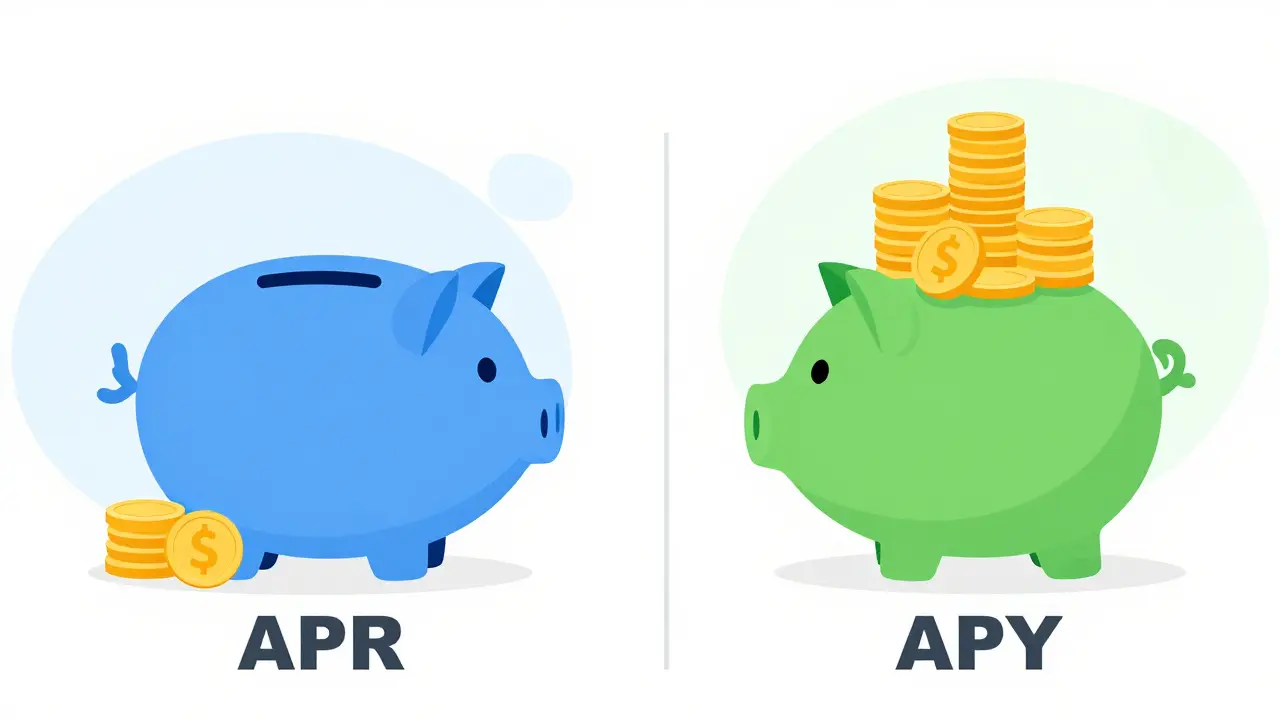
Before calculating anything, you need to know which metric you are looking at. In traditional banking, these terms are often used interchangeably, but in cryptocurrency staking, they tell two very different stories.
Annual Percentage Rate (APR) is a simple interest calculation that shows the base reward rate without accounting for compounding. If you stake $1,000 at a 5% APR, you earn $50 in a year. That’s it. The rewards are distributed, but they don’t automatically start earning more rewards themselves unless you manually reinvest them.
Annual Percentage Yield (APY) is the effective annual rate of return taking into account the effect of compounding interest. This means your rewards are reinvested immediately, generating their own rewards over time. Using the same $1,000 example, a 5% APY with daily compounding yields approximately $51.27 after one year. It sounds like a small difference, but over longer periods or with higher rates, the gap widens significantly.
| Feature | APR (Simple Interest) | APY (Compound Interest) |
|---|---|---|
| Calculation Basis | Initial principal only | Principal + accumulated rewards |
| Compounding | No automatic compounding | Includes compounding frequency |
| Best For | Fixed-term loans, simple lending | Auto-compounding staking pools, DeFi |
| Return Accuracy | Understates total growth if reinvested | Reflects actual growth potential |
Most modern staking platforms, especially those offering auto-compounding services, quote APY because it reflects the "real" return you get when rewards are continuously reinvested. Always check the fine print to see if the platform compounds hourly, daily, or weekly, as this affects the final yield.
The Math Behind Staking Rewards
You don’t need a degree in mathematics to understand staking returns, but knowing the formula helps you verify claims made by exchanges or decentralized finance (DeFi) protocols. The standard formula for calculating APY is:
APY = [1 + (r / n)]^n - 1
Here is what each variable represents:
- r: The nominal annual interest rate (e.g., 0.05 for 5%).
- n: The number of compounding periods per year (e.g., 365 for daily, 12 for monthly).
Let’s walk through a concrete example. Suppose you want to stake Ethereum (ETH), and the network offers a nominal rate of 4% compounded monthly. Here is how you calculate the effective APY:
- Divide the rate by the periods: 0.04 / 12 = 0.00333.
- Add 1 to the result: 1 + 0.00333 = 1.00333.
- Raise that number to the power of n (12): 1.00333^12 ≈ 1.0407.
- Subtract 1: 1.0407 - 1 = 0.0407.
Your effective APY is 4.07%. If you had ignored compounding and assumed 4%, you would have underestimated your earnings. Now, apply this to a $10,000 stake. With simple interest (APR), you’d earn $400. With this APY, you earn $407. While $7 might seem negligible, scale this to larger amounts or longer durations, and the difference becomes substantial.
Factors Influencing Your Actual Returns
The formula above assumes static conditions, but crypto markets are dynamic. Several variables can cause your actual returns to deviate from the projected APY.
1. Network Congestion and Validator Count
On proof-of-stake networks like Ethereum, rewards are distributed among all active validators. As more people stake their ETH, the total supply of staked assets increases. If the block reward remains constant, the share for each individual validator decreases. This phenomenon is known as "reward dilution." Conversely, if validators exit the network, remaining stakers may see their APY rise temporarily.
2. Slashing Risks
Validators must act honestly and stay online. If a validator fails to perform duties correctly or attempts to double-sign blocks, the protocol may "slash" their stake-penalizing them by burning a portion of their funds. This reduces the overall pool size and can impact the APY for everyone in that pool, depending on how the penalty is shared. Solo stakers bear this risk directly, while pooled staking distributes it across many participants.
3. Platform Fees
When using a centralized exchange (CEX) or a liquid staking derivative service, providers charge fees for managing the infrastructure. These fees are typically deducted from the gross rewards before they are credited to your account. A platform might advertise a 5% APY, but after a 10% fee, your net return drops to 4.5%. Always look for the "net APY" rather than the gross figure.
4. Token Price Volatility
This is the most critical factor for fiat-denominated investors. Staking rewards are paid in the native token. If you stake $1,000 worth of a coin and earn 5% more coins, you now hold $1,050 worth of that asset if the price stays flat. However, if the token’s price drops by 20% during that year, your holdings are worth significantly less in dollar terms, despite the positive staking yield. This is why experienced investors distinguish between "crypto-native returns" and "fiat-adjusted returns."

Real-World Calculation Scenarios
To make this practical, let’s look at two common scenarios involving popular assets.
Scenario A: Ethereum Liquid Staking
Imagine you hold 10 ETH. Instead of running your own node, you use a liquid staking protocol like Lido or Rocket Pool. These services issue receipt tokens (like stETH or rETH) that represent your staked ETH plus accrued rewards. Let’s assume an APY of 3.5% compounded daily.
After one year, your 10 ETH grows to approximately 10.35 ETH. If ETH is priced at $2,000, your initial investment was $20,000. Your new balance is worth $20,700. You gained $700 in value purely from staking, assuming no price change. Note that liquid staking tokens often trade at a slight discount or premium to underlying ETH, adding another layer of complexity to the exit value.
Scenario B: Solana Stake Pools
Solana uses a different mechanism where inflation is capped, and rewards are calculated based on the ratio of your stake to the total staked supply. Suppose the current inflation rate is 6.8%, and you delegate 100 SOL to a stake pool with a 2% commission fee. The net APY might be around 6.2%. Over six months, you wouldn’t just get half the annual reward linearly; the compounding effect applies to the daily emissions. Using a staking calculator, you can estimate that your 100 SOL could grow to roughly 103.1 SOL in six months, again assuming stable prices and consistent network participation.
Tools for Estimating Rewards
Doing the math manually every time is tedious. Most serious stakers rely on digital tools to model their outcomes. Here is what to look for in a good staking calculator:
- Compounding Frequency Input: Ensure the tool allows you to select daily, weekly, or monthly compounding.
- Fee Deduction: Look for fields to input platform or validator commissions.
- Unbonding Periods: Some calculators account for the lock-up period where your funds are inaccessible, helping you plan liquidity needs.
- Historical Data Integration: Advanced tools pull historical APY data to show trends, rather than relying on a single snapshot rate.
Websites like CoinMarketCap, CoinGecko, and specialized DeFi dashboards often embed these calculators. However, remember that these are estimates. They cannot predict future governance changes, sudden validator exits, or black swan events that crash the network.

Common Pitfalls to Avoid
Even with accurate calculations, mistakes happen. Here are three common errors beginners make:
- Ignoring Inflation: High APYs on newer, smaller chains are often driven by high token inflation. If the protocol prints too many new tokens to pay stakers, the value of each token may plummet, eroding your real gains. Always check the tokenomics model.
- Chasing Highest Yields Blindly: An unusually high APY (e.g., 50%+) often signals high risk. It could mean the project is unsustainable, or there is significant slashing risk involved. Due diligence is non-negotiable.
- Tax Implications: In many jurisdictions, staking rewards are considered taxable income at the moment they are received, not when you sell them. Failing to track these micro-transactions can lead to tax compliance issues later. Keep detailed records of every reward distribution date and value.
Next Steps for Your Staking Strategy
Now that you understand how staking rewards calculation works, you can approach opportunities with clarity. Start by identifying your risk tolerance. Are you comfortable locking up assets for long periods? Do you trust solo validators, or do you prefer the diversification of large pools?
Use the APY formula to compare options objectively. Don’t just look at the headline percentage; dig into the compounding frequency and fees. Finally, monitor your positions regularly. Markets change, and so do network parameters. What was a great deal last month might be mediocre today. Stay informed, calculate carefully, and stake wisely.
Is APY guaranteed in crypto staking?
No, APY is an estimate, not a guarantee. It depends on network activity, the total amount of staked assets, and token price stability. Rates can fluctuate daily based on these factors.
What is the difference between APR and APY in staking?
APR (Annual Percentage Rate) calculates simple interest on your initial deposit. APY (Annual Percentage Yield) includes the effect of compounding, meaning your rewards generate additional rewards. APY is always higher than APR if compounding occurs.
How does compounding frequency affect staking returns?
The more frequently rewards are compounded (e.g., daily vs. monthly), the higher your effective APY will be. Daily compounding allows your earnings to start generating new interest sooner, leading to greater exponential growth over time.
Do I need to pay taxes on staking rewards?
In many countries, including the United States, staking rewards are treated as ordinary income at fair market value when received. You should consult a tax professional to understand your specific obligations and keep detailed records of all transactions.
Can I lose money while staking even if APY is positive?
Yes. If the price of the staked cryptocurrency drops significantly, the loss in principal value can outweigh the gains from staking rewards. Additionally, slashing penalties for validator misbehavior can reduce your total stake.
Kim Kay
July 9, 2026 AT 09:26hey everyone! i just wanted to say that this guide is super helpful for people like me who are still figuring out the basics. its easy to get confused with all these numbers flying around, so seeing it broken down step by step really helps clear things up. thanks for sharing this info!
Michelle Walker
July 11, 2026 AT 08:07You clearly don't understand how inflation works. The article glosses over the fact that most of these 'high APY' projects are just printing money to pay stakers. It's a ponzi scheme wrapped in math. Don't be an idiot and put your life savings into a pool because you saw a shiny number. Do your own research instead of trusting some blog post.
Shay Thomson
July 12, 2026 AT 12:22Wow, that was harsh! 😲 I think we can all agree that learning the mechanics is important before diving in. It’s not about blindly trusting anything, but rather understanding the tools at our disposal. Maybe if we approached this with a bit more curiosity and less aggression, we could all learn something valuable together. Peace and love to all the stakers out there! 🌿✨
DJ Maleko
July 14, 2026 AT 07:28@Michelle Walker oh please, spare us your superior attitude 🙄 You act like you're the only one who knows what's going on in crypto. Everyone makes mistakes, including you probably. At least the OP tried to help people understand the difference between APR and APY. Not everything is a scam, sometimes it's just basic finance. Stop being such a toxic analyst and chill out 😂💸
Erika Pozzetto
July 14, 2026 AT 17:43I must respectfully disagree with the notion that all high-yield staking is inherently fraudulent as some have suggested here while acknowledging that due diligence is indeed paramount in any financial endeavor especially within the volatile cryptocurrency market where regulatory frameworks are still evolving rapidly and participants must remain vigilant against potential risks associated with smart contract vulnerabilities or protocol failures which could lead to significant losses despite the theoretical appeal of high annual percentage yields which often fail to account for the underlying tokenomics and inflationary pressures exerted by the issuance mechanisms designed to incentivize network participation and security provision through decentralized consensus models that rely heavily on economic game theory principles to maintain equilibrium between validators and delegators alike
Russ Fincham
July 16, 2026 AT 14:41The math checks out but the real issue is tax reporting. Most people ignore the micro-transactions until tax season hits and then they panic. Keep records or cry later.