How Validator Selection Works in Proof-of-Stake (PoS) Blockchains
 Jul, 12 2026
Imagine you want to join a club where the most influential members get to decide what happens next. In traditional mining-based blockchains like Bitcoin, influence comes from how much electricity and hardware you can throw at solving puzzles. But in Proof-of-Stake systems, influence is bought with money-specifically, by locking up cryptocurrency. This process, known as validator selection, determines who gets to write the next page of the digital ledger. It sounds simple: put up more cash, get picked more often. But if it were that easy, a single whale could control the entire network. So, how do these networks actually pick validators without falling into chaos or centralization?
The Core Mechanism: Weighted Randomness
At its heart, validator selection in PoS is about probability, not certainty. The network doesn't just hand the microphone to the richest person every time. Instead, it uses a lottery system where your ticket count depends on how many coins you've staked. If you hold 1% of all staked tokens, you have roughly a 1% chance of being selected to propose the next block.
To make this fair and unpredictable, networks use something called Verifiable Random Functions (VRF). A VRF generates a random number that only the validator can compute but anyone can verify. This prevents hackers from predicting who will be chosen next and trying to attack them before they act. Think of it like a sealed envelope draw: everyone knows the rules, but no one knows the result until the moment it matters.
In practice, this means two roles emerge in each cycle:
- Block Proposer: One validator is randomly selected to bundle transactions into a new block and broadcast it to the network.
- Attesters: Other validators are selected to review that block. They check if the transactions are valid and sign off on it. If enough attesters agree, the block is finalized.
This dual-layer approach ensures that even if a malicious actor is selected as a proposer, they can't easily rewrite history unless they also bribe or control the majority of attesters-a nearly impossible feat in a healthy network.
Staking Thresholds and Financial Barriers
You can't just stake any amount and expect to be picked. Most major PoS networks set minimum thresholds to ensure validators have "skin in the game." Take Ethereum, for example. To run a solo validator node, you must lock up exactly 32 ETH. As of mid-2026, with ETH prices fluctuating between $3,000 and $4,000, that’s an investment of $96,000 to $128,000. Why so high?
High stakes serve three purposes:
- Deterrence: It makes attacks prohibitively expensive. If you try to cheat the network, you risk losing your entire stake through a penalty called slashing.
- Decentralization Control: By setting a floor, the network avoids having millions of tiny, unreliable validators clogging the system.
- Commitment Signal: It proves you’re serious about maintaining uptime and security, not just looking for quick profits.
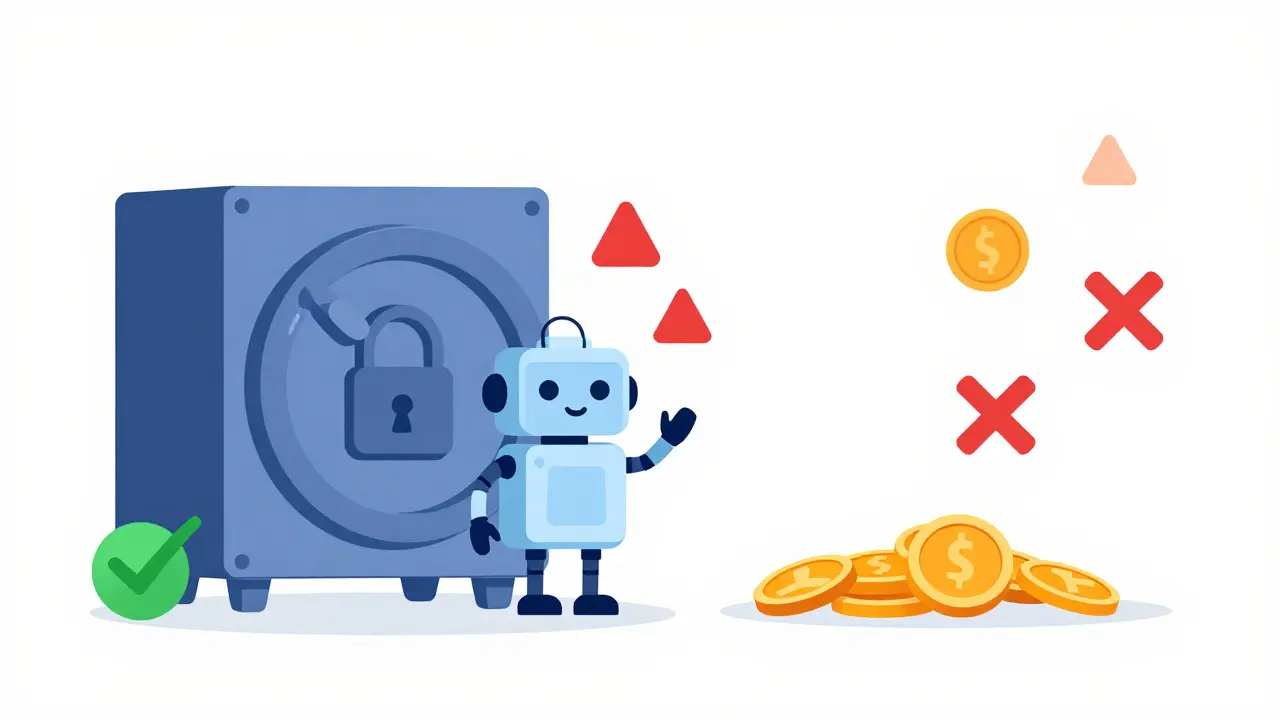
Slashing is the nuclear option. If a validator signs conflicting blocks (trying to double-spend) or goes offline for extended periods during critical consensus phases, smart contracts automatically confiscate part or all of their staked ETH. This economic threat keeps validators honest and online.
Variants of Proof-of-Stake: Not All Systems Are Equal
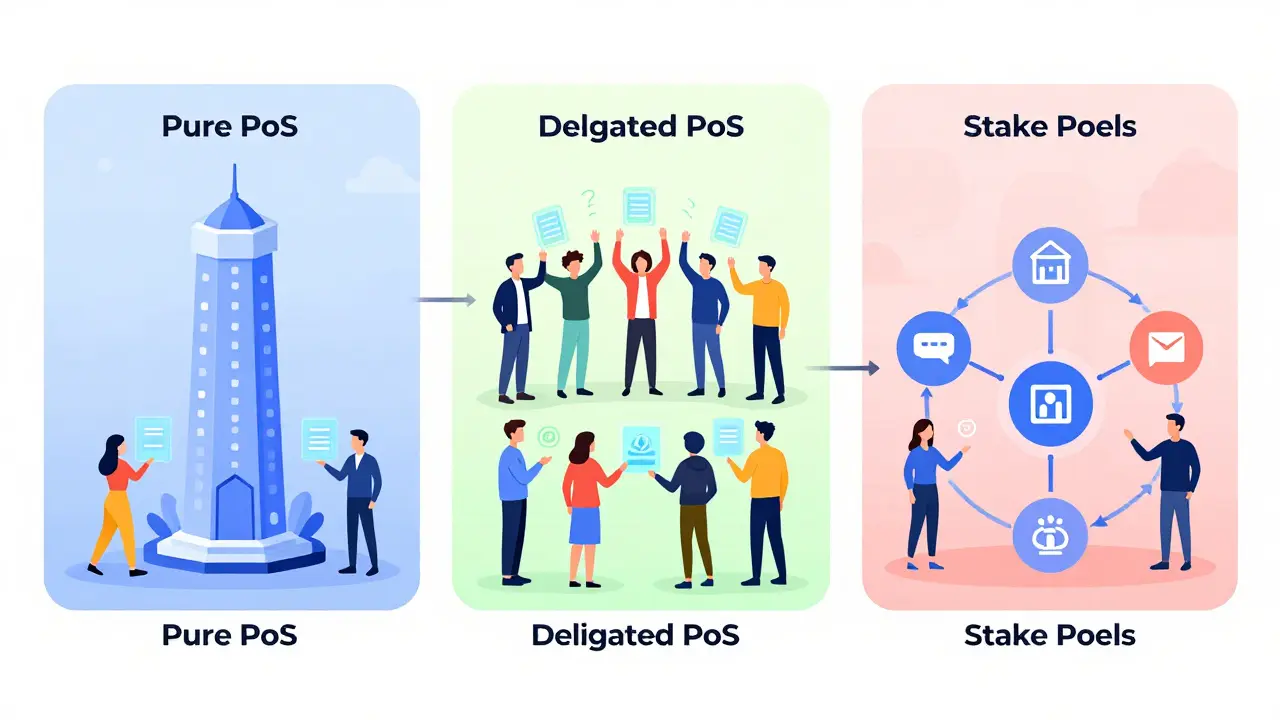
While Ethereum uses pure PoS with fixed stakes, other blockchains have tweaked the model to balance accessibility and efficiency. Here’s how they compare:
| Model | Network Example | Selection Method | Barrier to Entry | Centralization Risk |
|---|---|---|---|---|
| Pure PoS | Ethereum | Random VRF based on stake | High (32 ETH) | Low-Medium |
| Nominated PoS (NPoS) | Polkadot | Nominators back validators; top performers win slots | Medium (DOT tokens) | Medium |
| Delegated PoS (DPoS) | Cosmos, EOS | Tokens holders vote for limited number of producers | Low (Vote with any amount) | High (Oligarchy risk) |
| Stake Pool Model | Cardano | Users delegate to pools; pool operators produce blocks | Very Low (Any ADA amount) | Low-Medium |
In Nominated PoS (used by Polkadot), regular users don’t run nodes themselves. Instead, they nominate professional validators. The algorithm selects the best-performing, most-backed validators to secure the chain. This creates a meritocracy: if a validator performs poorly, nominators pull their support, and the validator loses slot opportunities.
Delegated PoS takes democracy further. Token holders vote for a fixed number of block producers (e.g., 21 in EOS). These producers rotate duties. While accessible, this model risks centralization because voters tend to cluster around a few well-known entities, creating a small group of powerful players.
Cardano’s Ouroboros protocol offers a middle ground. Users delegate their ADA to stake pools. The pool operator runs the hardware, but the rewards are shared. Crucially, adding more stake to a pool doesn’t linearly increase its chances forever; there’s a saturation point. This encourages the creation of many smaller pools rather than one giant monopoly.
Technical Requirements: More Than Just Money
Having the funds is only half the battle. Running a validator is a technical job. You need reliable hardware, stable internet, and constant monitoring. For Ethereum, this means running two separate software clients simultaneously: an execution layer client (like Geth or Nethermind) and a consensus layer client (like Lighthouse or Prysm).
Hardware specs aren’t extreme, but they must be consistent. A modern desktop with 16GB RAM, a fast SSD, and a dedicated CPU core can handle the load. However, the real enemy isn’t processing power-it’s downtime. If your server crashes or your internet drops, you miss attestations. Miss too many, and you start losing rewards. Miss critically important ones, and you face slashing.
Security is paramount. Your validator key controls significant assets. Storing it on a cloud server exposed to the internet is risky. Many professional validators use air-gapped setups or multi-signature schemes where multiple keys are required to authorize actions, reducing the risk of theft or accidental exposure.
Why Validator Selection Matters for Security
The beauty of PoS lies in its economic alignment. In Proof-of-Work, miners spend electricity. If they attack the network, they lose nothing but wasted energy. In PoS, validators lock up capital. An attack costs them real money.
Consider a 51% attack scenario. In PoW, an attacker needs to buy or build more hash power than the rest of the network combined. In PoS, they need to acquire 51% of all staked tokens. On Ethereum, that would cost billions of dollars. Even if they succeeded, attacking the network would devalue the very asset they just spent billions to buy. It’s a self-defeating strategy.
Furthermore, the randomness of VRF-based selection prevents targeted attacks. Hackers can’t know which validator will propose the next block, so they can’t prepare a specific exploit for that moment. They’d have to attack the entire network simultaneously, which is economically irrational.
Future Trends: Lowering Barriers Without Sacrificing Safety
The industry is moving toward greater accessibility. Two major trends are reshaping validator selection:
Liquid Staking: Services like Lido allow users to stake ETH without meeting the 32 ETH threshold. They receive a tokenized representation (stETH) that can be used elsewhere in DeFi while still securing the network. This increases total staked supply, enhancing security, but raises concerns about centralization if a few liquid staking providers dominate the validator set.
Simplified Client Diversity: Tools are emerging that automate validator setup and monitoring. Docker containers, one-click installers, and managed node services are reducing the technical barrier. However, experts warn against over-reliance on single providers. If everyone uses the same client software, a bug in that code could take down a large portion of the network. Diversity in software choices remains critical for resilience.
As we move deeper into 2026, the focus is shifting from "how do we select validators?" to "how do we ensure those validators remain diverse and independent?" The technology works. The challenge now is human behavior and economic incentives.
What happens if a validator goes offline?
If a validator goes offline temporarily, they simply miss out on rewards for that period. Their stake remains safe. However, frequent or prolonged absence triggers penalties. In severe cases, such as missing critical consensus deadlines repeatedly, the network may slash a portion of their stake to compensate for reduced security.
Can I become a validator with less than 32 ETH on Ethereum?
Not directly. The protocol requires exactly 32 ETH to activate a solo validator node. However, you can participate via staking pools or liquid staking protocols (like Lido or Rocket Pool) which aggregate funds from many users to meet the threshold, then distribute rewards proportionally.
Is Proof-of-Stake truly decentralized?
It aims to be, but decentralization depends on distribution. While PoS lowers energy barriers, financial barriers remain. If wealth concentrates among few entities, validator selection becomes centralized. Networks mitigate this through mechanisms like stake pooling limits and random selection algorithms, but vigilance is required.
What is slashing in detail?
Slashing is a punitive measure where a validator's staked funds are partially or fully confiscated. It occurs when a validator violates protocol rules, such as signing two different blocks for the same height (equivocation) or failing to respond to network challenges. It serves as a strong economic deterrent against malicious behavior.
How does VRF ensure fairness in selection?
Verifiable Random Functions generate a random output that only the validator can produce using their private key, but anyone can verify using their public key. This ensures the selection is unpredictable to attackers yet transparent to the network, preventing manipulation while maintaining trustlessness.