IMM Airdrop: What You Need to Know About the IMM Token Airdrop in 2025
 Dec, 9 2025
Crypto Airdrop Verification Tool
Verify an Airdrop
Check if an airdrop is legitimate using the 5 key verification criteria from the article.
There’s no official IMM airdrop. Not yet. Not ever, as far as verified sources can confirm.
If you’ve seen ads, Telegram groups, or YouTube videos promising free IMM tokens, you’re being targeted by scammers. The name "IMM" doesn’t belong to any known blockchain project with a public token, team, or roadmap. No whitepaper exists. No GitHub repo. No official website with verifiable contact info. And no reputable crypto exchange lists an IMM token.
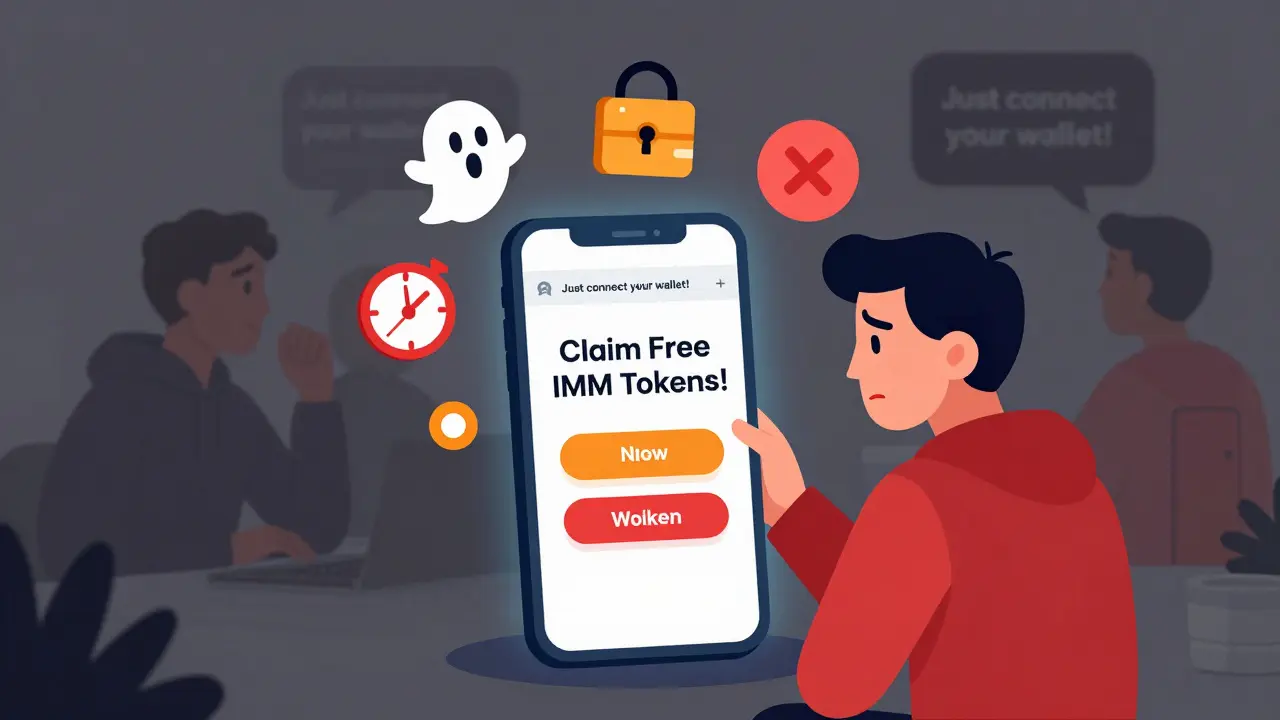
Here’s the hard truth: IMM is not a legitimate crypto project. It’s a ghost name being used to lure people into fake airdrops. These scams often start with a simple promise: "Join now, claim your IMM tokens before launch!" Then they ask you to connect your wallet, sign a malicious transaction, or send a small amount of ETH or SOL to "cover gas fees." That’s how they steal your funds.
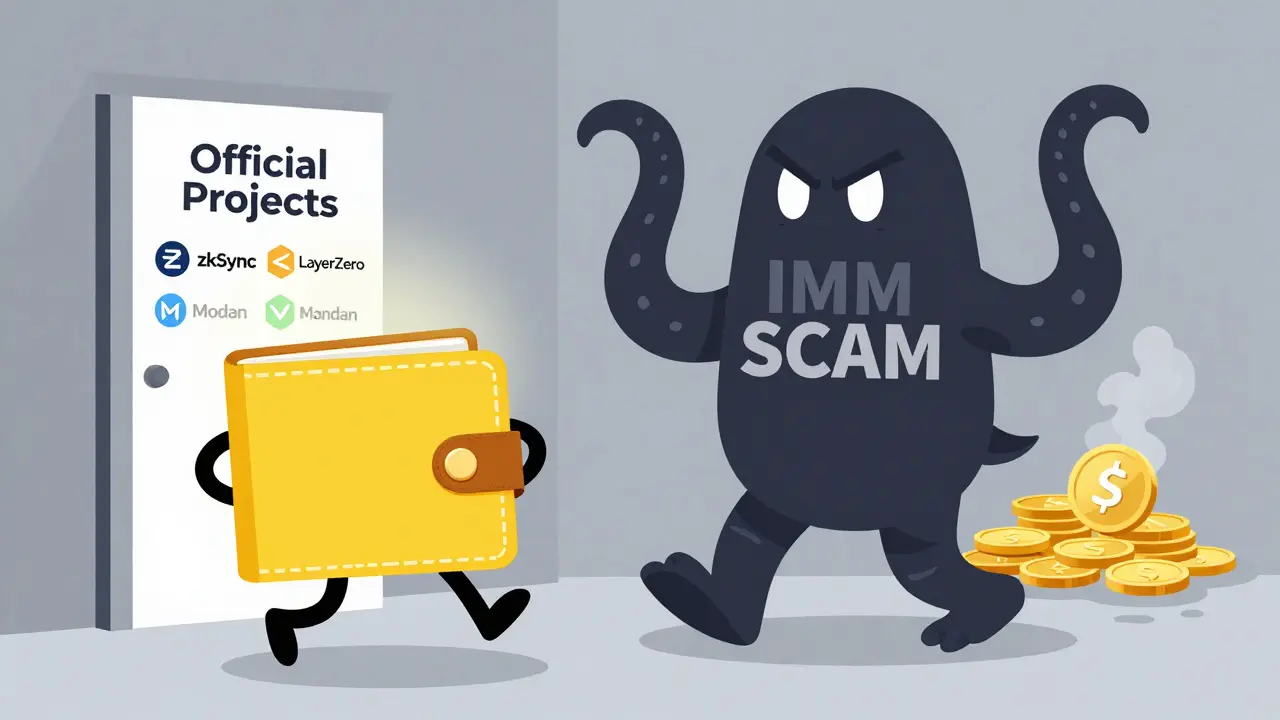
Real airdrops don’t ask for money upfront. They don’t pressure you. They don’t use vague language like "limited spots" or "exclusive access." Legit projects like zkSync, LayerZero, or MetaMask have spent years building communities before dropping tokens. They announce details on their official blogs, Twitter accounts, and Discord servers. They publish audit reports, tokenomics, and team profiles. None of that exists for IMM.
Why do fake airdrops like IMM keep popping up?
Because they work. In 2025, over 70% of crypto airdrop scams target users who are new to Web3. These scams exploit excitement, FOMO, and lack of research. People see a flashy landing page with a logo, a countdown timer, and a claim button - and they act without checking the basics.
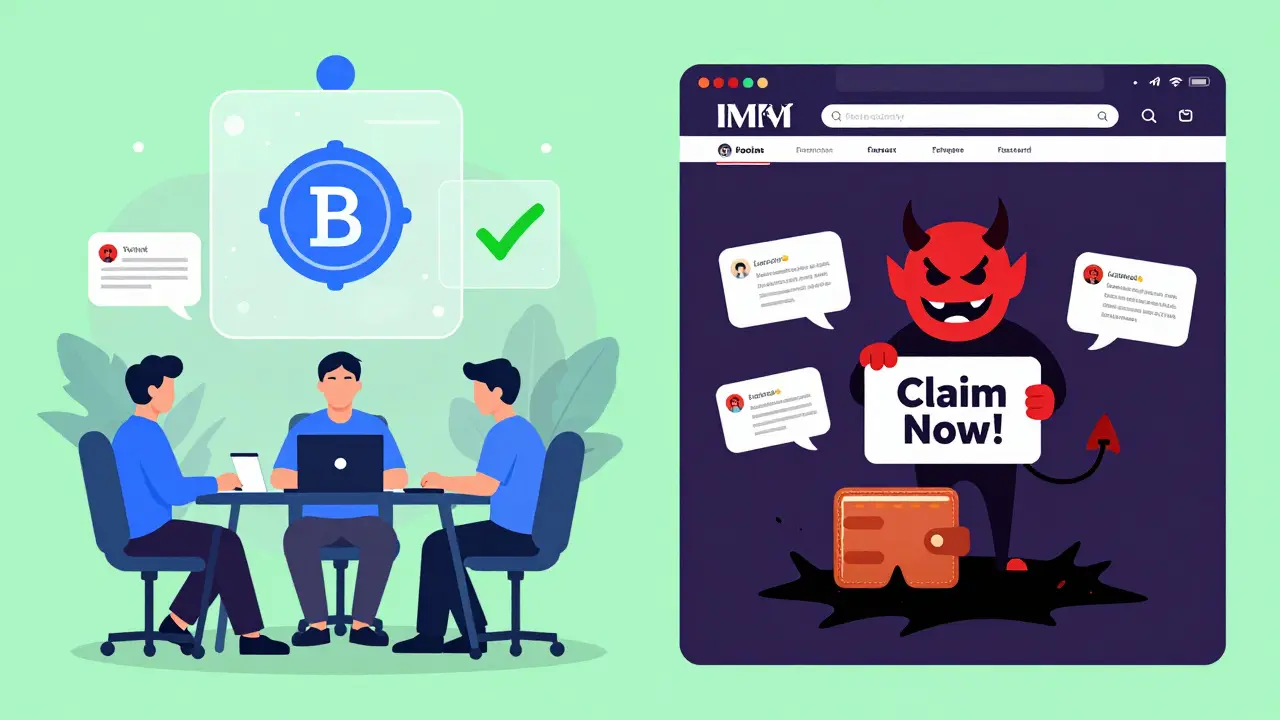
Scammers use domain names like imm-airdrop[.]com, immtoken[.]io, or imm-faucet[.]net. They copy design elements from real projects. They post fake testimonials from "verified users." They even hire actors to record fake voiceovers saying, "I got 10,000 IMM tokens - now I’m living off them."
But here’s what they can’t fake: transparency. Real projects are open about their code. They let anyone inspect their smart contracts on Etherscan or Solana Explorer. They have public governance votes. They answer questions from the community. IMM? Nothing.
How to spot a fake crypto airdrop
If you’re ever unsure whether an airdrop is real, ask yourself these five questions:
- Is there a documented team? Look for LinkedIn profiles, past projects, and public interviews. If the team is anonymous or uses stock photos, walk away.
- Is there a whitepaper? A real project explains its tech, token distribution, use case, and roadmap. If it’s just a 2-page PDF with buzzwords like "decentralized future," it’s a red flag.
- Is the contract address verified? Go to Etherscan or Solscan. If the contract isn’t verified or has no transaction history, it’s not real.
- Did you have to send crypto to claim tokens? Real airdrops give you tokens for free. If they ask for ETH, SOL, or USDT to "unlock" your claim, it’s a scam.
- Is there community verification? Check Reddit, Twitter, and CoinMarketCap. If no one’s talking about it except the promoter’s own accounts, it’s likely fake.
These steps aren’t just tips - they’re survival rules in Web3. In 2024, users lost over $1.2 billion to fake airdrops. Most of those victims didn’t know how to check for these signs.
What real airdrops look like in 2025
If you’re looking for actual airdrop opportunities, focus on projects with traction:
- zkSync - Already dropped tokens to early users. Their next airdrop will likely go to those who used their ZK-Rollups for swaps or bridging.
- LayerZero - Airdropped to users who bridged assets across chains before their mainnet launch.
- Meteora - Gave tokens to liquidity providers on Solana-based DEXs.
- Monad - Testing mainnet in early 2025; airdrop expected for testnet participants.
These projects didn’t rush. They built. They tested. They documented. They waited for real users to engage before rewarding them.
IMM? It’s the opposite. No build. No test. No documentation. Just a promise.
What to do if you already connected your wallet
If you clicked a link and connected your wallet to a fake IMM site, act fast:
- Do NOT sign any transaction you don’t understand.
- Go to your wallet (MetaMask, Phantom, etc.) and revoke all permissions. In MetaMask, go to Settings > Security & Privacy > Revoke Access. Remove any site connected to imm-airdrop.com or similar domains.
- Check your transaction history. If you sent any crypto, there’s no way to reverse it. Report the address to Chainalysis or Etherscan’s fraud reporting tool.
- Change your wallet password and enable 2FA if you haven’t already.
- Warn others. Share this warning on social media or in crypto groups.
Most scams don’t steal everything at once. They test with small transactions first. If you caught it early, you’re still safe.
Where to find real crypto airdrops
Stick to trusted sources:
- Official project blogs
- Verified Twitter/X accounts (blue check with history)
- CoinGecko’s Airdrop Calendar
- CoinMarketCap’s Airdrop section
- Reputable crypto news sites like The Block, CoinDesk, or Decrypt
Never trust a link sent via DM, Telegram, or Discord from someone you don’t know. Even if it looks legit - it’s not.
Final warning: No such thing as "free money" in crypto
The only thing free in crypto is the risk. Real value comes from participation, not speculation. If a project sounds too good to be true - it is. The IMM airdrop is a classic example. No team. No tech. No transparency. Just a trap.
Protect your wallet. Protect your funds. And if you hear about an airdrop you can’t verify - skip it. There will always be another real opportunity. But once your crypto is gone, there’s no recovery.
Is there an official IMM airdrop in 2025?
No, there is no official IMM airdrop. No verified project named IMM exists with a token, team, or public roadmap. Any website or social media post claiming otherwise is a scam.
How can I check if an airdrop is real?
Look for a published whitepaper, verified team members, a live mainnet or testnet, and a contract address on Etherscan or Solscan. If the project asks for money to claim tokens, it’s fake. Always check CoinGecko or CoinMarketCap for official listings.
What should I do if I sent crypto to an IMM airdrop site?
Immediately revoke all wallet permissions connected to the site. Check your transaction history for any transfers. Unfortunately, crypto transactions are irreversible. Report the scam address to Etherscan or Solscan’s fraud reporting system. Never interact with the site again.
Are there any upcoming airdrops I can trust in 2025?
Yes. Projects like zkSync, LayerZero, Monad, and Meteora are expected to run airdrops for active users. Follow their official blogs and verified social accounts. Never trust third-party announcements or influencers promoting unverified projects.
Can I get rich from crypto airdrops?
Some people have made money from airdrops, but most don’t. Real gains come from long-term participation, not quick claims. Many airdropped tokens drop in value after launch. Focus on using real tools and protocols - not chasing free tokens. Your time is better spent learning than hunting scams.
Kathleen Sudborough
December 11, 2025 AT 01:59I saw a Telegram group yesterday with a fake IMM airdrop link - looked so legit, with fake testimonials and a countdown timer. I almost clicked. Then I remembered this post. Thank you for writing this. I’m sharing it with my crypto newbie cousin who’s been asking about "free tokens." You saved her from losing her ETH.
Real talk: if it’s too easy, it’s a trap. Crypto isn’t lottery tickets. It’s work. And scams know we’re all tired of waiting for the next big thing.
Don’t be the person who says "I just wanted to try it." You don’t try a loaded gun. You walk away.
Vidhi Kotak
December 12, 2025 AT 06:54Been in crypto since 2018 and I’ve seen this exact script a hundred times. The fake logos, the urgency, the "only 500 spots left!" - it’s all recycled. Same playbook, different name.
IMM? More like I-Missed-My-Wallet. I’ve had friends lose hundreds to these. One guy sent 0.5 ETH to "unlock" a token that didn’t exist. He still talks about it like it was a bad breakup.
Always check Etherscan first. Always. Even if the site looks like Coinbase. If the contract has 0 transactions and no code verification? Run. Don’t walk.
amar zeid
December 12, 2025 AT 22:17The structural vulnerability here is not technological but psychological. The design of these scams exploits the cognitive bias of immediacy - the human brain prioritizes short-term reward over long-term verification, especially in environments saturated with FOMO-driven content.
Moreover, the replication of UI/UX patterns from legitimate platforms (zkSync, MetaMask) creates a perceptual heuristic that bypasses critical evaluation. This is not merely phishing - it is behavioral engineering.
For non-technical users, the five-question checklist provided is not merely helpful - it is a necessary cognitive framework. I recommend institutionalizing this into onboarding modules for new wallet users.
Additionally, the absence of a GitHub repository or audit report is a non-negotiable red flag. No serious project deploys without code transparency. Period.
Scammers rely on the inertia of inaction. The moment you pause to verify, you break their funnel. This post is a vital intervention in that loop.
Alex Warren
December 13, 2025 AT 17:28Ian Norton
December 14, 2025 AT 17:19Let’s be real - 90% of people who fall for this are the same ones who bought Dogecoin because Elon tweeted it. They don’t care about audits, contracts, or team backgrounds. They want a quick flip.
And that’s why these scams thrive. You can’t educate someone who doesn’t want to learn. You can only warn them. And even then, they’ll come back with "but what if this one’s real?"
Meanwhile, the real projects - the ones with actual devs, real code, and public governance - are getting ignored because they don’t have a TikTok ad with a guy in a suit saying "I turned $50 into $50K!"
So yeah. This post is right. But it’s also pointless. People will keep clicking. They always do.
Sue Gallaher
December 16, 2025 AT 09:20Why do we even care about these fake airdrops? America built the internet. America built crypto. And now some guy in India or Nigeria is running a Telegram bot with a fake logo and we’re all acting like it’s the end of the world?
My wallet’s fine. I didn’t click. I don’t need a 1000-word essay on Etherscan to tell me not to give my keys to a sketchy link.
If you’re dumb enough to send ETH to some "IMM" site, you deserve to lose it. No one forced you. No one lied. You just wanted free money.
Stop crying. Stop sharing. And for God’s sake, stop acting like crypto is babysitting.
Also, if you’re using MetaMask, you know how to revoke access. You don’t need a blog post. You’re just lazy.
And if you think this is a "scam epidemic" - look in the mirror. You’re the reason it exists.