India's 30% Crypto Tax: Complete Breakdown for Bitcoin Traders
 Jun, 17 2026
Imagine selling your Bitcoin for a profit, only to realize the government takes nearly a third of your gains before you even see the money. For traders in India, this isn't a hypothetical nightmare; it is the daily reality under one of the world's strictest cryptocurrency taxation regimes. Since April 2022, the Indian government has enforced a flat 30% crypto tax on all gains from virtual digital assets. This framework doesn't care if you held the asset for five minutes or five years. It treats every transaction with the same heavy hand, making India a challenging environment for active crypto investors compared to more flexible jurisdictions like the United States or Singapore.
If you are trading Bitcoin, Ethereum, or NFTs in India right now, understanding these rules is not optional-it is essential for staying compliant and protecting your capital. The system involves three distinct layers: the income tax on profits, the Tax Deducted at Source (TDS) on transactions, and Goods and Services Tax (GST) on platform fees. Missing any part of this puzzle can lead to penalties, blocked funds, or unexpected cash flow issues.
The Core Mechanism: Section 115BBH Explained
To understand why your tax bill looks the way it does, you need to look at Section 115BBH of the Income Tax Act. Introduced by Finance Minister Nirmala Sitharaman during the 2022 Union Budget, this section created a special bucket for taxing Virtual Digital Assets (VDAs). This definition covers cryptocurrencies like Bitcoin, non-fungible tokens (NFTs), and other digital representations of value, but explicitly excludes simple gift cards or vouchers.
Here is how the math works in practice. When you sell a VDA, the government calculates your taxable gain by subtracting the original purchase price from the selling price. There are no deductions allowed for transaction fees, wallet storage costs, or administrative expenses. The formula is brutally simple:
- Step 1: Determine Selling Price minus Purchase Price = Capital Gain.
- Step 2: Apply the flat 30% tax rate to that gain.
- Step 3: Add a 4% health and education cess.
- Result: An effective tax rate of 31.2% on your profits.
This structure eliminates the concept of long-term versus short-term capital gains. In traditional equity markets, holding an asset for over a year often reduces your tax liability significantly. With VDAs, holding Bitcoin for a decade yields the exact same 31.2% effective tax rate as flipping it within a day. This uniformity was designed to simplify administration for the tax department, but it creates a significant disadvantage for long-term holders who might otherwise benefit from lower rates in other asset classes.
The Loss Offsetting Trap
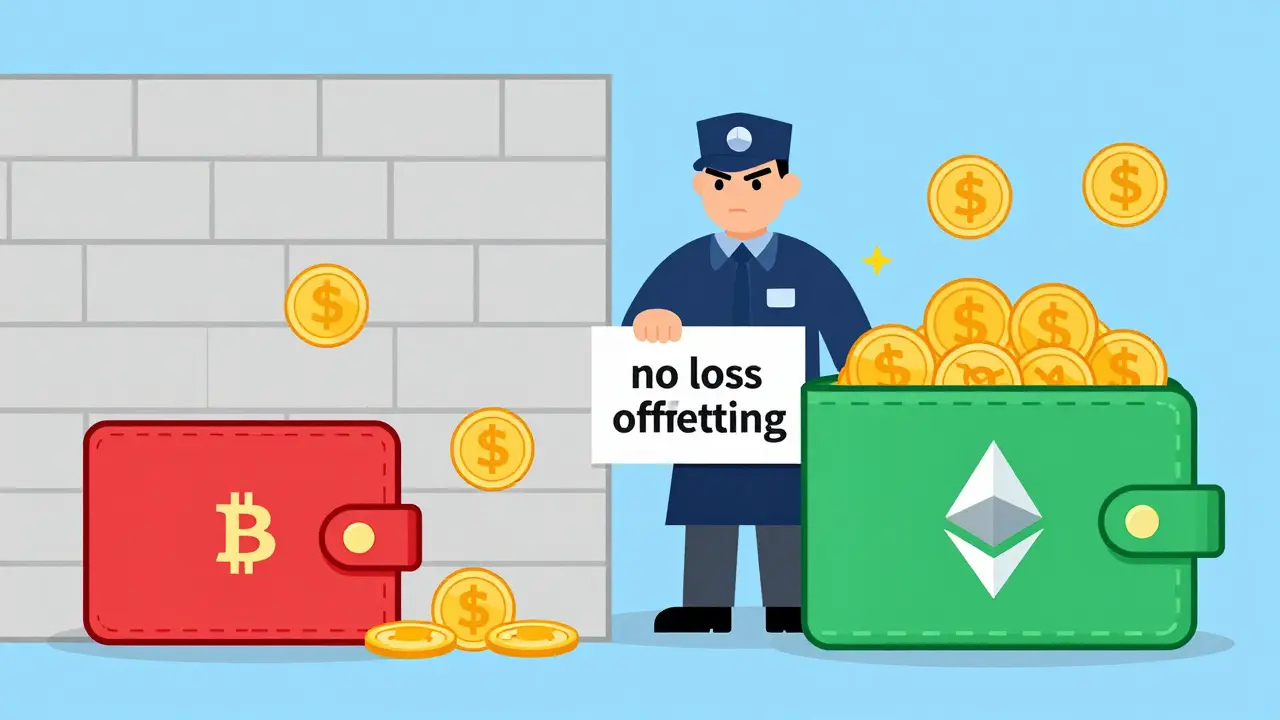
The most controversial aspect of India’s crypto tax regime is the prohibition on loss offsetting. This rule fundamentally changes how traders manage risk and portfolio performance. Under standard income tax principles, if you lose money on one investment, you can usually deduct those losses from your gains elsewhere to lower your overall tax bill. India’s VDA rules do not allow this.
Consider this scenario: You buy Bitcoin and lose ₹30,000 due to market volatility. Separately, you trade Ethereum and make a profit of ₹30,000. Your net financial position is zero-you haven’t actually gained anything. However, the tax department sees two separate events. They ignore the Bitcoin loss entirely. You must pay 30% tax on the ₹30,000 Ethereum profit, which amounts to ₹9,000. You cannot carry forward the Bitcoin loss to future years either. This means active traders who experience normal market ups and downs often end up paying taxes on paper gains that were effectively wiped out by simultaneous losses in other assets.
This restriction forces traders to be hyper-aware of each individual asset’s performance rather than looking at their portfolio holistically. It also discourages speculative trading, as the cost of being wrong is amplified by the inability to hedge tax liabilities against other successes.
TDS and GST: The Hidden Costs
Beyond the final tax bill you file annually, there are immediate deductions that affect your liquidity while you trade. Two key mechanisms operate here: Tax Deducted at Source (TDS) and Goods and Services Tax (GST).
| Charge Type | Rate / Threshold | Applicability | Impact on Trader |
|---|---|---|---|
| TDS (Section 194S) | 1% | On transfers exceeding ₹50,000 per year (₹10,000 for some cases) | Reduces immediate available capital; acts as advance tax payment. |
| GST on Services | 18% | Applied to exchange fees and services since July 2025 | Increases cost of entry/exit; added to trading fees. |
Tax Deducted at Source (TDS) under Section 194S requires exchanges to deduct 1% of the transaction value when the total crypto transfer exceeds ₹50,000 in a financial year. This amount is credited to your tax account, meaning it is not lost forever-it offsets your final tax liability when you file your return. However, it ties up your cash. If you are actively trading, this 1% deduction happens frequently, potentially locking up significant working capital until the next filing season.
Then there is the 18% GST, clarified in July 2025. This applies to the services provided by crypto platforms. When you pay a trading fee or withdrawal fee to an exchange, that fee is subject to 18% GST. While this doesn’t directly tax your profit, it increases the overhead of every trade. For high-frequency traders, these cumulative fees can erode margins significantly, especially when combined with the 30% income tax on eventual profits.
Global Comparison: How Does India Stack Up?
To appreciate the weight of India’s approach, it helps to compare it with other major economies. Most countries treat cryptocurrency similarly to stocks or commodities, applying progressive capital gains rates. India’s flat 30% rate places it among the highest globally, creating a distinct competitive disadvantage for local exchanges and traders.
| Country | Tax Rate Structure | Loss Offsetting Allowed? | Key Difference |
|---|---|---|---|
| India | Flat 30% + Cess | No | Highest effective rate; no distinction between short/long term. |
| United States | 0%, 15%, or 20% (Capital Gains) | Yes | Lower rates for long-term holdings; losses can offset gains. |
| Germany | 0% after 1 year holding | Yes | Tax-free if held long enough; very trader-friendly. |
| Singapore | No Capital Gains Tax | N/A | No tax on personal investment gains; business income taxed normally. |
| United Kingdom | 10% or 20% (Capital Gains) | Yes | Standard capital gains rates apply; annual exemption available. |
In the United States, for instance, if you hold Bitcoin for more than a year, your capital gains tax could be as low as 15% or even 0% depending on your income bracket. You can also deduct losses against other gains. Germany goes further, offering complete tax exemption if you hold the asset for more than one year. Singapore imposes no capital gains tax on personal investments. India’s model stands out for its rigidity. By removing the incentive to hold long-term and prohibiting loss offsets, the policy effectively penalizes participation in the crypto market regardless of strategy.

Compliance and Record Keeping
Navigating this system requires meticulous record-keeping. The Indian Income Tax Department introduced Schedule VDA in income tax returns specifically for reporting virtual digital asset transactions. You must report every single gain and loss separately. This means you cannot simply provide a net profit figure from your exchange statement.
Traders need to maintain detailed logs including:
- Date of acquisition and disposal.
- Purchase price and sale price in INR.
- Transaction IDs and wallet addresses involved.
- Exchange names where trades occurred.
For casual investors with a few transactions a year, this might take 10-15 hours annually. For active traders managing multiple wallets and exchanges, tracking cost basis across thousands of transactions can consume 40-50 hours or require professional software assistance. Tools like ClearTax and Koinly have developed India-specific modules to help automate this process, integrating with major exchanges to pull data and calculate liabilities according to Section 115BBH rules.
A common pitfall is ignoring Peer-to-Peer (P2P) transactions. Even if you sell Bitcoin directly to another person via UPI or bank transfer, it is still a taxable event. The buyer may be liable for TDS if thresholds are met, and you are liable for income tax on the gain. Failure to report P2P gains can lead to scrutiny during audits, especially as banking channels increasingly flag large crypto-related transfers.
Market Impact and Future Outlook
The introduction of these taxes has had a tangible impact on the Indian crypto landscape. Industry reports indicate a 40-60% drop in trading volumes on domestic exchanges following the implementation of the 30% tax and TDS rules. Many retail users migrated to international platforms or engaged more heavily in P2P markets to delay tax implications, though this carries its own compliance risks.
Despite the harsh rates, the regulatory clarity has been appreciated by some institutional observers. Before 2022, the status of crypto was ambiguous. Now, while expensive, the rules are defined. As of mid-2026, there have been no changes to the core 30% rate or the loss offsetting ban. However, discussions continue regarding potential adjustments to TDS thresholds and integration with broader digital asset regulations overseen by the Reserve Bank of India (RBI) and the Securities and Exchange Board of India (SEBI).
For now, the strategy for most traders remains defensive: minimize unnecessary trades, keep impeccable records, and factor the 31.2% effective tax rate into every entry and exit decision. The era of treating crypto as a low-tax speculation vehicle in India is over.
Is the 30% crypto tax applied to my entire portfolio value?
No. The 30% tax is applied only to the capital gains-the profit you make when you sell or transfer your crypto. If you bought Bitcoin for ₹1,00,000 and sold it for ₹1,20,000, you pay tax on the ₹20,000 gain, not the full ₹1,20,000. If your crypto value drops, you owe no tax until you realize a gain through a sale.
Can I claim losses from Bitcoin against profits from Ethereum?
No. Under Section 115BBH, losses from one Virtual Digital Asset cannot be set off against gains from another. Each transaction is treated independently. If you lose money on Bitcoin but profit on Ethereum, you must pay the full 30% tax on the Ethereum profit without deducting the Bitcoin loss.
Do I need to pay tax if I just hold Bitcoin and don't sell?
No. India does not have an annual wealth tax on cryptocurrency holdings. You only owe tax when you trigger a "transfer," which includes selling, exchanging for fiat currency, swapping one crypto for another, or gifting the asset. Mere holding does not create a tax liability.
How does the 1% TDS affect my final tax bill?
The 1% TDS is an advance payment of your tax liability. It is deducted at the source by the exchange when your annual transfers exceed ₹50,000. When you file your income tax return, this amount is credited against your total tax due. If your calculated tax liability is higher than the TDS paid, you pay the difference. If TDS exceeds your liability, you can claim a refund.
Are transaction fees deductible from my taxable gains?
No. The current rules allow only the cost of acquisition (purchase price) to be deducted from the selling price. You cannot deduct exchange fees, network gas fees, or storage costs. This means your taxable base is slightly higher than your actual net economic gain, increasing your effective tax burden.
Terry Hyland
June 19, 2026 AT 08:29the government is stealing from you because they know you are weak. this tax is just a way to control the people who try to be free. i say we should all stop paying and let them come for us. it is a conspiracy to keep us poor while the rich get richer in secret. do not trust the system ever.
Monica Pathammavong
June 20, 2026 AT 11:05u really need to look at ur own portfolio before complaining about taxes lol. its not hard math if u actually pay attention. also why r u trading so much if u cant handle the fees? maybe ur strategy is bad. dont blame govt for ur own losses. typical victim mentality here. fix urself first.
Tim Lefebvre
June 21, 2026 AT 14:24hey guys just wanted to add that koinly works pretty good for this stuff. i used it last year and it saved me hours of manual entry. yeah the tax is high but at least u can automate the reporting part. makes life easier for sure. hope that helps someone out there.
Amit Thakur
June 22, 2026 AT 21:15listen up traders! this is the reality check we needed. section 115BBH is brutal but we gotta adapt or die. no loss offsetting means every trade must be alpha. if u cant beat the 31.2% hurdle rate then stay away from vda markets. leverage your gains aggressively because passive holding is dead money now. wake up and grind smarter not harder.
Eric Scheinberg
June 22, 2026 AT 22:46it is important to note that compliance is mandatory regardless of sentiment. the schedule vda requirement ensures transparency which benefits the broader financial ecosystem over time. one must maintain precise records of acquisition and disposal dates to avoid penalties during audits. professional software assistance is highly recommended for those with high transaction volumes.
pankaj chawla
June 23, 2026 AT 14:30i agree with the points on record keeping. it is tedious but necessary. i use a simple spreadsheet for my smaller trades and switch to software when volume picks up. the key is consistency. if you document everything as you go it becomes manageable later. lets support each other in staying compliant and growing our portfolios despite the challenges.