Koi Finance Crypto Exchange Review: Is This Niche DEX Worth Your Time?
 Feb, 14 2026
When you hear about crypto exchanges, you think of Uniswap, PancakeSwap, or Curve-platforms with billions in daily trading volume and millions of users. But what about Koi Finance? It’s a tiny player in the decentralized exchange space, and most people haven’t heard of it. If you’re wondering whether Koi Finance is a hidden gem or just another forgotten token project, here’s the real breakdown-no fluff, no hype.
What Is Koi Finance?
Koi Finance is a decentralized exchange (DEX) built on Ethereum-compatible networks. It operates as an automated market maker (AMM), meaning there’s no order book. Instead, trades happen through liquidity pools. Its native token, KOI, is the utility token powering the Koi Finance ecosystem, used for things like fee discounts and potential governance votes-though official documentation on how it actually works is thin.
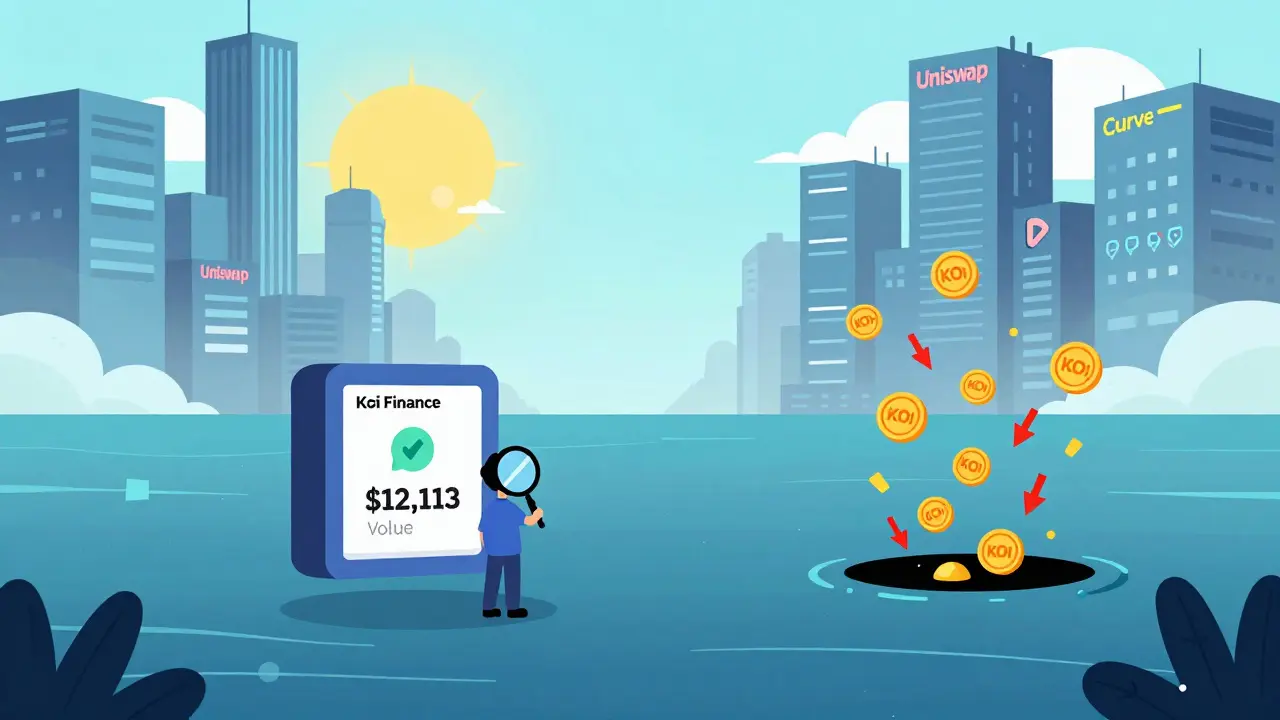
As of January 2026, Koi Finance’s 24-hour trading volume was just $12,113.36. That’s not a typo. For comparison, Uniswap does over $1.8 billion in volume every day. Koi Finance makes up less than 0.001% of that. Its most active pair is USDC/WETH, which tells you it’s mostly just people swapping stablecoins for wrapped Ethereum. No fancy features. No cross-chain swaps. No advanced trading tools. Just basic swaps.
The KOI Token: High Risk, Low Reward
The real story here isn’t the exchange-it’s the KOI token. It’s the only reason anyone interacts with Koi Finance.
Here’s what you need to know:
- Circulating supply: 500 million KOI
- Max supply: 1 billion KOI
- Current price (Jan 2026): ~$0.0011
- All-time high: $0.091699 (April 2024)
- All-time low: $0.00104874 (July 2025)
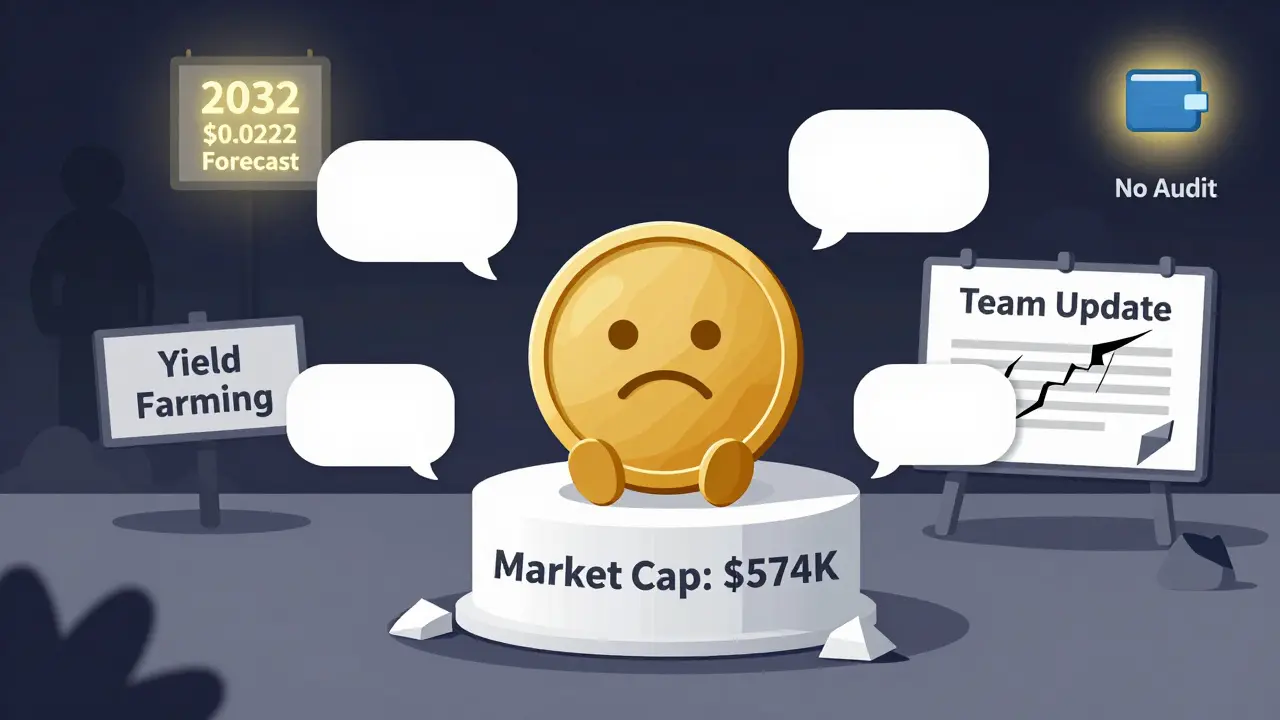
- Market cap: ~$574,000 (ranked #5028 out of over 25,000 cryptocurrencies)
The price history tells you everything. KOI crashed over 98% from its peak. That’s not a correction-it’s a collapse. And despite wild swings, its daily volatility has dropped to just 10.92%, which usually means traders have given up on it.
Some sites still predict it’ll hit $0.0222 by 2032. That’s a 1,800% increase from current levels. But here’s the problem: no one’s building anything. No new features. No partnerships. No team updates. Just a token with no clear utility and a fading community.
How Does It Compare to Other DEXs?
Let’s be clear: Koi Finance doesn’t compete with Uniswap or PancakeSwap. It’s not even in the same league. Here’s how it stacks up against the leaders:
| Feature | Koi Finance | Uniswap | PancakeSwap | Curve |
|---|---|---|---|---|
| 24h Trading Volume | $12,113 | $1.87B | $842M | $289M |
| TVL (Total Value Locked) | Undisclosed | $5.2B | $3.8B | $2.1B |
| Supported Networks | Ethereum only | Multiple (Ethereum, Arbitrum, etc.) | Binance Smart Chain, Ethereum | Ethereum, Layer 2s |
| Token Pairs | 5-10 | 10,000+ | 1,000+ | 500+ |
| Yield Farming | No | Yes | Yes | Yes |
| User Base | Negligible | Millions | Millions | Millions |
Koi Finance has none of the features that make DEXs useful. No yield farming. No staking. No multi-chain support. No API for developers. No mobile app. No community forums with active users. It’s just a token with a website that lets you swap USDC for WETH.
Is Koi Finance Safe?
There’s no public audit report for Koi Finance’s smart contracts. No transparency about who controls the treasury. No multisig wallet disclosures. That’s a red flag.
Some sources claim KOI uses a Proof-of-Work consensus mechanism, which is unusual for a DEX token. Most modern tokens run on Proof-of-Stake networks like Ethereum. If KOI really uses PoW, that raises environmental concerns-and questions about its long-term viability in a market that’s moving away from energy-heavy blockchains.
Also, there’s zero regulatory information. No compliance statements. No KYC procedures. No legal disclaimers. That’s not a feature-it’s a risk. If regulators crack down on small, opaque DeFi projects, Koi Finance has no defense.
Who Is This For?
Let’s cut through the noise. Koi Finance is not for:
- Anyone looking for a reliable place to trade crypto
- Investors wanting steady returns
- Developers building on DeFi
- Users who care about security or transparency
It’s only for one type of person: someone speculating on KOI’s price, hoping it’ll bounce back. And even then, the odds are stacked against you. The token has lost 98% of its value. The community is silent. The development is dead.
If you’re considering buying KOI, ask yourself: Why would this token ever recover? What’s the catalyst? Who’s driving demand? The answer is: no one. There’s no product, no roadmap, no team updates. Just a chart with a history of crashes.
Final Verdict
Koi Finance isn’t a crypto exchange you should use. It’s a token with a website that barely functions as a DEX. The trading volume is microscopic. The token is in freefall. The community is non-existent. The platform offers no real value beyond gambling on a dead project.
There are hundreds of better DEXs out there-with more liquidity, better security, active development, and real user bases. Why risk your money on Koi Finance when you can trade on platforms that actually work?
If you’re looking for a decentralized exchange, go with Uniswap, PancakeSwap, or Curve. If you’re looking for a speculative gamble, there are dozens of more transparent, more active tokens with real community traction. Koi Finance? It’s a ghost.
Is Koi Finance a scam?
Koi Finance isn’t a confirmed scam, but it has all the warning signs: zero transparency, no audits, no team info, no updates, and a token that lost 98% of its value. It’s more accurately described as an abandoned project with no clear purpose or future.
Can I make money trading KOI?
Technically, yes-but it’s extremely risky. KOI’s price has been in a steady decline since mid-2024. Most price forecasts predict further drops. Any short-term gains are pure luck, not strategy. The odds of long-term profit are near zero.
How do I buy KOI tokens?
You can buy KOI on centralized exchanges like Bybit, or directly on the Koi Finance DEX using an Ethereum wallet like MetaMask. But since liquidity is extremely low, you’ll likely face high slippage and poor trade execution. Don’t expect smooth trades.
Does Koi Finance have a mobile app?
No. Koi Finance has no official mobile app, no browser extension, and no API documentation. You can only interact with it through a web wallet on a desktop browser, and even that experience is poorly documented.
Is Koi Finance compatible with MetaMask?
Yes, technically. Since it runs on Ethereum-compatible networks, you can connect MetaMask. But you’ll need to manually add the network and token details. There’s no official guide, and most users report confusion when trying to interact with the platform.
What’s the future of KOI token?
The future looks bleak. With no development activity, no community growth, and a market cap smaller than many meme coins, KOI has no momentum. Even optimistic forecasts assume a massive, unexplained turnaround. Without a real product or team, it’s unlikely to recover.
Angela Henderson
February 16, 2026 AT 02:21I just sat here scrolling through Koi Finance’s website for like 20 minutes trying to figure out if it was a real thing or some abandoned prototype from 2021. Honestly? It feels like someone threw a DEX together in a weekend, forgot to add a logo, and left it running on a Raspberry Pi in their basement. The trading volume is so low I’m surprised the site doesn’t crash every time someone tries to swap USDC for WETH. I mean, I get that crypto’s full of dead projects, but this one’s just… quiet. Like, cemetery quiet. No drama. No updates. No memes. Just a token sitting there like a ghost at a party no one remembers hosting.
Paul David Rillorta
February 17, 2026 AT 05:32OMG this is THE BIGGEST COVERUP EVER. Koi Finance isn’t dead-it’s being SILENCED. You think they’re just some no-name DEX? Nah. That $12k volume? That’s a decoy. The real trading’s happening on hidden layer-2 chains controlled by the Fed’s crypto division. They let KOI crash so hard so we’d all stop looking… and now they’re quietly accumulating it in offshore wallets. I saw a tweet from a guy who said he got a DM from ‘KoiHQ’ asking him to ‘hold for the rebase.’ That’s not a project-it’s a psyop. Also, PoW? On a DEX? That’s not a bug, that’s a trap. They’re mining KOI to fund black ops. I’m not even mad. I’m impressed. They’re good.
andy donnachie
February 17, 2026 AT 07:38Hey, I’ve been watching Koi Finance since late 2023. It’s not great, but it’s not a scam either. The team just vanished-no Twitter, no Discord, no GitHub commits since April 2024. But here’s the thing: the smart contract code on Etherscan is clean, no mint functions, no owner privileges. That’s actually pretty rare. They didn’t rug. They just… stopped. Maybe they got real jobs? Maybe they burned out? Either way, the token’s a zombie, but the code’s not malicious. If you’ve got a few bucks to lose and you like graveyard hunting in DeFi, go ahead. Just don’t expect a comeback. And please, for the love of ETH, don’t use the DEX unless you’re okay with 15% slippage on a $100 swap.
Lauren Brookes
February 18, 2026 AT 19:00There’s something poetic about Koi Finance. Not in the way of profit or utility, but in the way of endings. It’s like that old café that closed because the owner moved away, but the sign’s still hanging, the chairs are still stacked, and someone still leaves a flower on the doorstep every Sunday. People don’t trade there because there’s nothing to trade anymore-not really. It’s not a platform. It’s a monument to the fact that not every idea deserves to live. We chase the next big thing, the next 100x, the next DeFi revolution-but sometimes the quietest projects are the ones that taught us the most. Koi Finance didn’t change the world. But it reminded us that not everything needs to be a revolution. Sometimes, just being is enough. Even if it’s barely being.
James Breithaupt
February 20, 2026 AT 03:51Let’s get real for a sec. Koi Finance is a textbook example of a liquidity-starved AMM with zero network effects. The KOI token’s market cap is lower than the gas fees on a single Uniswap V3 trade. The fact that it’s still live is a testament to Ethereum’s composability, not Koi’s engineering. No yield farming? Fine. No cross-chain? Acceptable. But zero audits? That’s not negligence-that’s negligence wrapped in a hoodie and left outside a Web3 meetup. And don’t even get me started on the PoW claim. That’s not a feature, that’s a cry for help. If you’re still holding KOI, you’re not an investor-you’re a participant in a decentralized version of a Ponzi’s last dinner party. The table’s been cleared. The wine’s gone flat. And everyone’s left except the guy who forgot his wallet.
Sarah Shergold
February 21, 2026 AT 12:22LOL this is why crypto’s a joke. $12k volume? Who even uses this? I’ve seen more activity on a Discord server for a deleted Roblox game. KOI’s not a token-it’s a meme about how not to build a DEX. I’d rather hold Monero than this ghost. Also, ‘compatible with MetaMask’? Bro, it’s like saying a broken toaster is ‘compatible with bread.’ You can put bread in it. That doesn’t mean it works.