Mandala Exchange Review: Is This Binance Cloud Platform Worth Your Trade?
 Apr, 8 2026
Finding a trading platform that doesn't eat your profits with hidden fees is a bit like searching for a needle in a haystack. Most of us are tired of the big names charging a premium just for the privilege of trading our own assets. Enter Mandala Exchange is a cryptocurrency trading platform launched in 2020 that leverages the Binance Cloud infrastructure to offer high liquidity and low costs. But does being a "Binance-powered" exchange actually make it a safe bet, or is it just a fancy marketing layer over a risky platform?
If you are already holding a portfolio of coins and want to swap them without paying a fortune in bridge fees or trading commissions, this platform looks tempting. However, if you are a complete beginner trying to buy your first fraction of a coin with a credit card, you might find the experience frustrating. Let's break down where this exchange actually fits in the current market.
The Core Engine: What is Binance Cloud?
To understand how Mandala works, you have to understand the Binance Cloud. Essentially, Mandala isn't building its own trading engine from scratch. Instead, it uses a white-label solution from the world's largest exchange. This means they get to plug directly into Binance's liquidity infrastructure, which is a huge deal. In plain English: you get the deep order books and fast execution speeds of a giant, but through a smaller, separate interface.
Because of this partnership, Mandala claims access to some of the largest liquidity pools globally. For the average trader, this means your trades are more likely to execute at the price you see on the screen without massive "slippage" (that annoying gap between the expected price and the actual price). They also leverage SAFU (Secure Asset Fund for Users), a safety net designed to protect user funds in extreme scenarios, though the extent of this protection for Cloud partners can sometimes be a gray area.
Trading Fees and the MDX Token
Where Mandala really tries to win over users is in the wallet. While giants like Coinbase are known for pricing that can feel like a daylight robbery, Mandala keeps things lean. Their fee structure is straightforward and aggressive.
| Fee Type | Mandala Exchange | Standard Industry Average |
|---|---|---|
| Maker Fee | 0.025% | 0.1% - 0.4% |
| Taker Fee | 0.075% | 0.2% - 0.6% |
To make these fees even lower, the platform introduced the Mandala Token (also known as MDX). By holding this native utility token, you can get trading rebates and discounts. It's a classic exchange move: give the users a reason to hold the house coin to save money on trades. If you're a high-volume trader, the math usually checks out, but for casual users, buying MDX just to save a few cents might be overkill.
Multi-Chain Support: Goodbye Bridge Fees
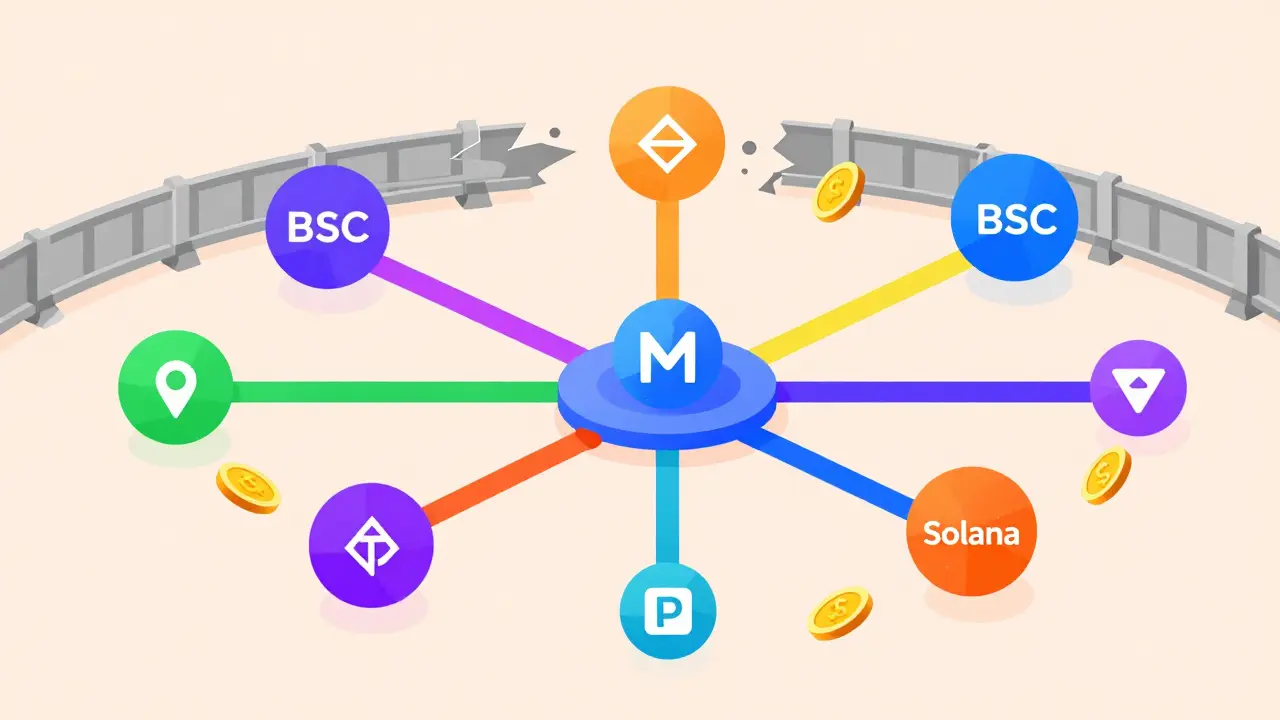
If you've ever tried to move assets between Binance Smart Chain (BSC), Polygon, and Solana, you know that "bridges" are often expensive and a nightmare to navigate. One of the strongest selling points of Mandala is its multi-chain support. It allows you to handle assets across various networks without the need for expensive third-party bridges.
The platform supports over 100 cryptocurrencies, including the heavy hitters like Bitcoin, Ethereum, and Cardano. This makes it a great hub for the "intermediate" trader-someone who knows how to manage a private wallet and just wants a low-cost place to shuffle their assets across different ecosystems like Avalanche or Fantom.
The "Catch": Fiat Onramps and Accessibility
Here is where the honeymoon phase ends for many users. Mandala is not a "one-stop-shop" for beginners. Most major exchanges allow you to link a bank account and buy crypto with a few clicks. Mandala doesn't do that. They are primarily a crypto-to-crypto platform. If you don't already own cryptocurrency, you can't just deposit US Dollars or Euros directly into the exchange.
They do offer a workaround through Indacoin, a third-party service based in London. This allows you to use a Visa or Mastercard to purchase MDX tokens. However, adding a third-party middleman adds another layer of complexity and potentially another set of fees. If you are a total newbie, you're better off starting with a platform like Kraken or Coinbase and then moving your funds to Mandala once you want to take advantage of the lower fees.
Furthermore, if you live in the United States, forget about it. Mandala is unavailable in the US. This is a massive blind spot, as the US is one of the largest trading markets in the world. This restriction is likely due to the platform's unregulated status, which makes it a tough sell for the strict legal requirements of the SEC or CFTC.
Security, KYC, and the Trust Factor
The question of security is always the most stressful part of choosing an exchange. On paper, Mandala is strong because it uses the Binance Cloud framework. This includes multi-signature cold wallets and withdrawal whitelisting. The fact that you can withdraw up to two Bitcoin per day without identity verification (KYC) is a huge draw for privacy advocates. You can sign up with just a name and email, deposit your coins, and start trading.
But here's the red flag: the regulatory story is confusing. Some sources list them as being based in the Seychelles, others say Malta. While they claim to adhere to strict legal standards, independent reports suggest they are largely unregulated. In the crypto world, "unregulated" often means "no one is watching the books." While the Binance Cloud tech provides a safety blanket, the actual management of the exchange is a separate entity. You're trusting Mandala Acquisition LLC with your keys.

User Experience: A Tale of Two Perspectives
If you look at the reviews, you'll see a weird contradiction. Some professional reviewers call the interface "high speed and efficient," while actual users on Reddit and other forums describe it as a "nightmare" or a "maze." This usually happens when a platform is designed for power users but marketed to beginners.
The trading bots integration is a nice touch for those who want to automate their strategies, but the general lack of comprehensive user guides makes the learning curve steeper than it needs to be. Customer support is another point of contention. While the company claims 24/7 availability, real-world feedback suggests that response times can be painfully slow. If you're a trader who needs an immediate answer when a transaction hangs, this lack of consistent support could be a dealbreaker.
Is Mandala Exchange safe to use?
It's a mixed bag. On the technical side, it uses Binance Cloud's security, which is top-tier. However, the exchange itself is largely unregulated and has conflicting information about its headquarters. As with any exchange, the safest move is to use it for trading and keep your long-term holdings in a hardware wallet.
Can I use Mandala Exchange in the USA?
No, Mandala Exchange is not available to users in the United States. If you are a US resident, you will need to look for alternatives that are compliant with US regulations.
Do I need KYC to trade on Mandala?
Not for basic crypto deposits and small withdrawals. You can currently withdraw up to two Bitcoin per day without going through a full identity verification process, making it a good option for those prioritizing privacy.
How do I buy crypto on Mandala if I only have cash?
Since Mandala doesn't offer direct fiat deposits, you have to use a third-party provider like Indacoin to buy MDX tokens with a credit card, or buy crypto on another exchange and transfer it to your Mandala wallet.
What is the benefit of the MDX token?
The MDX token acts as a utility coin within the ecosystem. Holding it allows you to access lower trading fees, receive rebates, and participate in platform-specific giveaways.
Final Verdict: Who is this for?
Mandala Exchange isn't trying to be the next Coinbase. It's a specialized tool for a specific type of person. If you're an experienced trader who already owns crypto, hates paying bridge fees, and wants the liquidity of Binance without using the main Binance app, this is a strong contender. The low fees are genuinely impressive and can save you a significant amount over hundreds of trades.
However, if you're a beginner, the lack of easy bank transfers and the confusing interface will likely push you away. And for anyone in the US, it's simply a non-starter. The regulatory uncertainty is the biggest long-term risk; in an industry moving toward strict compliance, being an "unregulated global exchange" is a dangerous game to play. Use it for what it is: a low-cost bridge for your assets, but don't treat it as your primary bank.
Rob Mitchell
April 10, 2026 AT 04:46Solid breakdown. Definitely agree that keeping long-term bags in cold storage is the only way to go.
Alan Seiden
April 10, 2026 AT 11:47Typical rubbish. Only a complete idiot would trust a platform based in the Seychelles. We in the UK actually understand what regulation means, unlike the savages running these shell companies.
EDOZIEM MICHAEL
April 11, 2026 AT 00:20money is just a flow of energy anyway so why worry about the bridge as long as the vibe is right
Samson Selleck
April 11, 2026 AT 03:01The marginal utility of MDX is practically negligible when you factor in the opportunity cost of capital. The liquidity arbitrage here is a mere derivative of the Binance ecosystem, offering no actual alpha for the sophisticated trader. It is an elementary exercise in brand dilution.
Tracie and Matthew Hartley
April 12, 2026 AT 17:58who cares if its unregulated lol that's the whole point of crypto anyway its for the wild west vibes
jennelle williams
April 14, 2026 AT 16:30just stay safe everyone
Chidinma Sandra okafor
April 14, 2026 AT 18:45Oh sure, because these platforms are just so incredibly honest. I love how we pretend these "innovations" aren't just new ways to lose money faster while the owners laugh in their offshore villas.
Akshay Gorad
April 15, 2026 AT 14:49I believe it is important to note that the lack of KYC for certain withdrawals is a double-edged sword for the community.
Lauren Abrams
April 17, 2026 AT 03:13The multi-chain support sounds pretty convenient for anyone tired of those endless bridge hurdles.