MDEX Crypto Exchange Review: Is This Decentralized Exchange Still Viable in 2026?
 Mar, 18 2026
When you hear the name MDEX, you might think of a thriving decentralized exchange with booming volume and active users. But if you check the numbers today, the story looks very different. Launched in January 2021, MDEX started with big promises: cross-chain trading, dual mining rewards, and a self-sustaining token economy. Now, in March 2026, its trading volume hovers around $11,480 daily, and it ranks 240th among all crypto exchanges. That’s not a glitch. That’s a collapse.
What Is MDEX, Really?
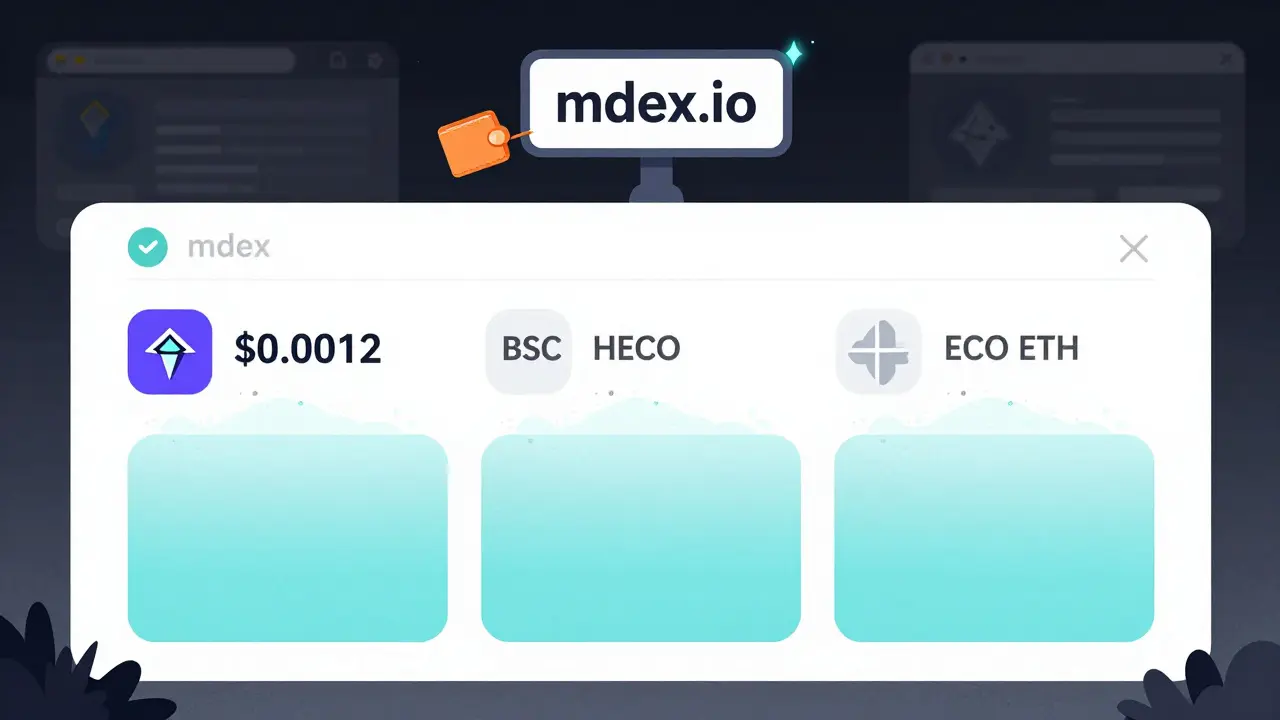
MDEX is a decentralized exchange (DEX) that runs on smart contracts across three blockchains: Binance Smart Chain (BSC), Huobi Ecological Chain (HECO), and Ethereum (ETH). Unlike centralized exchanges like Binance or Coinbase, MDEX doesn’t hold your funds. You connect your wallet-like MetaMask or TokenPocket-and trade directly from your account. That’s the whole point of DeFi: no middleman, no KYC, no bank.
Its original edge? Low fees. When Ethereum gas fees spiked to $50 per trade in 2021, MDEX offered similar trades for less than $0.10 on HECO and BSC. That drew in traders looking for speed and affordability. It also introduced a unique system called “dual mining.” For every trade, 66% of fees went into buying back MDX tokens and burning them, while the rest bought HT (Huobi Token). Stakers got rewards too. The idea was simple: more trading = more MDX burned = higher token value.
At its peak in early 2021, MDEX’s Total Value Locked (TVL) hit $3.4 billion. People were rushing in. MDX token hit an all-time high of $10. But that was the high water mark. Since then, everything went downhill.
The MDX Token Crash: A 99.6% Drop
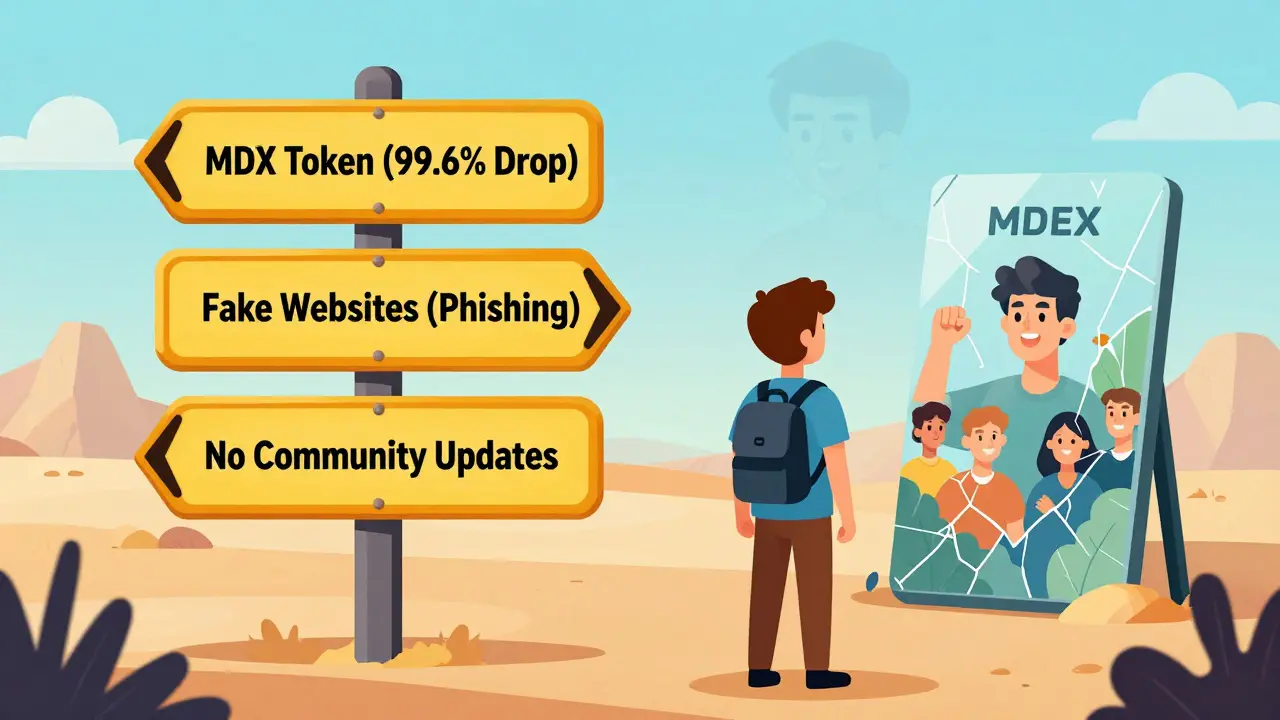
The biggest red flag isn’t the low volume. It’s the token price. MDX peaked at $10 in February 2021. Today? It’s trading around $0.0012. That’s a 99.63% drop from its peak. Let that sink in. A $1,000 investment in MDX at its peak is now worth $3.70.
Why? Because the token economy didn’t hold up. Burning MDX sounds great on paper, but if no one is trading, there’s no fee income to burn. No burn = no price support. And without price support, stakers leave. And when stakers leave, liquidity dries up. That’s a death spiral.
Some price forecasters still cling to hope. CoinLore says MDX could hit $0.60 by 2030. PricePrediction.net predicts $0.45. But WalletInvestor and TradingBeast see it falling below $0.007. These aren’t guesses-they’re based on current trends. And the trend is clear: MDX is losing value, not gaining it.
Competitors Are Leaving MDEX in the Dust
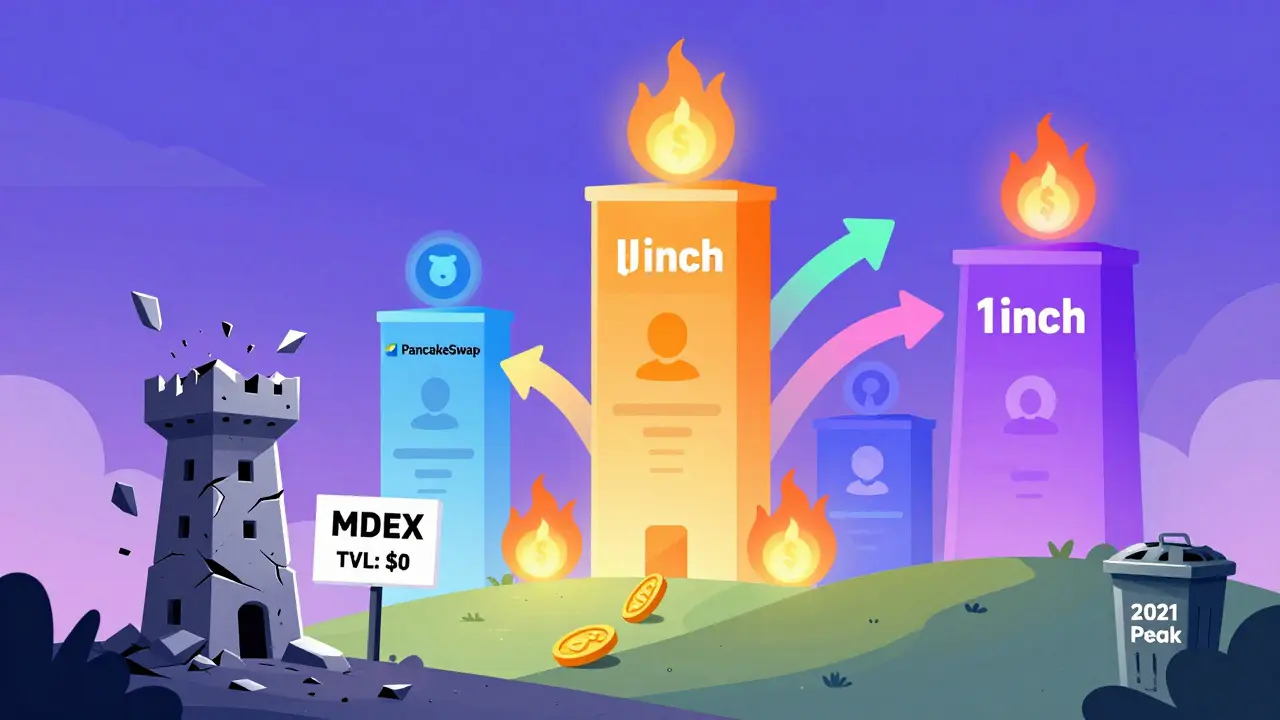
MDEX was never alone. On BSC, PancakeSwap dominates with over $5 billion in TVL. On Ethereum, Uniswap handles $30 billion. Even Sushiswap and 1inch have 10x the daily volume MDEX does.
What made MDEX different? Cross-chain support. The MDEX Bridge let users move assets between HECO, BSC, and ETH without going through centralized exchanges. That was useful. But today, every major DEX supports multi-chain. PancakeSwap works on Polygon. Uniswap has Layer 2s. MDEX’s edge? Gone.
And here’s the kicker: MDEX never built a real community. You won’t find active discussions on Reddit. No major influencers back it. No developer updates on GitHub. No press releases. Compare that to Uniswap, which has a DAO with 200+ active members and weekly governance votes. MDEX’s DAO? It exists on paper. But with MDX worth pennies, who cares?
Is MDEX a Scam?
This is where things get dangerous. ScamBitcoin has labeled MDEX a “confirmed scam that uses a fake website to steal your cryptocurrency.” They specifically warn against mdex.com and mdex.co-two domains that aren’t official.
So, is MDEX itself a scam? Probably not. The smart contracts are public. The code is open. But the brand has been hijacked. Fake sites mimic the real MDEX interface. They look identical. They even use the same logo. If you connect your wallet to one of these fake sites, your funds vanish. No warning. No refund. Just gone.
There’s no official MDEX app. No verified social media accounts. No customer support. The real site (mdex.io) is barebones, with minimal documentation. If you’re not a seasoned DeFi user who knows how to verify contract addresses, you’re at serious risk.
Who Should Even Try MDEX?
If you’re new to crypto? Don’t touch MDEX. The risks outweigh any potential rewards.
If you’re an experienced DeFi trader with a solid understanding of wallet security, contract verification, and tokenomics? Maybe you’ll find a few low-liquidity pairs to farm. But even then, you’re betting on a dead protocol.
Here’s the truth: MDEX’s infrastructure still works. The smart contracts haven’t been hacked. The bridge still functions. But the ecosystem is hollow. No users. No volume. No momentum. It’s like driving a car with a perfect engine-but no gas.
What Happened to MDEX?
It made three fatal mistakes:
- Overpromised-Dual mining sounded revolutionary, but it was unsustainable. When trading volume dropped, the reward system collapsed.
- Underinvested-No marketing, no community building, no developer outreach. It relied on hype, not loyalty.
- Ignored security-Allowing unverified domains to mimic its brand turned a technical project into a target for scammers.
The crypto market moves fast. In 2021, MDEX was hot. In 2026, it’s a ghost town. The tokens are still tradable. The wallets still connect. But the soul is gone.
Alternatives to Consider
If you want cross-chain DEXs with real volume and active communities:
- PancakeSwap (BSC) - Best for low fees, high liquidity, and active farming.
- Uniswap v3 (Ethereum + Layer 2s) - The gold standard for liquidity and governance.
- Curve Finance - Best for stablecoin swaps with minimal slippage.
- 1inch - Aggregator that finds the best rates across 15+ DEXs.
None of these have the MDX token drama. None of them have fake websites draining wallets. And all of them have real users.
Final Verdict
MDEX is not dead. But it’s not alive either. It’s in limbo.
Its technology was ahead of its time. Its tokenomics looked smart. But execution failed. Community failed. Security failed. And now, in 2026, the only people still using MDEX are either unaware of the risks or gambling on a miracle recovery.
If you’re looking for a DEX to trade on? Walk away. If you’re holding MDX? Consider it a paper loss and cut your losses. If you’re thinking of investing? Don’t. The data doesn’t lie. The price chart tells the whole story.
There’s no comeback story here. No redemption arc. Just a once-promising project that ran out of fuel-and now sits on the side of the road, collecting dust.
Is MDEX still operational in 2026?
Yes, the MDEX smart contracts are still active and functional on BSC, HECO, and Ethereum. You can still connect your wallet and trade tokens. However, daily trading volume is near zero, and the platform has no active development, community updates, or marketing. It’s technically alive but functionally obsolete.
Can I still earn rewards on MDEX?
Technically, yes. The dual mining system still exists, but there’s almost no trading volume to generate fees. Without fees, there’s no MDX to burn and no rewards to distribute. Staking pools are empty. Liquidity pools have been drained. Any rewards you see today are likely from leftover tokens-there’s no ongoing incentive structure.
Is mdex.com the real MDEX website?
No. The official MDEX website is mdex.io. Domains like mdex.com and mdex.co are fake and have been used in phishing scams to steal crypto. Always verify the URL before connecting your wallet. Even small typos can lead to total loss of funds.
Why did MDX crash so hard?
MDX crashed because its tokenomics relied on high trading volume to sustain value. When users moved to PancakeSwap and Uniswap-offering better fees and liquidity-the volume dried up. No volume meant no fee burns, which meant no price support. With no community or development team pushing updates, the token became a ghost asset. Over 99% of its peak value vanished.
Should I buy MDX now?
No. Buying MDX now is gambling, not investing. With a market cap under $5 million, zero development activity, and active scam websites targeting users, there’s no fundamental reason to believe MDX will recover. Even optimistic forecasts predict it may reach $0.07 by 2026-still 98% below its peak. The risk of total loss far outweighs any potential upside.
What wallets work with MDEX?
MDEX supports MetaMask, TokenPocket, Huobi Wallet, Math Wallet, ONTO, and Bitkeep. But because the platform is inactive and fake sites are rampant, you should only connect your wallet if you’ve confirmed you’re on the official mdex.io site. Never connect from links sent via Telegram, Twitter, or email.
Is MDEX regulated?
No. MDEX is a decentralized exchange and operates without any regulatory oversight. It doesn’t comply with KYC, AML, or MiCA regulations. This is standard for DEXs, but it also means there’s no legal recourse if funds are lost to scams or smart contract bugs. Always assume full responsibility for your actions on MDEX.
Can I withdraw my MDX from MDEX?
Yes. Since MDEX is non-custodial, your MDX tokens are always in your wallet. You can transfer them to any other wallet or exchange at any time. However, because MDX has almost no trading volume, you may struggle to sell it for ETH, BNB, or USDT without accepting a massive discount-or not selling at all.
If you’re still reading this, you’ve probably already heard conflicting things about MDEX. The truth is simple: the platform once had potential. Now, it’s a cautionary tale. Don’t chase dead projects. Build your portfolio on active, transparent, and community-driven protocols. Your crypto will thank you.
Prakash Patel
March 19, 2026 AT 01:14Zachary N
March 19, 2026 AT 03:31Katrina Smith
March 20, 2026 AT 12:36Billy Karna
March 22, 2026 AT 11:20Tobias Wriedt
March 23, 2026 AT 21:39