Midnight (NIGHT) Airdrop by Cardano: How the Glacier Drop Worked and Why It Mattered
 Feb, 17 2026
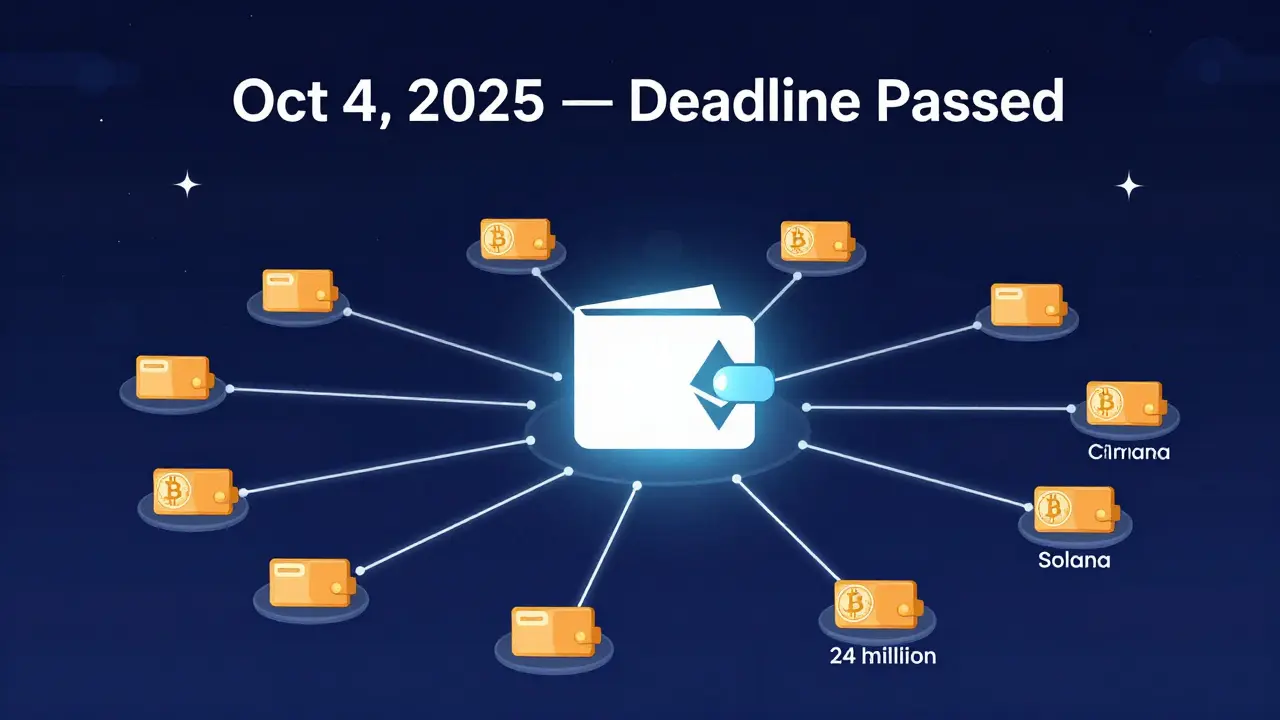
The Midnight (NIGHT) airdrop wasn’t just another token giveaway. It was one of the most carefully designed, cross-chain distribution events in cryptocurrency history - and it’s already over. Launched in August 2025 as the "Glacier Drop," this airdrop distributed 24 billion NIGHT tokens to over 34 million wallet addresses across eight blockchains. If you held even $100 worth of Bitcoin, Ethereum, or Cardano on June 11, 2025, you were eligible. But here’s the catch: you had to claim it yourself, using a Cardano wallet, and you only had 60 days to do it. The deadline passed on October 4, 2025. If you missed it, you missed the biggest chance to get involved.
Who Got Eligible and How
The Glacier Drop didn’t care if you were a whale or a beginner. It only cared about one thing: how much native cryptocurrency you held on a single day. On June 11, 2025, at an undisclosed time, the Midnight team took a snapshot of wallets on eight blockchains: Bitcoin, Ethereum, Ripple, Solana, Avalanche, BNB Chain, Brave (BAT), and Cardano. If your wallet had at least $100 worth of any of those assets at that moment, you qualified. No social media posts. No Discord roles. No surveys. Just pure on-chain ownership.The distribution wasn’t equal. Cardano holders got half of all NIGHT tokens - 12 billion. Bitcoin holders got 20%, or 4.8 billion. The remaining 30% was split among the other five chains based on how much total value was held on each. That meant if you held $500 in Ethereum and $200 in Bitcoin, you’d get a share of both allocations. You could claim from multiple chains if you qualified on more than one.
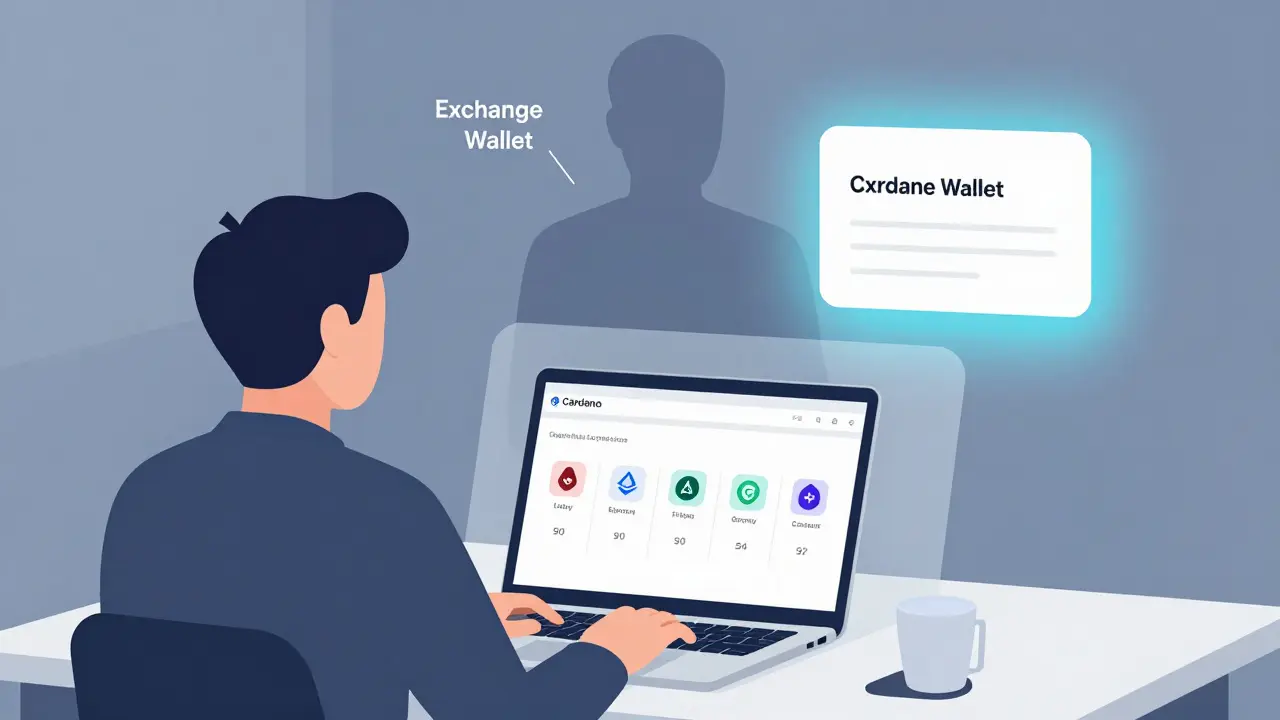
But not everyone got in. Exchanges like Binance, Coinbase, and Kraken were excluded unless they chose to claim on behalf of users - and almost none did. That’s because the claim process required you to prove you controlled your private keys. You couldn’t just log into your exchange account. You had to connect a self-custody wallet. If your crypto was sitting on an exchange, you were out of luck unless you moved it out before the snapshot.
The Claiming Process: Two Proofs, One Wallet
Claiming NIGHT wasn’t a one-click button. It was a two-step cryptographic process designed to stop bots and ensure real people got the tokens. First, you had to sign a message using your wallet - not to send funds, but to prove you owned the wallet that was snapshot. Second, you had to provide a brand-new Cardano wallet address to receive the tokens. That address had to be unused before. You couldn’t use an old one you’d already used for other transactions.This design had a big effect: it forced people to set up a Cardano wallet. Even if you only held Bitcoin or Ethereum, you still needed to interact with Cardano to claim. That meant downloading a wallet like Eternl, Lace, or Yoroi, learning how to generate a new address, and understanding how to sign messages. For many, this was the hardest part. Videos from community members became essential guides. One popular YouTube tutorial walked users through every step - from checking eligibility to finalizing the claim - and got millions of views.
The claim portal, available at midnight.gd and midnight.network, supported wallets from all eight chains. You could connect your MetaMask for Ethereum, Phantom for Solana, or Trust Wallet for BNB Chain. But no matter which chain you came from, the tokens always ended up on a Cardano address. That’s because Midnight is built as a privacy sidechain on Cardano. The tokens weren’t going to live anywhere else.
Why the Vesting Schedule Was a Game-Changer
Most airdrops hand out tokens and let you sell them immediately. That leads to massive dumps, crashing the price and leaving the project with no real users. Midnight flipped that script. Claimed NIGHT tokens didn’t unlock all at once. They were locked in a Cardano smart contract and released in four equal parts over 360 days - one quarter every 90 days. And here’s the twist: the unlock dates weren’t fixed. They were randomized after mainnet launch.This "gradual thawing" system was meant to stop coordinated selling. If everyone knew the exact day their tokens would unlock, they could plan a mass sell-off. But with random timing, no one could predict when their portion would become tradable. That forced holders to stay engaged. If you wanted to sell, you couldn’t just wait for a date. You had to watch, wait, and hope your unlock came first.
Plus, the tokens weren’t just for trading. They were meant to be used. NIGHT powers the Midnight network. You need it to participate in governance, run privacy nodes, and support applications built on the platform. The project didn’t want speculators. It wanted builders. The vesting schedule was a tool to turn airdrop recipients into long-term participants.
The Three-Phase Distribution: It’s Not Over Yet
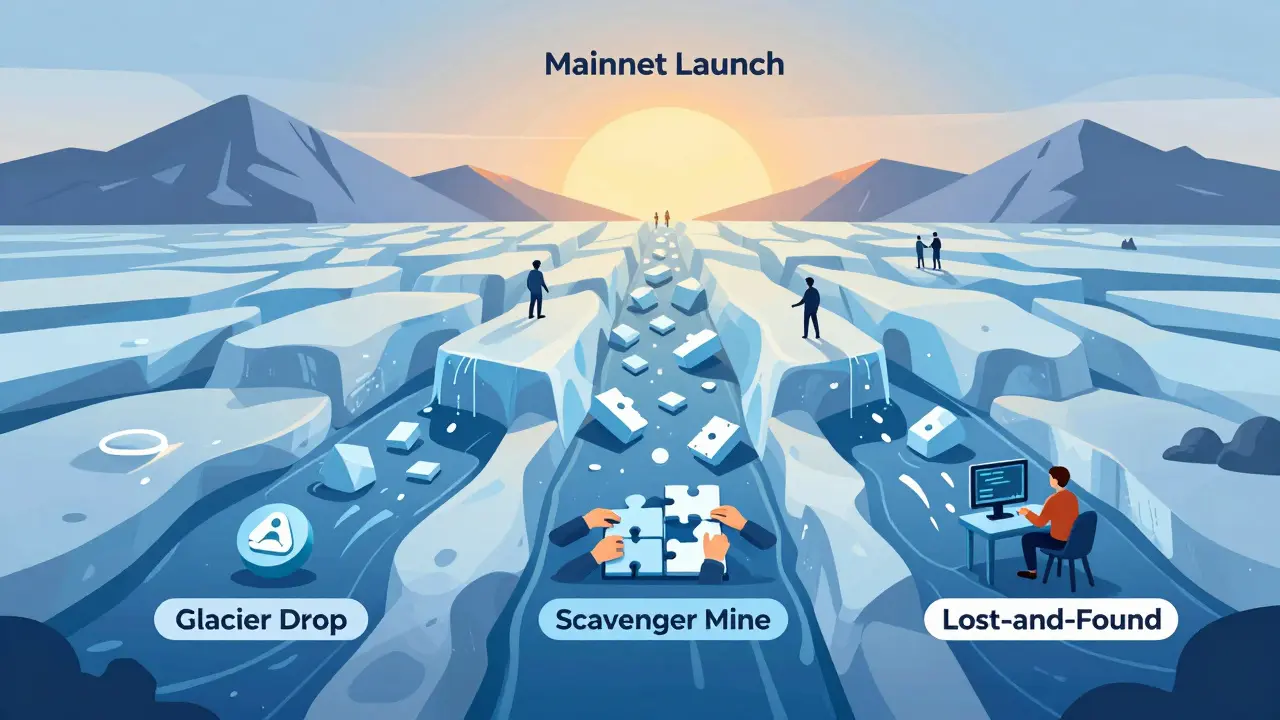
The Glacier Drop was just Phase One. The 24 billion tokens weren’t all claimed. Millions of eligible wallets didn’t complete the process. So what happened to the unclaimed tokens? They didn’t vanish. They didn’t go to the team. They went into Phase Two: the Scavenger Mine.In the Scavenger Mine, users solve public-good computational puzzles - tasks that help build the Midnight network’s infrastructure. Think of it like mining, but instead of using electricity to secure a blockchain, you’re using your computer to help test and improve privacy protocols. Solve the puzzles, and you earn a share of the leftover NIGHT tokens.
Then comes Phase Three: Lost-and-Found. After mainnet launches, anyone who missed both earlier phases can still claim tokens - but only if they actively contribute to the network. This could mean running a node, submitting code, or helping with community testing. The entire 24 billion supply will eventually be distributed, but only to people who do something useful for the network.
This structure is rare. Most airdrops are one-time events. Midnight turned its distribution into a multi-year engagement engine. It’s not about giving away free tokens - it’s about building a community that cares enough to earn them.
Why Midnight Matters
Midnight isn’t just another privacy coin. It’s trying to solve a real problem: you can’t have both utility and privacy on traditional blockchains. Bitcoin is transparent. Zcash is private but hard to use. Midnight says you shouldn’t have to choose. It uses advanced cryptography to let you hide transaction details while still being compliant with regulations. It’s called "rational privacy" - privacy that works with the real world, not against it.The Glacier Drop was its first major step. By targeting eight blockchains, Midnight reached users outside the Cardano bubble. By requiring self-custody, it avoided centralization. By locking tokens for 360 days, it discouraged speculation. And by creating three phases of distribution, it turned a simple airdrop into a long-term participation system.
Whether it works depends on what happens next. Mainnet launch, developer adoption, and real-world usage will determine if NIGHT becomes a key part of crypto’s privacy future. But one thing is clear: this wasn’t a marketing stunt. It was a blueprint for how to distribute tokens without creating a sell-off disaster.
What Happens Now?
The Glacier Drop is closed. The claim window is gone. If you didn’t claim by October 4, 2025, you lost your chance to get tokens from that phase. But you’re not out of the game.Start now: learn about the Scavenger Mine. Visit the Midnight documentation. Set up a Cardano wallet. Join the community. The next opportunity to earn NIGHT is tied to actual work - not passive holding. If you’re serious about privacy in blockchain, this is your chance to get involved before mainnet goes live.
The tokens are still out there. The network is still being built. And if you’re willing to put in the effort, you can still be part of it.
Was the Midnight airdrop only for Cardano holders?
No. While 50% of the NIGHT tokens (12 billion) were reserved for Cardano (ADA) holders, the airdrop was open to users across eight blockchains: Bitcoin, Ethereum, Ripple, Solana, Avalanche, BNB Chain, Brave (BAT), and Cardano. If you held at least $100 worth of any of those assets on June 11, 2025, you were eligible to claim a portion of the airdrop based on your holdings.
Can I still claim my Midnight (NIGHT) tokens?
The official Glacier Drop claiming window closed on October 4, 2025. If you didn’t complete the claim process by then, you can no longer claim from that phase. However, unclaimed tokens have moved into Phase Two: the Scavenger Mine. You can still earn NIGHT tokens by participating in public-good computational puzzles that help build the Midnight network. This is your new opportunity to earn tokens - but only through active contribution.
Why did I need a Cardano wallet to claim NIGHT tokens?
Midnight Network is a privacy sidechain built on Cardano. Although the airdrop snapshot included wallets from eight blockchains, all NIGHT tokens are issued and held on the Cardano blockchain. That’s why you had to provide a fresh, unused Cardano wallet address to receive your tokens - even if you only held Bitcoin or Ethereum. This design ensures that all participants engage with the Cardano ecosystem, which is central to Midnight’s architecture.
Why were exchange wallets excluded from the airdrop?
The Midnight team required self-custody wallets to ensure that only real users - not exchanges or bots - could claim tokens. Most exchanges don’t support airdrops because they can’t prove individual user ownership without moving funds, which creates legal and operational risks. If your crypto was on Binance, Coinbase, or Kraken, you had to move it to your own wallet before June 11, 2025, to qualify. Otherwise, you were ineligible.
How does the 360-day vesting schedule work?
Claimed NIGHT tokens are locked in a Cardano smart contract and unlock in four equal parts over 360 days - one quarter every 90 days. But unlike most vesting schedules, the unlock dates are randomized after Midnight’s mainnet launch. This prevents coordinated selling. You won’t know exactly when your tokens unlock, so you can’t plan a dump. The goal is to encourage long-term participation in the network, not short-term trading.
What’s the difference between NIGHT and DUST tokens?
NIGHT is the native utility token used for governance, staking, and participating in the Midnight network. DUST is the network’s resource token used to pay for transaction fees and computational operations. Think of NIGHT as the currency you earn and hold, and DUST as the fuel you spend to use the network. This dual-token model separates value storage from usage, helping stabilize the economy and prevent inflation.
Did the Midnight airdrop include OFAC compliance checks?
Yes. The Midnight team screened all eligible addresses against the U.S. Treasury’s Specially Designated Nationals (SDN) list. Any wallet linked to sanctioned entities was automatically excluded from the airdrop. This was done to ensure regulatory compliance and prevent abuse by bad actors - a rare step in the crypto space that helped the project maintain legitimacy while pushing for privacy.
Sarah Shergold
February 18, 2026 AT 12:04Andrew Edmark
February 18, 2026 AT 14:17After years of getting burned by airdrops that just crashed, this felt... different. Like someone finally cared about building something real instead of just sucking out liquidity. The vesting schedule? Genius. I didn't sell a single token. I'm learning to run a privacy node now. It’s weird, but I feel like I’m part of something that matters. 🙏
Dominica Anderson
February 20, 2026 AT 04:19sruthi magesh
February 21, 2026 AT 20:19Lisa Parker
February 22, 2026 AT 22:43Ian Plunkett
February 24, 2026 AT 06:23Now the Scavenger Mine is where the real men and women earn their tokens. The rest? They’re just ghosts in the ledger.