Multi-Currency Wallets: Pros and Cons for Businesses and Travelers
 Jan, 18 2026
Managing money across borders used to mean juggling multiple bank accounts, paying $30 in fees for every international transfer, and waiting days just to get paid. Today, a multi-currency wallet lets you hold, send, and receive over 40 currencies in one app-no more chasing exchange rates or paying hidden bank markups. But are they really as simple as they seem? For freelancers, e-commerce sellers, or small businesses shipping goods overseas, these wallets cut costs and save time. But they’re not perfect. Some freeze funds unexpectedly. Others hide fees in fine print. And if you only send money once a year, you might be better off sticking with your regular bank.
What Exactly Is a Multi-Currency Wallet?
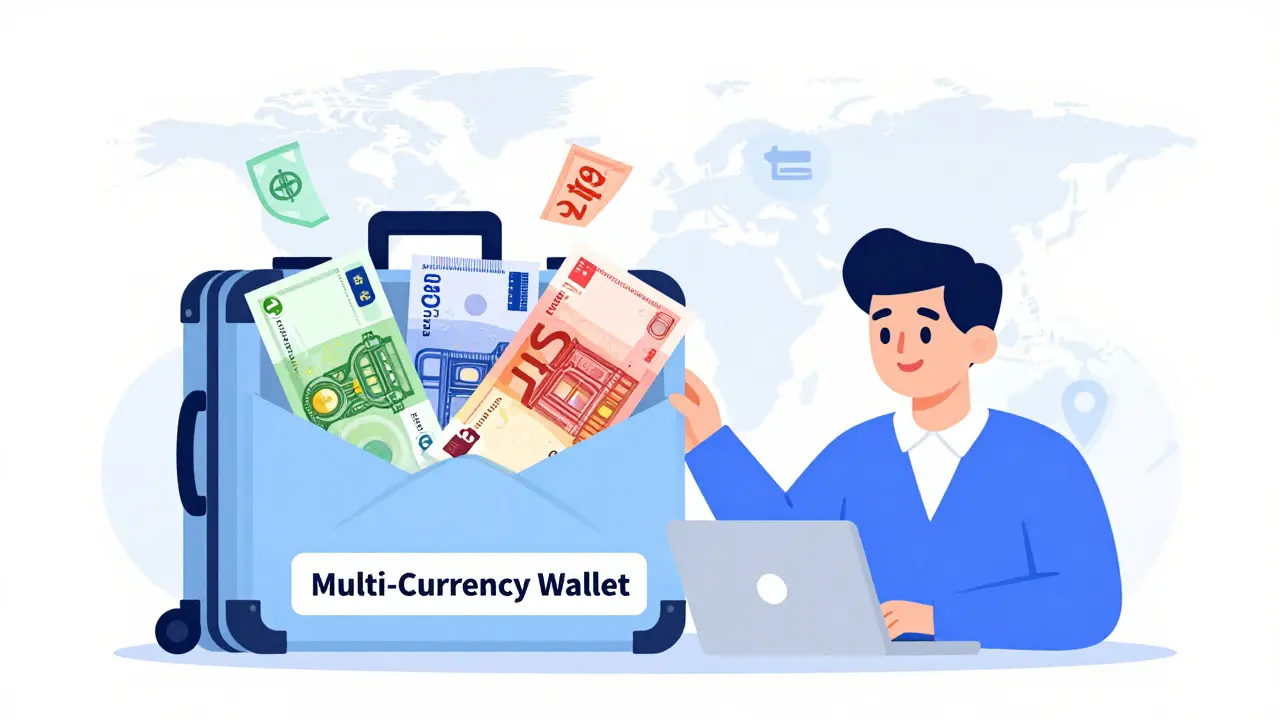
A multi-currency wallet is a digital account that lets you store, send, and receive money in multiple currencies-like USD, EUR, GBP, AUD, and even crypto in some cases-all from the same dashboard. Think of it like a digital suitcase that holds different kinds of cash, instead of needing a separate suitcase for each country.
These aren’t just crypto wallets. While some include Bitcoin or Ethereum, most are built for real-world money. Platforms like Wise, Airwallex, and Payset let you hold balances in up to 60 currencies. You can get local bank details in each currency-like a UK account number in GBP or a German IBAN in EUR-so clients can pay you like they’re paying a local business. That cuts out expensive international fees and speeds up payments from days to minutes.
They work through cloud-based systems with bank-level security: AES-256 encryption, two-factor authentication, and PCI DSS Level 1 compliance. Transactions happen in seconds domestically and under 30 seconds internationally-compared to the 3-5 days it takes for traditional SWIFT transfers.
Biggest Advantages of Multi-Currency Wallets
The biggest win? Saving money on exchange rates. Traditional banks charge 2.5% to 4.5% markup on currency conversions. Multi-currency wallets like Wise charge 0.35% to 0.65%. On a $100,000 transaction, that’s $2,500 to $4,500 in savings. For a freelancer earning €5,000 a month from clients in Europe, that’s over $300 saved every month.
Transfer fees are also way lower. Banks charge $25-$50 per international wire. Multi-currency wallets? Usually $1.50-$5.00. Payset users report cutting their monthly transfer costs by 70% after switching.
Then there’s convenience. Instead of logging into five different apps or bank portals, you manage everything in one place. You can see all your balances, track transactions in real time, and even schedule automatic conversions. Enterprise users say reconciliation time dropped from 15-20 hours a week to just 4-6. That’s a full workday saved every week.
Integration with tools like QuickBooks, Xero, Shopify, and WooCommerce means your accounting software automatically updates when payments land. No more manual entry. No more mismatches. For an e-commerce store selling to 8 countries, that’s a game-changer.
Where Multi-Currency Wallets Fall Short
Here’s the catch: not all wallets are created equal. Only about 30% support cryptocurrency. If you need to hold Bitcoin or USDT alongside USD and EUR, your options shrink fast. Most platforms are focused on fiat-real-world money-so crypto users need separate wallets.
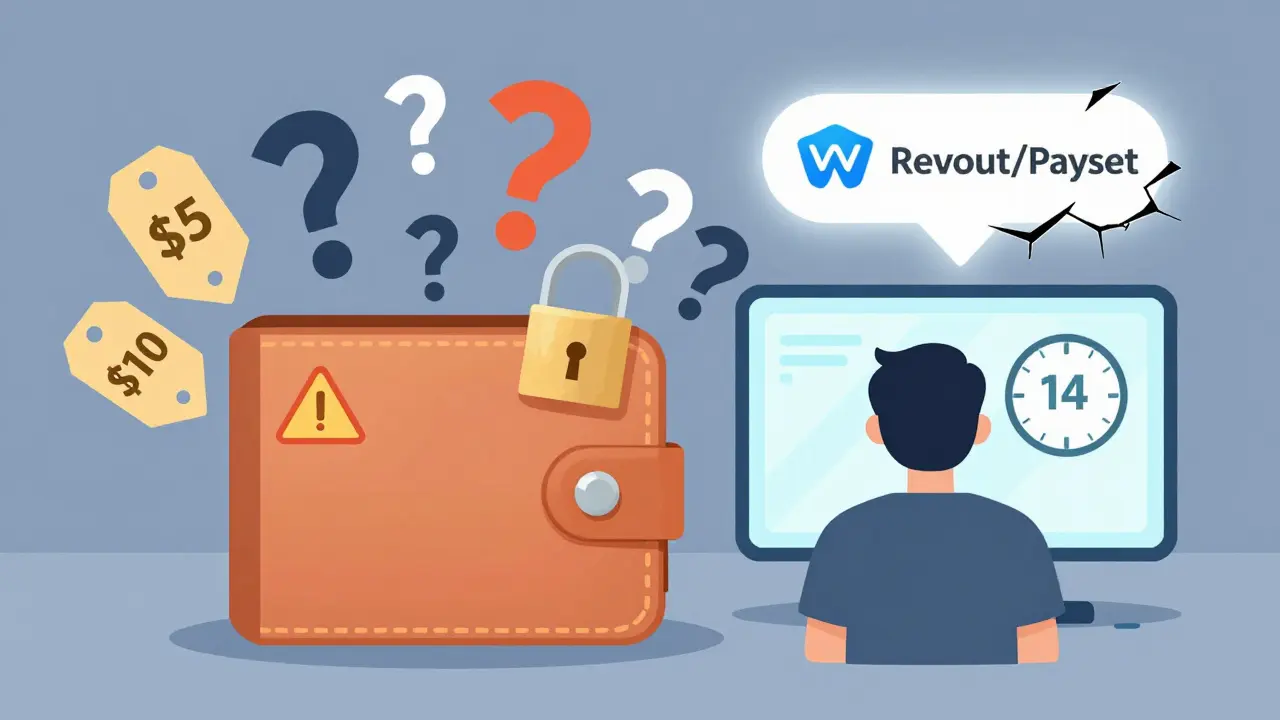
Regulation is another headache. Some countries, like Argentina and Venezuela, block foreign fintech services. Even if you’re based in the U.S., if you have clients in restricted regions, you might get locked out. And compliance holds? They happen. One user on Reddit had $8,500 frozen for 14 days because Airwallex flagged a payment as “unusual.” No explanation. No timeline. Just silence.
Hidden fees are common too. Some wallets charge monthly maintenance fees if you don’t hit a minimum activity level. Others charge for low balances or inactivity after 90 days. Consumer Reports found 37% of negative reviews cited surprise charges for users who didn’t use the wallet often.
Customer support varies wildly. Payset scores 92% satisfaction. Others hover around 60%. If you need help during a time-sensitive payment, waiting 48 hours for an email reply isn’t helpful. Reddit threads are full of stories like: “Paid for a shipment in USD. Got a confirmation. Still haven’t received the funds after 22 days.”

Who Benefits Most?
These wallets shine for people who move money across borders regularly.
- Freelancers and digital nomads who get paid in USD, EUR, or GBP from clients worldwide. They avoid PayPal’s 4% fee and get paid faster.
- E-commerce sellers using Shopify or Amazon Global. They can accept payments in local currencies, reduce chargebacks, and simplify refunds.
- Small businesses with international suppliers. Paying a vendor in China in CNY? No more currency conversion fees or delays.
- Travelers who want to avoid ATM fees and bad exchange rates at airports.
According to the World Bank, 68% of SMEs doing international trade now use multi-currency wallets-up from 42% in 2023. For businesses sending 10+ cross-border payments a month, the savings are undeniable.
But if you only send money twice a year? Stick with your bank. The setup time, learning curve, and risk of hidden fees aren’t worth it. A single SWIFT transfer might cost $30. That’s less than the time you’ll spend learning the app.
How to Choose the Right One
Not all wallets are built the same. Here’s what to look for:
- Currency coverage: Do they support the currencies you actually need? Payset and Wise cover 40-60. Others only do 10-15.
- Fee transparency: Look for a fee calculator. If they don’t show you the exact rate before you send, walk away.
- Integration: Does it connect to your accounting or e-commerce tools? If not, you’ll be doing manual work.
- Customer support: Check Trustpilot and Reddit. Look for patterns in complaints. “Slow support” or “frozen funds” are red flags.
- Speed: Can you send money in under 30 seconds? If it takes hours, it’s not much better than a bank.
Wise leads in user experience and transparency. Airwallex is best for businesses needing deep integrations. Payset has the highest support ratings. Revolut Business is good for individuals who also want crypto. MultiPass.co is newer but growing fast in Asia.
What’s Next for Multi-Currency Wallets?
The market is growing fast. Transaction volume hit $18.7 billion in 2025 and is projected to hit $35.2 billion by 2027. Big players are adding new features:
- AI-powered rate alerts: Payset now suggests when to convert based on historical trends.
- CBDC support: Airwallex added digital Euro integration in January 2026.
- ISO 20022 standard: By Q3 2026, most platforms will use richer payment data to reduce errors and improve tracking.
But risks remain. The IMF warns that unregulated wallets could create systemic risks if they hold too much foreign currency without proper reserves. And with cyberattacks on payment systems rising, a breach could expose millions in multi-currency balances.
Still, 89% of banks plan to offer multi-currency features by 2028. That’s not because they’re ahead of the curve-it’s because customers are leaving them for fintechs.
Final Thoughts: Worth It or Not?
If you’re sending or receiving money internationally more than once a month, a multi-currency wallet saves you time, money, and stress. The savings on exchange rates alone pay for the setup cost many times over.
But if you’re a casual user-maybe sending money to family overseas once a year-you’re better off with a simple wire transfer or even PayPal. The complexity, risk of freezes, and hidden fees aren’t worth it.
Start small. Open a free account with Wise or Payset. Send a small payment. Test the speed. Check the fees. See how the app feels. If it works for you, scale up. If not, stick with what you know. There’s no one-size-fits-all here-just what works for your money flow.
Are multi-currency wallets safe?
Yes, if you use reputable providers. Top platforms like Wise, Airwallex, and Payset use bank-grade security: AES-256 encryption, two-factor authentication, and PCI DSS Level 1 compliance. Your funds are held in segregated accounts at partner banks, not pooled like with some crypto platforms. But no system is immune to fraud or compliance freezes. Always enable two-factor authentication and monitor your account regularly.
Do multi-currency wallets support cryptocurrency?
Most don’t. Only about 30% of multi-currency wallets integrate crypto like Bitcoin or Ethereum. If you need to hold both fiat and crypto, you’ll likely need two separate wallets. Platforms like Revolut Business and MultiPass.co offer limited crypto support, but it’s not their main focus. For serious crypto users, a dedicated hardware wallet like Ledger or Trezor is still the safest option.
Can I use a multi-currency wallet as my primary bank account?
Technically yes, but it’s not ideal for everyone. These wallets are great for holding and transferring money, but they usually don’t offer features like direct deposits, checks, or overdraft protection. You can’t pay bills directly from most wallets unless they integrate with bill pay services. Most users treat them as supplementary accounts-ideal for international income and payments, but not for daily spending or payroll.
What happens if a multi-currency wallet company goes out of business?
Your money is still protected. Reputable providers hold customer funds in segregated accounts at regulated banks-separate from their own operating funds. If the company fails, your balance should be returned to you through the partner bank’s insolvency process. This is different from crypto exchanges, where funds are often pooled and at risk. Always check if the provider is licensed in your country (like FCA in the UK or FinCEN in the U.S.) for added protection.
How long does it take to set up a multi-currency wallet?
For individuals, it usually takes 1-2 business days. You’ll need ID, proof of address, and sometimes a selfie. For businesses, it can take 3-7 days, depending on documentation like business licenses and tax IDs. Enterprise setups with API integrations can take up to 3 weeks. Most platforms guide you step-by-step, and many offer live chat support during onboarding.
Do multi-currency wallets charge for holding money?
Some do, but not all. Wise charges no fees for holding balances. Payset doesn’t charge for holding, but may charge if your account is inactive for 90+ days. Others impose monthly fees if you don’t meet minimum transaction volumes. Always read the fee schedule before signing up. Look for phrases like “inactivity fee” or “low-balance fee.”
Can I use a multi-currency wallet to pay employees abroad?
Absolutely. Many businesses use multi-currency wallets to pay remote teams in their local currency. Instead of wiring $5,000 in USD to a freelancer in India and letting them convert it (and pay fees), you can pay them directly in INR. This reduces friction, improves morale, and cuts costs. Airwallex and Payset both offer payroll features for international teams.
Shaun Beckford
January 20, 2026 AT 01:13Let’s be real - these wallets are the digital equivalent of a Swiss Army knife with a broken corkscrew. You get 40 currencies, sure, but one wrong click and your $8K vanishes into ‘compliance review’ purgatory. I had Airwallex freeze my account for 11 days because I paid a freelancer in Vietnam. No email. No call. Just a robot saying ‘We’re reviewing your activity.’ Meanwhile, my rent was due. Banks are slow, but at least they answer the phone. And don’t get me started on ‘transparent fees’ - that’s just corporate speak for ‘we’ll bury it in the 14th paragraph of the T&Cs.’
Sarah Baker
January 21, 2026 AT 02:02Okay but imagine this: you’re a solo entrepreneur in Boise sending invoices to clients in Berlin, Tokyo, and Lagos - all in their local currencies, no more ‘exchange rate shock’ when you check your balance. I switched to Wise last year and my monthly overhead dropped by $400. It’s not magic, it’s just smart. And yes, sometimes things freeze - but that’s why you keep a backup bank account. Don’t let fear of the occasional glitch stop you from saving real money. You’ve got this. 💪
Pramod Sharma
January 21, 2026 AT 08:27Money is flow. Wallets are vessels. The real question is not whether they work, but whether you are flowing with the current or fighting it. If you are small, slow, or silent - use your bank. If you are loud, frequent, and global - adapt. The tool does not change the user. The user changes the tool.
Liza Tait-Bailey
January 21, 2026 AT 15:49i just tried payset last week and honestly?? the app feels like it was designed by someone who’s never used a phone before. but the transfers are stupid fast and the rates are insane. also i accidentally sent 20 bucks to my cousin in nigeria and he got it in 12 mins. no joke. i’m not saying it’s perfect but… it works?? 🤷♀️
Andre Suico
January 23, 2026 AT 14:18While the advantages of multi-currency wallets are well-documented, it is critical to distinguish between convenience and security. Reputable providers operate under strict regulatory frameworks, hold client funds in segregated accounts, and are subject to independent audits. However, users must also assume responsibility for enabling two-factor authentication, monitoring transaction alerts, and understanding jurisdictional restrictions. The technology is sound; the risk lies in user oversight, not platform failure.
Chidimma Okafor
January 23, 2026 AT 14:40As a small business owner in Lagos managing payments across 12 countries, I can confidently say that multi-currency wallets have transformed my operations. The reduction in transaction time-from 5 days to under 10 minutes-is nothing short of revolutionary. Yes, there are occasional compliance delays, but the transparency in pricing and the ability to pay suppliers directly in their local currency has increased my profit margins by 22%. This is not a trend; it is the future of global commerce.
ASHISH SINGH
January 24, 2026 AT 00:04They’re all just glorified Ponzi schemes with better UI. Who do you think owns the ‘partner banks’ they use? Big banks. Who controls the SWIFT network? Same people. These wallets are just middlemen selling you the illusion of freedom while they take a cut and report your transactions to the Feds. You think you’re saving money? You’re just trading one leash for a fancier one. And don’t even get me started on CBDCs - they’re coming for your cash. Always.
Vinod Dalavai
January 25, 2026 AT 16:41Been using Wise for 2 years. Paid my cousin in Manila $500 last week. Took 8 minutes. No fees. He got the full amount. I didn’t even think about it. That’s the beauty of it. You don’t need to be a finance nerd. Just open the app, type the amount, hit send. Done. If you do this more than once a year, just do it. No drama. 🙌
Tony Loneman
January 27, 2026 AT 16:35Wise? Airwallex? Please. These companies are just fintech’s answer to ‘trust me bro’ marketing. They don’t have bank licenses - they piggyback on them. And that ‘0.35% fee’? That’s the tip of the iceberg. They make money on spread manipulation, delayed settlements, and selling your transaction data. I’ve seen the internal docs. They literally have a spreadsheet called ‘User Naivety Index.’ You think you’re saving money? You’re the product. Wake up.
Nishakar Rath
January 29, 2026 AT 05:38if you use these wallets you are already losing because you are trusting a private company with your money not the state. banks are slow but at least they are backed by governments. these apps can vanish tomorrow and you will be left with nothing. i have 3 accounts and i still use swif for big payments. dont be fooled by the shiny app