NFT Art Ownership Rights Explained: What You Actually Own When You Buy an NFT
 Dec, 14 2025
NFT Ownership Rights Checker
What rights do you actually have?
Check your NFT's license terms and discover exactly what you can and cannot do with the digital art.
Your Rights Summary
Select your NFT type and click 'Check My Rights' to see what you can do.
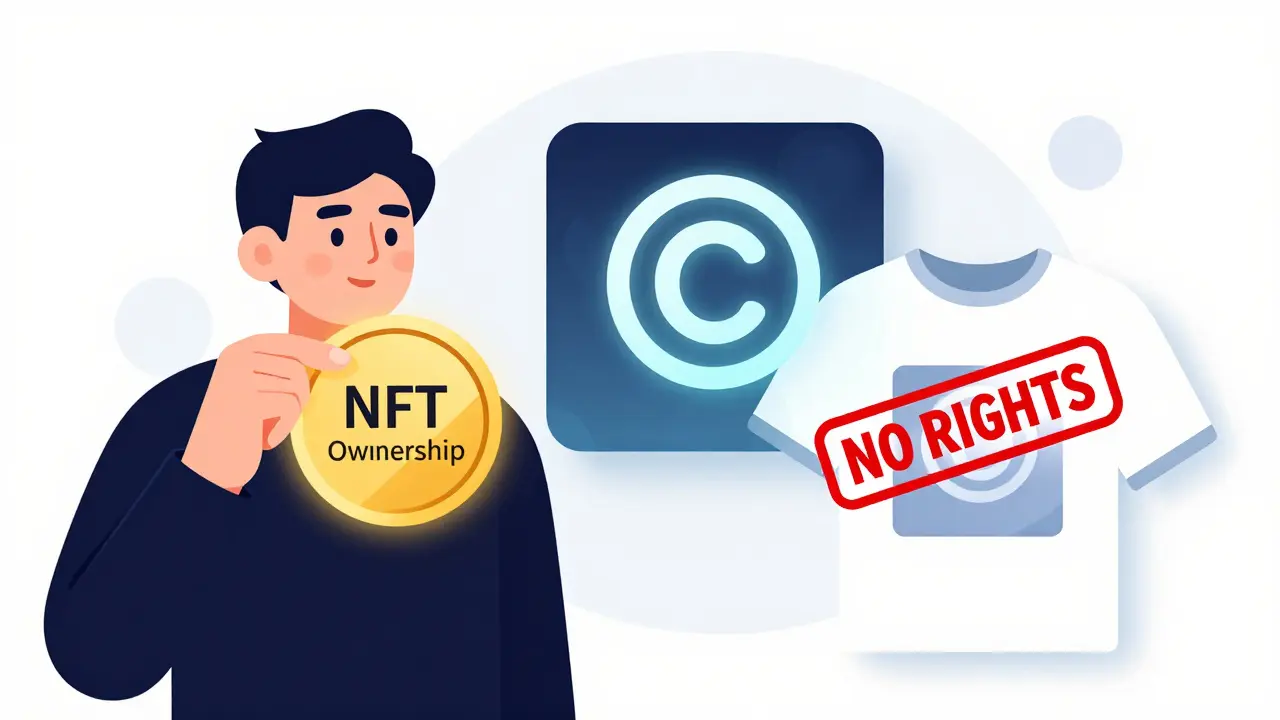
When you buy an NFT of a digital artwork, you’re not buying the image itself. You’re buying a token on the blockchain that points to it. This sounds simple, but most people get it wrong-and end up confused, frustrated, or even in legal trouble.
You don’t own the art. You own a receipt.
Think of an NFT like a numbered certificate for a painting. If you buy a Picasso at auction, you own the canvas. But you don’t own the right to print it on t-shirts or sell posters. The same logic applies to NFTs. The token proves you’re the one who owns that specific digital certificate. The artwork? That’s still owned by the artist-or whoever holds the copyright.
Take CryptoPunks. In 2022, Yuga Labs, the company behind them, changed their terms. Before that, owning a Punk didn’t let you use the image commercially. After the change, you could. But that wasn’t because you bought the NFT. It was because the company gave you those rights. The NFT itself didn’t change. Only the license did.
And that’s the key: NFTs are not licenses. They’re ownership records. The rights come from the project’s terms, not the blockchain.
Three types of rights you might get (and what they mean)
Not all NFTs are the same. There’s no universal rule. You need to check the project’s fine print. Here’s what you’re likely to see:
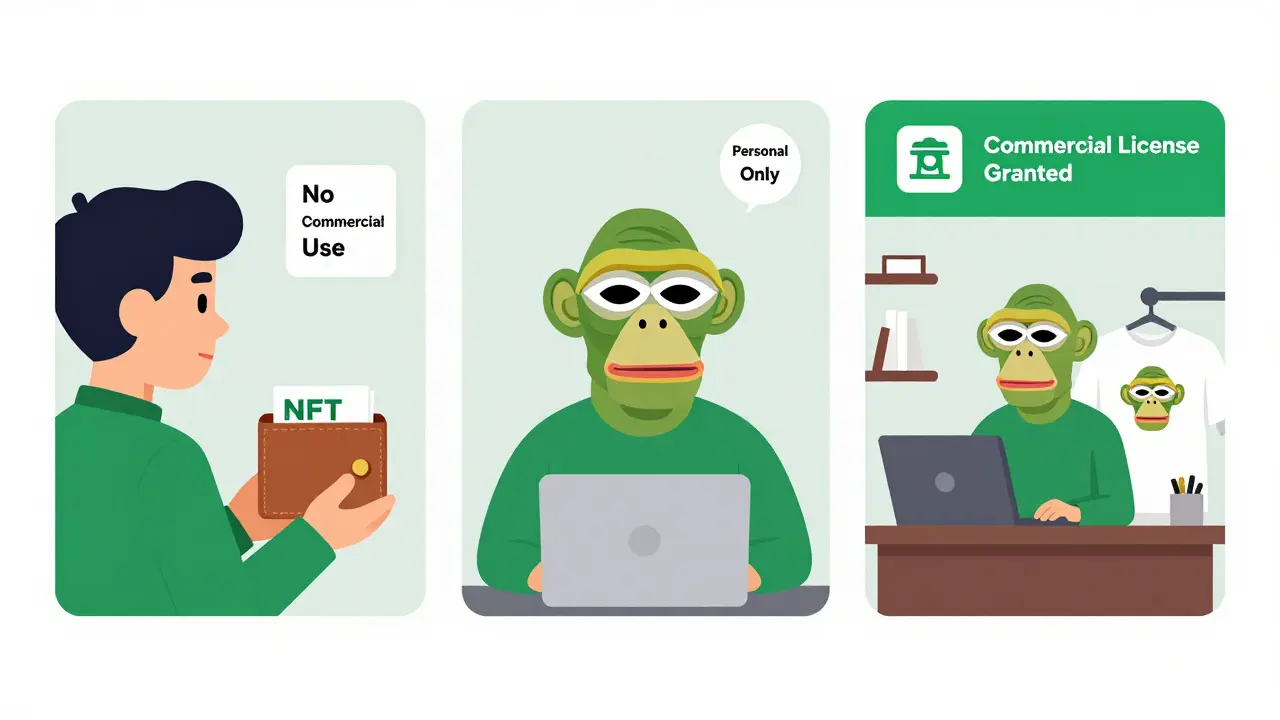
- No rights / silence: Many NFTs don’t say anything about usage. That means you can’t do anything with the image except display it on your wallet or social media. Printing it? Selling merch? Making a movie? That’s copyright infringement. You don’t have permission. The artist still owns every right.
- Personal use only: Some projects let you display the image, maybe even use it as your profile picture. But no selling, no merchandise, no adaptations. You’re just a fan with a digital badge.
- Full commercial rights: Projects like Bored Ape Yacht Club (BAYC) and Meebits give you the right to use your NFT’s image for anything-t-shirts, games, films, even a restaurant chain. You can license it to others. You can make money off it. But you still don’t own the copyright. You’re just granted a very broad license.
According to DappRadar’s Q2 2023 report, NFT collections that allow commercial use had floor prices 37% higher than those that didn’t. Why? Because people pay more when they know they can actually make money from it.
What you absolutely cannot do without permission
Even if you paid $100,000 for an NFT, here’s what you still can’t do:
- Print it on a T-shirt and sell it
- Use it in an ad or YouTube video
- Trademark the image
- Create a sequel or spin-off version
- Claim you’re the artist
There’s a real case where someone bought a CryptoPunk and tried to trademark the image. Yuga Labs sued. They didn’t own the art. They owned a token. The court sided with Yuga.
Even Jack Dorsey’s first tweet NFT-sold for $2.9 million-didn’t give the buyer rights to use the tweet itself. The buyer got a digital certificate. Not the content. Not the right to reproduce it. Just proof they bought it.
Why this confusion exists
Most buyers assume buying an NFT is like buying a physical painting. But digital files are different. You can copy a JPEG in seconds. The value isn’t in the file-it’s in the ownership record.
Marketplaces like OpenSea don’t explain this clearly. A CoinGecko survey in 2023 found only 32% of NFT marketplaces show IP rights at the point of sale. Most buyers just click "Buy Now" without reading anything.
Reddit threads are full of people who thought they owned the art. One user bought an NFT from a generative art project, printed it on hoodies, and got a cease-and-desist letter. They didn’t know the artist had reserved all rights.
68% of NFT buyers admitted they didn’t understand the rights they were getting, according to DappRadar. That’s not a small number. That’s most people.
What creators should know
If you’re an artist minting NFTs, you have a responsibility. Don’t mint art you didn’t create. Don’t use someone else’s design, even if you modified it. That’s copyright infringement-and you can get sued.
Also, be clear about what rights you’re giving. If you want to keep control, say so. If you want holders to make money, say that too. Vague terms lead to lawsuits. Clear terms build trust.
Some artists now use CC0 licenses, which means they give up all rights. Anyone can use the image however they want. That’s great for community growth-but you lose control. You can’t stop someone from turning your art into a meme or a logo for a scam project.
What buyers should do before clicking "Buy"
Don’t guess. Don’t assume. Here’s your checklist:
- Go to the project’s official website. Look for a "Legal" or "Terms" section.
- Read the license agreement. If it says "no commercial rights," don’t try to sell merch.
- Check if the NFT is based on AI-generated art. The U.S. Copyright Office says AI-only creations can’t be copyrighted. That means the NFT might not even have legal protection.
- If it’s worth more than $10,000, talk to a lawyer who understands digital assets.
- Remember: OpenSea, Foundation, and other marketplaces don’t give you rights. Only the project does.
Most NFTs are sold with a license, not a transfer of ownership. Treat it like a software license agreement. You wouldn’t buy Photoshop and think you own Adobe. Same thing here.
The future is clearer-but not yet
More brands are getting serious about rights. Deloitte found that 73% of big companies now define IP rights in their NFT terms, up from 41% in 2021. That’s progress.
But independent artists? Only 28% of them include clear licensing. That’s a problem. The market is growing fast-PwC predicts $136 billion by 2028-but without clear rules, it’ll keep facing legal chaos.
WIPO, the World Intellectual Property Organization, started a dedicated NFT working group in 2023. Courts are starting to hear cases. The first major U.S. case, McFarland v. Doe, is moving through the system. This isn’t going away.
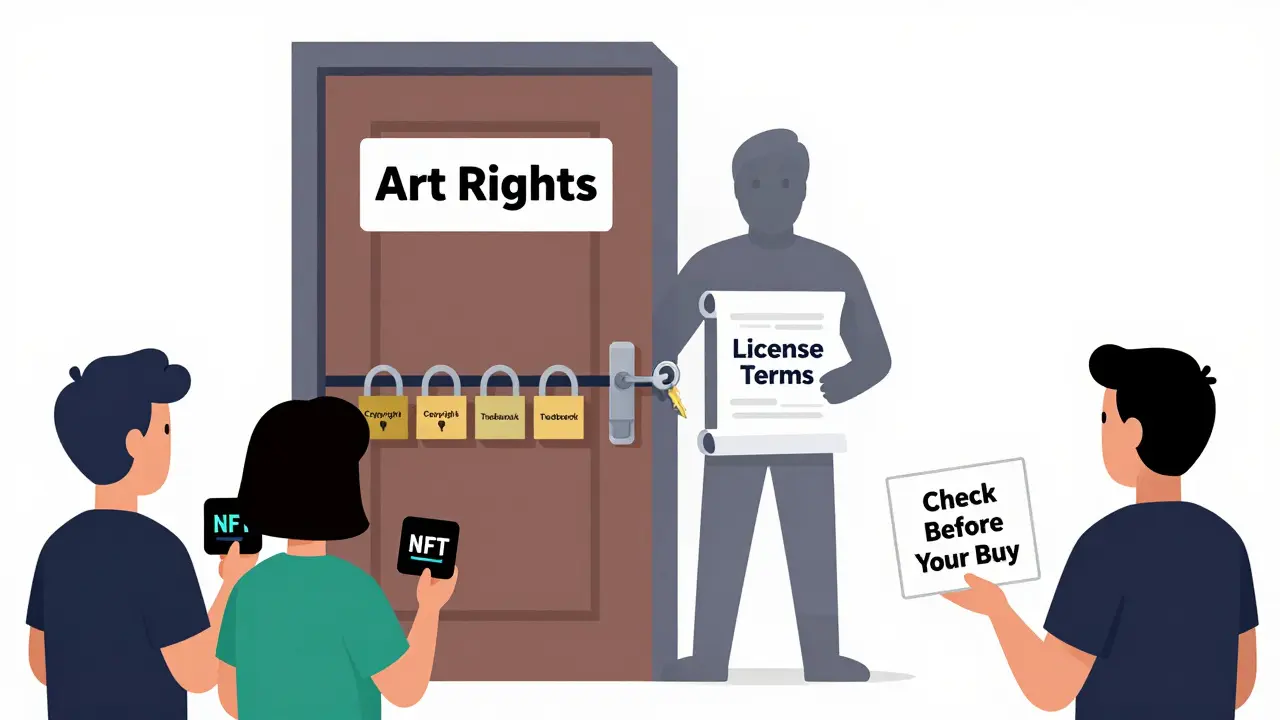
The message is simple: Ownership of an NFT is not ownership of the art. It’s a key to a door. And the door might be locked. You need to check the key before you turn it.
Can I print my NFT art and sell posters?
Only if the project’s license explicitly allows commercial use. Most NFTs don’t. Printing and selling without permission is copyright infringement, even if you paid a lot for the NFT. Always check the project’s terms before printing anything.
Do I own the copyright if I buy an NFT?
No. Copyright stays with the creator unless they explicitly transfer it in writing. NFTs are blockchain records, not legal documents for copyright transfer. Even if you own the NFT, you don’t own the rights to copy, modify, or profit from the artwork unless the license says so.
Can I use my Bored Ape NFT in my business?
Yes-Bored Ape Yacht Club (BAYC) explicitly grants holders a commercial license. You can use your Ape on merchandise, in ads, or even in movies. But you can’t claim you created it, trademark the BAYC name, or use other Ape images from the collection unless you own those NFTs too. Always follow the exact terms of the license.
What happens if the NFT project shuts down?
Your NFT token still exists on the blockchain. But if the project disappears, the link to the artwork might break. Many NFTs store images on centralized servers. If the company goes offline, the image could vanish. That’s why some projects use decentralized storage like IPFS. But even then, your license rights may expire if the legal team behind the project dissolves.
Are AI-generated NFTs protected by copyright?
In the U.S., the Copyright Office says no. If the artwork was created entirely by AI with no meaningful human input, it’s not eligible for copyright. That means the NFT linked to it has no legal protection. Buyers should be cautious-many AI-generated NFTs are sold with false claims of ownership rights.
Can I resell my NFT?
Yes, you can always resell the NFT token itself. Ownership of the token is transferable. But resale rights don’t extend to the artwork’s copyright. The new owner gets the same rights you had-no more, no less. You can’t sell them rights you never had.
Tiffany M
December 15, 2025 AT 11:28Okay, but let’s be real-most people buy NFTs because they think they’re getting a digital Picasso, not a blockchain receipt. I’ve seen people post their NFTs on Instagram like they own the art, then cry when they get a cease-and-desist. It’s not the buyer’s fault-marketplaces don’t explain this stuff. They just make it look like a cool digital collectible. No wonder everyone’s confused.
Eunice Chook
December 17, 2025 AT 07:04Ownership ≠ rights. That’s the only thing that matters. Stop romanticizing digital objects. You don’t own the file. You don’t own the IP. You own a pointer. Get over it.
Lois Glavin
December 18, 2025 AT 14:44I love how this post breaks it down so simply. I bought an NFT last year thinking I could print it on mugs-then found out I couldn’t. Felt so dumb. But now I always check the terms before buying. It’s not that hard. Just take 30 seconds. Seriously.
Abhishek Bansal
December 18, 2025 AT 17:29Wait, so you’re saying I paid $50k for a JPEG and I can’t even use it as my wallpaper without asking permission? That’s the dumbest thing I’ve ever heard. If I bought it, it’s mine. The blockchain doesn’t care about your copyright laws. You’re all just scared of decentralized ownership.
Bridget Suhr
December 20, 2025 AT 09:26ok so i just read this and i’m like… wow. i thought i owned the art. turns out i owned a link. and the link might break. and the license might change. and the artist might sue me. wow. just… wow. i need to go check my nfts.
Jessica Petry
December 22, 2025 AT 01:21Of course people don’t understand. They treat blockchain like it’s magic. They think if it’s on the internet and has a number, it’s valuable. This isn’t art-it’s speculative gambling with a side of delusion. And now we’re supposed to believe that someone who paid $200k for a monkey image has ‘rights’? Please.
Scot Sorenson
December 22, 2025 AT 01:37So let me get this straight: you can buy a Bored Ape, use it in your Netflix series, but you can’t trademark the name? That’s like buying a Lamborghini and being told you can drive it, but not name it. What’s the point? This system is designed to confuse people so companies can sue them later. Brilliant business model, really.
Ike McMahon
December 23, 2025 AT 18:28Always check the terms. Always. Even if it’s boring. Even if the website looks sketchy. If you’re spending more than $1k, read the legal page. It’s not hard. And if you can’t find it? Walk away. No NFT is worth a lawsuit.
JoAnne Geigner
December 24, 2025 AT 17:47I’ve been in this space since 2021, and honestly, the most beautiful thing I’ve seen isn’t the art-it’s when creators actually say, ‘Here’s what you can do.’ Some artists are now using CC0 and letting people run wild with their work. It’s messy, but it’s also empowering. Maybe the future isn’t about control-it’s about trust. And community. And giving people space to create. That’s the real value.
Kathleen Sudborough
December 25, 2025 AT 08:54I just spent an hour reading every single line of this post, and I’m crying. Not because I’m sad-because I finally get it. I bought an NFT last year thinking I was a ‘collector.’ Turns out I was just a digital hoarder. But now? Now I’m going back to every NFT I own and reading the terms. I’m gonna print them out. I’m gonna highlight them. I’m gonna tell my friends. This isn’t just about money-it’s about respect. For artists. For buyers. For the whole ecosystem. Thank you for writing this. I needed it.