No Capital Gains Tax on Bitcoin in El Salvador: What You Need to Know in 2026
 Feb, 25 2026
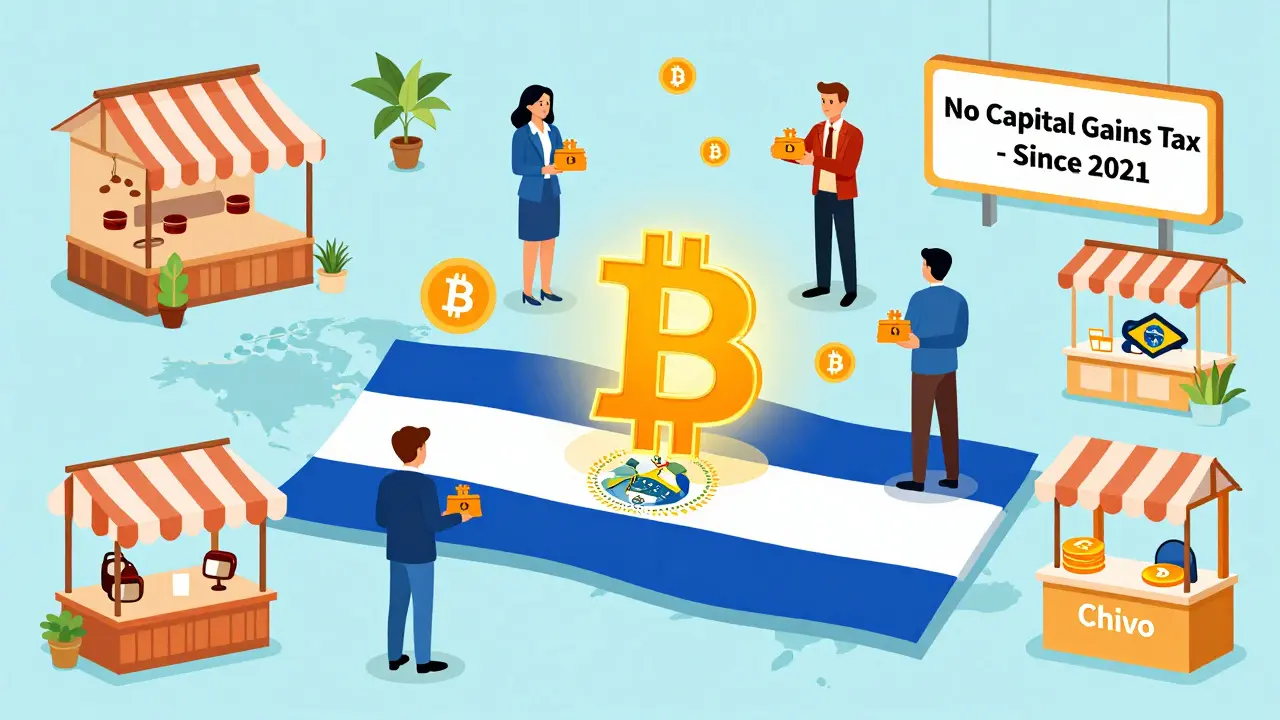
El Salvador made history in 2021 by becoming the first country in the world to make Bitcoin legal tender. But the most surprising part? No capital gains tax on Bitcoin - not for locals, not for foreigners. Even now, in 2026, that rule still stands - even after major changes to the law.
Why El Salvador Doesn’t Tax Bitcoin Gains
When President Nayib Bukele pushed through the Bitcoin Law in September 2021, the goal wasn’t just to adopt a new currency. It was to create a financial revolution. The law didn’t just say Bitcoin could be used to pay for coffee or rent. It also declared that any profit made from buying or selling Bitcoin would be completely tax-free. That includes people who bought Bitcoin at $30,000 and sold it at $70,000. No tax. Zero. Not even a dime.
This wasn’t an accident. It was intentional. The government wanted to attract foreign investors, entrepreneurs, and crypto businesses. And it worked - at least at first. The National Commission of Digital Assets (CNAD) is the regulatory body created to oversee all Bitcoin and digital asset activities in El Salvador started issuing licenses to crypto companies. Businesses could operate without paying corporate income tax, services transfer tax, or municipal fees. For investors, the message was clear: if you hold Bitcoin here, you keep every dollar of profit.
Who Benefits From This Rule?
The tax exemption isn’t just for Salvadorans. Foreigners who invest at least three Bitcoin (₿3) in the country get the same deal. That means if you’re a crypto investor from the U.S., Germany, or Brazil, and you buy Bitcoin in El Salvador, you don’t pay capital gains tax when you sell it - even if you cash out later in another country.
But here’s the catch: the rule only applies to Bitcoin. Other cryptocurrencies like Ethereum or Solana? Not covered. The Bitcoin Service Provider (BSP) license is for businesses that deal only with Bitcoin - wallets, exchanges, payment processors. If you’re running a Bitcoin-only business, you’re in the clear. But if you’re trading altcoins, you need a Digital Asset Service Provider (DASP) license, which doesn’t come with the same tax benefits.
What Changed After the IMF Deal?
In December 2024, El Salvador took a $1.4 billion loan from the International Monetary Fund (IMF). In exchange, the government had to make major changes to its Bitcoin policy. The Chivo wallet - the state-run app meant to push Bitcoin adoption - was scaled back. Merchants no longer had to accept Bitcoin. The government stopped using Bitcoin to pay taxes. And it cut back on buying more Bitcoin.
But here’s the key point: the capital gains tax exemption stayed. The IMF didn’t force El Salvador to tax Bitcoin profits. That part of the law was untouched. Why? Because it’s the core of the country’s entire crypto strategy. Remove the tax break, and you remove the reason anyone would come here.
Even with those changes, the tax-free rule still makes El Salvador one of the most attractive places in the world for Bitcoin investors. Only a handful of countries offer something similar: the Cayman Islands, the UAE, Germany (after 12 months of holding), and Portugal. But none of them treat Bitcoin like legal tender. None of them built an entire economic identity around it.
What About Businesses?
If you’re running a crypto business in El Salvador, the tax perks go even deeper. You don’t pay:
- Corporate income tax
- Services transfer tax
- Municipal taxes
- Import duties on equipment
- Income tax on earnings made outside the country
But you’re not completely free from rules. You still need to register with the CNAD. You still need to file annual financial statements. You still need to follow AML and KYC rules. You still need to report transactions. The government isn’t turning a blind eye - it’s just not taking a cut of your profits.
Real-World Usage? Not What They Expected
Here’s the irony: while the tax policy is bold, everyday adoption is fading. According to surveys from the Universidad Centroamericana, only 8.1% of Salvadorans used Bitcoin for payments in 2024 - down from 25.7% in 2021. People still use the Chivo wallet, but mostly for government payments or cash-outs, not daily spending.
Why? Many Salvadorans don’t trust Bitcoin. They don’t understand it. They’re scared of price swings. And they don’t see real benefits - like lower fees or faster payments - compared to cash or mobile money.
Meanwhile, the government’s Bitcoin wallet still holds over 3,000 BTC. When Bitcoin hit $70,000 in early 2025, those holdings were worth over $210 million - more than $50 million in profit since the original purchases. But the cost of promoting Bitcoin - marketing, education, infrastructure - was far higher. The country hasn’t broken even on its investment.
Is This Sustainable?
El Salvador’s Bitcoin experiment is still unfolding. The tax exemption is the only part that’s held strong. The rest - mandatory acceptance, state wallets, government buying - is being rolled back. But the tax rule? That’s locked in. It’s the one thing the IMF didn’t touch. And it’s the one thing that still draws interest from global investors.
Companies are still setting up shop. Investors are still moving money. The Bitcoin City project, a planned tax-free zone powered by geothermal energy and Bitcoin, is still moving forward. Even if most Salvadorans don’t use Bitcoin daily, the world is watching - and many are betting on its future.
How It Compares to Other Countries
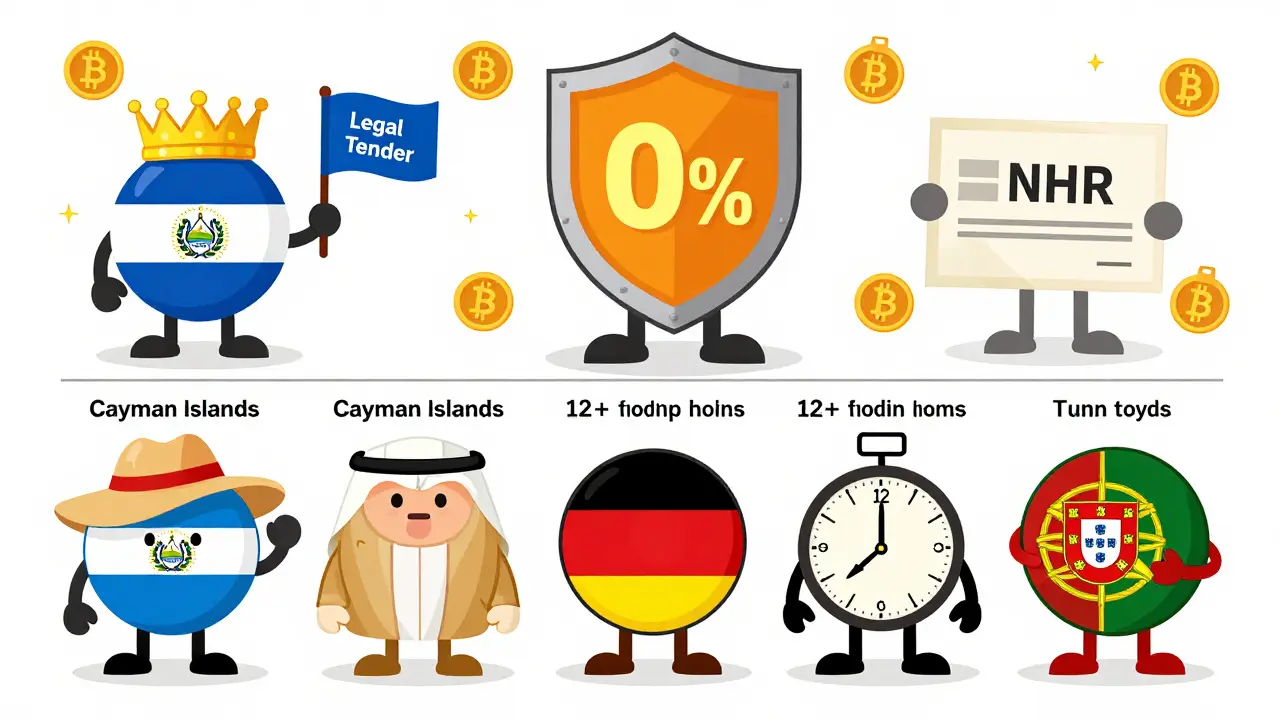
El Salvador isn’t the only place with no crypto taxes. But it’s the only one where Bitcoin is official money. Here’s how it stacks up:
| Country | Capital Gains Tax on Bitcoin | Legal Tender? | Special Conditions |
|---|---|---|---|
| El Salvador | 0% | Yes | Applies to all Bitcoin transactions; no holding period |
| Cayman Islands | 0% | No | No income, corporate, or capital gains tax for all crypto |
| UAE | 0% | No | Clear regulation; zero tax across all emirates |
| Germany | 0% | No | Only after holding 12+ months |
| Portugal | 0% | No | For individuals; NHR program adds extra benefits |
El Salvador’s rule is simpler. No waiting. No limits. Just pure tax-free Bitcoin. And that’s why it still matters.
What You Should Do If You’re Considering It
If you’re thinking about investing in Bitcoin through El Salvador:
- Only deal with CNAD-licensed businesses - check their license status online.
- Keep detailed records of every transaction. Even though there’s no tax, you still need proof.
- Don’t assume other cryptocurrencies are tax-free. Stick to Bitcoin.
- Understand that local adoption is low. Don’t expect to use Bitcoin like cash in daily life.
- Consult a tax advisor in your home country. Your home country might still tax your gains - even if El Salvador doesn’t.
El Salvador didn’t become a crypto haven because it’s perfect. It became one because it was bold. And that boldness is still alive - in the law, in the wallets, and in the minds of investors who see opportunity where others see risk.
Is Bitcoin really tax-free in El Salvador for foreigners?
Yes. Foreigners who invest in Bitcoin in El Salvador - even if they’re not residents - don’t pay capital gains tax on profits from Bitcoin sales. This applies regardless of where they live or where they sell. The only requirement is that the transaction happens within El Salvador’s legal framework.
Can I use Bitcoin to pay my taxes in El Salvador?
No. As of early 2025, the government stopped accepting Bitcoin for tax payments. This was part of the IMF agreement. Taxes must now be paid in U.S. dollars. However, you can still use Bitcoin to pay for goods and services from private businesses that accept it.
Do I need to report Bitcoin gains to my home country?
Yes. El Salvador doesn’t tax Bitcoin profits, but your home country might. For example, U.S. citizens must report all worldwide crypto gains to the IRS, even if they’re tax-free in El Salvador. Always check your home country’s tax rules before investing.
What happens if Bitcoin crashes? Does El Salvador still protect investors?
Yes. The tax exemption doesn’t depend on Bitcoin’s price. Even if Bitcoin drops 80%, any gains you make - even small ones - are still tax-free. The law protects the transaction, not the outcome. Losses aren’t taxed either - but they also can’t be claimed as deductions.
Is the Bitcoin City project still happening?
Yes. The Bitcoin City project, a planned city powered by geothermal energy and built around a Bitcoin economy, is still in development. While funding and timelines have shifted since 2024, the government continues to promote it as a future hub for tax-free crypto business and innovation.
maya keta
February 26, 2026 AT 01:46Okay, but let’s be real-El Salvador didn’t do this for ‘economic freedom.’ They did it because Bukele saw a chance to outmaneuver the IMF, the Fed, and every banker in D.C. by turning Bitcoin into a geopolitical weapon. The tax exemption? That’s the bait. The real game is creating a sovereign, crypto-backed state that operates outside the dollar system. And guess what? It’s working. Companies are relocating. Money is flowing. And the U.S. government? They’re quietly terrified.
Why? Because if El Salvador succeeds, every offshore tax haven, every crypto-friendly jurisdiction, every rogue nation will copy it. And suddenly, the U.S. tax base? Collapses. So they let it slide. Not because they’re okay with it. Because they can’t stop it. Not without triggering a global financial panic.
Also, the ‘Bitcoin City’? That’s not a city. It’s a prototype for a new kind of nation-state. Powered by volcanoes. Funded by BTC. Governed by code. And it’s being built while the world watches, paralyzed by bureaucracy. This isn’t a policy. It’s a revolution in slow motion. And you’re all just arguing about tax forms while the future gets built.
Jessica Carvajal montiel
February 26, 2026 AT 04:07Let me guess-you all think this is some kind of ‘crypto utopia.’ Wake up. This is a money laundering paradise with a side of tourist bait. The ‘tax-free’ rule? It’s a trap. The government doesn’t tax Bitcoin gains because they don’t need to-they’re already collecting in other ways. Every Bitcoin transaction flows through Chivo. Every wallet is monitored. Every IP logged. And when you sell? They know exactly who you are. And when the next crackdown comes? They’ll freeze your funds, claim ‘AML violations,’ and keep your profit. All legal. All documented. All perfectly sanitized.
They’re not making you rich. They’re making you compliant. And once you’re hooked? You’ll pay in trust, not taxes. This isn’t freedom. It’s surveillance with a smile.
bella gonzales
February 27, 2026 AT 19:36Wow. So much text. I’m just here for the Bitcoin City vibes. 🤡
Paul Reinhart
February 28, 2026 AT 05:51I’ve read through this entire post twice. And honestly? I’m torn. On one hand, El Salvador’s move is breathtakingly bold-unlike anything any nation has attempted in modern monetary history. On the other hand, the disconnect between policy and reality is staggering. The tax exemption is brilliant, yes-but if 92% of the population doesn’t use Bitcoin to buy bread, then what’s the point? Is this policy really about economic liberation… or is it performative sovereignty? A spectacle designed to impress global investors while leaving ordinary Salvadorans behind?
The fact that the IMF didn’t force a tax change speaks volumes. It means even the IMF, the ultimate enforcer of global financial orthodoxy, recognized that taxing Bitcoin gains here would be politically catastrophic. Not because it’s ‘fair’-but because it’s strategically essential. The government didn’t win a debate. It won a gamble. And now the world is watching to see if the gamble pays off.
Maybe the real story isn’t the tax exemption. Maybe it’s this: El Salvador is the first country to say, ‘We don’t care what you think we should do. We’re doing this anyway.’ And that… might be more revolutionary than any law ever could be.
Curtis Dunnett-Jones
March 1, 2026 AT 03:47It is imperative to underscore that the absence of capital gains taxation on Bitcoin in El Salvador constitutes not merely a fiscal anomaly, but a foundational paradigm shift in the architecture of sovereign monetary policy. The decision to exempt Bitcoin transactions from capital gains liability-while simultaneously maintaining rigorous AML/KYC protocols and institutional oversight via the CNAD-demonstrates a sophisticated, high-order governance model that prioritizes strategic economic autonomy over short-term revenue extraction. This is not an act of deregulation; it is an act of redefinition.
By anchoring its economic identity to Bitcoin as legal tender, El Salvador has engineered a system wherein value creation is decoupled from traditional taxation mechanisms. This is not anarchism. It is hyper-structured innovation. The fact that foreign investors are extended identical benefits underscores a commitment to meritocratic, borderless capital mobility-a principle that ought to be studied, not ridiculed.
Those who dismiss this as a ‘crypto gimmick’ fail to recognize that the true innovation lies not in the currency itself, but in the institutional architecture that enables it. The Bitcoin City project, when fully realized, will serve as the world’s first fully integrated, energy-positive, blockchain-governed economic zone. And history will record El Salvador not as a failed experiment, but as the vanguard of a new financial epoch.
Nicki Casey
March 2, 2026 AT 21:53Let me cut through the crypto-bro noise. El Salvador didn’t ‘make Bitcoin legal tender’-they made it a weapon of economic warfare against the United States. And now, because they’re small and poor, the U.S. government is too embarrassed to admit they’re losing. The tax exemption? That’s not generosity. That’s a trapdoor. Every Bitcoin transaction processed through Chivo is a data point. Every wallet is a honeypot. Every foreign investor who thinks they’re ‘tax-free’ is actually being profiled for future sanctions, asset seizures, or extradition. The IMF didn’t ‘allow’ this-they were bought off. Or blackmailed. Or both.
And let’s not pretend the ‘Bitcoin City’ is about geothermal energy. It’s about building a sovereign, untraceable, off-grid financial enclave on U.S. doorstep. A digital Bermuda Triangle. And if you think the U.S. intelligence agencies aren’t monitoring every BTC transfer from San Salvador to Miami? You’re naive. This isn’t innovation. It’s espionage with a blockchain.
Don’t celebrate this. Fear it. Because if El Salvador can do this… what’s next? Venezuela? North Korea? And who’s to say the U.S. won’t respond with a digital dollar that tracks every transaction… down to the last satoshi?
Carl Gaard
March 4, 2026 AT 20:05im just here for the bitcoin city 🤯🌋💸 i wanna live there and mine btc with volcanoes 😭 i dont care if 8% of salvadorans use it for coffee-im not here for them, im here for the vibe. if my btc gains are tax free and i can pay for tacos with btc and the city runs on lava?? sign me up. also i just bought 2 btc with my paypal and now i feel like a pioneer 🙌🌍 #bitcoincity2027
Sean Logue
March 6, 2026 AT 06:01As someone who’s lived in El Salvador for 12 years, I can tell you-the tax exemption is real. But the ‘revolution’? It’s mostly in the headlines. Most locals still use dollars. Most businesses still prefer cash. The Chivo wallet? Mostly used to cash out government handouts. The real winners? The foreign developers and investors who bought land cheap in La Unión and now own entire blocks. The average Salvadoran? They got a wallet they don’t understand and a government that’s more focused on global PR than local impact.
But hey-I’m not here to hate. I’m here to say: if you want to invest in Bitcoin here? Go for it. Just don’t expect to see a single Salvadoran using it to pay for bus fare. The dream is beautiful. The reality? It’s still a work in progress.