OKX Crypto Access Limitations by Country: What’s Allowed and Where You’re Blocked
 Jan, 12 2026
If you’ve tried to sign up for OKX and got a country restriction error, you’re not alone. Thousands of users worldwide hit this wall every day - especially those in the U.S., Canada, or the UK. The issue isn’t a glitch. It’s not a technical error. It’s regulation. OKX, one of the world’s largest crypto exchanges by volume, blocks or limits access in dozens of countries to stay legal. And if you’re trying to trade futures, use leverage, or even deposit funds, your location might be the only thing standing between you and the platform.
Which Countries Are Fully Blocked by OKX?
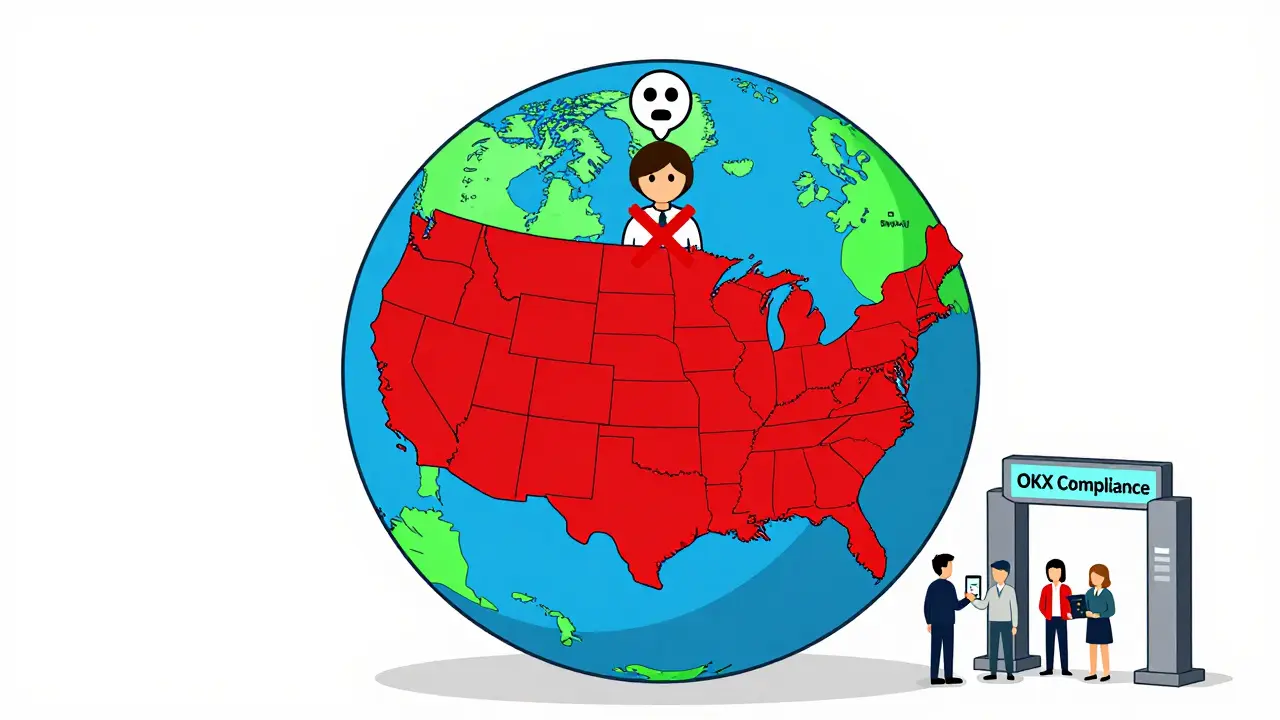
OKX doesn’t just limit features - it shuts down entire accounts in certain countries. According to their official Risk & Compliance Disclosure (March 2025), the following countries face complete service bans:
- United States
- Canada
- Malaysia
- Singapore
- Bahamas
- United Kingdom
- Cuba
- Iran
- North Korea
- Syria
- Crimea
- Donetsk and Luhansk regions
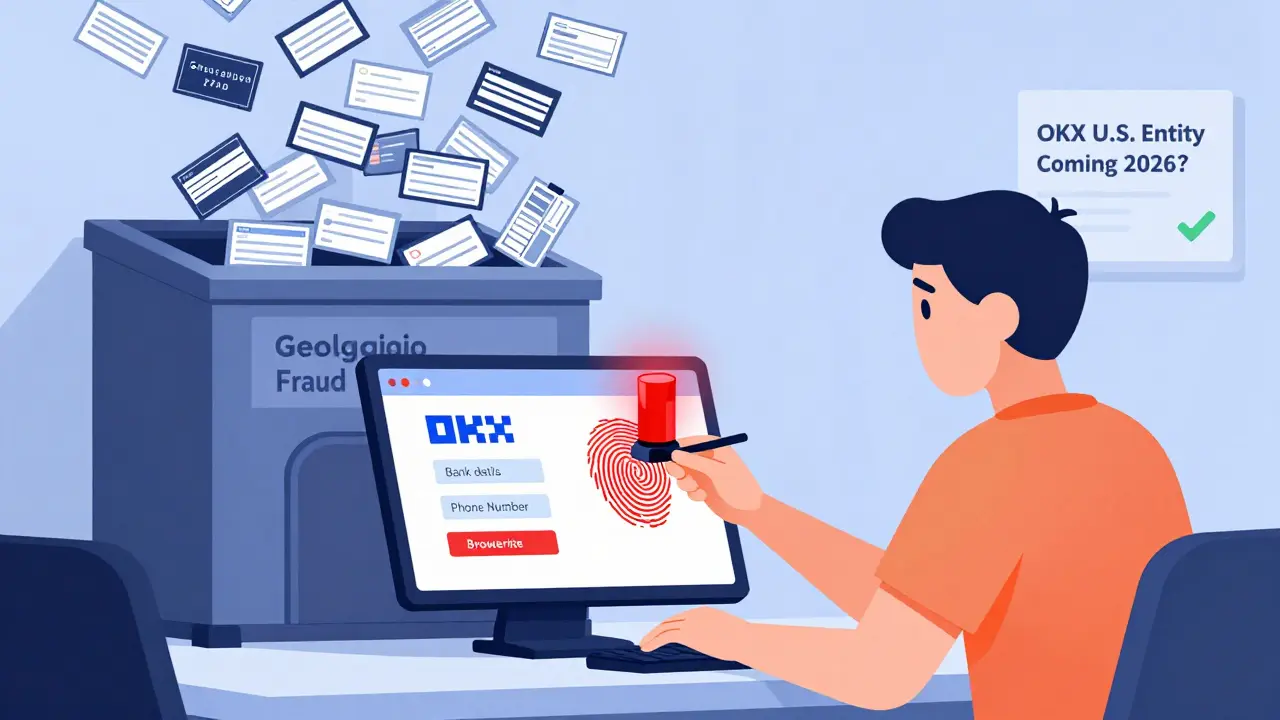
If you’re in any of these places, you can’t create an account. Even if you use a passport from a permitted country, OKX’s system will catch your IP address, device fingerprint, or bank details and reject you. There’s no workaround that won’t get your account permanently banned. In September 2025, OKX closed over 14,000 accounts for geolocation fraud - mostly from users trying to bypass these blocks with VPNs.
What About U.S. Territories?
The restrictions don’t stop at the U.S. mainland. OKX also blocks access in U.S. territories:
- Puerto Rico
- Guam
- Northern Mariana Islands
- U.S. Virgin Islands
Even though these are part of the U.S., they’re treated as separate jurisdictions under OKX’s compliance rules. Users in these areas report the same rejection messages as those in Texas or California. Some try using a friend’s address in Mexico or Colombia - but if the bank account or ID doesn’t match, KYC fails. And if you’re flagged for fraud, you lose access permanently.
Where Can You Use OKX - But With Limits?
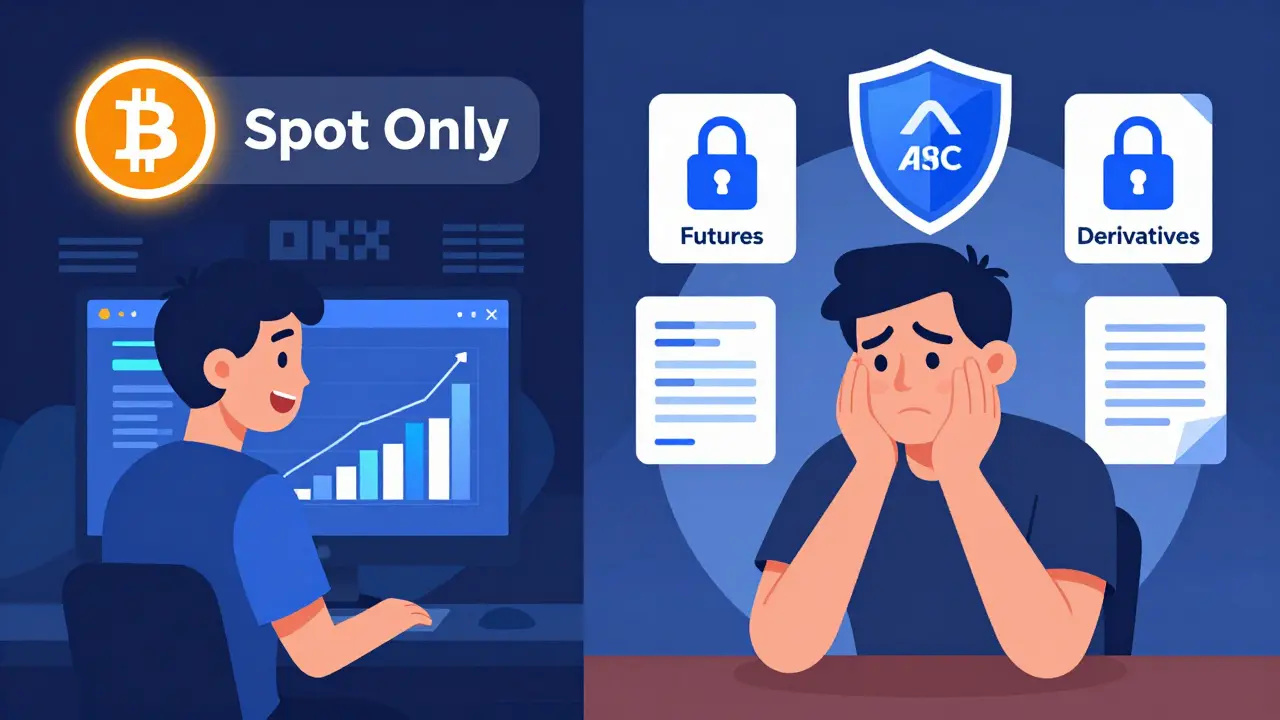
Not all restrictions are full blocks. In some countries, you can sign up and trade - but only spot trading. Derivatives, leverage, and futures are locked out. This applies to:
- Australia
- Brazil
- South Korea
- United Kingdom
In the UK, for example, you can buy Bitcoin or Ethereum with a bank transfer - but you can’t trade perpetual contracts or use 50x leverage. Why? Because the Financial Conduct Authority (FCA) banned crypto derivatives for retail users in 2021, and OKX chose to comply rather than fight it. The same goes for Australia’s ASIC and South Korea’s Financial Services Commission.
Users in these countries often don’t realize they’re missing out. They think OKX is “slow” or “unreliable” - when really, the platform is just hiding half its features. A CoinTelegraph usability study in September 2025 found that 63% of users in partially restricted countries didn’t know why certain trading options were missing.
Why Does OKX Have So Many Rules?
OKX is based in the Seychelles - a jurisdiction with light regulation. But to operate globally, it has to follow the rules of every country where users live. That means:
- Complying with U.S. Bank Secrecy Act and OFAC sanctions
- Following EU’s MiCA regulations (which banned crypto derivatives for retail users as of December 2024)
- Meeting Singapore’s MAS requirements
- Adhering to anti-money laundering laws in France, Japan, and Brazil
Instead of shutting down in every strict country, OKX built separate legal entities: OKX Europe, OKX Singapore, and OKX Japan. Each operates under local laws. That’s why Singapore appears on the banned list - but only the global platform blocks it. The local OKX Singapore entity, regulated by MAS, allows residents to trade under strict limits.
This system gives OKX flexibility - but it confuses users. Reddit threads like “Why is OKX blocked in Singapore but I can trade on OKX Singapore?” have over 2,100 posts since January 2025. The lack of clear communication leaves people guessing.
What Do You Need to Get Started?
If you’re in a permitted country, here’s what you’ll need:
- A government-issued ID (passport or national ID card)
- A proof of address (utility bill or bank statement, under 3 months old)
- A phone number from your country
- No VPN or proxy during signup
OKX requires mandatory KYC for all users - no exceptions. Even if you’re just buying $50 of Bitcoin, you must verify your identity. The process takes 2-4 hours on average, based on 500 user reports tracked by PureVPN in October 2025. Higher verification levels unlock higher limits:
- Level 1: $10,000 daily trading limit
- Level 2: $100,000 daily limit
- Level 3: $1,000,000 daily limit (requires additional documents)
Failure to submit clean documents - like a blurry photo or expired ID - delays verification. Some users report being asked to re-upload documents 3-4 times before approval.
What Happens If You Try to Bypass the Restrictions?
Many users turn to VPNs to hide their location. Others use a friend’s address in Germany or Thailand to register. But OKX doesn’t just check your IP. It checks:
- Your device fingerprint (browser type, screen resolution, installed fonts)
- Your bank details (if you deposit via SEPA or ACH)
- Your phone number’s country code
- Your login patterns (time zones, language settings)
These checks are 99.2% accurate, according to OKX’s Proof of Reserves audit (September 2025). If you’re caught, your account is suspended - and you lose access to all funds. In September 2025 alone, over 14,000 accounts were terminated for geolocation fraud.
And even if you get in, support won’t help you. OKX’s Q3 2025 report shows average response times of 8.2 hours for users in Europe - but over 24 hours for users in Africa or Asia. If you’re flagged as a “high-risk” user for using a VPN, your tickets get ignored.
How Does OKX Compare to Other Exchanges?
OKX isn’t the only exchange with restrictions - but its approach is unique:
| Exchange | Blocked Countries | Derivatives Allowed? | U.S. Access |
|---|---|---|---|
| OKX | 15+ full bans, 4+ partial restrictions | Yes, only in permitted countries | No |
| Binance | 49 countries including U.S. and Canada | Yes, but banned in UK and Australia | No |
| Coinbase | Only operates in U.S. and 41 other countries | Yes, in most permitted countries | Yes |
| Kraken | 47 countries including Iran and North Korea | Yes, with limits in Canada | Yes |
Coinbase and Kraken are U.S.-based and follow American rules tightly. That’s why they’re allowed to serve Americans - but they can’t operate in Iran or Syria. OKX, being offshore, can serve more countries - but not the U.S. It’s a trade-off: broader global access, but zero U.S. market.
What’s Changing in 2026?
OKX isn’t standing still. In October 2025, the company announced plans to launch a U.S.-compliant entity after months of talks with regulators. No timeline was given - but analysts at Gartner predict it could happen by Q2 2026.
They’ve also invested $230 million in compliance since January 2025. New offices are opening in Switzerland and the UAE to serve users from previously blocked regions. Derivatives access has been expanded to Thailand and Vietnam - but pulled from Bangladesh and Nepal after new local laws passed.
Still, the U.S. remains the biggest hurdle. The SEC’s lawsuit against Binance has made every non-U.S. exchange nervous. If OKX tries to enter the U.S. market without full approval, it could face fines, asset freezes, or even criminal charges. That’s why they’re moving slowly.
What Should You Do If You’re Blocked?
If you’re in a restricted country:
- Don’t use a VPN. It won’t work long-term, and you risk losing funds.
- Check if your country is on the partial restriction list. You might still be able to trade spot.
- Look for local exchanges that comply with your country’s laws. In the UK, for example, eToro and Coinbase are fully legal.
- Wait. If OKX launches a compliant version in your region, you’ll be able to sign up legally.
If you’re in a permitted country:
- Complete KYC with clean documents.
- Use your real phone number and address.
- Don’t log in from multiple countries.
- Keep your ID and proof of address updated.
OKX offers deep liquidity, low fees, and advanced tools - if you’re allowed to use them. The restrictions aren’t random. They’re the price of operating globally in a world where every country has its own crypto rules.
Why can’t I use OKX in the United States?
OKX is blocked in the U.S. because it doesn’t hold a U.S. license from the SEC or FinCEN. U.S. crypto regulations require exchanges to register as money services businesses, comply with strict AML rules, and report user activity to federal agencies. OKX chose not to pursue U.S. licensing due to the high cost and regulatory risk. Other exchanges like Coinbase and Kraken went through the process - OKX didn’t. Until they do, U.S. residents can’t legally use the platform.
Can I use OKX with a VPN?
Technically, you might get past the login screen using a VPN - but you won’t get far. OKX uses device fingerprinting, bank details, and phone number verification to detect location fraud. If you deposit from a U.S. bank account while using a German IP, your account will be flagged. Over 14,000 accounts were closed for this in September 2025 alone. Using a VPN violates OKX’s terms and will result in permanent suspension - with no way to recover your funds.
Why can I trade spot but not futures in Australia?
Australia’s financial regulator, ASIC, banned retail crypto derivatives in March 2021. OKX complies with this rule, so futures, leverage, and perpetual contracts are disabled for Australian users. Spot trading (buying and selling Bitcoin, Ethereum, etc.) is still allowed because it’s not classified as a derivative. This isn’t a technical limitation - it’s a legal one. You’ll see the same restriction in the UK and South Korea for the same reason.
How long does KYC take on OKX?
Standard KYC verification on OKX takes 2-4 hours on average for users in Europe, Asia, and Latin America. In some cases, especially if documents are unclear or mismatched, it can take up to 24-48 hours. Users in developing countries sometimes report delays of 3-5 days due to slower document review. To speed it up, submit a clear photo of your ID, a recent proof of address, and use your real phone number. Avoid using temporary or virtual numbers.
Is OKX safe to use in permitted countries?
Yes - if you’re in a country where OKX is fully permitted. The exchange holds over $13 billion in daily trading volume and has passed audits by independent firms like CipherTrace and CertiK. It stores 95% of user funds in cold wallets and publishes Proof of Reserves monthly. However, customer support response times vary. In Europe, you’ll usually get help within 8 hours. In Africa or Southeast Asia, it can take over 24 hours. Always enable 2FA and never share your recovery phrase.
Don Grissett
January 13, 2026 AT 21:35okx just dont wanna deal with the us regulators, plain and simple. they’d rather chill in seychelles and take money from everyone else than get a license and play nice. i tried using a vpn once-got my account nuked in 3 hours. no warning, no refund, just gone. 14k accounts wiped? that’s not enforcement, that’s a purge. they’re not protecting users-they’re protecting their bottom line. #donttrustbigcrypto
Veronica Mead
January 14, 2026 AT 13:48It is profoundly irresponsible to suggest that circumventing jurisdictional compliance through technological obfuscation is an acceptable practice. The regulatory frameworks governing financial instruments exist to protect the public from systemic risk, fraud, and exploitation. To advocate for or enable the circumvention of these safeguards-regardless of personal inconvenience-is not only unethical, but it actively undermines the integrity of the entire digital asset ecosystem. One cannot selectively obey laws based on convenience. The consequences of such behavior are not merely punitive-they are societal.
Mollie Williams
January 16, 2026 AT 09:56I keep thinking about how geography became the new currency gatekeeper. We live in a world where your birthplace decides whether you can trade futures, not your knowledge, not your risk tolerance, not your capital. It’s like being told you can’t enter a library because you were born on the wrong side of a border drawn by bureaucrats who’ve never held a Bitcoin. OKX isn’t being cautious-it’s being cowardly. They’d rather build 17 different legal shells than fight for one global standard. And we’re the ones who pay for it-with confusion, lost funds, and the quiet erosion of financial autonomy. Maybe the real question isn’t why OKX blocks us… but why we let them.
Surendra Chopde
January 17, 2026 AT 03:41Interesting how the same platform that offers 50x leverage in Thailand bans it in Australia. Regulation is not about safety-it’s about power. Who gets to decide what’s ‘too risky’? A regulator in London? A compliance officer in Seychelles? I don’t trust either. But I do trust that if I’m allowed to buy BTC, I should be allowed to trade it how I want. The system is rigged to favor institutions, not individuals. And we’re just supposed to accept it because ‘it’s legal’.
Tiffani Frey
January 18, 2026 AT 11:57