PandaSwap (PND) Airdrop Guide: How to Claim and Token Details
 Apr, 21 2026
Getting free tokens is one of the fastest ways to build a crypto portfolio, but the process can be confusing when multiple versions of a token exist. If you're looking into the PandaSwap airdrop is a token distribution initiative by the PandaSwap decentralized exchange to reward community members and grow its user base, you need to be careful. There is a significant difference between the PND token and the PANDA token, and missing this detail could lead to a lot of frustration.
How the PandaSwap Airdrop Actually Worked
The primary airdrop for PND wasn't a random giveaway; it was a structured campaign hosted via CoinMarketCap. To get a piece of the pie, users had to prove they were active and interested in the ecosystem. The project allocated a total of 666,666 PND tokens, which were split among 2,000 winners. Each lucky person walked away with 333.33 PND, with the total campaign value sitting at around $20,000 USD.
If you're wondering why projects do this, it's simple: growth. By requiring users to perform social tasks, they turn a small group of investors into a loud marketing army. For this specific campaign, the requirements were straightforward but mandatory. You had to:
- Add PandaSwap to your CoinMarketCap watchlist.
- Follow the official Twitter account (@pandaswap_okex).
- Join the PandaSwap Telegram chat group.
- Join the Telegram announcement channel.
- Retweet the pinned message on their Twitter profile.
The Technical Side: OKEx Chain and AMMs
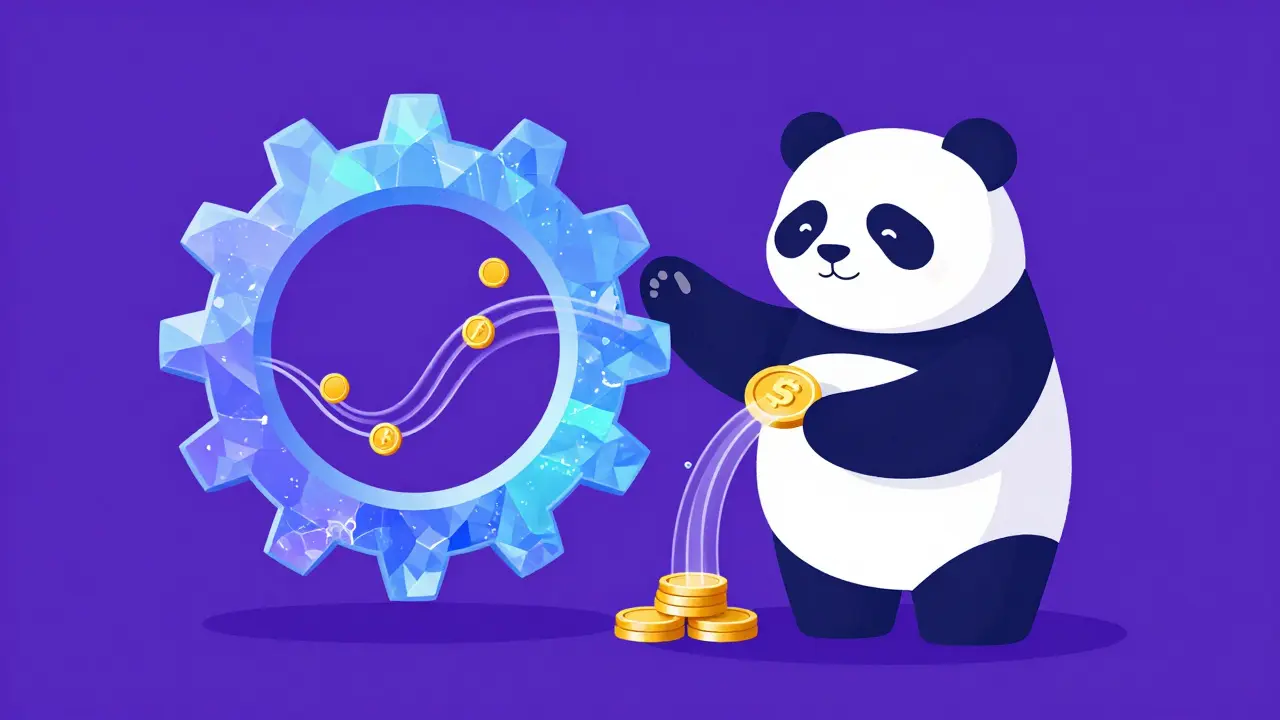
To understand what you're actually holding, you need to know that PandaSwap is an Automated Market Maker (AMM) built on the OKEx Chain. Unlike a traditional exchange where you wait for a seller to match your price, an AMM uses liquidity pools. This means users provide pairs of tokens to a pool, and the protocol handles the swaps automatically using a mathematical formula.
For those who enjoy passive income, PandaSwap doesn't just stop at swapping. It offers yield farming and staking. Essentially, you lock up your tokens or provide liquidity to the platform, and in return, you earn PND tokens as a reward. It's a way to make your assets work for you while supporting the network's stability.
The PND vs. PANDA Confusion
Here is where things get tricky. If you search for the token on tracking sites, you'll see two different assets: PND and PANDA. This isn't just a naming quirk; they are different entities with different market behaviors. While PND was the focus of the initial airdrop, Panda Swap (PANDA) has seen more active trading on platforms like CoinGecko, often trading around the $0.0016 level.
| Attribute | PandaSwap (PND) | Panda Swap (PANDA) |
|---|---|---|
| Primary Source | Community Airdrops/Farming | Exchange Trading/Swaps |
| Network | OKEx Chain | Various/Exchange-supported |
| Market Visibility | Low (Preview status on CMC) | Moderate (Active on CoinGecko) |
| Recent Activity | Stagnant supply data | Contract migrations/swaps |
The 2025 Contract Migration: What Happened?
If you held tokens on an exchange like MEXC, you might have noticed some movement in July 2025. MEXC executed a contract swap for PANDA tokens on July 28, 2025. This wasn't a free gift, but a necessary technical update.
The conversion ratio was 4:1. This means for every 4 old PANDA tokens you owned, you received 1 new token. MEXC handled this automatically for users who had their tokens in exchange accounts, but they stopped accepting deposits before the swap to prevent people from sending the "wrong" version of the token. If you deposited old tokens after the cutoff, you risked losing them entirely because the exchange wouldn't swap those specific deposits.
Where to Find and Trade These Tokens
Finding where to trade PND or PANDA depends on your risk appetite. Binance has provided purchasing guides for PANDA, showing users how to swap other cryptocurrencies for it via their interface. Meanwhile, MEXC has integrated PANDA into its Airdrop+ program, allowing users to earn tokens by completing simple platform tasks.
However, a word of caution: look at the data. CoinMarketCap currently lists PND with zero trading volume and a $0 price. In the crypto world, this is a massive red flag. It usually means one of two things: either the data feed is broken, or the token has lost its liquidity and is effectively dead. Always check multiple sources-like comparing CoinMarketCap with CoinGecko-before putting real money into a token that was distributed via airdrop.
Avoiding Airdrop Scams
Because PandaSwap used a "task-based" airdrop model, many scammers create fake Telegram groups or Twitter accounts pretending to be "PandaSwap Support." They will tell you that you've won the airdrop but need to pay a "gas fee" or provide your seed phrase to claim it. Remember: no legitimate airdrop will ever ask for your private keys or a payment to send you free tokens. If you are asked to send money to receive money, it is a scam. Every time.
Is the PandaSwap airdrop still active?
The primary CoinMarketCap airdrop of 666,666 PND tokens has already concluded. However, you can check platforms like MEXC's Airdrop+ for ongoing small-scale distributions of PANDA tokens or look for yield farming opportunities on the PandaSwap DEX.
What is the difference between PND and PANDA?
PND is the original token associated with the PandaSwap airdrops and OKEx Chain farming. PANDA is a separate token (or a migrated version) that has seen more active trading and a 4:1 contract swap on MEXC in 2025. Always verify the contract address before trading.
How do I claim PND tokens from the airdrop?
If you were one of the 2,000 winners of the CoinMarketCap campaign, tokens would have been sent to the wallet address you provided during the entry phase. If you didn't enter the campaign during its active window, you cannot claim those specific tokens now.
Why does CoinMarketCap show a $0 price for PND?
A $0 price usually indicates a lack of reported trading volume or a failure in the API data feed from the exchanges. It could also suggest that the token has been migrated to a new contract or has lost its market liquidity.
What was the PANDA token migration ratio?
The migration executed by MEXC on July 28, 2025, used a conversion ratio of 4 old PANDA tokens to 1 new PANDA token.
Next Steps for Users
If you currently hold PND or PANDA, your first move should be a wallet audit. Check if your tokens are on the old contract or the new one. If you are using a centralized exchange like MEXC, the swap was likely handled for you, but if you hold tokens in a private wallet (like MetaMask), you may need to manually migrate them if the project supports it.
For those looking for new airdrops, use the "watchlist" strategy. Following projects on CoinMarketCap and joining their official Telegram channels (like @pandaswap_okex) is the best way to get early alerts. Just keep your guard up-never share your private keys and always double-check the URL of the site you are connecting your wallet to.
Sara Ellis
April 22, 2026 AT 09:42getting free stuff is always the dream lol
Greg Reynolds
April 24, 2026 AT 06:52Calling these 'initiatives' is a generous interpretation of what is essentially a low-effort marketing scheme. The distinction between PND and PANDA is not a 'confusion' but a symptom of a fragmented ecosystem designed to mislead retail investors into holding bags of zero-value assets. Most people fail to realize that the 4:1 migration on MEXC is just a mathematical trick to mask the actual devaluation of the asset.
Sarah Fisher
April 24, 2026 AT 18:16It's interesting how these token cycles reflect our collective desire for sudden abundance. While the technicals are messy, there's a certain poetic irony in the way a community rallies around a 'panda' token, showing that the social layer of crypto is often more powerful than the actual code itself. I think we can all agree that caution is the only way to navigate this space sustainably.
Benjamin Forg
April 25, 2026 AT 05:47follow the money and you see the strings... the 4 to 1 swap is just a way to hide the inflation from the whales while we play with airdrop crumbs... probably some okex internal game to shake out the small fish before the next big crash
Robert Mosolygo
April 27, 2026 AT 02:27The data on CoinMarketCap isn't 'broken'; it is a definitive indicator of a dead project. Anyone still holding PND is essentially clinging to a digital corpse. This entire airdrop structure was engineered to create a temporary spike in social metrics, and now that the marketing objective is achieved, the liquidity has been drained. It's a textbook example of a liquidity trap that most of you are too naive to recognize.
Lisa Camp
April 27, 2026 AT 19:45STOP OVERANALYZING AND JUST MOVE YOUR ASSETS! If you're still sitting on the old contract, you're literally throwing money away! Get your wallets audited NOW or get out of the way for people who actually know how to make a profit in this market!
jill huyo-a
April 29, 2026 AT 09:24I really appreciate how this breakdown simplifies the difference between the two tokens. It's so easy for newer people to get overwhelmed by the terminology, and having a clear guide on the MEXC migration is genuinely helpful for anyone who might have missed the deadline. I've noticed that a lot of people struggle with the concept of AMMs, so explaining the liquidity pool part is a great touch that helps everyone feel more included in the conversation. It's always better when we help each other avoid those scary gas fee scams by sharing the right info. I'm sure many of us have felt that panic when seeing a $0 price, and knowing it could just be an API failure makes it much less intimidating. We should definitely keep reminding each other to check multiple sources like CoinGecko to stay safe. The 4:1 ratio is a bit confusing, but once you break it down, it makes total sense. I think we're all just trying to learn together. It's the best way to grow in this space without losing everything to a mistake. Thanks for putting this together for the community.