Penalties for Crypto Trading in Morocco: Fines, Risks, and What’s Changing in 2026
 Jan, 31 2026
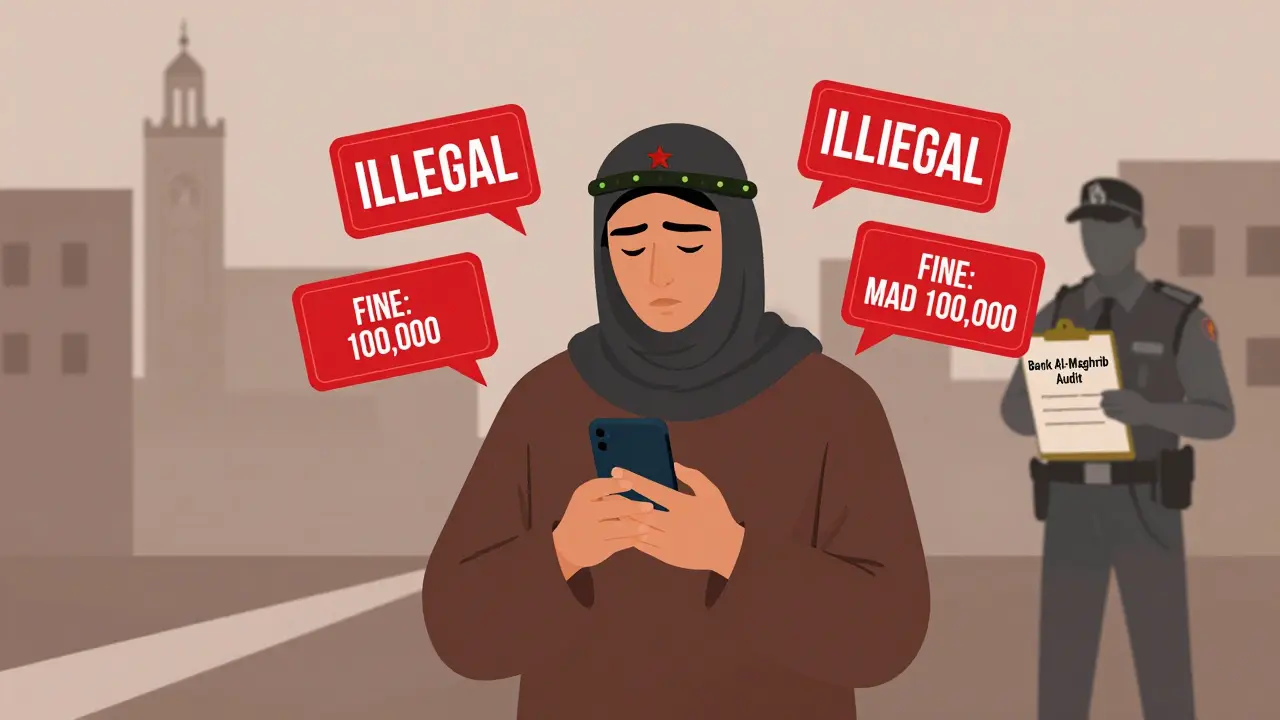
Buying or selling Bitcoin in Morocco isn’t just risky-it’s illegal. And if you get caught, the fines aren’t small. Between MAD 20,000 and MAD 100,000 (roughly $2,000 to $10,000 USD) for individuals, and up to MAD 500,000 for businesses, the Moroccan government doesn’t play around when it comes to unauthorized crypto trading. This isn’t a warning-it’s the law, and enforcement is getting tighter.
Why Is Crypto Illegal in Morocco?
In November 2017, Morocco’s Ministry of Economy and Finance declared all cryptocurrency transactions illegal. The reason? Foreign exchange controls. Morocco tightly regulates the flow of money in and out of the country to protect its currency, the Moroccan Dirham. Crypto, by design, bypasses banks and government oversight. That’s a problem when the state wants to track who’s sending money abroad, who’s importing goods, and who’s paying taxes. The ban wasn’t just a suggestion. It was a legal shutdown. Any transaction involving Bitcoin, Ethereum, Tether, or any other digital asset-whether buying, selling, mining, or using it to pay for something-became a violation of Morocco’s foreign exchange law. Even peer-to-peer trades between friends were technically illegal.Who Gets Fined-and How Much?
The penalties are clear, and they’re applied unevenly. Individuals who trade crypto on platforms like Binance or Coinbase without authorization face fines between MAD 20,000 and MAD 100,000. That’s enough to shut down a small business or wipe out a year’s savings for many Moroccans. Corporate entities-like shops accepting crypto payments, startups running token sales, or local exchanges operating without a license-are hit much harder. Fines can reach up to MAD 500,000. That’s not just a slap on the wrist. It’s a business-ending penalty. Repeat offenders don’t just pay more. They risk criminal charges. Moroccan financial law allows prosecutors to pursue jail time for repeated or large-scale violations, especially if money laundering or tax evasion is suspected. In February 2025, authorities launched targeted investigations into people using crypto to buy real estate. If you used Bitcoin to pay for a villa in Marrakech without declaring it, you were on their radar.What Happens If You Use Crypto to Pay for Goods or Services?
Using crypto to pay for anything-whether it’s a meal, a phone, or a car-is strictly forbidden. Businesses that accept digital currency as payment violate Morocco’s payment system rules. Even if the transaction seems harmless, the government sees it as a way to bypass banking oversight. In practice, enforcement focuses on businesses, not casual users. But if a shop is found accepting crypto, it’s not just fined. Their bank account could be frozen, their license revoked, and their name added to a public list of financial violators. That kind of exposure can kill a business overnight.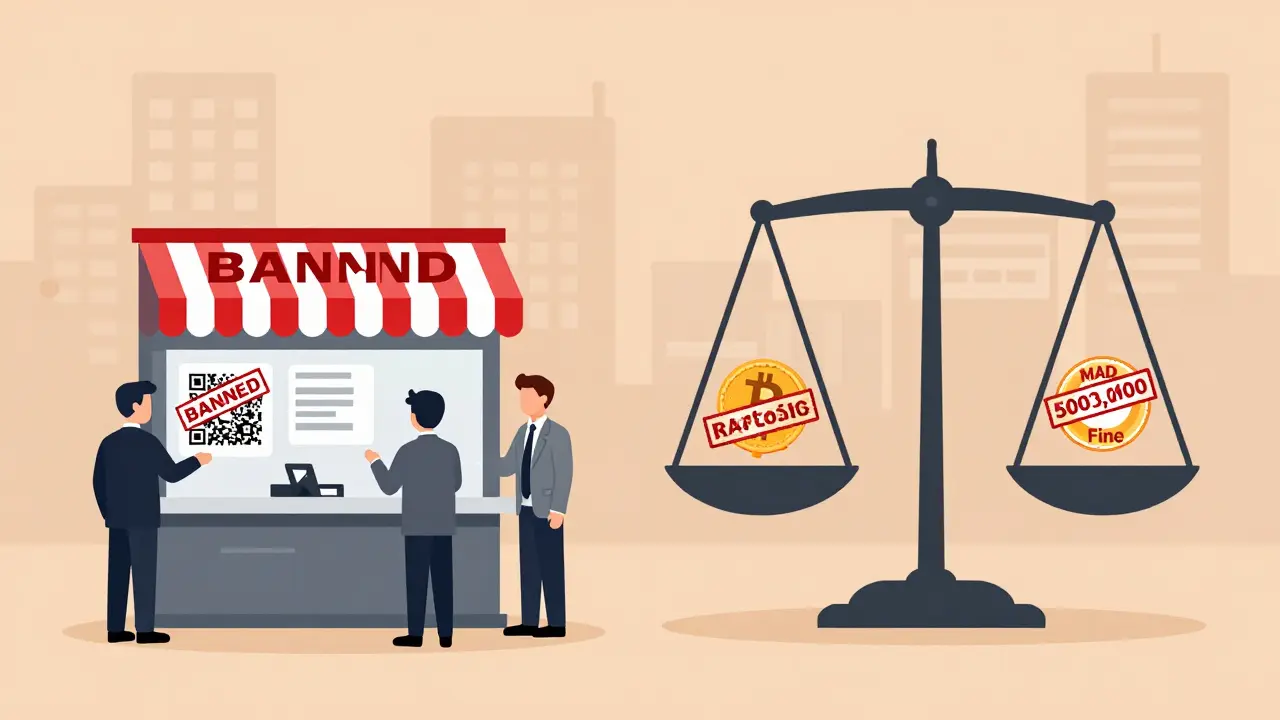
The Big Shift: Morocco Is Getting Ready to Legalize Crypto
Here’s where things get complicated. In November 2024, Abdellatif Jouahri, governor of Bank Al-Maghrib (Morocco’s central bank), announced a draft law to legalize and regulate cryptocurrency. This isn’t a rumor-it’s official policy. The goal? To bring crypto out of the shadows, not ban it forever. The new framework, expected to become law in 2025, will require all crypto exchanges operating in Morocco to get a license from Bank Al-Maghrib. These platforms will have to follow strict Anti-Money Laundering (AML) and Countering the Financing of Terrorism (CFT) rules. They’ll need to verify users’ identities, track transactions, and report suspicious activity. For individuals, the biggest change is taxation. The Moroccan Tax Administration (DGI) will start treating crypto gains like stocks or real estate. If you sell Bitcoin for a profit, you’ll owe tax. Rates range from 15% to 30% for capital gains, depending on your income level. For businesses, the corporate tax rate on crypto profits will be between 20% and 31%. Failure to report? That’s tax evasion-and the penalties there are even harsher.What’s Still Illegal Under the New Rules?
Even when the new law passes, not everything will be allowed. You still won’t be able to use crypto to pay your rent, buy groceries, or settle international invoices. Traditional banking channels will remain mandatory for commercial payments. Crypto will be treated as an asset, not a currency. Unlicensed platforms will still be shut down. If you’re running a local crypto exchange without a license, you’re still breaking the law. The new rules don’t make anonymity legal. They just create a legal path for regulated players.How Are People Still Trading Crypto in Morocco?
Despite the ban, crypto use is growing. U.S. State Department reports show Morocco has one of the highest crypto adoption rates in North Africa. People are using peer-to-peer apps, local Telegram groups, and cash trades to buy Bitcoin. The market is estimated to be worth $278 million in 2025-and still growing. Most users aren’t trying to break the law. They’re just trying to save money, send remittances, or invest in something beyond the sluggish local economy. But the risk is real. If your name shows up in a bank audit or your crypto wallet is linked to a property purchase, you could be flagged.
What Should You Do If You’re Trading Crypto in Morocco?
If you’re currently trading crypto in Morocco, here’s the reality:- Stay off unlicensed platforms. Use only those approved by Bank Al-Maghrib once the law changes.
- Keep records of every trade. You’ll need them for taxes.
- Don’t use crypto to pay for goods or services. Stick to cash or bank transfers.
- Don’t assume you’re safe because no one’s been caught. Authorities are actively monitoring transactions linked to real estate and foreign transfers.
What’s Next for Crypto in Morocco?
Morocco isn’t just regulating crypto-it’s preparing its own digital currency. Bank Al-Maghrib has been testing a Central Bank Digital Currency (CBDC) since 2024, with full rollout expected in 2026-2027. This means the government is building its own version of digital money, designed to replace cash and control digital payments. The Moroccan Capital Market Authority (AMMC) is also stepping in to regulate Initial Coin Offerings (ICOs). If you’re thinking of launching a token sale in Morocco, you’ll need their approval. No more shady crypto startups. The era of wild west crypto is ending.Final Thoughts: The Penalty Isn’t Just Money-It’s Opportunity
The real cost of trading crypto illegally in Morocco isn’t just the fine. It’s the missed chance to join the legal market when it opens. By waiting, you avoid jail, avoid fines, and position yourself to trade legally when the new system rolls out. Morocco’s shift from ban to regulation isn’t a sign of weakness. It’s a sign of pragmatism. The government realized it couldn’t stop crypto. So now, it’s trying to control it. If you want to be part of that future, play by the rules-even if they’re not written yet.Is crypto completely banned in Morocco right now?
Yes. As of early 2026, all cryptocurrency trading, mining, and use for payments remains illegal under Morocco’s 2017 foreign exchange law. Penalties apply to individuals and businesses. However, a new regulatory law is expected to take effect in 2025, which will legalize crypto under strict oversight.
How much can you be fined for trading crypto in Morocco?
Individuals face fines between MAD 20,000 and MAD 100,000 (about $2,000-$10,000 USD). Businesses can be fined up to MAD 500,000 ($50,000 USD). Repeat offenses may lead to criminal charges.
Can you go to jail for trading crypto in Morocco?
Yes. While fines are the most common penalty, Moroccan financial law allows for criminal prosecution for repeated violations, especially if linked to money laundering, tax evasion, or large-scale operations.
Will crypto become legal in Morocco in 2026?
Yes. A new regulatory framework is expected to be fully implemented by mid-2025. Crypto trading will be legal-but only through licensed platforms that follow AML/CFT rules and report to Bank Al-Maghrib and the tax authority.
Do you have to pay taxes on crypto profits in Morocco?
Once the new law takes effect, yes. Capital gains from crypto trading will be taxed between 15% and 30%, depending on your income level. Corporate profits from crypto will be taxed at 20%-31%. Failure to report is considered tax evasion.
Can you use crypto to buy property in Morocco?
No. Using crypto for property purchases is illegal and has been a key target of government investigations since early 2025. Authorities are actively tracking Bitcoin, Ethereum, and other digital assets used in real estate deals to enforce foreign exchange rules.
Are crypto exchanges like Binance blocked in Morocco?
Binance and other foreign exchanges aren’t officially blocked by internet filters, but they’re not licensed in Morocco. Using them is illegal under current law. Once the new law passes, only platforms approved by Bank Al-Maghrib will be allowed to operate legally.
Is mining cryptocurrency illegal in Morocco?
Yes. Mining is considered part of unauthorized cryptocurrency activity under the 2017 ban. It’s treated the same as trading-subject to fines and potential criminal charges if done at scale or for commercial purposes.
Lori Quarles
February 2, 2026 AT 03:00Wow, this is wild. Morocco’s trying to control crypto like it’s 2008 and the Fed’s got a magic wand. I get the foreign exchange stuff, but come on - people are using this to send money home to family, not launder drug cash. The real crime is forcing hardworking folks to risk jail just to survive. When the law catches up to reality, it’s gonna look like a joke.
Jeremy Dayde
February 3, 2026 AT 15:09Man I’ve been watching this whole thing unfold for years and honestly the government’s not wrong to be scared but also they’re acting like crypto is some alien invasion when it’s just money that’s better at doing what money does which is move fast and be hard to track and honestly if you’re gonna ban it you gotta at least give people a way to play nice with it like they’re doing now with licensing and taxes and honestly I think this is the smartest move any African country’s made on crypto so far even if it’s late
Tom Sheppard
February 3, 2026 AT 19:10bro the fact that people are still trading crypto in morocco like it’s a underground rave is kinda beautiful 😍 i mean yeah it’s illegal but it’s also people finding a way to beat a broken system 🤝 i’ve seen guys in casablanca trade btc for dirhams in coffee shops like it’s nothing. the gov’s gonna have to learn to chill and tax it instead of chasing ghosts. also if you’re using crypto to buy villas in marrakech… bro you’re asking for trouble 😅
Aaron Poole
February 3, 2026 AT 20:55Let’s be real - this isn’t about banning crypto, it’s about control. Morocco’s central bank is terrified of losing power over the flow of money, and honestly? They’re right to be. But banning it doesn’t stop adoption, it just pushes it into the dark. The fact that they’re moving toward licensing and taxation is actually a huge win. It means they’re listening. The real winners will be the people who wait out the chaos, document every trade, and jump in legally when the doors open. No need to risk jail when the future’s literally coming next year.
Edward Drawde
February 5, 2026 AT 09:50People deserve to get fined. If you break the law, you pay. No sympathy for crypto gamblers. This isn't a video game. You don't get to cheat the system because you think you're smart.
Rico Romano
February 6, 2026 AT 16:11Of course Morocco’s banning crypto. The country still operates on 19th century economic models. The Dirham is a paper anchor dragging the entire region down. Anyone trading crypto is either a financial rebel or a fool. The fact that they’re even considering regulation proves they’re behind the curve. In 2026, they’ll still be arguing about KYC while the rest of the world has moved to decentralized identity.
Calvin Tucker
February 7, 2026 AT 09:12The imposition of capital gains taxation on cryptocurrency represents not merely fiscal pragmatism but a profound epistemological shift in the state’s ontological relationship to value. By codifying digital assets as taxable property, the Moroccan state reifies the very notion of decentralized exchange - not by eradicating it, but by assimilating it into the apparatus of sovereign accounting. The irony is not lost: the state, in attempting to control the uncontrolled, becomes the architect of its own obsolescence.
Gustavo Gonzalez
February 9, 2026 AT 01:12Wait, so you're telling me people are still trading crypto in Morocco? That’s not just illegal - it’s statistically reckless. The government’s monitoring real estate transactions linked to wallets? That’s basic forensic accounting. If you’re using BTC to buy a villa, you’re not just breaking the law - you’re leaving a digital breadcrumb trail that leads straight to your door. And don’t even get me started on the tax evasion risk. You think you’re being clever? You’re just funding the next audit team’s vacation.
Dahlia Nurcahya
February 9, 2026 AT 19:18Honestly? I’m proud of Morocco for not doubling down on the ban. They could’ve gone full North Korea and blocked everything. Instead, they’re building a bridge. That takes guts. Most governments panic and ban, then panic harder and try to catch up. Morocco’s doing the hard thing - regulating with clarity. To anyone still trading in the shadows: don’t panic, don’t rage, just keep records. The legal window’s opening. Walk through it with your eyes open.
Sunil Srivastva
February 11, 2026 AT 18:54As someone from india where crypto was banned then legalized too, i can say this is the right path. morocco is not fighting tech, they're trying to tame it. the key is patience. wait for the licensed exchanges, keep your trades documented, and don't use it to pay for anything. the tax part? yeah it sucks but better than losing your bank account. i've seen friends lose everything because they rushed. don't be them.