Price Oracles for Cryptocurrency: How DeFi Gets Real-World Data
 Oct, 4 2026
Imagine you’re trying to buy a coffee, but the barista has no idea what money is worth today. You hand them a token, and they have to guess its value based on vibes alone. That’s essentially how blockchains operate without price oracles. They are isolated systems that cannot natively see the outside world. Without these critical bridges, decentralized finance (DeFi) would be blind, unable to execute loans, liquidate positions, or maintain stablecoin pegs because it wouldn’t know if your collateral is still valuable.
This isn't just theoretical. In October 2020, attackers exploited a flaw in an oracle mechanism to steal $24 million from Harvest Finance. It wasn't a bug in the smart contract logic itself, but in the data feeding it. This incident highlights why understanding price oracles is non-negotiable for anyone involved in crypto infrastructure. If you're building protocols or managing risk, knowing how these mechanisms work-and where they fail-is your first line of defense against catastrophic loss.
The Core Problem: Why Blockchains Need External Eyes
Blockchains are deterministic state machines. Every node must agree on every transaction. But real-world data-like the price of Bitcoin on Coinbase-is dynamic and external. A blockchain can't make API calls; it doesn't have internet access in the traditional sense. If one node fetched a price and another got a slightly different number due to network latency, consensus would break.
A price oracle is a service that provides off-chain data to on-chain smart contracts. It acts as a trusted intermediary, fetching prices from multiple sources, aggregating them, and pushing them onto the blockchain. The challenge is trust. How do you trust a centralized server when the whole point of crypto is decentralization? This tension drives the entire industry of oracle development.
How Major Price Oracles Work Under the Hood
Not all oracles are created equal. The two most prominent solutions, Chainlink and Uniswap's native oracle, use fundamentally different approaches to solve the same problem.
Chainlink uses a multi-layered approach. It aggregates data from multiple independent nodes, each pulling from various centralized exchanges like Binance, Kraken, and Coinbase. These nodes compete to provide accurate data, and the median price becomes the official feed. This redundancy protects against single points of failure. As of late 2023, Chainlink secured over $30 billion in DeFi value across more than 1,000 assets on 12 different blockchains.
In contrast, Uniswap V2/V3 Oracles rely on on-chain liquidity. Instead of asking external servers, they look at the actual trades happening within the Uniswap pools. Specifically, they use Time-Weighted Average Prices (TWAPs). By averaging prices over time, they smooth out momentary spikes caused by large trades. However, this method assumes high liquidity. If a pool is thin, a single whale trade can skew the average, making the oracle vulnerable to manipulation.
| Feature | Chainlink | Uniswap Native Oracle | Pyth Network |
|---|---|---|---|
| Data Source | Off-chain APIs (Centralized Exchanges) | On-chain Liquidity Pools | First-party Publisher Data |
| Update Frequency | Heartbeat-based (e.g., every hour or on deviation) | Per Block (on demand) | Sub-second updates |
| Manipulation Risk | Low (Multi-source aggregation) | Medium-High (Depends on pool depth) | Low (Signed data from publishers) |
| Gas Cost | Higher (Node rewards + gas) | Lower (No external calls) | Moderate |
| Best For | Critical financial operations (Loans, Derivatives) | DEX Arbitrage, Simple Swaps | High-frequency trading apps |

The Danger Zone: Oracle Manipulation Attacks
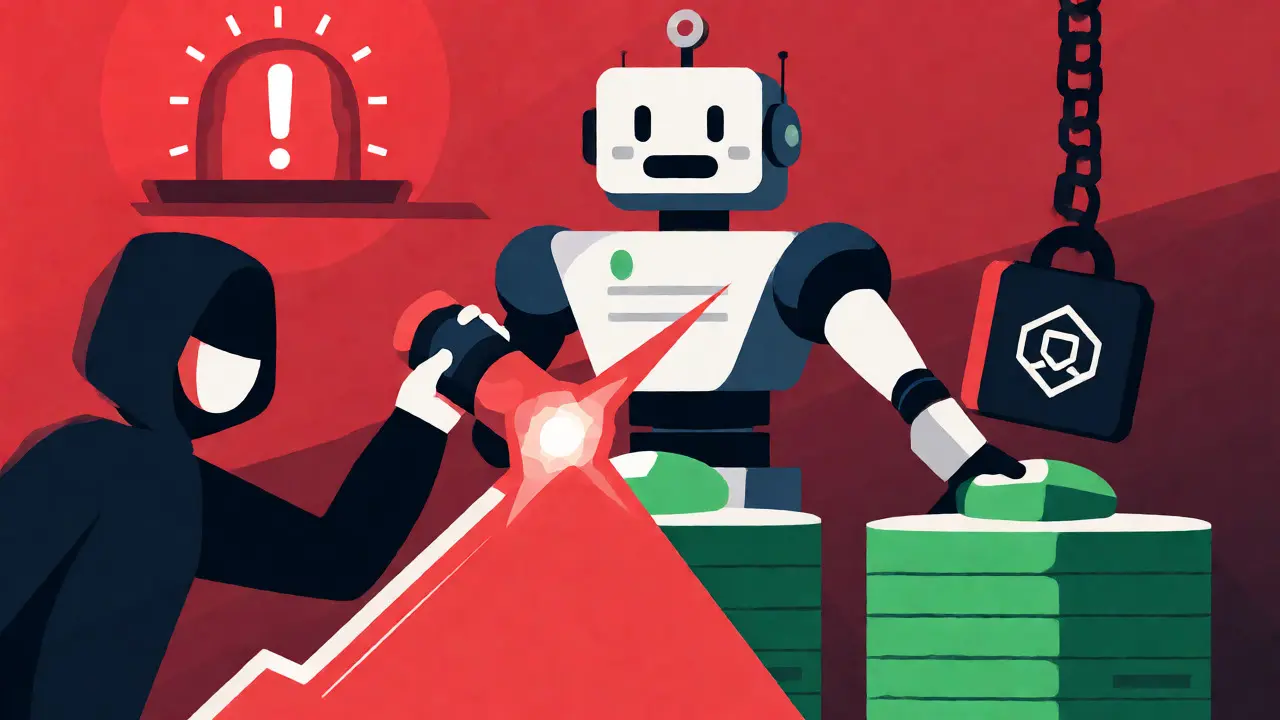
If an attacker can control the price feed, they can drain a protocol. This is known as an oracle manipulation attack. Attackers often use flash loans to temporarily distort spot prices. Since some oracles rely on instantaneous price snapshots, a massive buy order can spike the price artificially. The protocol reads this inflated price, thinks your collateral is worthless, and liquidates your position at a discount. The attacker then buys back the collateral cheaply.
The May 2021 "Black Thursday" crash exposed another weakness: latency. During extreme market volatility, Ethereum gas fees skyrocketed. Oracles couldn't update fast enough. MakerDAO’s system relied on hourly updates, which became stale during the rapid drop. This led to undercollateralized liquidations, costing users millions. Stale data is just as dangerous as manipulated data.
Implementation Best Practices for Developers
Integrating an oracle isn't just about calling a function. It requires careful configuration to avoid pitfalls.
- Set Heartbeats and Deviation Thresholds: Don't update prices every second. Use a heartbeat (time interval) combined with a deviation threshold (percentage change). Only update if the price moves significantly or after a set time. This saves gas and reduces noise.
- Check for Staleness: Always verify the timestamp of the oracle data. If the data is older than your allowed window, halt operations. A Consensys audit found that 17% of DeFi protocols failed to properly configure staleness thresholds.
- Use Multiple Sources: For high-value protocols, don't rely on a single oracle. Cross-reference Chainlink with Uniswap TWAPs or Pyth. If they diverge significantly, trigger a circuit breaker.
- Avoid Spot Price Reliance: Never use the current block's spot price for critical decisions. Always use a time-weighted average to prevent flash loan attacks.
The Future: Hybrid Models and Standardization
The industry is moving toward hybrid models. Purely off-chain oracles face censorship risks, while purely on-chain oracles lack liquidity in bear markets. Newer solutions like Pyth Network combine the speed of first-party data (from exchanges like Binance directly) with on-chain verification. This reduces the reliance on third-party node operators.
Regulatory pressure is also shaping oracle design. The EU’s MiCA legislation requires reliable price sources for stablecoins. This pushes projects toward audited, transparent oracle providers rather than obscure data feeds. Expect to see more standardization in how oracles report confidence intervals and data provenance.
What happens if a price oracle goes offline?
If an oracle fails to update, smart contracts typically revert transactions or enter a paused state. Well-designed protocols implement "circuit breakers" that stop lending or borrowing if the oracle data is stale or missing. This prevents executing trades on outdated information, protecting user funds until the oracle resumes normal operation.
Why is Chainlink considered safer than Uniswap's oracle?
Chainlink aggregates data from multiple independent off-chain sources, reducing the impact of any single exchange outage or manipulation attempt. Uniswap's oracle relies solely on on-chain liquidity. If a specific pool has low volume, a single trader can manipulate the price easily. Chainlink's multi-node architecture provides higher resilience against targeted attacks.
Can I build my own price oracle?
Yes, but it's complex. You need a network of trusted nodes to fetch and sign data, plus a smart contract to aggregate those signatures. Most developers prefer using established networks like Chainlink or Band Protocol because maintaining a secure, decentralized node network is expensive and difficult to bootstrap securely.
What is a Time-Weighted Average Price (TWAP)?
A TWAP calculates the average price of an asset over a specific period, rather than taking a snapshot at one moment. This smooths out short-term volatility and makes it much harder for attackers to manipulate the price with a single large trade, as they would need to sustain the price distortion over time.
Do price oracles cost money to use?
Yes. Using Chainlink involves paying gas fees for reading the data on-chain and potentially paying node operators for the service. Some protocols pass these costs to users via transaction fees. On-chain oracles like Uniswap's have lower direct costs but may require more gas for complex calculations if not optimized.
Jennifer Moore
October 5, 2026 AT 06:59It is absolutely fascinating how much of our current financial infrastructure relies on these invisible bridges, yet the average person has no clue they even exist. I mean, think about it for a second: we trust a handful of centralized exchanges to tell us what Bitcoin is worth, and then we let smart contracts make life-or-death decisions based on that data. It’s like building a skyscraper on a foundation made of quicksand, but everyone agrees to pretend the ground is solid until the earthquake hits. The Harvest Finance hack wasn't just some random glitch; it was a direct consequence of prioritizing speed over security, which is something the crypto industry seems to do on repeat every single cycle. We keep repeating history because we’re too busy chasing the next bull run to fix the plumbing underneath.
Michael DeGroat
October 7, 2026 AT 04:55tl;dr oracles are still centralized garbage waiting to get hacked again
Muyiwa Osibolu
October 7, 2026 AT 13:24The reliance on Western centralized exchanges such as Coinbase and Binance introduces a significant geopolitical vulnerability that cannot be ignored. When we speak of decentralization, we often forget that the data sources themselves are subject to regulatory capture by entities outside our sovereign control. If the United States or Europe decides to freeze assets or manipulate price feeds during a crisis, our so-called decentralized systems will crumble instantly. We must advocate for oracle solutions that prioritize first-party data from diverse global markets rather than relying solely on US-centric liquidity pools.
sai charan
October 8, 2026 AT 11:04This analysis is painfully surface-level and misses the actual technical debt accumulating in the ecosystem. You mention Chainlink's multi-node architecture as if it's a silver bullet, but you completely ignore the fact that node operators are increasingly consolidating into a few large firms, effectively recreating the centralization problem at a higher layer. Furthermore, the comparison with Uniswap TWAPs is misleading because it ignores the gas cost implications during high-congestion periods, which actually makes on-chain oracles prohibitively expensive for small protocols. Until we see true economic security models where slashing penalties outweigh potential gains from manipulation, these 'secure' oracles remain fragile experiments.
Matthew Twin
October 9, 2026 AT 23:14Hey there! 👋 Just wanted to add a little color to this discussion. Think of price oracles like the nervous system of DeFi-without them, the body (the blockchain) can feel pain (price changes), but it can't react fast enough to save itself! 🧠⚡️ It’s wild to think that one bad signal can trigger a cascade of liquidations, wiping out years of savings in seconds. That’s why checking those staleness thresholds isn’t just good practice; it’s basically wearing your seatbelt before driving on an icy road. Stay safe out there, folks! 🛡️💸
Richard Holle
October 10, 2026 AT 20:57Respectfully, I believe we should focus on the philosophical implication here. The core issue isn't just technical; it's epistemological. How can a deterministic system truly know truth when the source of that truth is probabilistic? We accept this trade-off for convenience, but we must acknowledge that perfect knowledge is impossible in a distributed network. This humility should guide our risk management strategies more than any specific oracle provider ever could.
Ayodele Emmanuel
October 12, 2026 AT 16:54Yo, this is huge! Seriously, if you aren't looking at Pyth or Band Protocol, you're missing out big time. The speed difference is insane compared to old school Chainlink heartbeats. Keep grinding, devs! We need more people understanding this stuff so we don't get wrecked again! 💪🚀 Let's build better!
Sandy Garg
October 13, 2026 AT 23:57I have been contemplating the ethical dimensions of oracle dependency recently. There is a profound irony in seeking absolute certainty through mechanisms that are inherently uncertain. Perhaps the goal should not be to eliminate error entirely, but to create systems that degrade gracefully under uncertainty. This shifts the burden from prediction to resilience, which feels like a more mature approach to infrastructure design.
Nicoletta Milanesio
October 14, 2026 AT 12:09Love this breakdown! 😍 It really helps visualize why things go wrong sometimes. I always wondered why my positions got liquidated even when the market didn't seem that crazy... now I get it, it's all about the data feed! 📉 Thanks for sharing this, super helpful! ✨