Qatar's Crypto Ban: Why the Financial Sector Prohibits Bitcoin but Embraces Tokenization
 Nov, 11 2026
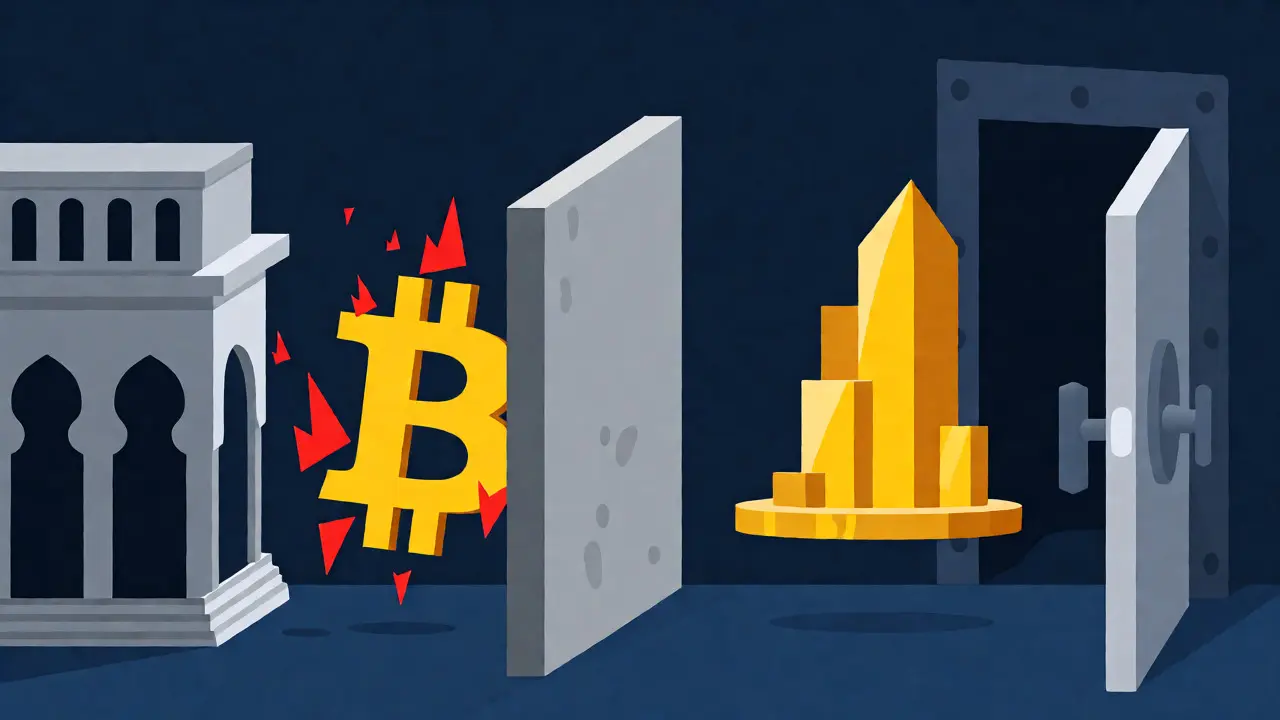
Imagine trying to buy a cup of coffee in Doha with Bitcoin. You can't. In fact, if you try to trade it through a local bank, you'll hit a wall so hard it feels like a concrete bunker. Since February 2018, Qatar has maintained one of the strictest prohibitions on cryptocurrency in the world. The Qatar Central Bank (QCB) issued Circular No. (6) of 2018, effectively banning all financial institutions from engaging with digital currencies. This wasn't just a warning; it was a hard stop. For years, this stance placed Qatar alongside Kuwait at the most conservative end of the Gulf Cooperation Council (GCC) spectrum. But here is the twist that confuses many outsiders: while Qatar bans Bitcoin trading, it recently opened its doors wide for blockchain technology. Specifically, for something called asset tokenization.
If you are an investor, a fintech founder, or just someone curious about why the Middle East's regulatory landscape looks so fragmented, you need to understand this distinction. Qatar isn't anti-technology. It is anti-volatility. The country is strategically choosing which parts of the blockchain revolution to adopt and which to leave out. This article breaks down exactly what is banned, what is allowed under the new QFC Digital Assets Regulations 2024, and why this specific approach might actually be smarter than going all-in on crypto speculation.
The Core Prohibition: What Exactly Is Banned?
Let's get the bad news out of the way first. If you are looking to buy, sell, or hold cryptocurrencies as investments within Qatar's regulated financial sector, you are mostly out of luck. The prohibition targets what regulators call "Excluded Tokens." These are virtual assets that do not represent a right in any property other than the token itself, or those that act as a substitute for currency.
This definition explicitly includes:
- Bitcoin and Ethereum: The major speculative cryptocurrencies.
- Stablecoins: Yes, even USDT or USDC are currently restricted in the same category as volatile coins within the QFC framework.
- Central Bank Digital Currencies (CBDCs): While Qatar is researching a digital riyal, public trading of CBDCs falls under strict oversight.
The ban applies to exchanging these assets for fiat currencies, transferring them, safekeeping them, and offering services related to their issuance. The Qatar Financial Centre Regulatory Authority (QFCRA) reinforced this in December 2019 with a comprehensive alert that banned virtual asset services within the Qatar Financial Centre (QFC). The logic? Protecting the financial system from the wild swings of crypto markets and preventing money laundering risks associated with anonymous digital wallets.
The Pivot: Enter Asset Tokenization
So, if crypto is dead in Qatar, why are people talking about blockchain there? Because on September 1, 2024, the QFC Authority and QFCRA jointly enacted the QFC Digital Assets Regulations 2024. This framework creates a controlled legal environment that maintains the crypto ban but permits the tokenization of real-world assets (RWAs).
Think of it this way: You can't buy Bitcoin, but you can buy a digital token that represents a share of a commercial building in Lusail City. That token is backed by physical property, not market hype. The regulations allow for the tokenization of illiquid assets such as:
- Commercial real estate towers.
- Islamic finance products (Sukuk).
- Bonds and commodities.
- Special Purpose Vehicles (SPVs).
This shift allows Qatar to embrace the efficiency benefits of blockchain-like faster settlement times and fractional ownership-without exposing its economy to the risk of a Bitcoin crash. Yousef Al-Jaida, CEO of the QFC, emphasized that this ban doesn't hinder innovation; it redirects it toward stable applications. It’s a calculated move to use blockchain as plumbing for traditional finance, rather than letting it become the house itself.

How the New Framework Works
The QFC Digital Assets Regulations 2024 aren't just a press release; they come with technical teeth. The framework establishes legal recognition of ownership rights to tokens and their underlying assets. This means if you hold a token representing a Sukuk bond, the law recognizes your claim to that bond. It also defines custody arrangements, transfer protocols, and exchange mechanisms.
A key component is the regulatory sandbox. This allows businesses to experiment with digital financial products while containing risks within the QFC's legal perimeter. Firms can test tokenization models for up to 18 months before seeking full licensing. As of April 2025, 14 firms were participating in this sandbox. The goal is to create a safe space where innovation happens under supervision, ensuring that smart contracts-which are now legally enforceable in Qatar-work as intended without creating systemic chaos.
Qatar vs. The Rest of the GCC
To understand Qatar's position, you have to look at its neighbors. The GCC is not a monolith when it comes to crypto. Each country has taken a different path based on its economic priorities and risk appetite.
| Country | Crypto Trading Status | Tokenization/RWA Status | Key Regulator |
|---|---|---|---|
| Qatar | Prohibited (Banks cannot engage) | Permitted & Regulated (QFC Framework) | QFCRA / QCB |
| UAE | Regulated (VARA licenses exchanges) | Active (Dubai focuses on both) | VARA / CBUAE |
| Kuwait | Prohibited (Total ban) | Limited/Unclear | CBK / CMA |
| Bahrain | Regulated (Licensed exchanges) | Emerging | CBB |
| Saudi Arabia | Restricted (No licensed exchanges yet) | Exploratory | CMA / SAMA |
The UAE has captured approximately 68% of the GCC's cryptocurrency trading volume, estimated at $450 billion annually as of Q1 2025. Dubai wants to be the global crypto hub. Qatar, conversely, has positioned itself as a leader in institutional-grade tokenized assets. While retail adoption of crypto in Qatar is low-only about 0.8% of the population compared to 14% in the UAE-institutional interest is high. Twenty-three international asset managers expressed formal interest in establishing QFC-based tokenization operations as of April 2025.
The Cost of Compliance and Real-World Impact
Implementing this framework isn't cheap or easy. Businesses seeking to operate within the tokenization framework typically require 6-8 months for full compliance implementation. The average setup cost is around QAR 850,000 ($233,500 USD). You need comprehensive asset verification, legal opinions, and detailed technical specifications of the blockchain infrastructure.
For financial professionals, the learning curve is steep. A February 2025 survey found that 63% of compliance officers needed specialized blockchain training. Furthermore, 78% of surveyed financial services firms reported increased compliance costs, averaging 15% higher than regional competitors, because they must rigorously verify that transactions don't involve prohibited cryptocurrencies.
However, early adopters are seeing results. Barwa Real Estate Company successfully tokenized a QAR 150 million commercial property in Q1 2025. The result? Settlement times dropped from 30 days to just 48 hours. That kind of efficiency gain is exactly what the QFC aims to achieve by using blockchain for RWAs instead of speculative coins.
Expert Opinions and Future Outlook
Is this strategy working? Experts are split, but generally respectful of the caution. Dr. Ibrahim Al-Hashimi, a Professor of Finance at Qatar University, noted that the framework reflects a sophisticated understanding of the difference between speculative crypto and utility-focused tokenization. It aligns with Qatar's conservative financial tradition while positioning the country for blockchain-enabled efficiency.
On the flip side, critics like blockchain consultant Ahmed Mansoor argue that by excluding stablecoins entirely, Qatar misses out on liquidity and price discovery mechanisms that could benefit its tokenized asset markets. The Financial Stability Board acknowledged Qatar's "cautious but progressive steps" but noted that excluding stablecoins creates fragmentation between traditional markets and emerging digital ones.
Looking ahead, industry analysts project that Qatar will maintain its prohibition on cryptocurrencies through 2030 while expanding its tokenization framework. The QFC's roadmap identifies carbon credits, intellectual property rights, and art collections as potential future targets for tokenization. With 68% of citizens aged 18-35 expressing support for limited cryptocurrency legalization, pressure may build, but the government's priority remains clear: financial stability over short-term market participation.
Can I buy Bitcoin in Qatar?
You cannot buy Bitcoin through Qatar's regulated financial institutions. The Qatar Central Bank prohibits banks from facilitating crypto trades. However, some residents use offshore exchanges, though this comes with higher fees and KYC hurdles, and lacks local consumer protection.
What is the difference between crypto and tokenization in Qatar?
Crypto (like Bitcoin) is banned because it is seen as speculative and volatile. Tokenization involves creating digital tokens that represent real-world assets like real estate or bonds. This is permitted under the QFC Digital Assets Regulations 2024 because it offers tangible value and stability.
Are stablecoins banned in Qatar?
Yes, under the current QFC framework, stablecoins are classified as "Excluded Tokens" along with cryptocurrencies. They are treated as substitutes for currency and are therefore subject to the same restrictions as Bitcoin within the regulated financial sector.
How long does it take to set up a tokenization business in Qatar?
It typically takes 6-8 months for full compliance implementation. Costs average around QAR 850,000 ($233,500 USD), covering legal opinions, asset verification, and technical setup. There is also an 18-month regulatory sandbox option for testing models.
Why did Qatar ban crypto but allow blockchain?
Qatar prioritizes financial stability. Cryptocurrencies are viewed as too volatile and risky for the banking system. Blockchain technology, however, is valued for its ability to improve efficiency, transparency, and settlement speeds for traditional assets like real estate and Islamic finance products.