RadioShack (Polygon) Crypto Exchange Review: Is the Starfish Topology Worth Your Money?
 Aug, 10 2026
Remember RadioShack? The electronics store that once dominated every mall in America is back. But this time, they aren’t selling headphones or soldering irons. They are launching a cryptocurrency protocol built on the Polygon network. It sounds like a nostalgic marketing stunt, but under the hood, RadioShack Swap is a decentralized exchange (DEX) component of the RadioShack blockchain protocol designed to improve liquidity concentration through a unique 'Starfish Topology'. The big question isn't just whether the brand name brings attention-it’s whether the technology actually works for your trades.
If you are looking for a place to swap tokens quickly without losing half your value to slippage, you need to know what you are getting into. This isn't Uniswap. It isn't PancakeSwap. It is an experimental protocol trying to solve a specific problem in decentralized finance: fragmented liquidity. Let's break down if RadioShack Swap is ready for your wallet or if it is still too risky for real money.
What Exactly Is RadioShack Swap?
First, let's clear up the confusion. When people search for "RadioShack crypto exchange," they often expect a centralized platform where you can log in with an email and buy Bitcoin. That doesn't exist here. RadioShack is a decentralized project. You connect your Web3 wallet-like MetaMask or Trust Wallet-and interact directly with smart contracts on the blockchain.
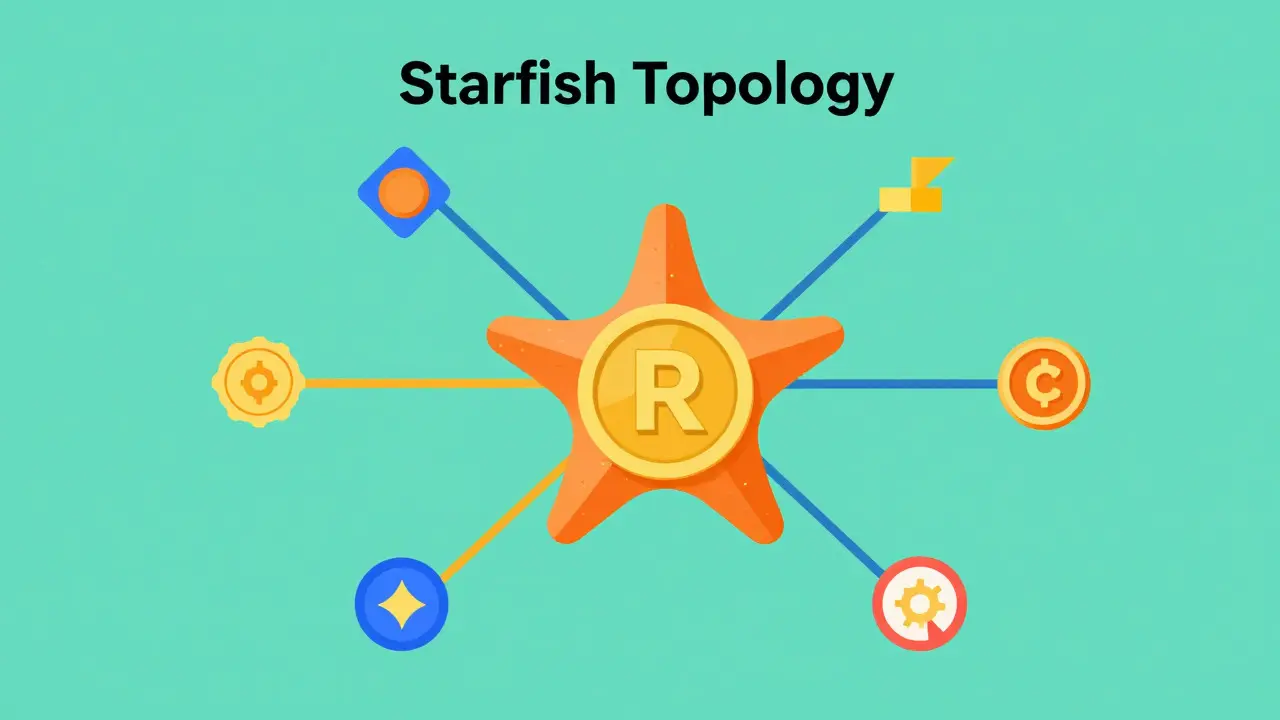
The core innovation here is something called the Starfish Topology. Unlike traditional Automated Market Makers (AMMs) that rely on direct pairs between any two tokens, RadioShack uses a single central node-the RADIO token-to facilitate swaps. Imagine a starfish. The center is the RADIO token. Every other token connects directly to the center. If you want to swap Token A for Token B, the trade routes through RADIO. Theoretically, this reduces the number of steps needed to find liquidity and concentrates funds in one efficient hub.
This approach targets the "chaotic and dispersed" nature of current AMMs. By forcing all liquidity through the RADIO node, the protocol aims to reduce the "diameter" of the token graph. In plain English: fewer hops mean faster, potentially cheaper trades for niche tokens that usually suffer from low liquidity on other platforms.
The Numbers: Volume, Liquidity, and Red Flags
Here is where things get messy. If you read the press releases, RadioShack looks like a powerhouse. Reports from late 2025 claimed trading volumes nearing $40 million with daily averages between $500,000 and $2 million. Those numbers sound impressive for a new entrant. But when you look at on-chain data from authoritative sources like CoinMarketCap and CoinGecko as of October 31, 2025, the picture changes drastically.
CoinMarketCap reported a 24-hour trading volume of just $1,217.65. CoinGecko showed total liquidity locked in the protocol at roughly $969,800. Compare that to Uniswap v3, which holds over $3.2 billion in liquidity across all chains, or even QuickSwap on Polygon, which processes millions in daily volume. The discrepancy suggests either massive reporting errors or inflated claims by the team.
| Platform | Total Value Locked (TVL) | 24h Volume (Approx.) | Liquidity Model | Token Pairs Available |
|---|---|---|---|---|
| RadioShack Swap | $969,800 | $1,217 - $318k (Conflicting Data) | Starfish Topology (Single Node) | 87 |
| Uniswap v3 | $3.2 Billion+ | $12.3 Billion | Concentrated Liquidity | 10,000+ |
| QuickSwap (Polygon) | $15 Million+ | $18.3 Million | Standard AMM (x*y=k) | 1,245 |
| PancakeSwap (Polygon) | $1.1 Billion (BNB Chain) | $12.7 Million (Polygon) | Standard AMM + Syrup Pools | 2,000+ |
Note the supply issue too. Data shows a circulating supply of 3.4 billion RADIO tokens against a stated total supply of 1 billion. While this might be a display error on aggregators, it highlights the lack of polish in their data infrastructure right now.
User Experience: Is It Easy to Use?
If you have used DeFi before, you will feel at home. The interface is clean and modern, leveraging the nostalgia of the RadioShack brand with a sleek, tech-forward design. Connecting your wallet takes about five minutes if you already have MetaMask set up for Polygon. For beginners, however, there is a steep learning curve. You need to understand gas fees, network switching, and slippage tolerance.
But here is the catch: the experience falls apart when you try to trade anything significant. User reports from Reddit threads in October 2025 tell a consistent story. Small trades under $500 go through smoothly with minimal slippage. But try swapping $2,000 worth of USDC for MATIC, and you might face 8.2% slippage. That means you lose over $160 instantly due to thin liquidity. One user noted, "The interface is clean, but the lack of token pairs beyond major assets makes it less useful than QuickSwap."
Support is also lacking. There is no dedicated customer service chat. You are left with a Telegram group of around 4,852 members and some basic API documentation. If your transaction fails during network congestion-a common issue reported by 23% of users-you are on your own to troubleshoot.
Risks: The Single Point of Failure
The Starfish Topology is clever, but it has a fatal flaw: centralization risk. Because every trade routes through the RADIO token, the entire ecosystem depends on the stability and liquidity of that single asset. Dr. Elena Rodriguez, DeFi Research Lead at Messari, pointed out in September 2025 that this creates a "classic chicken-and-egg problem." You need deep liquidity in RADIO to attract traders, but traders won't provide liquidity unless there is high volume.
History warns us here. Bancor tried a similar single-token hub model years ago and struggled with manipulation risks and inefficiencies. If the price of RADIO crashes or gets manipulated, every other token paired with it suffers. Michael Chen from Alpha5 analysis firm noted that "mainstream adoption requires deeper liquidity than their current $1 million market cap can support." With a market cap hovering around $1.08 million, RADIO is highly volatile and susceptible to whale attacks.

Who Should Use RadioShack Swap?
So, who is this for? It is not for institutional investors. It is not for day traders moving large sums. Based on the data, RadioShack Swap is best suited for:
- Niche Token Holders: If you hold a small-cap token listed on RadioShack but not on Uniswap or QuickSwap, this might be your only option to swap it efficiently.
- Speculators: Traders betting on the RADIO token itself or early-stage governance rewards might find opportunities here, but they should expect high volatility.
- DeFi Experimenters: Users interested in testing new liquidity topologies with small amounts of capital ($50-$200) to see how the Starfish model performs in real-time.
If you are looking for stable, deep liquidity for major pairs like ETH/USDC, stick to Uniswap or PancakeSwap. You will save yourself money on slippage and avoid the headache of failed transactions.
Future Outlook: Can It Grow?
The roadmap promises integration with Solana and Cosmos by Q2 2026 and a concentrated liquidity model similar to Uniswap v3 by Q4 2025. These are ambitious goals. The Polygon ecosystem is growing, with projected throughput reaching 65,000 TPS, which benefits all DEXs on the chain. However, RadioShack ranks #142 by TVL among 127 active DEXs on Polygon. To compete, they need partnerships. Alpha5 analysts suggest that securing deals with major Polygon-based gaming projects could provide the necessary niche liquidity to survive.
Until then, RadioShack remains a curious experiment wrapped in a vintage brand. It offers a novel solution to liquidity fragmentation, but the execution is still raw. Use it with caution, keep your trade sizes small, and always verify the liquidity depth before clicking swap.
Is RadioShack Swap a centralized or decentralized exchange?
RadioShack Swap is a decentralized exchange (DEX). It operates via smart contracts on the Polygon network and does not require user accounts or KYC verification. You connect directly using a Web3 wallet like MetaMask.
What is the Starfish Topology?
The Starfish Topology is RadioShack's unique liquidity model. Instead of pairing tokens directly, all tokens pair with a central hub token (RADIO). This aims to concentrate liquidity and reduce the number of hops required for complex swaps, theoretically improving efficiency for niche assets.
Why is there conflicting data on RadioShack's trading volume?
There is a significant discrepancy between RadioShack's self-reported volume (~$40 million) and on-chain data from aggregators like CoinMarketCap (~$1,200). This likely stems from inflated internal metrics or double-counting, whereas external trackers reflect actual on-chain transactions. Always trust third-party on-chain data for accuracy.
Is it safe to trade large amounts on RadioShack Swap?
No. Due to low Total Value Locked (TVL) of under $1 million, large trades (above $5,000) suffer from severe slippage, sometimes exceeding 8%. It is recommended to keep trades under $500 to minimize losses.
How does RadioShack compare to QuickSwap on Polygon?
QuickSwap is far more established with higher liquidity, more token pairs (1,245 vs 87), and better user support. RadioShack is a niche alternative that may offer better rates for very specific, low-volume tokens not found on larger DEXs, but for general trading, QuickSwap is superior.
What wallets work with RadioShack Swap?
RadioShack Swap supports standard Web3 wallets compatible with Ethereum and Polygon networks, including MetaMask, Trust Wallet, and Coinbase Wallet. Ensure your wallet is configured to use the Polygon network to minimize gas fees.
Paul Smith
August 12, 2026 AT 07:36Oh wow, RadioShack is back in the game! 📻✨ I remember buying my first soldering iron there as a kid. It’s wild to see them pivoting to crypto on Polygon now. The Starfish Topology sounds super interesting for niche tokens, but honestly, the slippage numbers are scary. 😬 Who wants to lose 8% on a trade? I guess we’ll have to wait and see if they can actually pull off those Solana integrations by next year. Fingers crossed they don’t end up like those other failed DEXs from last cycle. 🤞🚀
Aryan MISHRA
August 13, 2026 AT 12:57The liquidity metrics are fundamentally flawed.!! TVL under $1M is negligible.!! Slippage of 8.2% indicates severe market depth deficiency.!! Do not deploy capital here.!! Uniswap v3 remains superior.!!
Ryan Robinson
August 13, 2026 AT 14:14i mean its cool theyre trying something new with that starfish thingy but like... why would u trust a brand that went bankrupt before? lol. i tried swapping some usdc and it was fine for small amounts but yeah dont put ur rent money in there. feels kinda sketchy with all the conflicting data tho.
Earl Kott65
August 14, 2026 AT 16:55Oh, look at you, Mr. 'I Know Everything'! 🙄 You think just because you read CoinGecko you’re a genius? The whole point of early-stage DeFi is the risk-reward ratio! Sure, the slippage is high, but have you seen the governance rewards potential? 🎁 Maybe if you weren't so obsessed with 'fundamental flaws' you'd realize innovation requires experimentation! Or maybe you're just scared of missing out on the next big thing while hiding behind your safe Uniswap pairs! 😂💅
Ethan Yuwono
August 16, 2026 AT 13:01it is what it is. the tech is neat but the execution is lacking. i prefer to keep my distance until the roadmap delivers on the concentrated liquidity model. no need to rush into a single point of failure just for nostalgia points.
Jack Delasquez
August 17, 2026 AT 12:51hey guys just wanted to say this looks pretty dope! i love the retro vibes mixed with blockchain tech. im gonna try swapping a little bit tomorrow. lets gooo! hope it works out for everyone. cant wait to see how it grows!
Harman Singh
August 18, 2026 AT 04:46why does nobody care about the real issues here?? the supply discrepancy is huge and nobody is talking about it properly. its just hype and nothing else. typical american obsession with shiny new toys without looking at the basics. sad really.
Qolbina Islami
August 18, 2026 AT 20:21THIS IS A SCAM!!!!! American brands should be proud not selling cheap crypto scams!!!! The data is manipulated!!!! Support local businesses!!!! Not these digital ponzi schemes!!!! Wake up people!!!!!!
SUBHAM CHOUDHURY
August 19, 2026 AT 22:11let's give them a chance. every great project starts small. the team seems dedicated to solving fragmentation. maybe we can help build the community instead of tearing it down. positive energy attracts success.
Joy Kwant
August 20, 2026 AT 18:18You people are so naive. Trusting a defunct electronics store with your life savings is morally bankrupt. They sold out once, why would they be any different now? It's greedy and irresponsible. Stick to regulated exchanges or learn to live with the consequences.