Sharding vs Layer 2 Solutions: Which Blockchain Scaling Method Wins in 2026?
 Jul, 21 2026
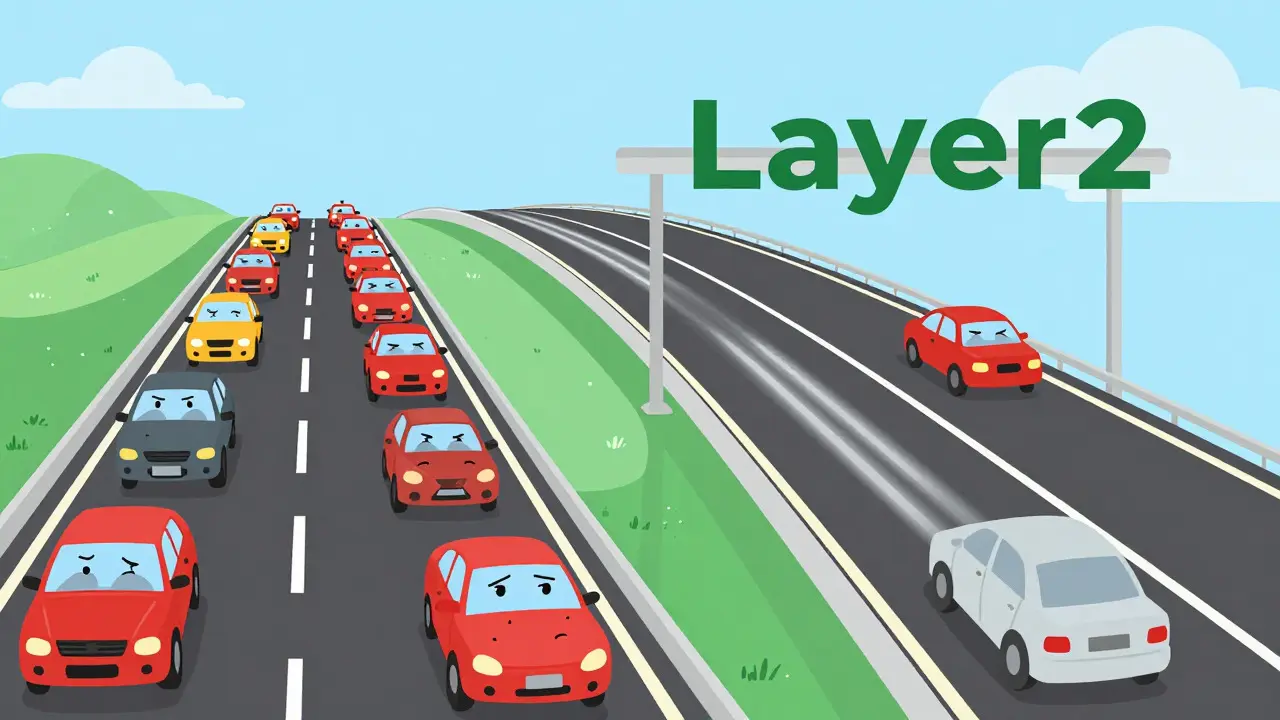
Imagine trying to drive across the country during a major holiday weekend. The highways are gridlocked. You’re stuck in your car, burning gas, going nowhere fast. That was blockchain life for most of the 2010s and early 2020s. As more people joined networks like Ethereum, the main chain got clogged. Transaction fees skyrocketed, and confirmation times stretched from seconds to hours.
To fix this, the industry split into two camps. One group said, "Let’s build extra lanes on top of the highway." The other said, "Let’s tear up the road and rebuild it with multiple parallel tracks." These are Layer 2 solutions and Sharding. Both promise speed and low costs, but they work in completely different ways. If you are building an app, investing in crypto, or just trying to understand why your wallet fee is so high, knowing the difference matters.
How Layer 2 Solutions Work: The Off-Ramp Strategy
Layer 2 solutions act like express toll roads sitting above the main blockchain. They don’t change how the base network (Layer 1) works. Instead, they take transactions off the main chain, process them quickly and cheaply, and then bundle the results back onto the main chain for security.
Think of it like a restaurant kitchen. The main blockchain is the head chef who signs every invoice. It’s secure, but slow. A Layer 2 solution is like a prep station where sous-chefs chop veggies and plate meals. They do all the heavy lifting. Once the meal is ready, they hand the final ticket to the head chef for signature. This keeps the head chef from being overwhelmed.
The most popular types of Layer 2s today are:
- Optimistic Rollups: These assume transactions are valid unless someone proves otherwise. Projects like Arbitrum and Optimism use this model. It’s efficient but requires a waiting period (usually seven days) to ensure no fraud occurs.
- ZK Rollups: These use zero-knowledge cryptography to mathematically prove transactions are valid instantly. Projects like zkSync and Polygon zkEVM lead here. They offer faster finality but require more complex hardware to generate proofs.
In 2026, Layer 2s handle the bulk of daily activity on Ethereum. They can process thousands of transactions per second (TPS) because they bypass the congestion of the main net. However, you still need to pay a small fee to post data to Layer 1, which means costs never hit zero.
How Sharding Works: The Parallel Processing Approach
If Layer 2 builds upward, Sharding expands outward. Sharding splits the entire blockchain database into smaller pieces called shards. Each shard handles its own subset of transactions and state data.
Picture a library. In a non-sharded blockchain, one librarian has to check out every book for every customer. In a sharded blockchain, you have ten librarians, each managing a specific section-fiction, science, history. Customers go directly to the right librarian. The workload is distributed, so no single person gets overwhelmed.
NEAR Protocol is the prime example of a sharded blockchain. By splitting the network, NEAR reduces storage costs by nearly 40% and allows nodes to join the network without needing massive hard drives. Every node only needs to store the data for the shard it validates, not the entire history of the chain.
Ethereum also adopted a form of sharding through its Data Availability Sampling (DAS) mechanism. While Ethereum didn’t shard execution in the way originally planned, it uses sharding principles to distribute data availability, making it easier for Layer 2s to operate efficiently. This hybrid approach shows that the lines between L2 and sharding are blurring.

Performance and Speed: Who Is Faster?
When it comes to raw speed, both technologies crush the limitations of traditional blockchains. But they achieve it differently.
| Metric | Layer 2 Solutions | Sharding |
|---|---|---|
| Max TPS Potential | 4,000+ (varies by chain) | Thousands (scales with shard count) |
| Latency | Seconds to minutes (depending on bridge/finality) | Near-instant within a shard |
| Scalability Limit | Limited by L1 data capacity | Limited by cross-shard communication complexity |
| User Experience | Requires bridging assets | Native account abstraction often included |
Layer 2s are great for immediate relief. If you want to trade tokens on a decentralized exchange today, you’ll likely use Arbitrum or Optimism. They feel fast. But their scalability hits a ceiling. Why? Because they still rely on the main chain to store transaction data. If too many Layer 2s try to post data at once, the main chain gets congested again.
Sharding offers theoretically infinite horizontal scaling. If you add more shards, you get more throughput. Solana, while not using traditional sharding, employs similar parallel processing techniques to handle high loads. For long-term projects like metaverse worlds or global payment systems, sharding provides a more sustainable path because it doesn’t depend on a single bottleneck.
Security Trade-offs: Trust vs. Math
Security is the hardest part of the blockchain trilemma. You want speed, decentralization, and security-but usually, you have to pick two.
Layer 2 solutions inherit security from Layer 1. When you use a ZK Rollup, you trust the mathematics of the proof. If the proof is valid, the transactions are valid. With Optimistic Rollups, you trust that someone will watch the chain and challenge bad transactions. The risk here is centralization. If only a few entities can run validators or sequencers on a Layer 2, the network becomes less secure. Also, if the underlying Layer 1 gets hacked, the Layer 2 falls with it.
Sharding introduces a different risk: shard isolation attacks. In a sharded network, an attacker might target a single shard with fewer validators. If they compromise that shard, they could corrupt data before the main network notices. To prevent this, protocols like NEAR use random validator assignment and economic staking penalties. The security is distributed, meaning the whole network must be attacked to break the system, not just one part.
Vitalik Buterin, co-founder of Ethereum, noted that Layer 2s and execution sharding share the same underlying tech-zero-knowledge proofs and data availability sampling. The difference is who controls the code. Layer 2s allow developers to create custom rules, fostering innovation. Sharding keeps everything under one protocol roof, ensuring uniformity but potentially slowing down experimental features.
Interoperability: Talking to Each Other
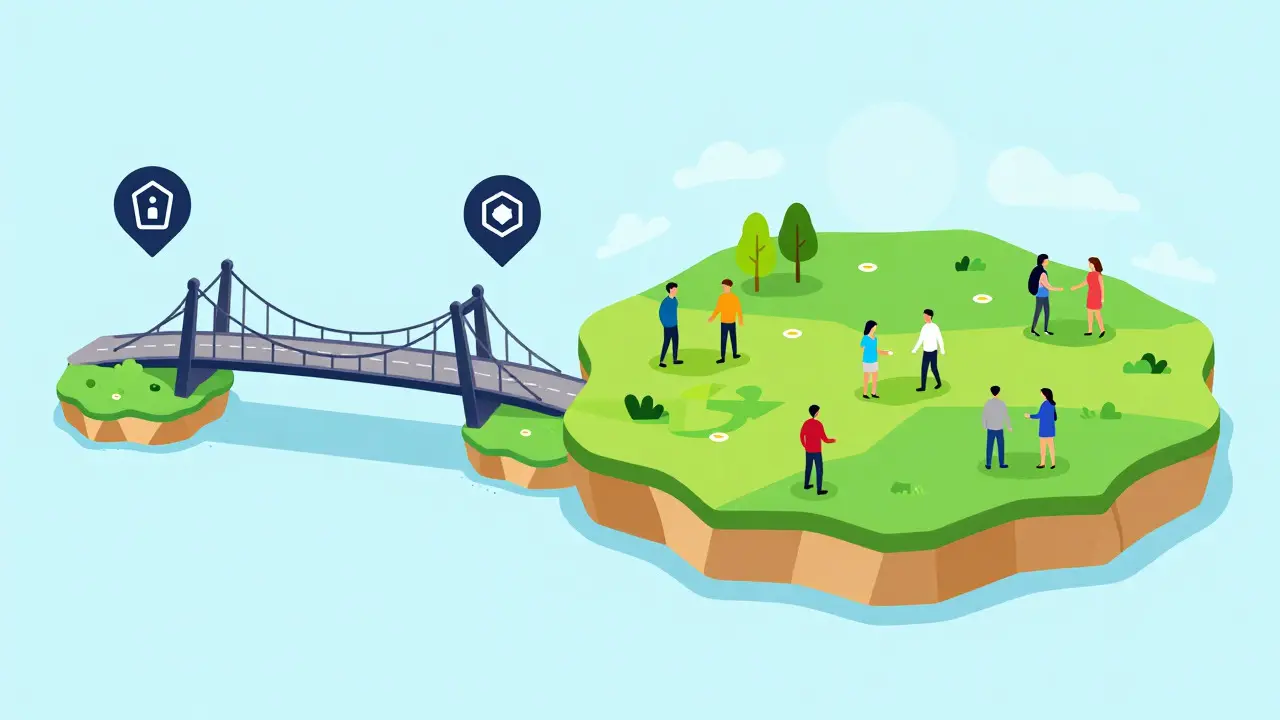
This is where the user experience diverges sharply. Moving money between Layer 2s is painful. You want to send USDC from Arbitrum to Optimism? You can’t just click “send.” You have to bridge the funds back to Ethereum Layer 1, wait for confirmation, and then bridge them to Optimism. This process takes time, costs fees, and carries bridge hack risks.
Sharded blockchains solve this natively. On NEAR, your account exists across the entire network. You can interact with a smart contract on Shard A while holding assets on Shard B without moving anything manually. The protocol handles the communication behind the scenes. This seamless interaction is crucial for complex apps like gaming platforms or supply chain trackers that span multiple components.
Which Should You Choose?
There is no single winner. The right choice depends on what you are building or using.
Choose Layer 2 if:
- You are building a DeFi application or NFT marketplace that needs to launch quickly on Ethereum.
- You want access to Ethereum’s massive developer community and liquidity.
- Your users are already familiar with wallets like MetaMask and bridges.
Choose Sharding if:
- You are building a large-scale ecosystem, such as a metaverse or social media platform, that requires millions of daily interactions.
- You want to avoid bridge risks and provide a unified user experience.
- Long-term sustainability and lower node requirements are priorities.
In 2026, the trend is toward coexistence. Ethereum continues to evolve as a settlement layer for Layer 2s, while networks like NEAR and Solana push the boundaries of parallel processing. For developers, the key is understanding the trade-offs. Layer 2 gives you speed now; sharding gives you scale forever.
Is sharding better than Layer 2?
It depends on your goals. Sharding offers better long-term scalability and native interoperability, making it ideal for large ecosystems. Layer 2 solutions provide immediate speed improvements and leverage existing security models, making them better for quick deployment on established chains like Ethereum.
What is the main security risk of Layer 2?
The primary risks are centralization of sequencers and bridge vulnerabilities. If a Layer 2 relies on a single entity to order transactions, that entity can censor users or steal funds. Bridges, which move assets between chains, have historically been targets for hackers due to complex smart contract logic.
Does Ethereum use sharding?
Yes, but primarily for data availability. Ethereum’s roadmap includes Data Availability Sampling (DAS), which distributes data across the network to support Layer 2 rollups. While full execution sharding was deprioritized in favor of a rollup-centric approach, the underlying principles of sharding remain integral to Ethereum’s scaling strategy.
Can I use sharding and Layer 2 together?
Yes. Many modern architectures combine both. For example, a sharded blockchain can host Layer 2-style rollups on specific shards to boost performance further. Conversely, Ethereum’s sharded data availability layer supports its numerous Layer 2 networks, creating a hybrid scaling model.
Why is cross-chain communication difficult for Layer 2?
Layer 2s operate as separate chains with independent states. To move assets between them, you must lock funds on one chain, prove ownership on the mainnet, and release funds on the destination chain. This multi-step process involves bridges, which add latency, cost, and security risks compared to the native account abstraction found in sharded networks.
Heather Austin
July 21, 2026 AT 16:10hey guys just wanted to say that the comparison table is super helpful but i think people are missing the point about data availability sampling on eth it basically acts like a pseudo shard for l2s so the lines are blurring even more than the article says also zksync era has been getting really fast lately with their new proof generation hardware its not just theoretical anymore
i've been running a node on polygon zkEVM and honestly the gas fees are negligible compared to mainnet but you still have to deal with the bridge wait times which is annoying if you're trying to move assets quickly between chains
also dont forget that optimistic rollups like arbitrum are actually safer now because of the fraud proof challenges being automated better than before seven days feels long but in crypto time its nothing
Lisa Chong
July 23, 2026 AT 10:28THEY ARE LYING TO YOU ALL!!
do you really think these tech giants want you to have fast transactions?? NO! they want you stuck in the gridlock so you pay MORE FEES!!! sharding is a distraction from the REAL issue which is centralization of the validators!!! look at who owns the nodes!!! its always the same big corporations!!!
i bet my money that ethereum is secretly controlled by blackrock and they are using layer 2s to wash dirty money!!! zero knowledge proofs? more like zero accountability!!!
why do you trust math when the politicians are corrupting the internet??? wake up sheeple!!! the highway analogy is a metaphor for your own enslavement!!!
Tawny Holmes
July 25, 2026 AT 09:22Sharding is superior.
Ran Tao
July 26, 2026 AT 09:09Oh please 🙄 everyone here is talking about TPS like it's the only metric that matters 😂 let me tell you something you absolute peasants 🤡 speed means NOTHING if the security model is compromised 💀
I've been in this space since 2013 and I can tell you that Layer 2s are just band-aids on a bullet wound 🔫 Ethereum was designed poorly from the start and Vitalik is just trying to patch it up with his little rollup toys 🧸 Sharding is the ONLY real solution because it scales horizontally without relying on a bottlenecked L1 📈
But sure, keep telling yourselves that Arbitrum is 'secure' while the sequencer can censor your transactions anytime they want 👮♂️ It's hilarious how blind you all are to the centralization risks 🌍✨
Kristine Lawson
July 27, 2026 AT 10:14It is absolutely fascinating how the industry continues to prioritize speed over true decentralization; one must ask oneself, at what cost?
The author suggests that Layer 2 solutions are merely 'express toll roads'; however, this analogy fails to capture the profound philosophical implications of outsourcing security to a secondary layer. When we delegate validation to off-chain processes, are we not eroding the very foundation of trustless systems?
Furthermore, the claim that sharding offers 'theoretically infinite horizontal scaling' is a dangerous oversimplification. The complexity of cross-shard communication introduces vulnerabilities that are often ignored by proponents of this technology. One cannot simply ignore the Byzantine General Problem when splitting the network into shards.
In conclusion, neither option is truly 'better'; both are flawed attempts to solve a problem created by poor initial design. We should perhaps focus on reducing demand rather than increasing supply.
Jessie Smith
July 27, 2026 AT 21:53look, im gonna be honest with ya'll... most of you dont even know what a merkle tree is let alone how zkp works lol
sharding is cool n all but its like trying to build a skyscraper on sand if the underlying consensus isnt rock solid u r screwed. NEAR is doing some neat stuff with their chunk producers but lets not pretend its perfect. the latency between shards is still a pain in the ass for high freq trading apps
layer 2s are basically just renting space on eths back porch. its convenient sure but u r paying rent to someone else forever. thats not freedom thats tenancy. but hey if u wanna play nice with meta mask go ahead i guess
Winston Lacewing
July 28, 2026 AT 01:22Hey there friends! :) Just wanted to pop in and share my two cents because I feel like nobody is talking about the USER experience enough! :D
I mean seriously, why do I need to understand what a 'rollup' is just to buy a coffee? ☕ It's ridiculous! The whole point of blockchain was supposed to be invisible tech right? But instead we have bridges and keys and phrases and waiting periods! 😩
I tried moving some tokens from Optimism to Arbitrum last week and I almost lost my mind! 😱 Why is it so hard?! The article says sharding solves this but honestly I don't care about the tech specs I just want it to work like Venmo! 🤷♂️
Also does anyone know if Solana is actually sharded or if they just use parallel processing? I'm confused! 😅 Anyway hope everyone has a great day! ❤️
Drew M
July 28, 2026 AT 20:19Greetings fellow enthusiasts! 🌟
I must say, this article is quite delightful to read! ✨ However, I find myself slightly disappointed by the lack of nuance regarding the economic incentives of sequencers in Layer 2 ecosystems. 🎭
You see, while the technical aspects of ZK-Rollups are indeed impressive, the social layer remains the weakest link. 🧠 The notion that 'mathematical proofs' equate to absolute security is a charming illusion, one that many naive investors cling to. 📉 In reality, the centralization of key generation ceremonies poses a significant threat to the decentralization ethos. 🗝️
That said, I do appreciate the clarity of the comparison table! 📊 It serves as a useful heuristic for those who prefer visual aids over dense prose. 📚 Until next time, may your transactions be swift and your fees low! 🚀💖