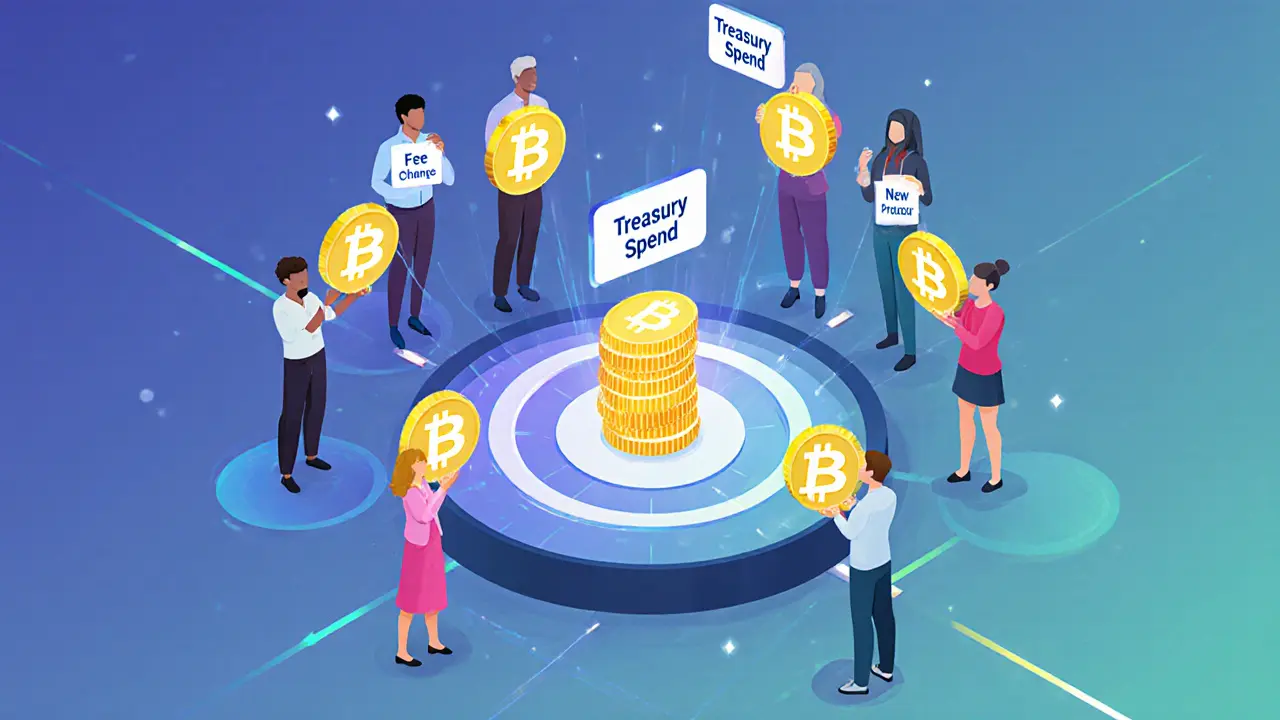
Governance tokens let token holders vote on key decisions in DAOs, turning economic stake into political power. Learn how they work, who really controls them, and why most people don't vote-even when it matters.
Crypto Governance: How Communities Decide the Future of Blockchain
When you hold a token like DAO, a decentralized autonomous organization that lets token holders vote on protocol changes, you’re not just owning a piece of software—you’re getting a vote in how that project evolves. This is crypto governance, the system where token holders propose and vote on changes to a blockchain protocol. It’s not about CEOs or boards. It’s about anyone with tokens deciding whether to fund a new feature, change the fee structure, or even shut down a project. This is how Web3 tries to be truly decentralized.
But it’s not always smooth. token voting, the most common method of crypto governance where votes are weighted by token holdings can be dominated by big wallets. A single address holding 10% of the supply can sway a vote. That’s why some projects, like LON, the governance token behind Tokenlon, a decentralized exchange, tie voting power to active participation—not just ownership. Others, like RDNT, the token used for governance in Radiant Capital’s cross-chain lending protocol, reward long-term holders with extra voting weight. The goal? To stop whales from pulling strings while still giving real users influence.
And it’s not just about voting. Crypto governance includes how proposals are written, who can submit them, how long debates last, and whether the outcome is binding. Some projects let voters choose between options. Others lock up tokens to vote, making participation costly. Some even use quadratic voting to reduce the power of large holders. But here’s the truth: most people don’t vote. In many DAOs, less than 5% of token holders show up to the ballot. That means the few who do—often insiders or speculators—end up making the calls. If you care about where a project is headed, you need to pay attention. Not just hold. Not just buy. Crypto governance only works if you show up.
Below, you’ll find real examples of how governance has played out—some successful, some disastrous. You’ll see how airdrops like LON and RDNT were used to distribute voting power, how failed projects like FEAR and CYT lost community trust, and why some tokens, like UCO and BUILT, have no governance at all because there’s no one left to govern. This isn’t theory. It’s what’s happening right now. And if you’re holding any token, you’re already part of it.