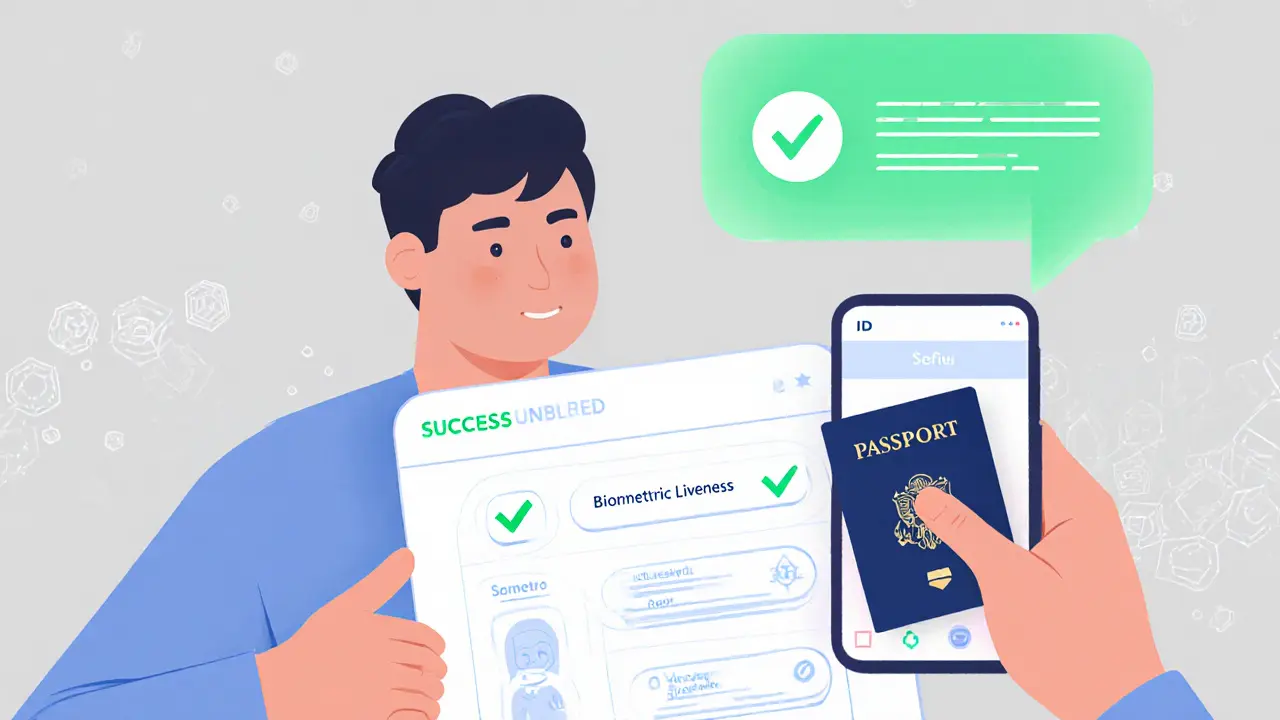
Learn how to complete KYC verification for crypto platforms quickly and successfully. Understand the required documents, common rejection reasons, and how to avoid delays. Essential for anyone using blockchain exchanges.
Crypto KYC: What It Is, Why It Matters, and How It Affects Your Wallet
When you sign up for a crypto exchange, you’re often asked to upload a photo of your ID, a selfie, or even proof of address. That’s crypto KYC, the process of verifying your identity before you can trade or withdraw cryptocurrency. Also known as Know Your Customer, it’s not optional—it’s mandatory for almost every major platform. Without it, you can’t buy Bitcoin on Coinbase, trade Ethereum on Binance, or even claim most airdrops. It’s the gatekeeper between you and the crypto world.
But why does it exist? AML compliance, anti-money laundering rules enforced by governments and financial regulators forced exchanges to adopt KYC. If someone tries to launder $10 million through crypto, regulators want to know who they are. That’s why exchanges collect your name, address, and government ID. It’s not about spying—it’s about staying legal. And because most exchanges are based in the U.S., EU, or other regulated regions, they have to follow the same rules as banks. This also means your crypto isn’t as anonymous as you might think. Even if you use a decentralized exchange, many still require KYC for withdrawals or higher limits.
What about crypto exchanges, platforms where you buy, sell, or trade digital assets? They’re the ones doing the heavy lifting. Sites like Coincall, Bitpin, and Serum DEX all enforce KYC—but not equally. Some ask for just an email and phone number. Others demand full government ID and proof of income. The stricter the KYC, the more trustworthy the exchange usually is. That’s why you’ll see fewer scams on platforms that verify users. It’s not perfect, but it cuts down on fake airdrops, phishing sites, and pump-and-dump schemes. Look at the posts below: many scams pretend to be airdrops, but real ones require KYC to claim tokens. If a site says you can get free crypto without ID, it’s likely a trap.
And here’s the trade-off: crypto security, how well your assets and personal data are protected improves with KYC, but your privacy takes a hit. Your identity is stored in a database, and if that database gets hacked, your data could be leaked. That’s why some users avoid KYC entirely and stick to non-custodial wallets. But those wallets don’t let you buy crypto with a credit card or cash out to your bank. You’re stuck with peer-to-peer trades or risky decentralized platforms. Most people end up choosing convenience over anonymity—and that’s okay, as long as you know the risks.
What you’ll find below isn’t just a list of articles. It’s a real-world look at how KYC connects to everything in crypto—from airdrops that require verification to exchanges that shut down because they skipped compliance. You’ll see why some airdrops fail (like FEAR or TRO), why fake billboards in Times Square are scams, and how platforms like CoinMarketCap use KYC to verify participants. You’ll also learn how to spot phishing attempts that target users who’ve already gone through KYC, and why even verified accounts aren’t safe if they click the wrong link. This isn’t theory. These are the patterns that keep happening—and the ones you need to understand to stay safe.