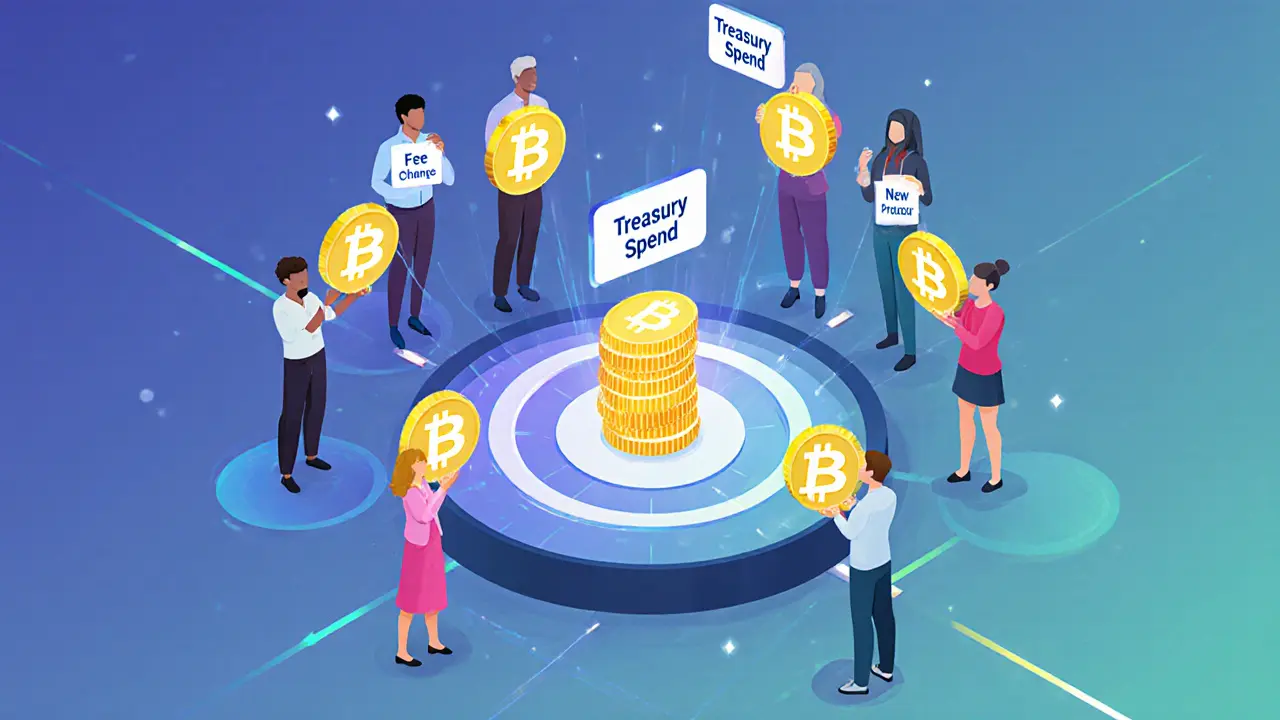
Governance tokens let token holders vote on key decisions in DAOs, turning economic stake into political power. Learn how they work, who really controls them, and why most people don't vote-even when it matters.
DAO Voting: How Decentralized Governance Works and Why It Matters
When you hold tokens in a DAO, a decentralized autonomous organization that runs on blockchain rules without central bosses. Also known as decentralized organization, it lets people vote on everything from treasury spending to new features—no CEO needed. This isn’t theory. Real money moves based on these votes. If a DAO’s treasury has $10 million, and 60% of token holders say "fund the game dev team," that’s what happens. No board meeting. No email chain. Just code and consensus.
But not all DAOs are equal. Some let you vote with just one token. Others require you to stake hundreds or even lock up your tokens for months. That’s where things get messy. A few big wallets can swing votes, turning "decentralized" into "rich kid rule." That’s why some DAOs, like early ones tied to failed airdrops, ended up with zero real participation. People got free tokens, didn’t bother voting, and the project died quietly. On the other hand, projects like LON, the governance token behind Tokenlon, a decentralized exchange and RDNT, the token powering Radiant Capital’s cross-chain lending protocol actually use voting to guide development. Their token holders decide fee structures, partnerships, and even which blockchains to expand into.
DAO voting doesn’t just affect tech—it affects your wallet. If you hold tokens in a DAO, your vote can mean the difference between a project thriving or vanishing. That’s why understanding how voting works matters more than ever. Some DAOs require you to hold tokens in a specific wallet. Others track activity—like trading or staking—to decide who gets a vote. And if you miss the cutoff? You’re out. No second chances. That’s why many people treat DAO voting like a job: they check proposals, research the impact, and vote even if they only have a few tokens.
What you’ll find here isn’t fluff. These posts show real cases: the airdrops that promised power but delivered nothing, the tokens that actually gave users control, and the scams that pretended to be DAOs just to steal your seed phrase. You’ll see how FEAR token holders watched their governance rights disappear, how PLAYA3ULL’s community voted on game upgrades, and why some DAOs—like those tied to fake airdrops—never even had a real vote. This isn’t about hype. It’s about who really runs the show when there’s no boss in the room.