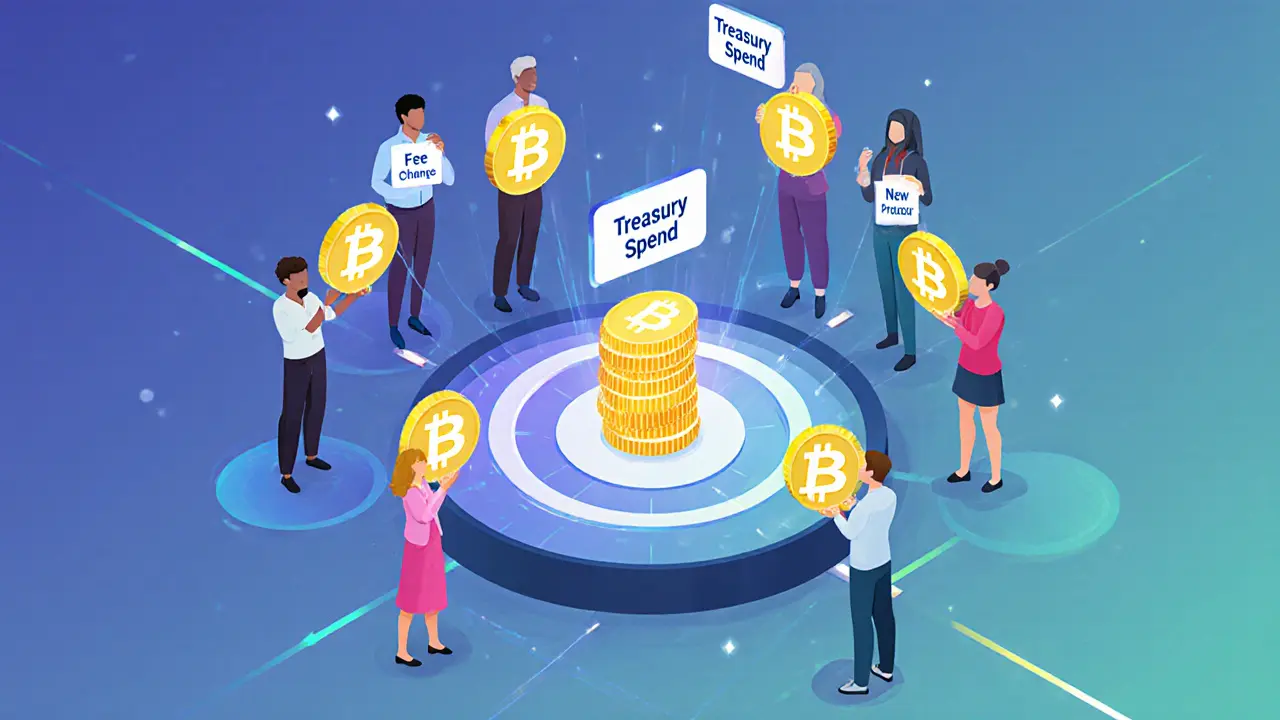
Governance tokens let token holders vote on key decisions in DAOs, turning economic stake into political power. Learn how they work, who really controls them, and why most people don't vote-even when it matters.
Decentralized Governance: How Crypto Communities Make Decisions Without CEOs
When you think of a company, you picture a CEO, a board, and top-down orders. But decentralized governance, a system where token holders vote on protocol changes without central authority. Also known as DAO governance, it’s how projects like Uniswap, Aave, and MakerDAO update their rules—no corporate HQ needed. This isn’t theory. It’s real code running on blockchains, letting anyone with tokens weigh in on upgrades, treasury spending, or even who gets paid.
At its core, DAO, a blockchain-based organization run by rules encoded in smart contracts is the engine behind decentralized governance. These aren’t companies. They’re digital cooperatives where your token balance equals your vote. But here’s the catch: voting power isn’t always fair. Big holders—often called whales—can swing votes. That’s why some projects now use quadratic voting, where small holders get more influence per token to balance things out. And it’s not just about voting. token voting, the process where token ownership grants decision-making rights is how upgrades get approved, fees get changed, or new features get funded. But if no one votes, the system breaks. Many DAOs see less than 5% participation, leaving power in the hands of a few active members.
Decentralized governance isn’t magic. It’s messy. Look at the FEAR token airdrop or the TopGoal NFT event—both promised community control but collapsed when leadership vanished. Real governance needs more than a voting contract. It needs active participants, clear proposals, and consequences for bad actors. That’s why projects like Radiant Capital and Tokenlon tie governance to actual utility—holding their tokens means you’re not just voting, you’re helping shape the system you use daily. Meanwhile, platforms like Serum DEX and Bamboo Relay show how governance can keep a project alive even after its original team leaves.
What you’ll find below isn’t a list of buzzwords. It’s a collection of real stories—some successful, some failed—about how crypto communities try (and sometimes fail) to run themselves. You’ll see how airdrops, tokenomics, and exchange design all tie into who gets to decide what happens next. Whether you’re holding a governance token or just watching, this is the behind-the-scenes look at who really runs crypto when the CEOs aren’t there.