Thailand SEC Crypto Exchange Regulations: What You Need to Know in 2025
 Jun, 26 2025
When you trade crypto in Thailand, you’re not just using an app-you’re operating under one of Asia’s strictest regulatory systems. Since April 2025, the Thailand SEC has shut down major foreign exchanges like Bybit and OKX for failing to comply with new rules. If you’re a Thai trader, you now only have nine licensed platforms to choose from. If you’re a foreign exchange trying to reach Thai users, you’re facing a legal minefield. This isn’t just about paperwork. It’s about survival-for businesses and for investors.
Who Needs a License to Operate in Thailand?
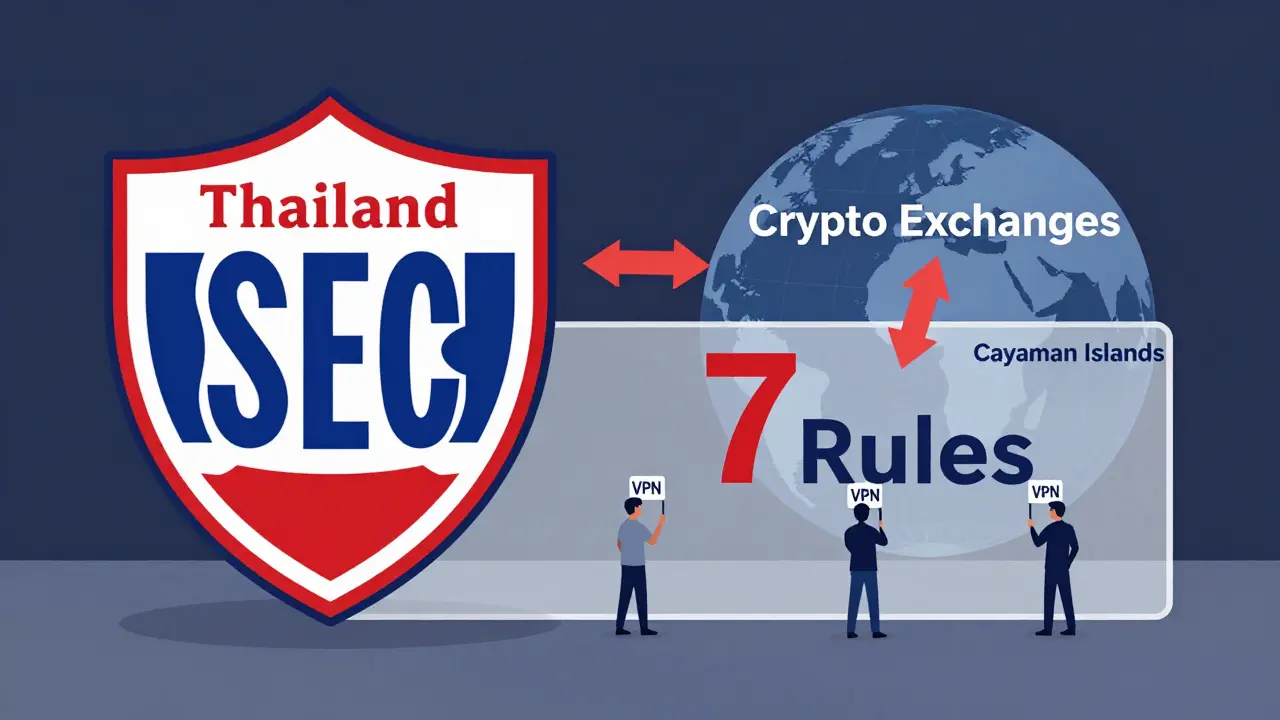
The Thailand Securities and Exchange Commission doesn’t just regulate companies based in Thailand. It regulates any digital asset platform that serves Thai users-even if it’s based in Singapore, the U.S., or the Cayman Islands. The rules are clear: if your platform does any of these seven things, you’re legally required to get a Thai license:
- Display your website in Thai language
- Use a .th or .ไทย domain
- Accept payments in Thai baht or through Thai bank/e-wallet accounts
- State that Thai law governs your terms or that Thai courts handle disputes
- Pay for ads targeting Thai users on Google or Facebook
- Have offices, staff, or customer support teams based in Thailand
- Any other behavior the SEC explicitly defines as serving Thai customers
This extraterritorial reach is unusual. Most countries only regulate exchanges physically located within their borders. Thailand doesn’t care where your servers are. If you’re marketing to Thai people, you’re subject to Thai law. That’s why Bybit and OKX pulled out. They didn’t want to comply. And they didn’t have time.
What Happens If You Don’t Get Licensed?
Non-compliance isn’t just a fine. It’s criminal. Under the Emergency Decree on Digital Asset Businesses (No. 2) B.E. 2568, unlicensed operators face up to 10 years in prison and fines of up to ฿100 million ($2.7 million). The Ministry of Digital Economy and Society (MDES) can block your website within hours-no court order needed. That’s how fast Thailand moves.
Since April 2025, over 30 foreign crypto platforms have been blocked. Users trying to access them see a government notice: “This site is not licensed to operate in Thailand.” There’s no appeal. No warning. Just a hard block.
How to Get Licensed: The Real Cost
Getting licensed isn’t a formality. It’s a full-scale overhaul. The application fee is ฿1,000,000 ($27,400). Then there’s the annual license fee: ฿500,000 ($13,700). But those are just the start.
You need:
- Minimum capital of ฿50 million ($1.37 million) in reserve
- AML/CFT systems that meet FATF standards
- Source code audits from SEC-approved firms
- Real-time transaction monitoring software
- A Thai-language interface with full compliance disclosures
The approval process takes 90 to 120 days. Bitkub, Thailand’s largest licensed exchange, spent six months getting everything right. That’s not unusual. Many companies underestimated how deep the compliance rabbit hole goes.
What You Can’t Do on Licensed Exchanges
Even if you’re licensed, the rules are tight. The SEC doesn’t allow just any crypto. As of June 2025, only 35 tokens are approved for trading. That’s down from over 350 on foreign platforms before the crackdown.
Here’s what’s banned on Thai-licensed exchanges:
- Privacy coins (Monero, Zcash)
- Meme tokens (Dogecoin, Shiba Inu)
- Fan tokens
- Non-fungible tokens (NFTs)
- Staking with guaranteed returns
- Using crypto as payment for goods or services
- Offering lending or deposit services with interest
Only Bitcoin and Ethereum are allowed for ETFs. Altcoin ETFs are planned for 2026, but right now, your options are limited. And withdrawal limits? Daily caps of ฿500,000 ($13,700) are common. That’s fine for casual traders. It’s a nightmare for institutional players.
How Thai Traders Are Reacting
On Pantip.com, Thailand’s biggest forum, the split is clear. One thread with 142 upvotes says: “Finally, no more scams.” Another with 203 upvotes complains: “I can’t trade the coins I want, and the fees are double what they were.”
Security has improved. Eighty-seven percent of positive reviews mention fewer scams. But liquidity? It’s down. Transaction fees on local exchanges average 0.25%, compared to 0.1% on foreign platforms. Spreads are wider. Volume is lower.
And then there’s the VPN effect. Chainalysis estimates 35% of Thai crypto activity has moved offshore since April 2025. People are still trading. They’re just doing it illegally. The SEC knows this. They’re not stopping it-not yet. But they’re watching.
How Thailand Compares to Other Countries
Thailand’s rules are stricter than Singapore’s. MAS lets foreign exchanges operate with minimal oversight if they don’t target locals. Japan requires licensing, but doesn’t block platforms outside its borders. China just banned everything.
Thailand sits in the middle-strict but not total. It’s more like Japan, but with a digital firewall. The seven-point test for serving Thai users is unique. No other country has codified it like this.
Compared to the EU’s MiCA framework, Thailand lacks two big things: stablecoin rules and passporting. If you’re licensed in Thailand, you can’t automatically operate in the EU. That limits growth for Thai exchanges trying to go global.
What’s Coming Next?
The SEC isn’t done. In Q4 2025, they plan to update the Digital Asset Business Act to include decentralized finance (DeFi) protocols. That’s a huge step. Right now, DeFi platforms operate in a gray zone. If they interact with Thai users, they’ll soon need licenses too.
Also in 2026, a pilot project will test integration between licensed exchanges and Thailand’s central bank digital currency (CBDC). That could make Thai exchanges the first in Asia to offer direct CBDC trading.
And don’t forget the money. The government has allocated ฿2.1 billion ($57.6 million) for blockchain projects through 2027. This isn’t about shutting down innovation. It’s about controlling it.
Is This Good for Thailand?
SEC Secretary-General Pornanong Budsaratragoon says the goal was “to stop scammers, not stifle innovation.” And the data backs it up. Crypto-related fraud reports dropped 37% in Q2 2025 compared to Q1. That’s real progress.
But innovation is slowing. Startups are leaving. Developers are moving to Malaysia or Dubai. The market grew 7.2% in Q1 2025-but that’s mostly from existing users, not new ones. The number of active crypto users in Thailand is 4.7 million. That’s 23% of adults. But only 78% of trading volume is now on licensed platforms. The rest? Offshore. Unregulated. Risky.
Thailand’s system protects consumers. It doesn’t protect traders. It doesn’t protect innovation. It protects the state’s control.
For now, if you want to trade crypto legally in Thailand, you have two choices: use one of the nine licensed exchanges and accept the limits… or use a VPN and risk your funds on unregulated platforms. There’s no third option. Not yet.