Turkey Crypto Payment Ban: 2021 Regulations and Current Rules Explained
 Jul, 18 2026
Imagine standing in a bustling market in Istanbul, holding your phone ready to pay for fresh baklava with stablecoins. You tap the screen, but the transaction fails. The merchant’s register doesn’t beep. Why? Because in Turkey, while you can own digital assets, you generally cannot use them to buy groceries or dinner.
This is the core of the Turkey crypto payment ban. It wasn't just a sudden whim by regulators; it was a specific legal move made in 2021 that has evolved into a complex regulatory framework. If you are trading crypto in Turkey or doing business there, understanding the difference between "trading" and "paying" is critical. Getting this wrong can mean frozen accounts, heavy fines, or even blocked platforms.
The 2021 Decision: Why Turkey Banned Crypto Payments
To understand where we are now, we have to look back at April 2021. The Central Bank of the Republic of Turkey (CBRT) issued a regulation on April 16, 2021, which took effect on April 30, 2021. This rule explicitly stated that cryptoassets would not be used for payments, directly or indirectly.
The CBRT didn't pull this trigger without reason. They cited five specific risks that threatened financial stability:
- Lack of Supervision: Crypto markets lacked a central regulatory authority.
- Extreme Volatility: Prices swung wildly, making them unreliable as a store of value for daily transactions.
- Anonymity Risks: The anonymous nature of some wallets facilitated illegal activities.
- Theft Vulnerability: Digital wallets could be stolen or accessed without the holder's authorization.
- Irrevocability: Once a crypto transaction is sent, it cannot be reversed, leaving consumers unprotected against fraud.
Crucially, the regulation clarified that crypto assets were not considered prohibited goods. You could still buy, sell, hold, and transfer them via licensed platforms. The ban was strictly on using them as a medium of exchange for goods and services.
How the Rules Evolved: From 2021 to 2025/2026
The landscape hasn't stayed static since 2021. In July 2024, Turkey implemented the 'Law on Amendments to the Capital Markets Law.' This shifted the focus from just banning payments to strictly regulating who gets to touch your crypto.
Now, all Crypto Asset Service Providers (CASPs)-which includes exchanges, custodians, and wallet providers-must obtain an operating license from the Turkish Capital Markets Board (CMB). This isn't a paperwork exercise. The barriers to entry are high:
| CASP Type | Minimum Capital (TRY) | Approximate USD Value |
|---|---|---|
| Crypto Exchanges | 150 million TRY | $4.1 million |
| Custodians | 500 million TRY | $13.7 million |
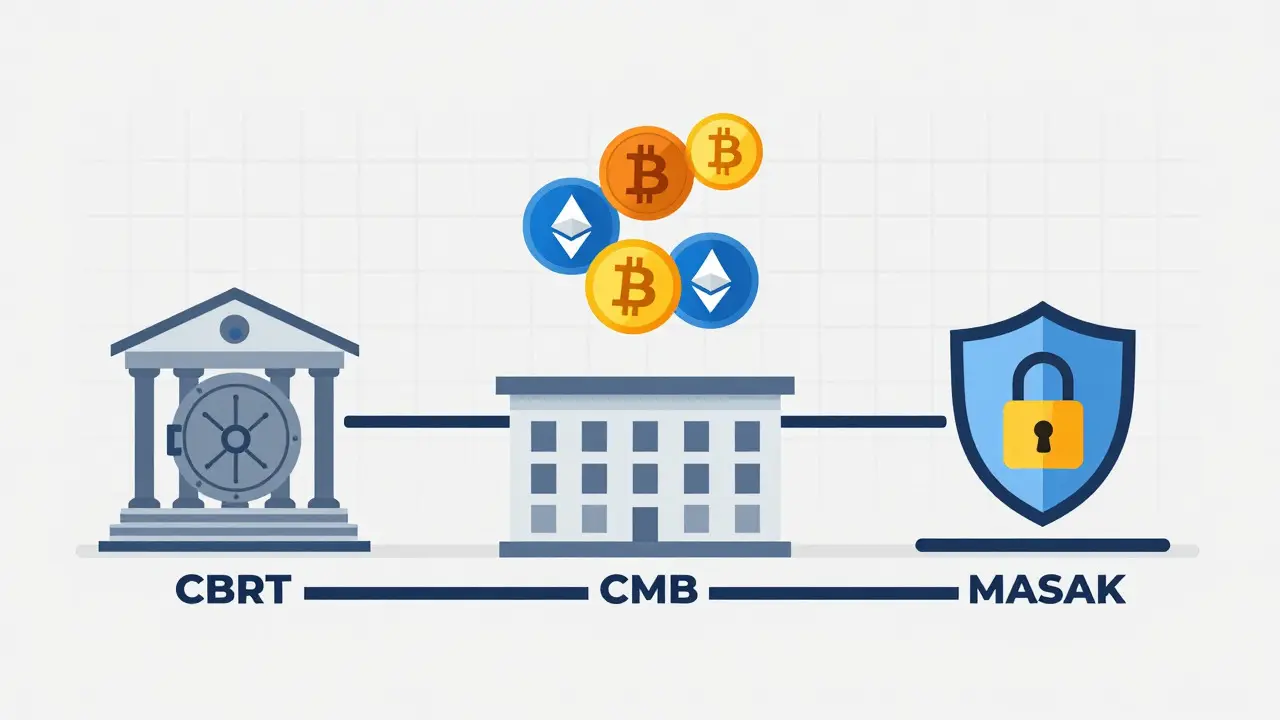
This structure ensures that only well-capitalized entities operate in the market. The CMB acts as the primary regulator, while the Financial Crimes Investigation Board (MASAK) enforces Anti-Money Laundering (AML) rules. Meanwhile, the Scientific and Technological Research Council of Türkiye (TÜBİTAK) oversees technical compliance standards.
The New AML Thresholds: What Changed in Early 2025
If you thought the licensing rules were strict, wait until you see the transaction monitoring. In December 2024, Turkey published new AML regulations that took effect on February 25, 2025. These rules introduced a hard limit for anonymity.
Any transaction exceeding 15,000 Turkish lira (approximately $425) requires full identity verification. But it goes deeper than that. Transactions involving unregistered wallet addresses are now flagged as 'risky.' If a transfer lacks adequate sender details, it can be suspended entirely.
For businesses, this means significant operational overhead. Exchanges reported a 30-40% increase in compliance staffing needs according to Deloitte Turkey's January 2025 industry report. They must record comprehensive transaction data, including canceled trades, and maintain systems to detect suspicious activity.
Real-World Impact: The User Experience
So, what does this look like for the average person? The paradox is real. On one hand, Turkey has a massive crypto community. Surveys from 2023 showed that 19.3% of the population actively uses cryptocurrencies. That’s nearly one in five people.
On the other hand, enterprise adoption for payments is near zero. Only 2% of Turkish businesses accept cryptocurrency, compared to 14% in neighboring Georgia, which has more permissive regulations. Users love trading but hate the inability to spend.
Take a typical user comment from the r/CryptoTurkey subreddit: "I can trade freely but can't use my USDT to pay for dinner-that's the Turkish crypto paradox." This sentiment is echoed on Trustpilot reviews for major exchanges like Binance Turkey, where users praise the trading efficiency but complain about the lack of utility for everyday spending.

Legal Challenges and Future Outlook
Is the ban here to stay? Not necessarily. Sima Baktaş, founding partner of Turkish law firm GlobalB, launched a landmark case challenging the payment ban. Scheduled for May 28, 2025, in Ankara, this lawsuit argues that lifting the ban would foster financial sector development and make Turkey more attractive for blockchain businesses.
Baktaş cites data showing an 11-fold increase in crypto users during 2021. She argues that the current restrictions stifle innovation. However, the CMB’s actions in March 2025 suggest they aren't backing down anytime soon. They blocked 46 DeFi platforms, including PancakeSwap, enforcing stricter local registration and AML compliance.
The future likely holds increased centralization. Whether the court rules in favor of GlobalB or not, the trend is clear: Turkey wants oversight. They want to capture the economic benefits of a $170 billion crypto sector (as estimated by Finance Magnates in late 2024) without the risks of unregulated money laundering or consumer fraud.
Key Takeaways for Traders and Businesses
If you are navigating the Turkish crypto market today, keep these points in mind:
- No Direct Payments: Do not attempt to set up a point-of-sale system that accepts direct crypto payments for goods. It violates the 2021 CBRT regulation.
- License or Leave: If you are a service provider, you need a CMB license. The capital requirements are steep, so partnerships with existing licensed entities might be necessary.
- Watch the 15,000 Lira Limit: For transactions over this amount, ensure full KYC (Know Your Customer) data is available. Unverified transfers will face scrutiny.
- DeFi Risks: Be aware that many decentralized platforms are currently blocked or restricted. Accessing them may require technical workarounds that carry their own risks.
The Turkish model is unique. It’s not a total ban like China’s, nor is it a free-for-all like early-stage El Salvador. It’s a controlled corridor where trading thrives under a microscope, but spending remains largely offline.
Can I use Bitcoin to buy things in Turkey?
Generally, no. The Central Bank of the Republic of Turkey (CBRT) banned the use of cryptoassets for payments in 2021. While you can hold and trade Bitcoin, merchants are prohibited from accepting it as a direct payment method for goods and services.
What is the penalty for violating the crypto payment ban?
While specific fines vary by case, payment institutions found processing crypto transactions can face severe regulatory penalties from the CBRT and CMB. This includes potential suspension of banking licenses, heavy monetary fines, and forced restructuring of compliance teams.
Do I need a license to run a crypto exchange in Turkey?
Yes. Since July 2024, all Crypto Asset Service Providers (CASPs) must obtain an operating license from the Turkish Capital Markets Board (CMB). Exchanges must meet a minimum capital requirement of 150 million TRY.
What happens if I send more than 15,000 TRY in crypto?
Transactions exceeding 15,000 TRY (approx. $425) require mandatory identity verification under AML rules effective February 2025. Transfers involving unregistered wallets or lacking sender details may be flagged as risky and suspended by exchanges.
Is the crypto payment ban permanent?
Not necessarily. A landmark legal challenge led by law firm GlobalB is scheduled for May 2025, arguing that the ban stifles innovation. However, recent enforcement actions by the CMB suggest regulators remain cautious about opening the door to crypto payments.
Which government bodies regulate crypto in Turkey?
Three main bodies are involved: The Central Bank of the Republic of Turkey (CBRT) sets monetary policy and payment rules; the Capital Markets Board (CMB) licenses and supervises exchanges; and MASAK enforces anti-money laundering regulations.
Lisa Chong
July 19, 2026 AT 17:08Oh, great. Another layer of bureaucratic shackles on the free market, orchestrated by the shadowy cabal in Ankara who clearly fear what happens when people actually control their own wealth. It is not about 'financial stability' or 'consumer protection,' that is just the sugar-coated lie they feed you to keep you docile and dependent on their failing fiat currency which loses value every single day while they print more of it out of thin air. They ban crypto payments because they cannot track every single baklava purchase if you use stablecoins, and anonymity is a dirty word to those who thrive on surveillance capitalism and state-sponsored theft through inflation. The Central Bank of Turkey doesn't care about your safety; they care about maintaining their monopoly on money so they can continue to drain the lifeblood from the economy without anyone noticing until it is too late. You think this is isolated? Look at the US, look at Europe, they are all moving towards CBDCs because they want total control over your spending habits, down to the last penny, and banning crypto is just the first step in that dystopian march toward a cashless society where dissent is literally unpayable. Wake up, sheeple, before they take away your last shred of financial privacy and leave you begging for crumbs from the table of the elite.
Heather Austin
July 21, 2026 AT 14:07honestly its pretty standard stuff really most countries are doing similar things right now but turkey is being extra strict with the capital requirements which makes sense given how volatile everything has been lately i mean 150 million try for an exchange is no joke thats like 4 million usd which is gonna filter out a lot of the sketchy operators but also probably kill some innovation too since startups cant afford that kind of entry barrier
the part about the 15k lira limit for kyc is interesting though feels like they are trying to stop small scale money laundering while still letting big players operate as long as they play nice with the regulators its a bit of a paradox that you can trade freely but cant spend it directly which is super annoying for daily life but i guess thats the compromise they made to keep the sector alive instead of banning it completely like china did
Ran Tao
July 22, 2026 AT 03:27You guys are missing the forest for the trees! 🌲🌳 This isn't just about regulations, it's about the *spirit* of decentralization being crushed under the weight of institutional greed! 💸💀 I mean, come on, who needs a license to swap tokens? That's the whole point! But sure, let's pay $13.7 million USD just to hold other people's coins like a digital bank vault from the dark ages. 🏦⛓️ It's absolutely tragic how we've regressed from the wild west of early crypto to this sterile, corporate-approved playground. And don't even get me started on the DeFi bans-blocking PancakeSwap? In this day and age? It's like banning bicycles because someone might ride them into traffic! 🚴♂️🚫 The drama is real, and my soul is tired. 😩📉
Russ Fincham
July 23, 2026 AT 07:14The analysis provided here is superficial at best and ignores the fundamental macroeconomic pressures driving these decisions. Turkey has suffered from hyperinflation and currency devaluation for years, making the lira practically worthless for savings, which drives citizens to crypto as a hedge. However, the state views this capital flight as an existential threat to its monetary sovereignty. By banning payments, they force the transaction back into the formal banking system where they can tax it and monitor it. The high capital requirements are not about 'quality' but about creating oligopolies that can be easily co-opted by the state. Expect further crackdowns as the election cycle approaches and the government needs to show 'control' over the financial sector to appease traditionalist investors and foreign creditors.
Linda Hilliard
July 24, 2026 AT 03:59Let’s be clear: this regulatory framework is a textbook example of rent-seeking behavior disguised as consumer protection. The 'risks' cited by the CBRT-volatility, anonymity-are inherent features of decentralized systems, not bugs. By mandating such exorbitant capital reserves (150M TRY for exchanges), the CMB is effectively erecting barriers to entry that only incumbents or state-aligned entities can surmount. This stifles competition and innovation, leading to higher fees for end-users. Furthermore, the AML thresholds are arbitrarily low, catching retail traders in a net designed for institutional bad actors. It is a clumsy, heavy-handed approach that reveals a profound misunderstanding of blockchain technology by policymakers who are decades behind the curve. :/
Winston Lacewing
July 25, 2026 AT 20:53I just read the article and I am shaking with rage! 😡 How dare they tell us how to spend our own money?! My neighbor bought bread with Bitcoin last week and now he's worried his account will be frozen! Can you believe the audacity? It's personal, okay? They're targeting us, the everyday people who just want to buy fresh baklava without filling out a novel-length KYC form. 🥐💸 And don't get me started on the 'risky' wallet flags. Who decides what's risky? The same bureaucrats who printed trillions of worthless lira? I say burn it all down and start over! 🔥😤 #CryptoFreedom #BanTheBureaucrats
Kristine Lawson
July 26, 2026 AT 12:06One must consider the broader ethical implications of this regulatory stance. Is it truly 'protection' when the state restricts individual autonomy in financial matters? Or is it merely a mechanism to enforce compliance with a flawed monetary policy? The distinction between 'trading' and 'paying' is artificial; both are forms of economic exchange. By prohibiting one while permitting the other, the Turkish authorities create a schizophrenic legal environment that benefits neither consumers nor businesses. Moreover, the reliance on centralized intermediaries (CASPs) reintroduces the very counterparty risks that blockchain technology was designed to eliminate. It is a step backward, shrouded in the language of progress.
Tawny Holmes
July 26, 2026 AT 16:23The 150 million TRY requirement is a hard cap. Only 3 local firms have that liquidity. Competition dies. Prices rise. Users lose.
Jessie Smith
July 26, 2026 AT 19:42its funny how they talk about 'stability' while their own currency is doing the cha-cha down the drain. the whole setup is a bit of a farce, really. they want the tax revenue from trading but none of the hassle of actual adoption. its like wanting to eat the cake but refusing to let anyone bake it properly. the dephi bans are just petty tantrums from regulators who dont understand code. meanwhile the users are left in limbo, trading on licensed platforms that charge arms off because there's no competition. its a gilded cage, folks. shiny bars, but bars nonetheless. maybe the lawsuit will change something, but i doubt it. bureaucracy moves slower than a snail on sedatives.