Txbit Crypto Exchange Review: Closed in 2023 - What Happened and Where to Go Now
 Jun, 10 2026
If you are looking for the Txbit cryptocurrency exchange today, you will hit a dead end. The platform permanently shut its doors in September 2023. For anyone still holding funds there or wondering if it is safe to use, the answer is simple: it is gone. But why did this Netherlands-based exchange, which promised privacy and low fees, vanish? And more importantly, what should you do now?
This review isn't just about a closed website. It is a case study in risk. Txbit operated from 2019 until its abrupt end, serving as a cautionary tale for traders who prioritize obscure platforms over regulated ones. By understanding exactly where Txbit failed, you can protect your own portfolio in 2026 and beyond.
The Rise and Fall of Txbit
Txbit Exchange B.V. launched with a clear value proposition: security, privacy, and simplicity. Based in Amsterdam, the company tried to carve out a niche in a crowded market. In its early days, the growth looked promising. Trading volume jumped from roughly $12,000 in September 2019 to over $2 million by late 2021. That is a massive percentage increase, suggesting real user adoption.
However, raw volume numbers can be misleading. While $2 million sounds impressive, major players like Binance or Coinbase process billions daily. Txbit remained a small fish in a very large pond. More critically, the exchange operated in a regulatory gray area. It did not explicitly ban US users but advised them to check their own local laws. This ambiguity was a red flag that many investors missed at the time.
The collapse in September 2023 was sudden. There was no gradual wind-down. Users found themselves locked out, unable to withdraw assets. This pattern mirrors other high-profile failures in the industry, reminding us that liquidity and regulation are not optional features-they are survival requirements.
Why Txbit Was Risky: A Look at the Fees and Features
Even before it closed, Txbit had structural weaknesses that made it uncompetitive. Let’s look at the numbers, because they tell a story of inefficiency.
The fee structure was arguably the biggest deterrent. Txbit charged a flat fee of 0.0014 BTC per transaction. To put that in perspective, in December 2021, when Bitcoin was trading around $57,000, that single fee equated to approximately $80 USD. Compare that to top-tier exchanges charging fractions of a percent (often under 0.1%). If you were trading smaller amounts, those fees ate up your profits instantly. A minimum order size of 0.0005 BTC further limited accessibility for retail traders.
| Feature | Txbit (Closed) | Major Exchanges (e.g., Coinbase, Kraken) |
|---|---|---|
| Trading Fee | 0.0014 BTC (~$80+) | 0% - 0.6% |
| Mobile App | No | Yes (iOS & Android) |
| Regulatory Status | Ambiguous / Gray Area | Licensed in Multiple Jurisdictions |
| User Rating | 3.3/5 (11 reviews) | 4.0+/5 (Thousands of reviews) |
Beyond fees, the user experience was lacking. There was no mobile application. In 2021, and certainly by 2023, expecting crypto traders to stick to desktop browsers was outdated. Most competitors offered robust apps for iOS and Android, allowing users to trade on the go. Txbit’s refusal to adapt to mobile trends signaled a lack of investment in user convenience.
Security and Transparency: The Missing Pieces
Marketing materials often highlight "security" and "privacy." But claims mean nothing without proof. Reputable exchanges publish regular security audits, detail their cold storage protocols, and explain how they safeguard user funds. Txbit provided very few specific details about its infrastructure.
Experts noted this opacity as a major warning sign. When an exchange operates in multiple jurisdictions without clear compliance, it often indicates regulatory avoidance rather than global expansion. The lack of transparency regarding security measures contrasted sharply with industry leaders who treat audit reports as public documents.
User feedback reflected these concerns. With only 11 reviews on platforms like Cryptogeek.info, averaging a 3.3 out of 5 rating, community trust was low. Established exchanges boast thousands of reviews. A sample size of 11 suggests limited adoption and potentially concentrated risk among a small group of users.
What Happened to Txbit Users?
The closure in September 2023 left many questions unanswered. For those who held native tokens or fiat deposits on the platform, the outcome was likely total loss. This is a harsh reality of unregulated or poorly capitalized exchanges. When liquidity dries up or legal pressures mount, funds disappear.
This event reinforces a critical rule: never keep significant assets on an exchange. Use hardware wallets for long-term storage. Even then, choosing the right exchange for active trading matters. Platforms operating in legal gray areas face higher shutdown risks. The US Securities and Exchange Commission (SEC) and other global bodies have increased scrutiny since 2022, making non-compliant platforms vulnerable to enforcement actions that can lead to immediate cessation of operations.
Where Should You Trade Instead? Safe Alternatives for 2026
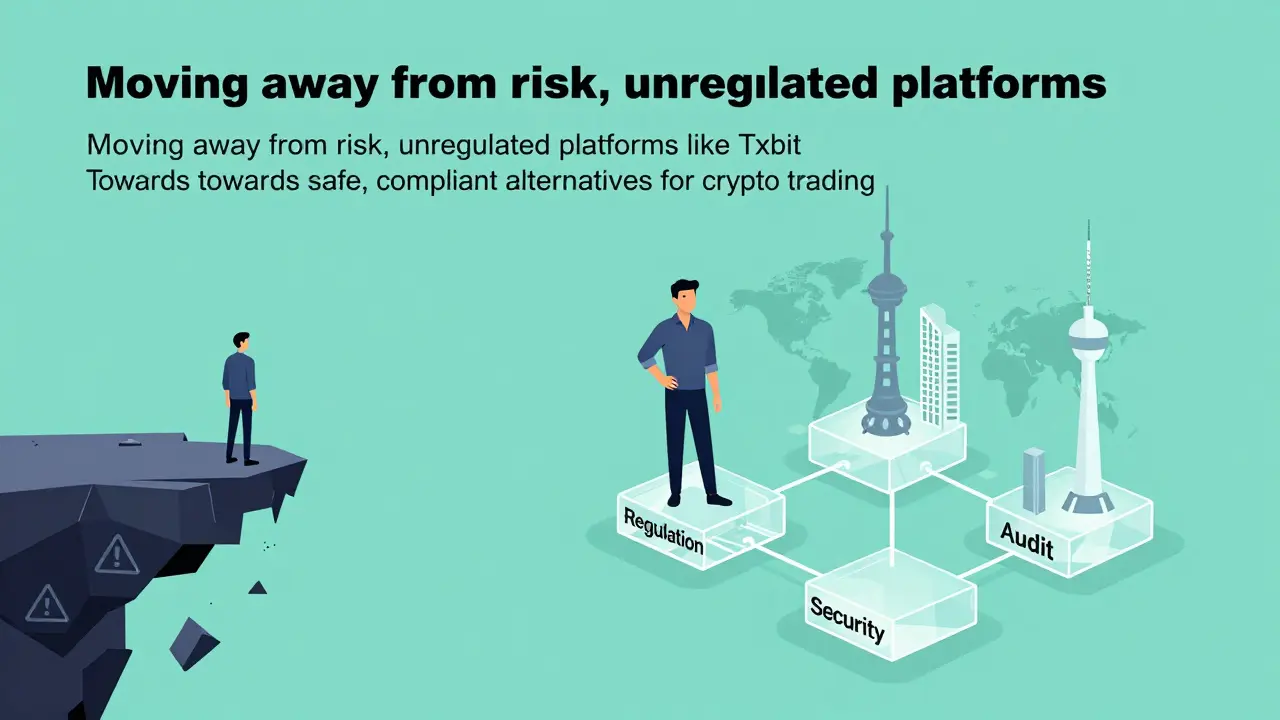
If you were a Txbit user, you need a new home for your crypto. Here is what to look for in 2026:
- Regulatory Compliance: Choose exchanges licensed in your jurisdiction. In the US, look for SEC-registered entities or state-chartered trusts. In Europe, MiCA (Markets in Crypto-Assets) regulation provides a strong framework.
- Transparent Fees: Avoid flat high fees. Look for maker/taker models that reward volume.
- Proof of Reserves: Top exchanges now publish monthly proofs of reserves to show they hold customer assets 1:1.
- Mobile Accessibility: Ensure the platform has a secure, well-reviewed app.
Platforms like Coinbase, Kraken, and Binance (where legally available) offer the scale, security, and regulatory oversight that Txbit lacked. They may have stricter KYC (Know Your Customer) requirements, but that friction is the price of safety.
Lessons Learned from the Txbit Collapse
The demise of Txbit is not just a statistic; it is a lesson in due diligence. Here are three takeaways for every trader:
- Ignore Marketing Hype: Words like "private" and "secure" are cheap. Look for technical documentation and audit logs.
- Check Regulatory Footprints: If an exchange tells you to "check your own laws," run. Compliant platforms clearly state where they operate and who they serve.
- Diversify Your Exposure: Never rely on a single mid-sized exchange. Spread your activity across tier-1 platforms to mitigate systemic risk.
The cryptocurrency market is maturing. The wild west era of unregulated platforms is closing. As regulations tighten, only the most compliant and transparent exchanges will survive. Txbit’s closure serves as a stark reminder that in crypto, safety is not a feature-it is a foundation.
Is Txbit still operational in 2026?
No, Txbit permanently ceased operations in September 2023. The website is no longer active, and users cannot access their accounts or withdraw funds.
Can I recover my money from Txbit?
Recovery is highly unlikely. Since the exchange closed abruptly without a formal bankruptcy proceeding visible to the public, most users faced total loss of assets held on the platform. Consult a legal professional specializing in crypto assets for any potential recourse, but expect minimal recovery.
Why did Txbit close down?
While no official detailed report was released, the closure is attributed to a combination of regulatory pressure, high operational costs due to inefficient fee structures, and inability to compete with larger, compliant exchanges. Operating in regulatory gray areas ultimately proved unsustainable.
Was Txbit safe for US users?
No. Txbit advised US users to assess their own legal risks, indicating it did not comply with US securities laws. This lack of regulatory compliance posed significant legal and financial risks to American traders.
What are the best alternatives to Txbit?
For safety and reliability, consider regulated exchanges like Coinbase, Kraken, or Binance (if available in your region). These platforms offer lower fees, mobile apps, and strict regulatory compliance.
Mauricio Contreras Loredo
June 11, 2026 AT 18:22Oh wow, another exchange that thought they could outsmart the SEC by hiding in a Dutch gray area. Classic move. I bet they spent all their marketing budget on fancy logos instead of actually securing the backend infrastructure. It is always hilarious to watch these guys get crushed by reality.
Kumaran sowkarpet
June 12, 2026 AT 09:21hello friends, i read this post and it make me sad for those people who lost money :( but yes, txbit was very risky.
i am from india and we have many scams here too so i know how hard it is. please always use hardware wallet like ledger or trezor. do not keep big amount on any exchange. even binance can have problems sometimes.
the fee structure of 0.0014 btc was crazy high! in india we trade with small amounts so that would eat all profit. better to look at wazirx or coinDCX which are more regulated for us. stay safe everyone :)
Grace Newman
June 13, 2026 AT 09:17It is quite evident that this closure was not merely a business failure but a coordinated effort by regulatory bodies to suppress decentralized financial autonomy. The narrative presented here ignores the deeper implications of state control over digital assets. One must question why certain platforms are targeted while others remain untouched despite similar operational models. Transparency is often used as a smokescreen for surveillance. Users should be wary of migrating to 'regulated' exchanges that likely share data with intelligence agencies. The loss of funds is a small price compared to the erosion of privacy rights. We are being herded into centralized pens under the guise of safety. Do not let them dictate where your wealth resides. The truth about Txbit is buried beneath layers of bureaucratic obfuscation designed to protect the powerful.
Abby Sivertsen
June 13, 2026 AT 16:04I mean, yeah, it sucks when you lose money but honestly? You signed up for a platform that didn't even have a mobile app in 2023. That is a huge red flag right there. Why would anyone trust a company that lazy with their security and user experience? Coinbase is annoying with the KYC but at least I know my shit isn't gone tomorrow. Just accept that if you want easy mode, you pay for it with privacy. If you want privacy, you deal with the risk. There is no free lunch.
Annemarie Fitzgerald
June 15, 2026 AT 12:45The essence of existence within the crypto sphere is fundamentally flawed when one relies on external validation of security. Txbit was merely a symptom of a larger disease: our collective inability to self-sovereign.
We are told to fear the chaos of the unregulated yet we crave the comfort of the cage. It is a paradox that defines our modern condition. The fees were exorbitant, yes, but perhaps they were paying for the illusion of stability. Now the illusion shatters. What remains is the void. We must look inward, not outward, for salvation. My own experiences suggest that every exchange is a potential trap. Trust no one. Not the regulators, not the auditors, not the founders. Only the code remains true, and even that is mutable. We are all just waiting for the next rug pull. It is inevitable. Embrace the entropy.
sreeja boora
June 17, 2026 AT 03:54This article highlights the necessity for strict adherence to national regulations. Platforms operating outside clear legal frameworks pose a significant threat to economic stability. It is imperative that users prioritize compliance over convenience. The lack of transparency in Txbit's operations is unacceptable. Regulatory bodies must enforce stricter penalties for such entities. Users should only engage with platforms that have undergone rigorous scrutiny by authorized authorities. This ensures the protection of individual assets and maintains the integrity of the financial system. Ambiguity in legal status is not a feature; it is a liability. We must demand accountability from all service providers in the cryptocurrency sector.
Benjamin Eisen
June 17, 2026 AT 19:48hey guys, just wanted to add that i also heard about txbit closing. it is really scary stuff.
i think the best thing to do is diversify. dont put all eggs in one basket. i use kraken mostly because they seem pretty solid and transparent with their reserves. also check out bitfinex if you are advanced trader.
but yeah, always withdraw to cold storage if you are not trading actively. it gives peace of mind. hope everyone stays safe out there!