Uniswap vs SushiSwap: Which DEX Is Right for You in 2026?
 Feb, 28 2026
When you want to trade crypto without a middleman, you don’t need a bank or a broker. You just need a decentralized exchange - or DEX. And right now, two names keep popping up: Uniswap and SushiSwap. Both let you swap tokens directly from your wallet. Both run on blockchain code. But they’re not the same. One is simple, reliable, and dominates trading volume. The other is complex, reward-heavy, and built for users who want more than just a swap. So which one should you use? It depends on what you’re looking for.
Uniswap: The Original, Built for Trust and Simplicity
Uniswap launched in 2018 and didn’t just enter the market - it rewrote the rules. Before Uniswap, DEXs were clunky, slow, and barely used. Uniswap made swapping tokens as easy as clicking a button. Its core idea? Automated Market Makers (AMMs). Instead of matching buyers and sellers like a traditional exchange, Uniswap uses smart contracts and pools of liquidity. If you want to trade ETH for USDC, the system pulls from a pre-funded pool. No order books. No delays. Just instant trades.
By 2026, Uniswap handles $1-2 billion in daily trading volume. Its Total Value Locked (TVL) sits at around $4 billion. That’s more than ten times what SushiSwap holds. Why? Because it’s the default. Most new crypto users start here. The interface is clean. The app works smoothly on mobile. The documentation is clear. You connect your wallet - MetaMask, WalletConnect, or even a hardware wallet - and you’re trading in under a minute.
Uniswap V3 introduced something game-changing: concentrated liquidity. Instead of spreading your funds across a wide price range, you can now choose exactly where you want your liquidity to work. If you believe ETH will stay between $3,000 and $3,500, you put all your capital in that range. That means more fees earned per dollar invested. It’s powerful - but only if you know what you’re doing. For beginners, the default 0.3% fee pool still works perfectly.
Uniswap’s UNI token doesn’t pay staking rewards. It’s purely for governance. You can vote on changes to the protocol - like adding new tokens or adjusting fees - but you won’t earn extra tokens just for holding it. The max supply is 1 billion, and it’s designed to be distributed over time, not hoarded. That’s intentional. Uniswap wants users to trade, not speculate.
SushiSwap: The Reward Engine for DeFi Power Users
SushiSwap didn’t start as a rival. It started as a fork - a copy of Uniswap’s code with one big twist: rewards. In 2020, the team behind SushiSwap launched a liquidity mining program that paid users in SUSHI tokens just for providing liquidity. It exploded. People flocked to SushiSwap not just to trade, but to earn.
By 2026, SushiSwap still offers those rewards - and they’re more structured than ever. Its Onsen Program gives bonus SUSHI tokens to liquidity providers on new or low-liquidity pairs. If you add ETH and a new altcoin to a pool, you might earn 2x or 3x the usual rewards. That’s why yield farmers still use it. It’s the go-to for users who treat DeFi like a job.
But the real kicker is xSUSHI. When you stake your SUSHI tokens, you get xSUSHI. And xSUSHI holders get 0.05% of every trade fee on SushiSwap. That’s not a small slice. With $50-150 million in daily volume, that’s $25,000 to $75,000 per day going straight to stakers. It’s passive income tied directly to platform usage. No other major DEX does this.
SushiSwap also supports 14+ blockchains - Avalanche, Fantom, Polygon, Harmony, and more. If you’re trading tokens on chains outside Ethereum, SushiSwap is often the only DEX with deep liquidity. Uniswap only supports six. That makes SushiSwap essential for anyone using multi-chain wallets or DeFi tools across networks.
But it’s not simple. The interface has menus for lending, limit orders, yield farming, staking, and cross-chain bridging. New users often feel overwhelmed. One Reddit user said, “I spent two hours trying to figure out how to just swap tokens.” That’s the trade-off: more features mean more complexity.
Trading Fees: Who Gets Paid?
Every time you swap on either platform, you pay a fee. It’s not a charge from the exchange - it’s a small cut taken from your trade and distributed to liquidity providers.
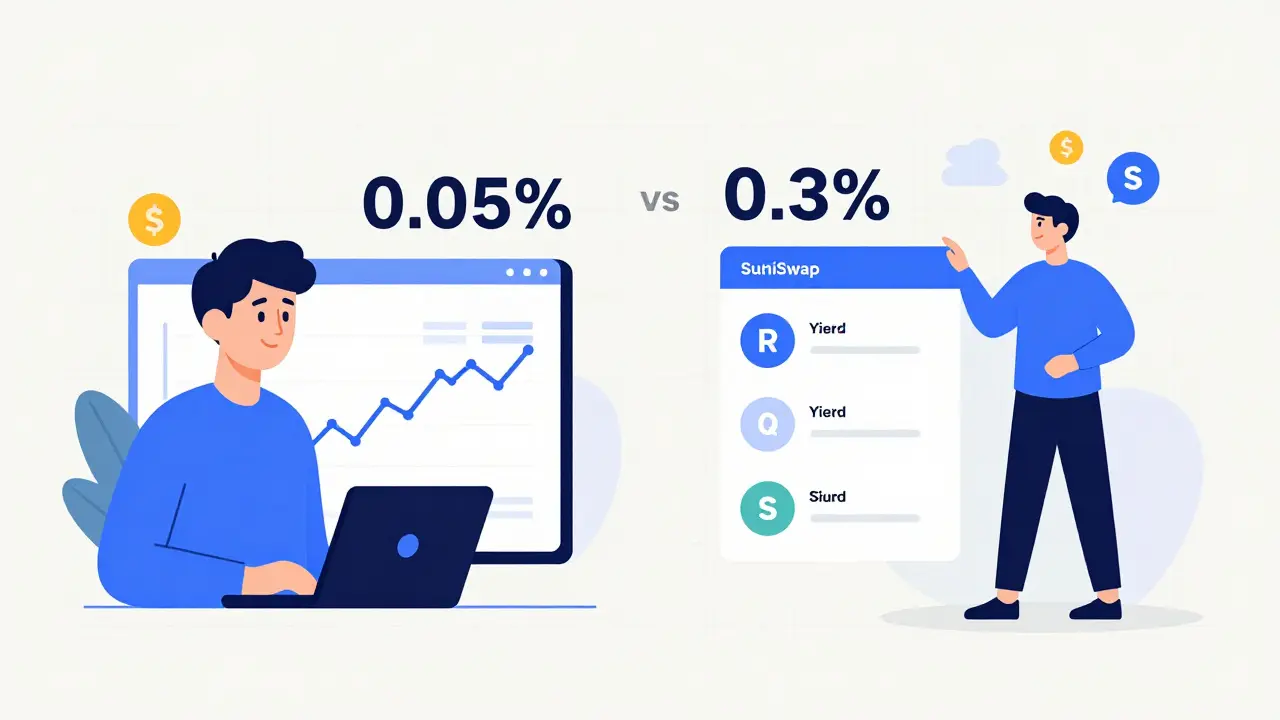
- Uniswap: Uses variable fees - 0.05%, 0.3%, or 1% - depending on the token pair. Stablecoins like USDC and DAI use 0.05%. Volatile tokens like ETH or SOL use 0.3%. The full fee goes to liquidity providers.
- SushiSwap: Uses a flat 0.3% fee. 0.25% goes to liquidity providers. 0.05% goes to xSUSHI stakers. That means if you’re only providing liquidity, you earn less than on Uniswap. But if you’re also staking SUSHI, you earn twice.
So if you’re a liquidity provider without staking, Uniswap pays more. If you’re staking SUSHI, SushiSwap can pay more - especially if you’re already holding the token.
Who Should Use Which?
Let’s cut through the noise. Here’s who wins where:
- Use Uniswap if:
- You’re new to DeFi.
- You just want to swap ETH for USDC or DAI.
- You prefer a clean, fast interface with no distractions.
- You’re trading on Ethereum, Polygon, or Arbitrum.
- You don’t want to manage staking, farming, or rewards.
- Use SushiSwap if:
- You’re already holding SUSHI tokens.
- You want to earn extra tokens just by providing liquidity.
- You trade on lesser-known chains like Fantom or Avalanche.
- You like yield farming, limit orders, or lending tools.
- You’re comfortable with a slightly cluttered interface.
There’s no shame in using both. Many experienced users keep Uniswap for quick swaps and SushiSwap for earning. It’s not an either-or choice - it’s a toolset.
Security and Reputation
Both platforms have been audited. Both have never been hacked at the protocol level. That’s rare in DeFi. But Uniswap has a longer track record - over six years of uptime. That matters. When you’re trading large amounts, you want confidence. SushiSwap has had a few minor issues with third-party integrations, but never with its core swap function.
Uniswap is trusted by institutions. Crypto funds, hedge funds, and even some traditional finance teams use it for daily trading. SushiSwap is trusted by yield farmers. If you’re looking for a place to farm, SushiSwap is the place. If you’re looking for a place to trade, Uniswap is the place.
The Future: What’s Next?
Uniswap is adding NFT marketplaces and better analytics tools. It’s not trying to be everything - just the best place to swap. SushiSwap is pushing into lending, borrowing, and cross-chain bridges. It’s trying to become a full DeFi suite.
Competition is heating up. DEXs like Curve,Balancer, and Trader Joe are offering better rates, lower fees, or more rewards. But Uniswap and SushiSwap have something no one else does: massive liquidity. You can’t replicate that overnight.
Uniswap’s dominance isn’t going away. But SushiSwap isn’t fading either. It’s found its role: the platform for users who want to earn, not just exchange.
Is Uniswap safer than SushiSwap?
Yes, in terms of track record. Uniswap has operated without a major exploit since 2018. SushiSwap has had minor issues with third-party integrations, but its core swap function is just as secure. Both are audited and open-source. If you’re trading small amounts, either is fine. If you’re moving large sums, Uniswap’s longer history gives more peace of mind.
Can I earn rewards on Uniswap like I can on SushiSwap?
No. Uniswap doesn’t offer token rewards for liquidity providers. All fees go directly to those who supply liquidity. SushiSwap gives you SUSHI tokens on top of trading fees. If you want passive income from DeFi, SushiSwap’s xSUSHI staking is one of the few mechanisms that pays users just for holding and staking.
Which one has lower fees?
For stablecoin pairs like USDC/DAI, Uniswap’s 0.05% fee is lower than SushiSwap’s flat 0.3%. For volatile assets, both charge 0.3%. So Uniswap wins on fee flexibility. But remember: SushiSwap’s 0.05% fee goes to xSUSHI stakers, not liquidity providers. So while the fee is the same, who benefits is different.
Should I stake SUSHI if I use SushiSwap?
Yes - if you already hold SUSHI. Staking SUSHI for xSUSHI gives you 0.05% of every trade fee on SushiSwap. That’s real income. If you don’t hold SUSHI, don’t buy it just to stake. The token’s value is volatile, and staking won’t make up for a price drop. Only stake if you believe in the long-term health of the platform.
Is SushiSwap better for altcoins?
Yes, especially if they’re on chains like Avalanche or Fantom. SushiSwap supports 14+ networks, while Uniswap only supports 6. If you’re trading a new token on a lesser-known chain, SushiSwap is often the only DEX with enough liquidity to make the trade smooth. Uniswap is still the best for Ethereum and Polygon tokens.
Michael Teague
March 1, 2026 AT 10:39kati simpson
March 1, 2026 AT 19:02Cory Derby
March 3, 2026 AT 02:47Colin Lethem
March 3, 2026 AT 07:55Kaitlyn Clark
March 4, 2026 AT 04:54christopher luke
March 5, 2026 AT 18:43Mary Scott
March 7, 2026 AT 07:46Shannon Holliday
March 8, 2026 AT 05:21Amanda Markwick
March 8, 2026 AT 21:23