VPN Usage for Crypto in Iran: Detection Risks and Enforcement Challenges
 Sep, 23 2026
Imagine waking up to find your life savings locked behind a digital wall you didn't build. For thousands of Iranian traders, this isn't a hypothetical nightmare-it's the reality of using Virtual Private Networks (VPNs) to access global cryptocurrency markets while dodging aggressive international sanctions and domestic surveillance. The stakes are incredibly high. In just the first seven months of 2025, Iranian users moved approximately $3.7 billion in cryptocurrency flows. That’s real money, often representing years of labor or family inheritance, sitting on exchanges that are actively hunting for them.
The situation changed dramatically in October 2024. Two major blockchain intelligence platforms launched a bounty program specifically targeting Nobitex, Iran’s largest domestic exchange. They published wallet information and started identifying users who tried to bypass restrictions. This wasn't just a minor policy update; it triggered widespread account freezes and forced stricter Know Your Customer (KYC) checks. If you’re an Iranian trader relying on a VPN to trade on Binance or Kraken, you need to understand exactly how these detection systems work and why your current setup might be failing you.
Why the Risk Landscape Shifted in 2025
You might think a simple IP address change is enough to hide your location. It used to be. But the enforcement machinery has matured. By January 2025, crackdowns had already frozen over one million bank accounts linked to crypto activities. The Central Bank of Iran prohibits domestic payments with crypto but allows licensed miners to sell coins, creating a confusing legal gray area where your trading activity could be flagged as illegal capital flight.
The data tells a stark story of decline. Between June and July 2025, crypto inflows to Iran dropped by more than 76% year-over-year. Why? Because detection methods got smarter. Exchanges aren't just looking at your IP anymore. They are analyzing device fingerprints, transaction timing, and withdrawal destinations. When a VPN connection drops for even a second during a trade, your Iranian IP address leaks. That momentary slip is often all it takes for an automated system to suspend your account permanently.
The Underground Economy of Identity Circumvention
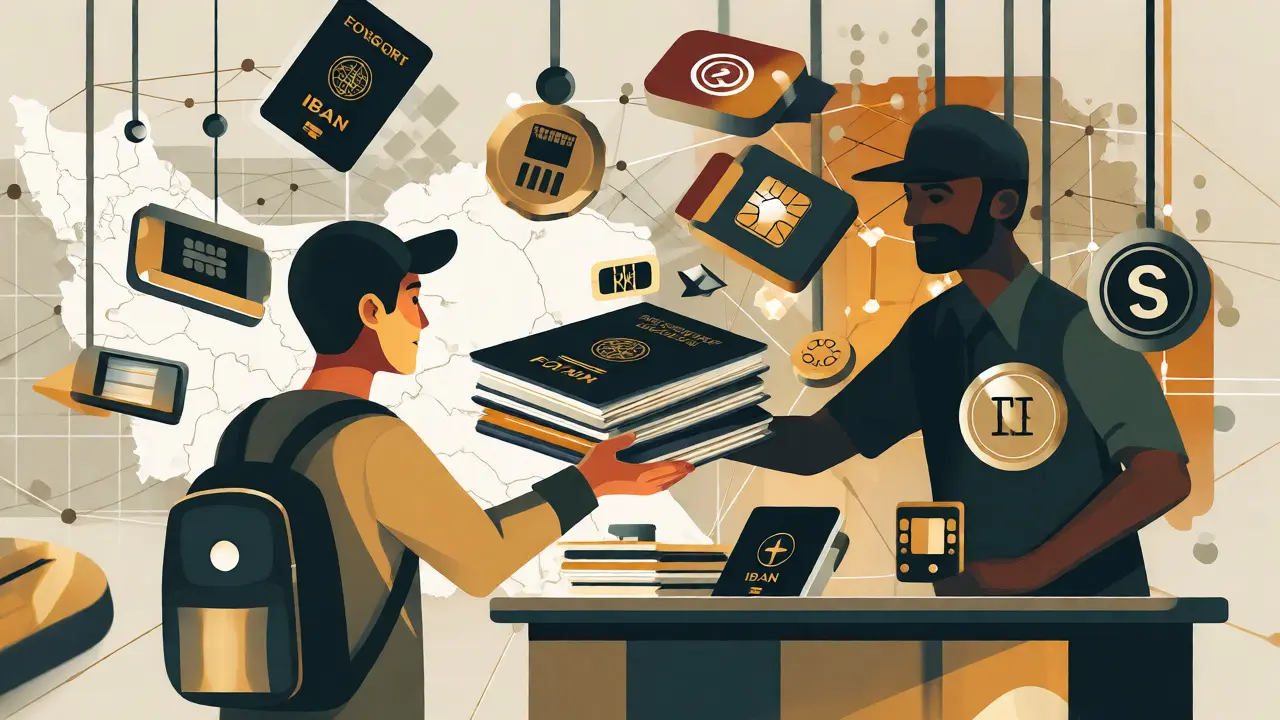
To survive this pressure, a sophisticated underground ecosystem emerged. It’s not just about downloading a free app from the App Store anymore. Serious traders are buying complete "identity packages." These services provide foreign International Bank Account Numbers (IBANs), SIM cards for receiving One-Time Passwords (OTPs), and authentic-looking residency documents. This allows Iranians to pass KYC checks on international exchanges using fake foreign identification.
Nicholas Smart, Crystal Director of Intelligence, noted that there is a huge tranche of normal people using crypto who need these tools just to participate in the global economy. However, this reliance on third-party identity providers introduces new risks. If the provider selling you the SIM card gets compromised, or if the document database they use is leaked, your anonymity evaporates instantly. You are trusting your financial security to an unregulated shadow market.
Technical Detection Methods: Beyond the IP Address
How do exchanges actually catch you? It’s a mix of technical fingerprinting and behavioral analysis. Here is what they are looking for:
- Device Fingerprinting: Even if you change your IP, your browser settings, screen resolution, and installed fonts create a unique ID. If this ID matches a pattern seen on other banned accounts, you’re flagged.
- Transaction Patterns: Iranian traders often move funds through specific networks. Data shows that over $2 billion of Nobitex’s $3 billion processed volume moved through the TRON network. This concentration makes it easier for analytics firms to spot Iranian-linked transactions because the flow is predictable.
- Behavioral Analytics: Do you log in at 3 AM local Tehran time? Do you withdraw to wallets that have previously interacted with sanctioned entities? Algorithms detect these anomalies faster than humans can.
Free VPNs are particularly dangerous here. Many lack robust encryption protocols and may sell your user data to third parties. Worse, they suffer from high traffic loads, causing slow speeds and frequent disconnections. A disconnect during a live trade exposes your true location immediately. Paid, reputable services with dedicated IPs are safer, but they still don’t solve the problem of behavioral tracking.
The Nobitex Breach and Domestic Surveillance
If you think staying on domestic platforms like Nobitex is safe, think again. The platform processes over 87% of all Iranian-linked crypto transaction volume. While this centralization offers liquidity, it also creates a single point of failure. The recent security breach at Nobitex revealed its role in enabling warrantless surveillance. Users lost trust rapidly, driving capital flight to foreign exchanges despite the higher risk of detection.
Illicit activity at Iranian exchanges accounts for roughly 0.9% of total volume, which matches global averages. Yet, the scrutiny is disproportionate. The combination of geopolitical tensions and internal monitoring means that domestic platforms are under constant watch by the Iran Cyber Police (FATA). Using a VPN to access a foreign exchange might get you banned by the exchange, but using domestic platforms without care can get you investigated by local authorities.
Comparison of Trading Environments for Iranian Users
| Feature | Domestic (e.g., Nobitex) | Foreign (e.g., Binance/Kraken) |
|---|---|---|
| Primary Risk | Government surveillance & freezing | Account bans & fund seizure |
| Detection Method | Bank linkage & KYC records | IP leak, Device Fingerprint, Behavioral AI |
| Cost of Failure | Fines, Legal Action, Confiscation | Permanent Loss of Access to Funds |
| Privacy Level | Low (Known to State) | Medium (Dependent on VPN Quality) |
| Liquidity | High (Local Market Dominance) | Very High (Global Access) |
Strategies to Mitigate Detection Risks
So, what can you actually do? First, stop using free VPNs. Invest in a service that offers obfuscated servers and dedicated IPs. Second, diversify your storage. Don’t keep all your assets on an exchange. Move profits to a hardware wallet immediately after trading. Third, be mindful of your on-chain behavior. Since TRON is heavily monitored due to high Iranian usage, consider rotating through other networks like Ethereum or Solana when possible, though fees may be higher.
Also, consider the rise of alternative earning methods. Games like Hamster Combat have gained traction among ordinary Iranians as a way to earn crypto without directly interacting with high-surveillance exchange interfaces. While these methods yield smaller returns, they bypass the heavy scrutiny placed on large-scale trading volumes.
Future Outlook: Escalating Sophistication
The cat-and-mouse game is intensifying. Blockchain intelligence platforms are expanding their Iranian-focused monitoring programs. We are likely to see more coordinated international efforts to limit access, potentially leading to stricter geoblocking technologies that block based on GPS signals from mobile devices, not just IP addresses. Trust in domestic Virtual Asset Service Providers (VASPs) continues to erode following breaches, pushing more users toward risky offshore solutions.
If you are trading from Iran today, assume you are being watched. The era of easy circumvention is over. Success now depends on meticulous hygiene-clean devices, reliable paid infrastructure, and conservative transaction patterns. The $3.7 billion flowing out of Iran in early 2025 proves the demand is there, but the cost of maintaining access is rising every month.
Can I lose my money if my Binance account is frozen?
Yes. If Binance detects you are an Iranian resident violating terms of service, they will freeze your account. While they rarely confiscate funds outright, they may restrict withdrawals until you provide proof of residence outside Iran, which many users cannot provide. In some cases, funds remain locked indefinitely.
Is using a VPN for crypto illegal in Iran?
It exists in a legal gray area. The Central Bank of Iran prohibits using crypto for domestic payments, but owning and mining crypto is permitted under specific licenses. Using a VPN to access foreign exchanges is technically a violation of internet censorship laws and potential sanctions evasion rules, making you vulnerable to fines or account freezes by the Iran Cyber Police (FATA).
Why is the TRON network significant for Iranian traders?
TRON is popular due to low fees and fast transactions, making it ideal for small-to-medium trades. Over $2 billion of Nobitex’s volume moves through TRON. However, this high concentration makes it easier for blockchain analytics firms to identify Iranian transaction patterns, increasing detection risk compared to less saturated networks.
What happened to Binance users in 2021?
In October 2021, Binance hardened its anti-money laundering rules. Prior to this, many Iranian users accessed the platform via VPN without strict KYC. After the update, thousands of accounts were restricted or closed. Traders confirmed they lost access suddenly, highlighting the fragility of relying on lenient enforcement periods.
Are free VPNs safe for crypto trading?
No. Free VPNs often lack strong encryption, suffer from slow speeds leading to connection drops, and may sell your browsing data to third parties. A dropped connection exposes your Iranian IP address to the exchange, triggering immediate suspension algorithms.