What Crypto Exchanges Are Banned in China? Full List and Current Rules in 2025
 Nov, 13 2025
China doesn’t just discourage cryptocurrency trading-it actively blocks it. Since 2017, the government has been shutting down access to every major crypto exchange operating within its borders. By 2025, the ban is total, enforced with surveillance tools, financial blacklists, and internet firewalls. If you’re in China, you can’t legally use Binance, Coinbase, Kraken, or any other centralized exchange. Not even through a VPN without risking legal trouble.
Which exchanges are officially banned in China?
All centralized cryptocurrency exchanges are banned in China. That includes the biggest names in the industry: Binance is the world’s largest crypto exchange by volume, which was forced to shut down its China-based operations in 2017 and has been blocked from serving Chinese users since. Coinbase is the U.S.-based exchange that stopped accepting Chinese users in 2021 after government pressure. Kraken is a U.S. exchange that no longer allows Chinese residents to trade or deposit funds. Huobi is a Chinese-origin exchange that relocated its headquarters overseas after the 2017 crackdown and now blocks all traffic from mainland IP addresses.
Even lesser-known platforms like OKX, Gate.io, and Bybit are blocked. The Chinese government doesn’t publish an official list-but if an exchange has ever accepted Chinese users or offered yuan-denominated trading, it’s on the restricted list. Over 200 exchanges have been blocked since 2017, and new ones get added every few months.
How does China enforce the ban?
China doesn’t rely on laws alone-it uses technology and financial control to make compliance unavoidable.
- The Great Firewall blocks direct access to exchange websites. Even if you type in binance.com, you’ll get a connection error.
- Internet providers are ordered to cut off VPN services used to bypass restrictions. Many popular VPNs no longer work reliably inside China.
- Banks and payment processors like Alipay and WeChat Pay are forbidden from handling crypto transactions. If you try to deposit yuan to buy Bitcoin, your account gets flagged.
- Government systems monitor KYC data. If you use your Chinese ID on a foreign exchange-even from abroad-your account can be frozen, and you may be investigated for illegal capital flight.
It’s not just about access. In 2024, Chinese courts processed over 500 cases related to crypto trading under laws against illegal fundraising and unauthorized foreign exchange. People have been fined, had assets seized, and even faced criminal charges for using crypto exchanges.
Is it illegal to own crypto in China?
No-holding cryptocurrency isn’t illegal. But it’s extremely risky.
The government doesn’t ban you from owning Bitcoin or Ethereum in your wallet. But if they find out you’re actively trading, sending large amounts, or using foreign exchanges, you could be accused of violating capital controls or engaging in illegal financial activity. In practice, owning crypto is tolerated only if you’re not moving it, not trading it, and not drawing attention.
False rumors spread in May 2025 claimed China had made crypto ownership fully illegal. Those claims were debunked by multiple fact-checkers, including Bitcoin Junkies and Grok. No new law was passed. The confusion came from recycled reports from the 2021 ban. As of December 2025, ownership is still not criminalized-but trading is.

What are Chinese users doing instead?
Despite the ban, crypto isn’t dead in China. It’s gone underground.
Many users rely on peer-to-peer (P2P) platforms like LocalBitcoins or Paxful, where buyers and sellers trade directly. These platforms often use cash, bank transfers, or gift cards to avoid detection. Others use decentralized exchanges (DEXs) like Uniswap or PancakeSwap, which don’t require KYC and run on blockchain networks outside China’s control.
Some set up offshore companies or use foreign bank accounts to access exchanges legally from outside China. But this is expensive, complicated, and still risky. If Chinese authorities trace your identity to a foreign account, you could face penalties.
One of the most common workarounds is using over-the-counter (OTC) brokers. These are private traders who buy and sell crypto for cash or bank transfers. They operate in Telegram groups or WeChat communities. But they’re unregulated-and many have been arrested for money laundering.
How has the ban affected the global crypto market?
China’s ban removed the largest potential market from crypto trading. Before 2017, Chinese users accounted for over 70% of Bitcoin trading volume globally.
Since then, global liquidity has dropped. When rumors of new restrictions surfaced in May 2025, Bitcoin briefly crashed from $111,000 to under $104,000 in under an hour. Ethereum fell 7%. Stablecoins like USDT spiked in demand as traders scrambled to preserve value.
But the ban also created opportunity. Many international traders saw the drop as a buying signal. As one analyst put it: “When fear hits hardest-smart money loads up.”
China’s absence also shifted trading hubs. The U.S., Singapore, and the UAE now dominate global crypto volumes. But the market still feels the weight of China’s silence.
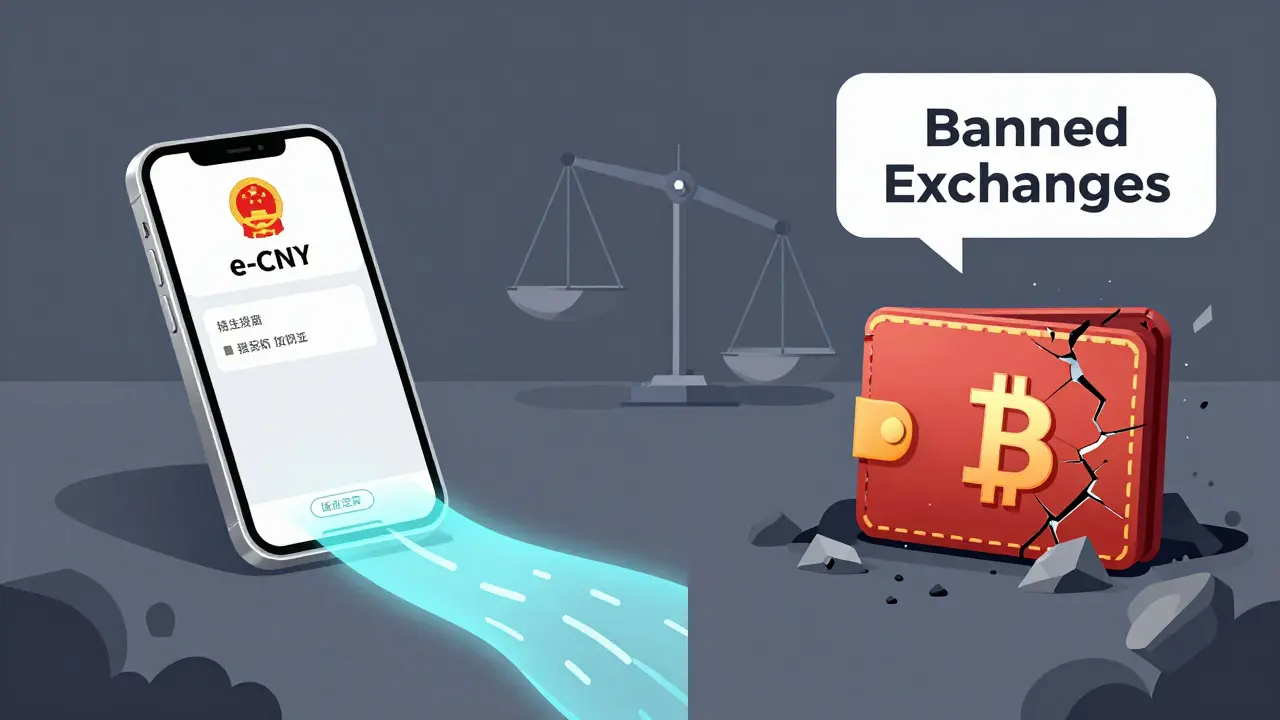
What’s China’s alternative to crypto?
China isn’t rejecting digital money-it’s building its own.
The e-CNY is the digital yuan, a state-controlled central bank digital currency (CBDC) launched in pilot form in 2020 and expanded nationwide by 2024. Unlike Bitcoin, the e-CNY is fully traceable. The government knows who you paid, how much, and when. It’s designed to replace cash, not compete with crypto.
Beijing is also exploring a yuan-backed stablecoin-a digital token tied to the Chinese currency, but controlled entirely by the state. This isn’t about innovation. It’s about control. The government wants to monitor every transaction, prevent capital flight, and reduce reliance on the U.S. dollar.
While the rest of the world debates decentralization, China is doubling down on centralization.
Will the ban ever end?
Don’t expect it to.
Chinese officials have shown no sign of reversing course. In July 2025, the Shanghai State-owned Assets Supervision and Administration Commission hinted that digital assets might lead to “softening” of policy-but offered no timeline, no plan, and no details.
Industry experts from ThinkBRG suggest China might one day allow trading on licensed domestic exchanges-but only if they’re fully monitored, tied to the e-CNY, and under state control. That’s not freedom. It’s regulation with a Chinese face.
For now, the ban stands. And with over 400 million potential users locked out, China remains the biggest outlier in the global crypto landscape.
What happens if you get caught trading crypto in China?
If you’re caught using a banned exchange or facilitating crypto transactions, the consequences can be serious.
- Your bank accounts may be frozen.
- Your crypto wallets can be traced and seized.
- You could be investigated for “illegal fundraising” or “capital flight”-both criminal offenses under Chinese law.
- Repeat offenders face fines, asset confiscation, and even jail time.
There are no publicized cases of someone going to jail just for holding Bitcoin. But there are multiple cases of people sentenced for running OTC businesses, acting as intermediaries, or helping others bypass capital controls.
The message is clear: Own crypto quietly, and you might be ignored. Trade it openly, and you risk everything.
Are all crypto exchanges banned in China?
Yes. All centralized exchanges-whether based in China or abroad-are banned from serving Chinese users. This includes Binance, Coinbase, Kraken, Huobi, OKX, and over 200 others. The ban covers trading, deposits, withdrawals, and account creation for Chinese residents.
Can I still own Bitcoin in China?
Yes, owning Bitcoin or other cryptocurrencies is not illegal. But if you trade, send large amounts, or use foreign exchanges, you risk being investigated for violating capital controls or engaging in illegal financial activity. Ownership is tolerated only if it’s passive and untraceable.
Is using a VPN to access crypto exchanges legal in China?
No. Using a VPN to bypass China’s internet restrictions is against government policy. While enforcement varies, many VPN providers have been shut down, and users have been fined or warned. Accessing banned exchanges via VPN still violates financial regulations and can lead to account freezes or legal action.
Why did China ban crypto exchanges?
China banned crypto exchanges to maintain control over its financial system, prevent capital flight, stop money laundering, and promote its own digital currency, the e-CNY. The government views decentralized cryptocurrencies as a threat to monetary policy and social stability.
Are there any legal ways to trade crypto in China?
No. There are no legal, government-approved crypto exchanges for Chinese residents. Any platform claiming to offer legal trading in China is either misleading or operating illegally. The only legal digital asset is the e-CNY, China’s state-controlled digital yuan.
What’s the future of crypto in China?
The future lies in state-controlled digital assets, not decentralized crypto. China will continue to ban foreign exchanges and push adoption of the e-CNY and potentially a yuan-backed stablecoin. Any relaxation of the ban would likely mean licensed, government-monitored platforms-not open markets.
Jess Bothun-Berg
December 4, 2025 AT 12:57Joe B.
December 5, 2025 AT 01:22Rod Filoteo
December 5, 2025 AT 02:49Layla Hu
December 7, 2025 AT 00:27Nora Colombie
December 8, 2025 AT 20:37Bhoomika Agarwal
December 8, 2025 AT 21:56