What is Aster (ASTER) Crypto Coin? A Complete Guide to the Next-Gen Decentralized Trading Platform
 Feb, 16 2026
When you hear "Aster (ASTER)" in crypto circles, don't think of it as just another token. Think of it as a trading platform built from the ground up to fix real problems most decentralized exchanges ignore. Aster isn’t a coin you hold to moon - it’s the engine behind a full trading experience that lets you trade spot, perpetuals, and even stock derivatives - all while earning yield on your collateral. And yes, it’s real, active, and already listed on Binance.
What Exactly Is Aster (ASTER)?
Aster is a decentralized exchange (DEX) that merged two existing platforms - Astherus and APX Finance - in late 2024. It’s not a wallet. It’s not a meme coin. It’s a full-stack trading venue built for people who actually trade crypto for a living. Unlike most DEXs that just mirror centralized exchanges, Aster rebuilds the entire trading stack to handle issues like MEV (Miner Extractable Value), front-running, and capital waste.
The ASTER token is the heartbeat of this system. With a max supply of 8 billion, it’s a BEP-20 token on Binance Smart Chain (address: 0x000Ae314E2A2172a039B26378814C252734f556A). But here’s the twist: you don’t just hold ASTER to speculate. You use it to trade, vote, and earn.
How Aster Solves Real Trading Problems
Most DeFi trading platforms treat your assets like parked cars - they sit idle while you trade. Aster flips that. It lets you use liquid-staked tokens like asBNB (a staked version of BNB) and its own stablecoin, USDF, as collateral. That means when you open a leveraged position, your collateral is still earning yield. No more losing 5-10% a year on idle margin.
Then there’s MEV. If you’ve ever had your trade sandwiched by bots - where your buy order gets front-run and you pay 3% more than expected - you know the pain. Aster’s Simple Mode eliminates this entirely. It uses private mempools and custom order matching to hide your trades from bots. No front-running. No slippage. Just clean execution.
And if you think that’s impressive, wait until you hear about stock perpetuals. Aster lets you trade perpetual contracts on real-world assets like AAPL, TSLA, and NVDA - 24/7. No brokerage account. No market hours. Just on-chain exposure to Tesla stock with up to 1001x leverage.
Three Trading Modes - One Platform
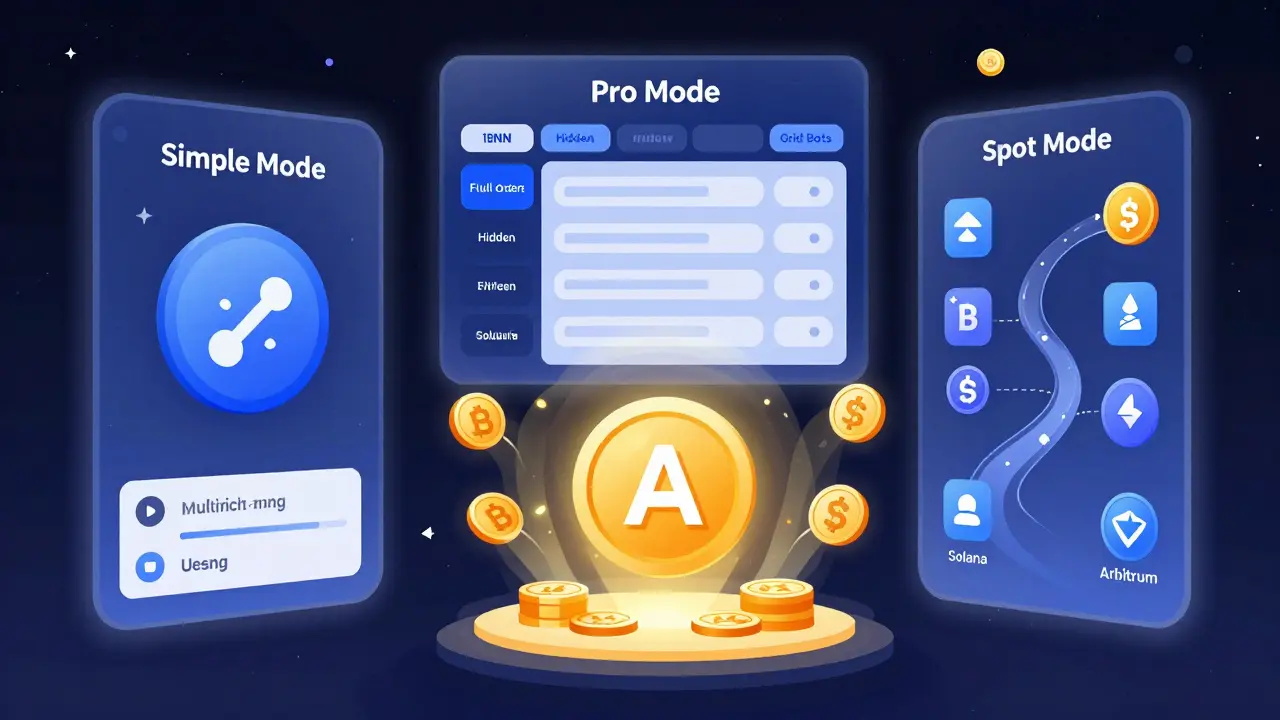
Aster doesn’t force everyone into the same interface. It offers three distinct modes, each targeting a different kind of trader.
- Simple Mode (1001x): Designed for beginners. One-click trades, MEV-free execution, up to 1001x leverage. No order books. No complexity. Just pick your asset, set your leverage, and go.
- Pro Mode: Built for professionals. Full order book, hidden orders, grid trading, and 24/7 stock perpetuals. Maker fees as low as 0.01%, taker fees at 0.035%. Supports multi-asset margin and advanced risk controls.
- Spot Mode: Traditional spot trading with deep liquidity across BNB Chain, Ethereum, Solana, and Arbitrum. No bridges needed. Trades happen natively on each chain.
Most platforms make you choose: easy or powerful. Aster gives you both - on the same platform.
Why Cross-Chain Matters
Aster doesn’t lock you into one blockchain. It works on BNB Chain, Ethereum, Solana, and Arbitrum. That means if you’re holding SOL on Solana, you can trade it against BTC on Ethereum without bridging. No slippage. No gas spikes. No waiting 10 minutes for a bridge to confirm.
This isn’t just convenience - it’s liquidity. By aggregating pools across chains, Aster creates deeper markets. A $10M trade on one chain might move the price. On Aster, it’s barely a ripple.

The ASTER Token: More Than Just a Utility Coin
The ASTER token isn’t just for paying fees. It’s the governance backbone. Holders vote on:
- Fee structure changes
- Treasury allocations
- New asset listings
- Protocol upgrades
Stake your ASTER and earn a share of trading fees. The platform also runs regular buybacks using a portion of revenue to burn tokens - reducing supply and increasing scarcity.
Token distribution is community-first: 53.5% goes to airdrops and rewards, 30% to ecosystem growth, 7% to treasury, 5% to team, and 4.5% to liquidity. That’s not a typical launch. Most projects give 15-20% to the team. Aster gives 5%. That says something about its long-term focus.
Price Oracles and Security
Perpetual trading needs accurate price feeds. Aster doesn’t rely on one source. It pulls data from Pyth Network, Chainlink, and Binance Oracle. Three independent feeds. If one fails, the others keep the system running. This isn’t just good design - it’s necessary for a platform handling billions in open interest.
Who Backs Aster?
Aster isn’t a solo project. It’s backed by YZi Labs, a well-known crypto investment group with a track record in infrastructure projects. This isn’t a team of 3 devs in a Discord. This is institutional-grade support.
The October 2025 listing on Binance with the Seed Tag was a turning point. Binance doesn’t list random tokens. The Seed Tag means the asset passed strict due diligence on liquidity, team, and tech. That listing alone gave Aster access to millions of new traders overnight.
How Aster Compares to GMX, dYdX, and Hyperliquid
GMX lets you trade perpetuals. dYdX has deep liquidity. Hyperliquid has speed. But none of them combine what Aster does:
- Yield-bearing collateral (earn while you trade)
- MEV-free execution (no bots stealing your profits)
- Stock perpetuals (trade real-world assets on-chain)
- Multi-chain native liquidity (no bridges)
- Three trading modes for all skill levels
It’s not just better - it’s a different category of platform.
Getting Started With Aster
If you’re new, start with Simple Mode. Connect your wallet (MetaMask, Phantom, etc.), deposit asBNB or USDF, and pick a trade. No learning curve. No complex settings. The interface guides you.
If you’re experienced, jump into Pro Mode. Use hidden orders to avoid revealing your position size. Set up grid bots to automate buys and sells. Trade TSLA perpetuals at 50x leverage while your collateral earns 7% APY.
The official documentation is clear, detailed, and updated regularly. There are also guides from major crypto education sites like CoinGecko and CryptoSlate that break down how to use each mode.
Is Aster Safe?
No DeFi platform is risk-free. But Aster reduces common risks:
- MEV? Eliminated in Simple Mode.
- Price manipulation? Mitigated by triple oracle feeds.
- Capital inefficiency? Solved with yield-bearing collateral.
- High leverage? You’re still responsible - but now you’re trading on a transparent, auditable system.
It’s not a magic bullet. Always use stop-losses. Never risk more than you can afford to lose. But Aster gives you tools most platforms don’t - and that’s what makes it stand out.
What’s Next for Aster?
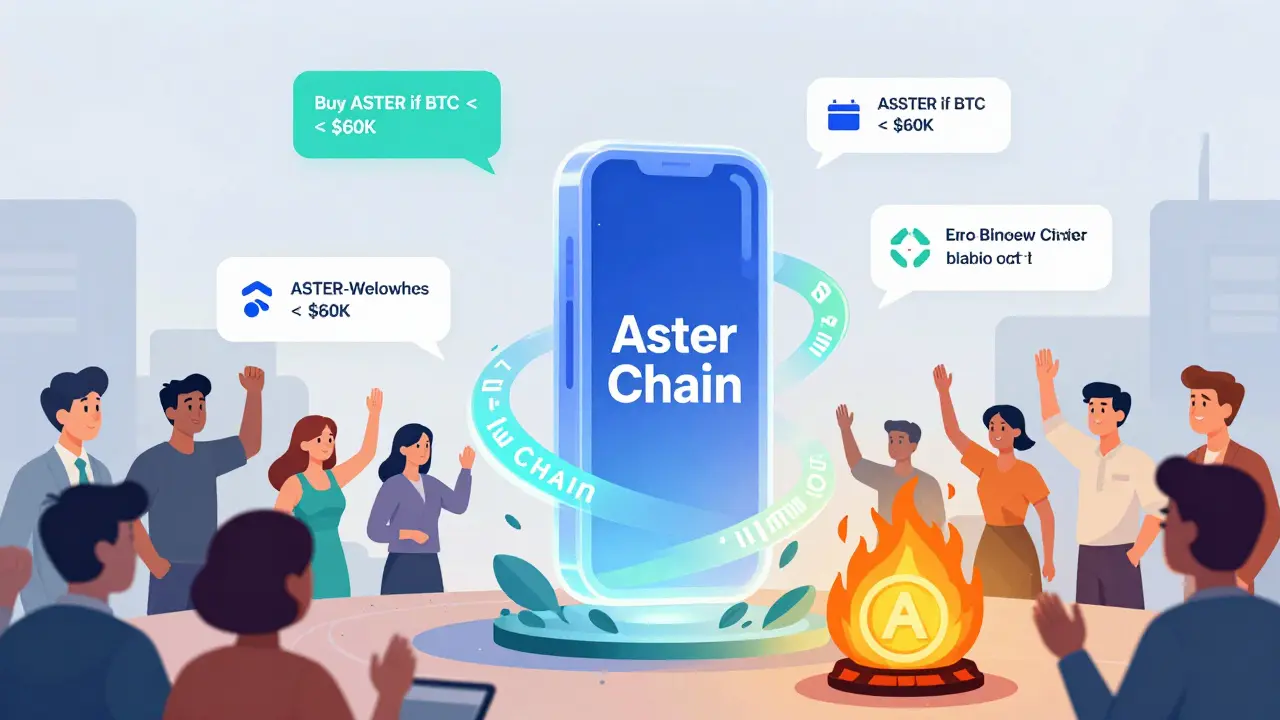
The roadmap is aggressive. The team is building Aster Chain - a Layer 1 blockchain powered by zero-knowledge proofs. This will let users trade privately while keeping everything auditable. Think: anonymous trades on a public ledger.
They’re also testing intent-based trading. Imagine typing: "Buy 1000 ASTER if BTC drops below $60K" - and the system automatically finds the best price across all chains, executes, and settles. No manual monitoring. Just automation.
If they pull this off, Aster won’t just be a DEX. It’ll become the operating system for decentralized trading.
Is Aster (ASTER) a good investment?
ASTER isn’t an investment like Bitcoin or Ethereum - it’s a utility token tied to a trading platform. Its value grows as more people use the exchange. If trading volume increases, so does demand for ASTER through fee discounts and staking rewards. But like all crypto assets, it’s volatile. Don’t invest money you can’t afford to lose.
Can I trade stocks with Aster?
Yes. Aster offers perpetual contracts on real-world stocks like Apple (AAPL), Tesla (TSLA), and NVIDIA (NVDA). These are synthetic assets pegged to the real stock price, traded 24/7 on-chain. You’re not buying actual shares - you’re trading derivatives. This is perfect for crypto-native traders who want exposure to traditional markets without a brokerage.
How do I get ASTER tokens?
You can buy ASTER directly on Binance, where it was listed in October 2025 with the Seed Tag. It’s also available on major DEXs like Uniswap and PancakeSwap. If you’re new, the easiest way is to buy it on Binance using USDT or BUSD. You can also earn ASTER by trading on the platform - early users received rewards through airdrops and fee-sharing programs.
What makes Aster different from dYdX or GMX?
dYdX and GMX are great at perpetual trading, but they don’t offer yield-bearing collateral or MEV-free execution for retail traders. Aster combines deep liquidity, multi-chain support, stock perpetuals, and private trading - all in one place. It’s not just another DEX. It’s a full upgrade to how decentralized trading works.
Is Aster only for advanced traders?
No. Aster’s Simple Mode is designed for beginners. You can trade with up to 1001x leverage using just one click. The interface hides complexity and prevents front-running. You don’t need to understand order books or gas fees. If you’ve ever used a mobile trading app, you can use Aster.
Does Aster have a mobile app?
Not yet. Aster is currently accessed through web wallets like MetaMask or Phantom. But the platform is optimized for mobile browsers, and a native app is planned for late 2026. For now, you can trade seamlessly from your phone using your wallet’s browser.
Can I stake ASTER tokens?
Yes. You can stake ASTER to earn a share of platform trading fees. Staking also gives you voting power in governance decisions. Rewards are distributed weekly, and you can unstake anytime without penalties. The annual yield varies based on trading volume but typically ranges between 5% and 12%.
Charrie VanVleet
February 18, 2026 AT 05:36Okay but like… I tried Simple Mode yesterday and it was *too* easy. Like, I just clicked "Buy ASTER" and boom - 500x leverage, no slippage, and my asBNB was still earning yield. I didn’t even need to think. It’s like DeFi got a personality transplant and became my chill uncle who gives advice but never judges. 🙌
Anandaraj Br
February 19, 2026 AT 17:26this whole aster thing is just another pump and dump with fancy words. they say "no front-running" but every time i try to trade the bot gets there 0.3s before me. and stock perpetuals?? bro i can just buy tsla on robinhood for free. this is just web3 vaporware with a binance listing and a ton of hype. 🤡
Geet Kulkarni
February 21, 2026 AT 16:12While I appreciate the ambition behind Aster’s architecture, one must question the ontological coherence of integrating real-world asset derivatives on a chain that still struggles with finality guarantees. The claim of "MEV-free execution" is statistically dubious without formal verification of the private mempool protocol. Furthermore, the reliance on triple oracle feeds introduces unnecessary latency - a fatal flaw for high-frequency traders. Truly, this feels like an academic paper dressed as a product. 🤔
Paul David Rillorta
February 23, 2026 AT 11:35so binance listed this?? lol. they’re just trying to make people think they’re not dead. remember when they listed doge? then the rug got pulled? same energy. aster? more like asteRIP. they’re gonna vanish after the next bull run. and that "stock perpetuals" thing? bro, you’re not trading tesla - you’re trading a number that someone on a server in singapore made up. 😂
Chris Thomas
February 23, 2026 AT 19:15Let’s cut through the marketing noise. Aster’s innovation isn’t in the UI - it’s in the capital efficiency model. Yield-bearing collateral is a paradigm shift because it solves the opportunity cost problem that’s plagued DeFi since 2020. Most DEXs treat liquidity as a static asset. Aster treats it as a dynamic yield generator. And multi-chain native liquidity? That’s not a feature - it’s the future. Anyone still bridging assets is operating on 2021 tech. The real question isn’t whether Aster works - it’s whether you’re ready to stop using a shovel when you’ve got a backhoe.
James Breithaupt
February 24, 2026 AT 17:33Just spent 4 hours on Aster last night. Pro Mode is wild - I set up a grid bot on AAPL perpetuals while my USDF earned 8% APY. Then I switched to Spot Mode and traded SOL/BTC without bridging. No gas wars. No waiting. Just smooth. I’ve used dYdX, GMX, Hyperliquid… this is the first time I felt like I was trading on a platform built for humans, not just bots. Also, the fact they’re building an L1 with ZK? That’s not next-level - that’s next-century.
Sarah Shergold
February 26, 2026 AT 17:25me: tries aster
also me: still paying 10 gwei on ethereum
also me: still using a bridge
also me: why am i like this
Andrew Edmark
February 27, 2026 AT 07:41Hey everyone - just wanted to say I’m really glad to see folks actually using this instead of just yelling about it. I started with Simple Mode last week, and honestly? It’s the first time I’ve felt like crypto trading didn’t feel like a casino. The fact that I can trade TSLA at 50x and still earn yield on my collateral? That’s not magic. That’s smart design. If you’re new, don’t overthink it. Just try one trade. You might be surprised. And if you’re stuck? I’m happy to help. No jargon. Just real talk. 💙