What is Bee (BEE) Crypto? Token History, Price & Reality Check
 Sep, 22 2026
You might have seen Bee or BEE popping up in your wallet or on a random exchange list and wondered what it actually does. Is it the next big thing in decentralized housing? Or is it just another ghost token from the 2018 ICO boom that nobody talks about anymore? The answer isn't simple because "Bee" isn't just one project. There’s the original Bee Token, which tried to disrupt Airbnb with blockchain smart contracts, and then there’s Bee Network, a mobile mining app trying to copy Pi Network’s playbook. If you’re holding BEE or thinking about buying it, you need to know exactly which one you’re looking at, because their stories-and their prices-are wildly different.
The Original Vision: Decentralizing Short-Term Rentals
Back in 2018, when Ethereum was still the darling of the crypto world, a team launched Bee Token with a bold promise. They wanted to build a decentralized platform for short-term rentals, essentially an Airbnb competitor that didn’t take a massive cut of every booking. The core idea was smart. By using Ethereum smart contracts, they could automate payments, handle disputes, and keep reputation scores immutable-meaning hosts couldn’t delete bad reviews.
The BEE token was designed as the fuel for this ecosystem. It was an ERC-20 token with a fixed supply. No mining required. You bought it during their Initial Coin Offering (ICO), and it served as a medium of exchange within their platform. The pitch was compelling: pay in BEE tokens to avoid fees entirely, while paying in Bitcoin or fiat incurred higher transaction costs. This fee structure was meant to incentivize users to buy and hold BEE, creating organic demand.
But here’s the reality check. Despite raising significant funds and building a community of over 50,000 members on Telegram, the platform never achieved the network effect needed to survive against giants like Airbnb and Booking.com. Smart contracts are great for trustless transactions, but they don’t magically solve the cold-start problem. Without enough hosts and guests, the utility of the token remains theoretical. Today, the original Bee Token platform is largely inactive, serving more as a historical case study than a live service.
Don’t Confuse Them: Bee Token vs. Bee Network
This is where most people get tripped up. If you search for "Bee crypto," you’ll find two distinct entities that share a name but have almost nothing else in common. Confusing them can lead to serious investment mistakes.
| Feature | Bee Token (Original) | Bee Network (Mobile Mining) |
|---|---|---|
| Launch Year | 2018 | ~2021 |
| Primary Function | Decentralized rental marketplace utility | Social mining / User acquisition |
| Blockchain | Ethereum (ERC-20) | Proprietary / Layer 2 integration |
| Acquisition Method | ICO Purchase | Free Mobile App Tapping |
| Current Status | Negligible activity, low liquidity | Active user base, pre-mainnet phase |
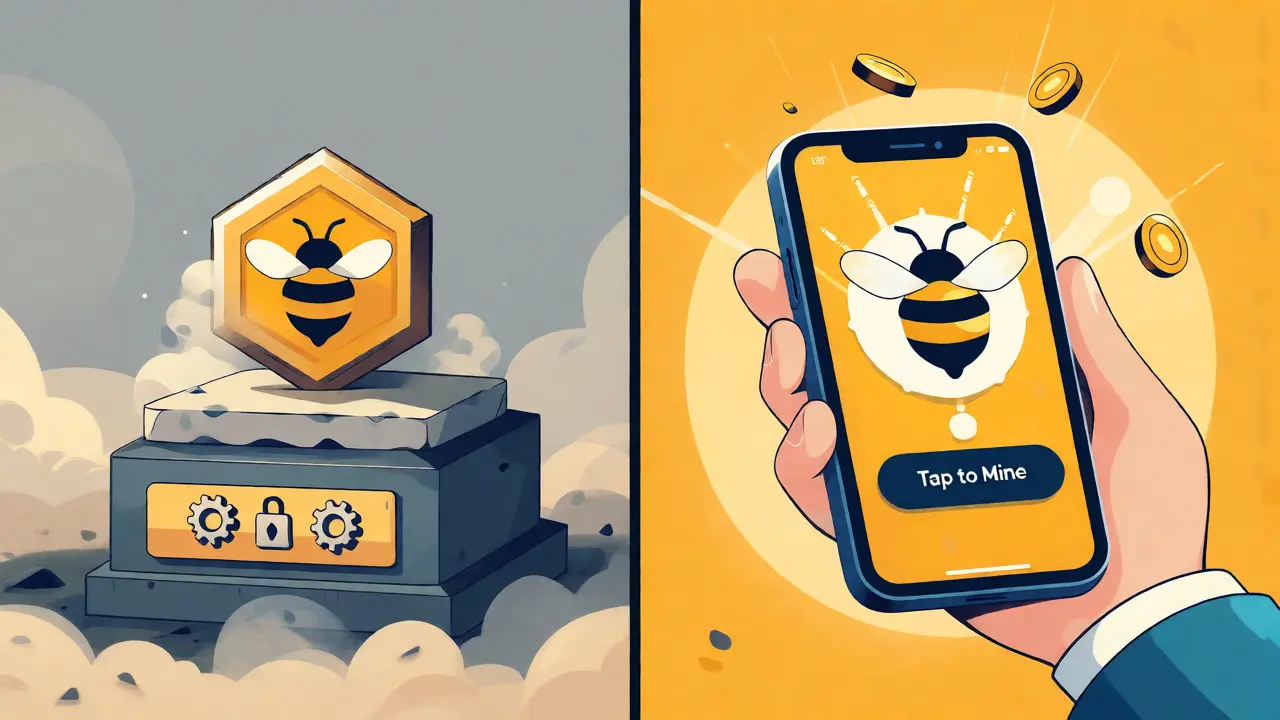
The Bee Network is the newer player. It operates similarly to Pi Network. Users download an app, tap a button once a day, and accumulate BEE coins. It’s designed for mass adoption through accessibility rather than technical utility right now. While Bee Token failed to capture the housing market, Bee Network is betting on capturing the casual crypto-curious demographic who want to own digital assets without understanding gas fees or private keys.
Price History and Market Performance
If you’re looking at the charts, prepare for some shock. The original BEE token experienced a classic crypto boom-and-bust cycle, but with extreme severity. During its ICO in early 2018, tokens were sold at approximately $0.14 USD. That sounds cheap by today’s standards, but for a new ERC-20 token, it was a standard valuation based on the hype cycle of that era.
Fast forward to September 2026, and the price has collapsed. Current trading data shows BEE hovering between $0.000010 and $0.000025 USD. That is a decline of over 99.99% from its launch price. We aren’t talking about a dip; we’re talking about near-total value destruction. The market capitalization sits around $22,000, which is incredibly low for a token with a circulating supply of nearly 1 billion units.
Why did it crash so hard? Several factors converged:
- Lack of Adoption: The decentralized rental platform never gained critical mass. Without real-world usage, the token had no intrinsic demand.
- Competition: Established platforms improved their own tech, making the blockchain advantage less obvious to average users.
- Market Sentiment: The broader crypto bear markets wiped out speculative interest in altcoins with weak fundamentals.
Trading volume is also a major red flag. On many exchanges, daily volume for BEE is under $10. This means if you try to sell a large amount, you might crash the price further because there simply aren’t enough buyers on the other side of the trade.
How Does Bee Network Work?
Since the original token is mostly dormant, let’s look at the active side: Bee Network. This project relies on social verification. You can’t just spam accounts; you invite friends, and their activity validates yours. This creates a web of trust, similar to how credit scores work, but applied to crypto distribution.
The mining process is energy-efficient because it doesn’t require proof-of-work computation on your phone. Instead, it uses consensus mechanisms that rely on user engagement. The goal is to distribute coins fairly before launching the mainnet. However, like all free mining apps, the catch is usually delayed gratification. You accumulate numbers in an app database, not necessarily liquid crypto on a blockchain yet. When (or if) these coins migrate to a public chain, their value will depend entirely on whether the network attracts developers and merchants.
Is it better than Pi Network? Not necessarily. Pi has a larger head start and more established partnerships. Bee Network is playing catch-up. If you’re participating, treat it as a lottery ticket with zero financial risk (since it’s free) rather than a solid investment strategy.

Should You Buy or Hold BEE?
Let’s be direct. For the original BEE token, the window for profit has likely closed. Unless the development team announces a massive pivot or acquisition, the token suffers from zombie status. It trades on obscure exchanges with thin order books. Buying now is gambling on a miracle revival, not investing in growth.
For Bee Network users, the advice is different. Since acquisition cost is zero, the downside is limited to your time. The upside potential exists if the project successfully launches its mainnet and lists on major exchanges like Binance or Coinbase. But remember, thousands of similar projects fail to deliver on their promises. Keep your expectations realistic.
If you already hold the original BEE tokens from 2018, consider the tax implications of selling at a loss versus holding indefinitely. In many jurisdictions, realizing a loss can offset gains elsewhere, which might be more valuable than waiting for a price recovery that may never happen.
Key Takeaways for Investors
Before you put any money into anything labeled "Bee," run through this checklist:
- Check the Contract Address: Ensure you are buying the correct ERC-20 token if you mean the original Bee Token. Scams often create fake tokens with similar names.
- Verify Liquidity: Look at the 24-hour trading volume. If it’s under $1,000, you might struggle to exit your position.
- Identify the Project: Are you dealing with the defunct rental platform or the active mining app? Their roadmaps and risks are completely different.
- Assess Utility: Does the token do anything useful right now? If it’s purely speculative, assume high volatility.
The crypto space is littered with projects that had great whitepapers but poor execution. Bee Token is a prime example of technology outpacing adoption. Just because a smart contract works perfectly doesn’t mean people will use it. Always prioritize network effects and real-world utility over technical novelty.
Is Bee crypto the same as Pi Network?
No, they are separate projects. Pi Network runs on a modified Stellar Consensus Protocol, while Bee Network has its own infrastructure. Both offer mobile mining, but they have different communities, tokenomics, and development teams. Do not assume they will behave identically in the market.
Why is the BEE token price so low?
The original BEE token suffered from a lack of real-world adoption for its decentralized rental platform. With minimal trading volume and no significant updates for years, the price collapsed from its ICO level of $0.14 to fractions of a cent. Low liquidity exacerbates the price drop, making it difficult for large holders to sell without crashing the market further.
Can I mine Bee coins on my iPhone?
Availability varies. Bee Network primarily targets Android users due to easier background process management. iOS restrictions on battery usage and background tasks often limit or prevent continuous mining features found on Android. Check the latest app store listing for current iOS compatibility.
Where can I buy the original BEE token?
The original ERC-20 BEE token is listed on smaller, decentralized exchanges like IDEX or specific aggregators. Major centralized exchanges like Coinbase or Binance typically do not list it due to low volume and compliance checks. Be cautious of fake listings on unknown platforms.
Is Bee Network a scam?
It is not necessarily a scam, but it carries high risk. Like many social mining projects, it generates revenue potentially through ads or data collection while promising future token value. The risk lies in the uncertainty of the mainnet launch and whether the token will have actual utility beyond speculation. Treat it as experimental.
Zach Evans
September 23, 2026 AT 05:22Let's cut through the noise because most people are still confused about which Bee they're talking about and honestly it's embarrassing. The original Bee Token from 2018 is basically a zombie project that raised money on pure hype and failed to deliver any real network effects against Airbnb. You cannot compete with incumbent giants by just slapping 'blockchain' on a website without solving the cold start problem which is exactly what happened here. The price collapse of over 99% is not a bug it is a feature of poor execution and lack of utility. Meanwhile Bee Network is playing the Pi Network game where you tap a button for free coins hoping for a mainnet launch that may never bring liquidity. It is crucial to understand that one is an ERC-20 token with negligible volume and the other is a mobile app database entry waiting for a migration event. If you are holding the original BEE you are holding a bag from the last bull run that likely won't recover unless there is a miraculous pivot. Do not confuse the two because their risk profiles are completely different despite sharing a name. One is dead weight in your wallet and the other is a lottery ticket with zero cost basis but high uncertainty. Stop asking if it will moon and start asking if the developers have actually shipped code recently. The market does not care about whitepapers anymore it cares about active users and transaction volume. Both projects fail that test right now so keep your expectations at absolute zero. This is not investing this is gambling on hope which is the most expensive emotion in crypto. Check your contract addresses before buying anything labeled Bee because scams love these generic names. Liquidity is the killer here and neither has enough depth to support institutional interest. Treat this as a cautionary tale rather than a golden opportunity. Stay skeptical and do your own research instead of following influencers who shill garbage tokens. The reality check is harsh but necessary for anyone touching this ticker. Move on to projects with actual product-market fit.
dillon wright
September 24, 2026 AT 09:15yeah i remember seeing bee token back in 2018 and thinking it was gonna be huge
ended up being nothing really
Samantha Dalton
September 25, 2026 AT 15:45the confusion between the two is such a pain
i had a friend sell his pi thinking it was bee and lost out on potential gains
definitely check the contract address like always
liquidity is super low on the old one so selling is hard anyway
just treat the new app as free money or time waste depending on how you look at it
Sean Russo
September 27, 2026 AT 00:29I appreciate the clarity in breaking down the distinction between the two entities because it helps reduce anxiety for newcomers who might feel overwhelmed by similar naming conventions.
It is important to approach both projects with an open mind while acknowledging the historical context of the 2018 ICO era which was vastly different from today's regulatory environment.
The failure of the original platform highlights that technology alone cannot sustain a marketplace without community engagement and trust which takes years to build.
For those participating in Bee Network I think viewing it as an educational experience rather than a financial investment reduces stress significantly.
We should encourage each other to learn from these cases so we can better identify viable projects in the future.
Sharing knowledge inclusively helps everyone navigate these complex waters more confidently.
Let us remain supportive even when discussing assets that did not perform as expected.
Every lesson learned contributes to our collective growth in this space.
I hope this perspective helps balance the often negative sentiment surrounding older altcoins.
Community support matters more than price action in the long run.
Greeshma Umapathi
September 27, 2026 AT 14:02OMG YES FINALLY someone explains this clearly!!!
I have been screaming into the void about this exact confusion for months!!
The original Bee Token is literally a ghost town and everyone needs to wake up!!!
You cannot expect a 100x return on a project with $10 daily volume that is mathematically impossible!!!
Bee Network is exciting but please do not quit your job based on tapping a screen!!!
Pi Network has a headstart and partnerships that Bee lacks so compare carefully!!!
Treat free mining apps as fun experiments not retirement plans!!!
If you hold the old token realize your loss for tax benefits and move forward!!!
Do not let sunk cost fallacy keep you holding dead bags forever!!!
Stay energetic and informed because the market rewards those who adapt!!!
Let us all stay motivated to find the next real gem amidst the dust!!!
This breakdown is essential reading for every beginner!!!
Spread the word so no one gets burned by name confusion again!!!
Knowledge is power and sharing it is caring!!!
emmanuel ivan
September 28, 2026 AT 00:01Thank you for this comprehensive overview, it is indeed vital to distinguish between the legacy ERC-20 asset and the newer mobile-first initiative.
From a technical standpoint, the smart contract implementation of the original project was sound, yet the economic model failed to incentivize sufficient host adoption.
We must consider the regulatory implications as well, especially regarding securities classifications for tokens sold via ICOs in jurisdictions like the US.
For international investors, particularly those in regions with varying crypto laws, understanding the legal status of these tokens is paramount.
The Bee Network approach mirrors successful user acquisition strategies seen in fintech, leveraging social graphs for distribution.
However, the transition from centralized database entries to decentralized blockchain assets remains the critical hurdle for many such projects.
I would advise consulting with a tax professional regarding the realization of losses on the original token holdings.
Collaborative discussion among experts helps refine these insights for the broader community.
Let us continue to share accurate information to foster a healthier ecosystem.
Best regards to all fellow enthusiasts navigating this complex landscape.
Alison Cooper
September 28, 2026 AT 14:03Stop wasting your time on dead projects like the original Bee Token. It is a graveyard of failed promises and useless technology.
If you want exposure to mobile mining wait for mainnet launches with actual trading pairs not vaporware.
Airbnb does not need blockchain to work and neither did this project. They tried to solve a non-existent problem.
Be assertive with your capital and avoid tokens with under $10k market cap unless you are speculating with pocket change.
The cultural shift away from utility-focused crypto towards meme-driven speculation hurts projects like this that had genuine intent.
Do not let nostalgia for the 2018 bull market cloud your judgment today.
Focus on assets with clear value propositions and active development teams.
Anything else is just noise designed to extract fees from retail investors.
Move on and find something that actually works.
Theresa Flores
September 29, 2026 AT 17:08There is a certain beauty in the cycle of rise and fall that reminds us of the impermanence of digital value 😊
We often seek permanence in assets but perhaps the lesson is in the journey of discovery itself 🌱
The original Bee Token taught us that innovation without adoption is merely philosophy in code form.
Bee Network offers a playful interaction with technology that might appeal to those who enjoy the ritual of daily engagement.
Perhaps the true utility is the connection formed between users in the social verification layer 🤝
We should view these experiences as opportunities to reflect on what we truly value in currency and exchange.
Optimism allows us to see potential even in seemingly dormant projects 💫
May we find wisdom in the volatility and peace in the process ✨
Steve McNeil
September 30, 2026 AT 18:27Listen up because this is the most important thing you will read today!!
The original Bee Token is a complete disaster and anyone holding it is clinging to a corpse!!
They promised to disrupt Airbnb and delivered absolutely NOTHING except empty Telegram groups!!
Ninety-nine percent loss is not a dip it is a total wipeout of investor confidence!!
Do not let them tell you it is undervalued because it is worthless until proven otherwise!!
Bee Network is better but still risky because it relies entirely on future promises!!
If you are serious about crypto stop chasing ghosts and look for products people use!!
Wake up and smell the coffee because the easy money days are gone forever!!
Protect your capital and do not get emotionally attached to failed experiments!!
This is a warning label for every altcoin with a cool name and no substance!!
Take it seriously or lose your shirt!!
John Morgan
October 2, 2026 AT 11:48These foreign-backed projects always come in promising the world and leaving American investors with empty pockets.
We need more regulation to protect domestic buyers from these offshore pump-and-dump schemes.
The original Bee Token team disappeared after taking our money which is typical for these global ventures.
Stick to established US-based exchanges and verified projects to avoid getting burned.
Don't buy into hype created by overseas marketing firms targeting gullible Americans.
Support local crypto initiatives that contribute to our economy rather than draining it.
Be cautious with any token that doesn't have transparent US compliance.
Our dollars deserve better than speculative garbage from unknown origins.
Keep it patriotic and keep your money safe within known borders.