What Is Eternity (ENT) Crypto? A Deep Dive Into Its Price, Supply, and Risks
 Aug, 8 2026
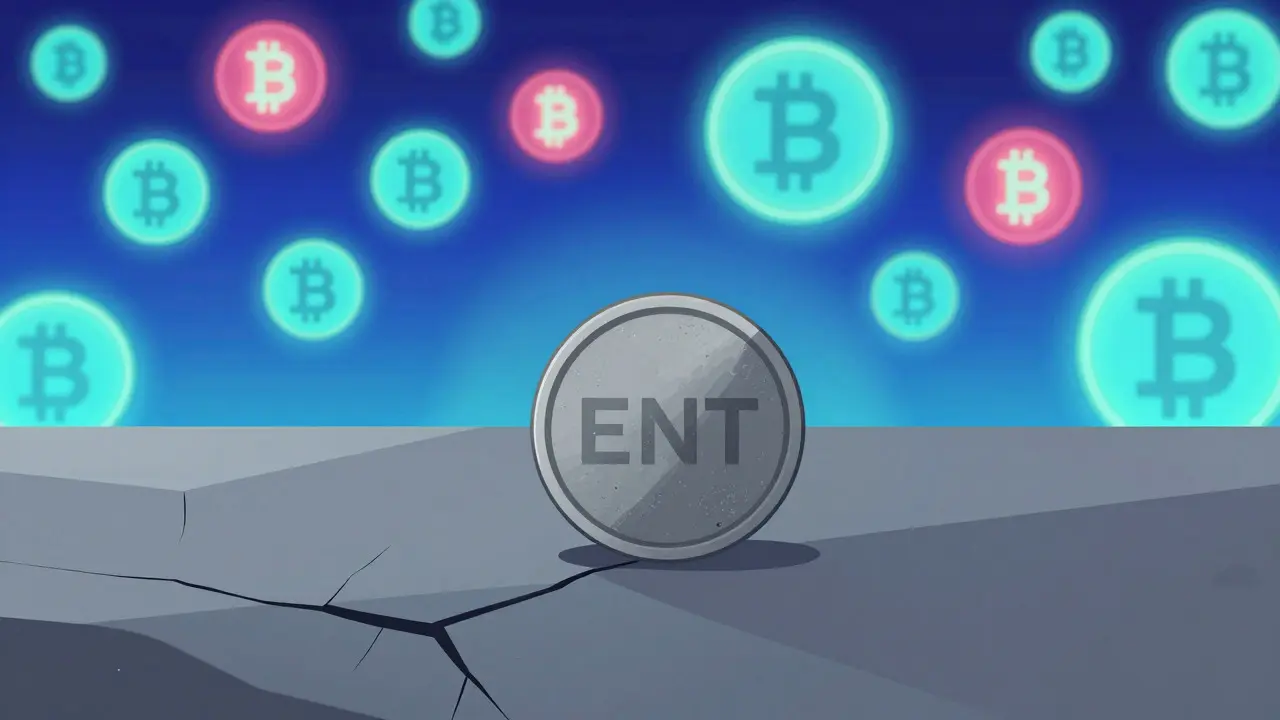
Imagine finding a digital currency that once traded near $1.50 but now costs less than one cent, with almost no one buying or selling it. That is the reality of Eternity (ENT), an experimental cryptocurrency that has faded into the background of the massive crypto market. If you are seeing this name pop up on a tracker or in a forum, you probably have questions: Is it still active? Can you actually buy it? And why does every data site show different numbers?
The short answer is that Eternity is a legacy micro-cap asset with virtually zero liquidity. It exists on its own blockchain, uses older mining technology, and lacks the community support or exchange listings needed to function as a practical payment method today. Understanding what Eternity really is requires looking past the confusing charts and digging into the supply mechanics, technical specs, and the stark risks involved in trading such a dormant asset.
The Basic Facts: What Is Eternity?
Eternity was originally marketed as a peer-to-peer digital currency designed for anonymous, instant payments worldwide. The core idea was simple: let users send money without banks or central authorities getting in the way. In the early days of crypto, projects like this were common experiments in decentralized finance.
However, the project’s identity has become blurry over time. Some sources describe it as a privacy-focused cash system similar to early versions of Dash. Others claim it launched in 2021 as a platform for smart contracts and decentralized applications (dApps). This contradiction is a red flag. There is no evidence of active dApp development, total value locked, or a robust developer community. The most likely explanation is that the project either stalled after its initial phase or underwent a rebranding that never gained traction.
Unlike tokens built on top of Ethereum or Solana, Eternity runs on its own independent blockchain. This means it requires its own network of nodes and miners to keep running. But without a large user base, maintaining that infrastructure becomes difficult, leading to the low activity levels we see today.
Supply and Economics: Why the Numbers Don't Match
If you check different crypto trackers for Eternity, you will notice something strange: the data often conflicts. This happens frequently with micro-cap coins because automated scrapers struggle to verify information from thin markets.
| Data Provider | Total Supply | Circulating Supply | Market Cap Estimate |
|---|---|---|---|
| CoinPaprika | 9,526,449 ENT | 9,526,449 ENT | ~$32,500 USD |
| CoinLore | 9,526,449 ENT | 9,526,449 ENT | ~$43,200 USD |
| CoinMarketCap | 9.52 Million ENT | 0 ENT | $0 USD |
| Coinbase Tracker | 9,526,448 ENT | 0 ENT | N/A |
The total supply is consistently reported around 9.53 million coins. The disagreement lies in whether those coins are "circulating." Major platforms like CoinMarketCap and Coinbase list the circulating supply as zero. This doesn't mean the coins don't exist; it means there is no reliable trade data to prove they are being actively bought and sold on major venues. When a coin has zero volume, trackers often default to zero circulation to avoid inflating the market cap artificially.
This discrepancy matters because it affects how you view the coin's value. A fully diluted valuation (FDV) assumes all coins are in play, while a real-time market cap only counts liquid assets. For Eternity, both metrics suggest a microscopic economic footprint compared to mainstream cryptocurrencies.

Technical Specifications: How Does It Work?
Under the hood, Eternity uses the X11 proof-of-work (PoW) algorithm combined with a proof-of-stake (PoS) component. X11 is a hashing algorithm that chains together eleven different functions to make mining more resistant to specialized ASIC hardware. It was popularized by Dash and other early altcoins.
Because it is mineable, new ENT coins can theoretically be generated by running compatible mining software. However, finding reliable, secure mining pools or wallet clients for such a small network is challenging. Many legacy mining tools are outdated or unmaintained, which increases the risk of malware if you download unofficial binaries.
There is no public documentation suggesting Eternity supports complex smart contracts or integrates with modern virtual machines like the Ethereum Virtual Machine (EVM). Without these features, the blockchain remains limited to basic transaction processing. It cannot host DeFi protocols, NFTs, or other advanced applications that drive value in larger ecosystems.
Price History and Market Performance
The price history of Eternity tells a story of significant decline. The coin reached an all-time high of approximately $1.49 USD in August 2017. Since then, it has lost over 99% of its value. As of mid-2026, prices hover between $0.0017 and $0.006 USD, depending on the source.
Liquidity is the biggest issue. On days when trades do occur, the 24-hour volume is often measured in single-digit dollars-sometimes less than $5. To put that in perspective, you could buy the entire day's worth of trading volume for the price of a lunch. This extreme illiquidity means that even if you manage to buy ENT, selling it later might be impossible without crashing the price further due to slippage.
Major exchanges like Binance, Coinbase, and Crypto.com track the price of Eternity for informational purposes but explicitly state that the coin is not listed for trading. You cannot deposit fiat or swap other crypto for ENT directly on these platforms. Your options are limited to smaller, niche exchanges like YoBit, which carry higher counterparty risk and lower security standards.

Risks and Considerations for Investors
Before considering any interaction with Eternity, it is crucial to understand the risks. This is not a blue-chip asset; it is a speculative micro-cap with several warning signs:
- Lack of Development Activity: There are no recent updates, whitepapers, or roadmaps from a identifiable team. The absence of a clear founding group suggests the project may be abandoned or maintained by a very small, anonymous group.
- No Community Presence: Unlike active projects, Eternity lacks vibrant communities on Reddit, Discord, or Twitter. Social sentiment is effectively non-existent.
- Exchange Delisting Risk: With no presence on major tier-1 exchanges, your ability to exit a position depends entirely on smaller venues that could shut down at any time.
- Data Reliability: Because volume is so low, price charts can be manipulated easily. A single small trade can spike the price percentage dramatically, creating false signals.
For most investors, the opportunity cost of holding Eternity is high. Capital tied up in an illiquid asset with no growth catalyst offers little chance of recovery. Mainstream alternatives like Bitcoin or Ethereum provide vastly superior liquidity, security, and ecosystem support.
Conclusion: Is Eternity Worth Your Time?
Eternity (ENT) serves as a case study in the long tail of the cryptocurrency market. It represents thousands of projects that launched with ambitious goals but failed to gain the critical mass needed for survival. While it technically still exists and can be mined, its utility is negligible, and its financial prospects are dim.
If you are a collector of obscure crypto artifacts or a researcher studying dead chains, Eternity might be of interest. For anyone seeking investment returns or a functional payment tool, however, the risks far outweigh the potential rewards. Stick to assets with transparent teams, active development, and deep liquidity unless you are prepared to treat your investment as a total loss.
Is Eternity (ENT) a scam?
There is no definitive proof that Eternity is a malicious scam, but it exhibits many characteristics of an abandoned project. The lack of a public team, zero liquidity, and conflicting data suggest it is inactive rather than actively fraudulent. However, investing in such assets carries high risk due to the inability to sell holdings.
Where can I buy Eternity (ENT)?
You cannot buy ENT on major exchanges like Coinbase, Binance, or Kraken. It is primarily tracked on minor platforms like YoBit. Be aware that trading on these smaller venues involves higher fees, wider spreads, and greater counterparty risk.
Can I mine Eternity?
Yes, Eternity uses the X11 proof-of-work algorithm, making it mineable. However, you must find compatible mining software and pools independently, as official resources are scarce. Ensure any software you download is from a trusted source to avoid malware.
Why do different sites show different prices for ENT?
Due to extremely low trading volume, price data is fragmented. Some aggregators calculate price based on the last known trade, while others may use weighted averages from multiple thin markets. Additionally, disagreements over circulating supply lead to vastly different market cap calculations.
Does Eternity support smart contracts?
Public documentation is unclear. While some profiles mention smart contract capabilities, there is no evidence of active decentralized applications (dApps) or developer activity. It is safest to assume Eternity functions primarily as a basic peer-to-peer transfer chain without advanced programmability.